
What Small and Mid-Sized Oil and Gas Operators Should Look for in Software

Summary
×Start With the Operator’s Real Scale
Small and mid-sized oil and gas operators often need the same workflow discipline as larger companies, but they usually do not have the same internal resources. A large operator may have dedicated IT teams, system administrators, integration specialists, and separate departments for accounting, land, production, and operations. A smaller operator may have one team handling several of those responsibilities at the same time.
That difference matters when choosing software. A system with broad enterprise capability may look impressive, but it can become difficult to manage if it requires heavy configuration, long implementation cycles, and constant technical support. Smaller operators need software that is structured enough to control work, but practical enough for lean teams to use every day. The best starting question is not “Which system has the most features?” It is: which system helps the team close the month, manage costs, track production, handle owners, and make decisions with less manual work?
Choose Workflow Fit Over Feature Count
Small and mid-sized operators should avoid buying software based only on a long feature list. More features do not always mean better fit. If the core workflows still require spreadsheets, manual exports, email approvals, or duplicate entry, the software may not solve the real problem.
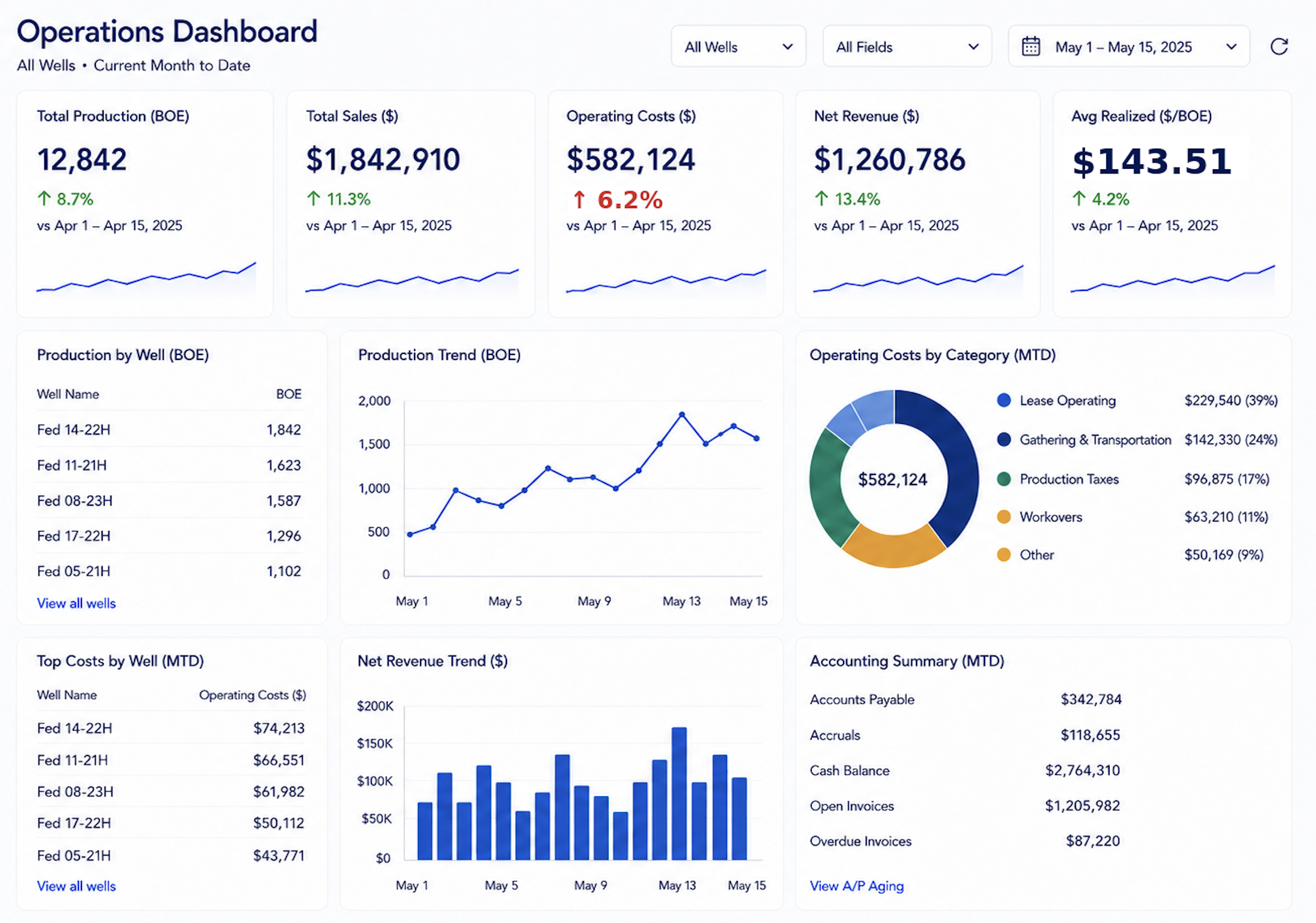
A strong system should match the operator’s daily work. That includes field cost capture, production reporting, vendor invoice review, AFE tracking, JIB preparation, royalty payment support, owner data management, and month-end close. These workflows do not need to be overly complicated, but they do need to be connected. For lean teams, visibility is not a luxury. Missing production data, unmatched costs, owner record issues, pending approvals, and unusual cost variances should be visible before they consume days of manual follow-up.
Operators should look for software that helps them:
Reduce spreadsheet dependency
Connect field, office, and accounting workflows
Track approvals and exceptions in one place
Review costs by well, lease, owner, project, or cost category
See missing data before month-end close
Give management useful visibility without extra manual reporting
Look for Oil and Gas-Specific Data Structures
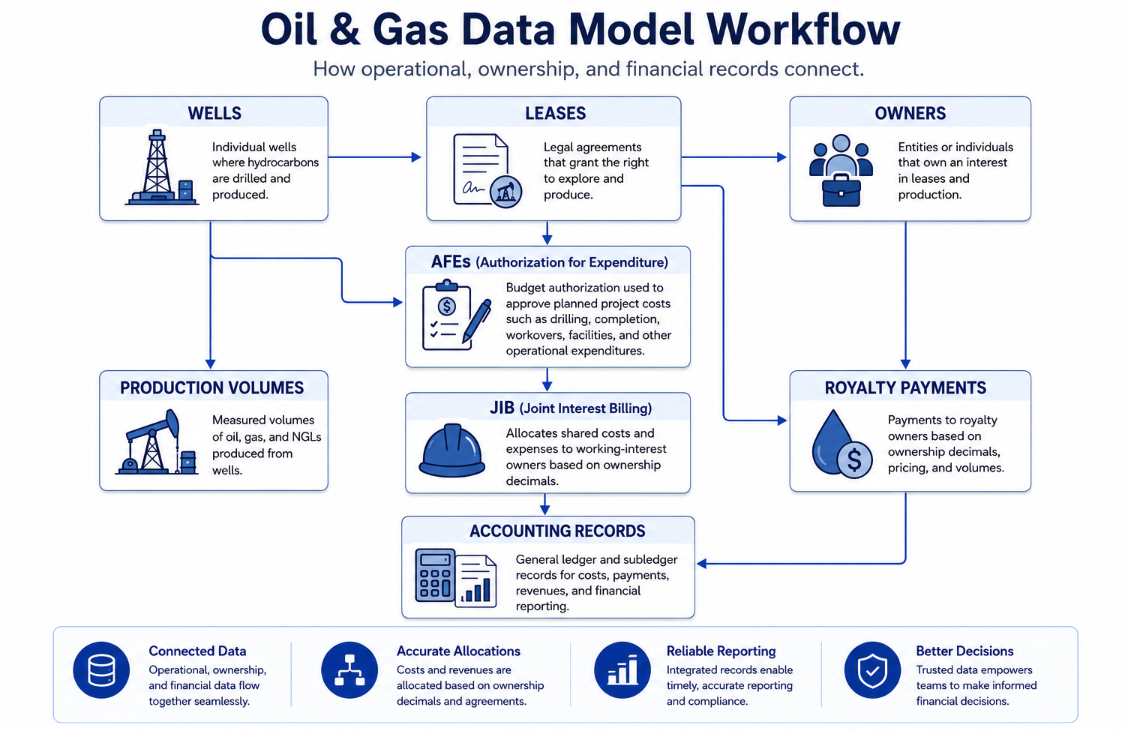
A general business system may handle invoices and accounting, but oil and gas operators also need data organized around industry structures. Wells, leases, owners, working interests, royalty interests, AFEs, JIB statements, production volumes, cost centers, and division orders should not feel like afterthoughts. They should be part of the system’s natural operating language.
This is especially important for operators managing multiple wells or ownership groups. If the system cannot report by well, lease, owner, project, or cost category, accounting and management teams may still need spreadsheets to understand performance. That creates more work and weakens confidence in the system.
Operators should ask vendors to demonstrate these structures with real examples. A useful demo should show how a cost is tied to a well, how that cost flows into reporting, how ownership affects billing or payment, and how management can review the result. Screens alone are not enough; the workflow needs to make sense.
Prioritize Fast Implementation and Practical Adoption
Small and mid-sized operators should be realistic about implementation capacity. A system that takes too long to configure, test, and train may lose momentum before users see value. Implementation should be structured, but it should not require the operator to pause normal business or dedicate a large internal team for months.
The software should support phased adoption. For example, an operator may start with accounting, JIB, and reporting, then add production workflows, owner data, or field operations later. This approach helps the team get value early while reducing the risk of a large, disruptive rollout. Training also matters. Users should not need advanced technical knowledge to complete everyday tasks. If accounting staff, operations users, and management cannot use the system confidently, the company will fall back into Excel, email approvals, and manual reports.
A practical adoption plan should confirm:
Which workflows go live first
Which users need training
Which data must be cleaned before launch
Which reports are required for day one
Which workflows can be added later
What support is available after go-live
Use a Simple Fit Formula
Small and mid-sized operators can evaluate software with a simple formula: Software Value = Workflow Coverage + Ease of Use + Visibility - Implementation Burden. In upstream oil and gas software evaluation, implementation burden is the silent killer of digital transformation initiatives. A high-visibility system becomes a multi-million dollar liability the moment its configuration demands endless custom coding, specialized IT staff, and prolonged operational downtime.
Workflow coverage measures whether the system supports the operator’s core oil and gas processes. Ease of use measures whether real users can work in the system without constant help. Visibility measures whether the system gives management and teams useful information before problems grow. Implementation burden measures the time, cost, data cleanup, customization, and training effort required to go live.
This formula helps operators avoid two common mistakes. The first is choosing a system that is too basic and still leaves the hardest work in spreadsheets. The second is choosing a system that is too heavy and requires more administration than the team can support. Settling for under-engineered software traps your staff in manual spreadsheet hell, while over-engineered platforms end up completely abandoned by an overwhelmed workforce. Striking the perfect equilibrium preserves organizational focus, ensuring that your team is running lean operations rather than fighting software limitations.
Evaluate Month-End Close Support
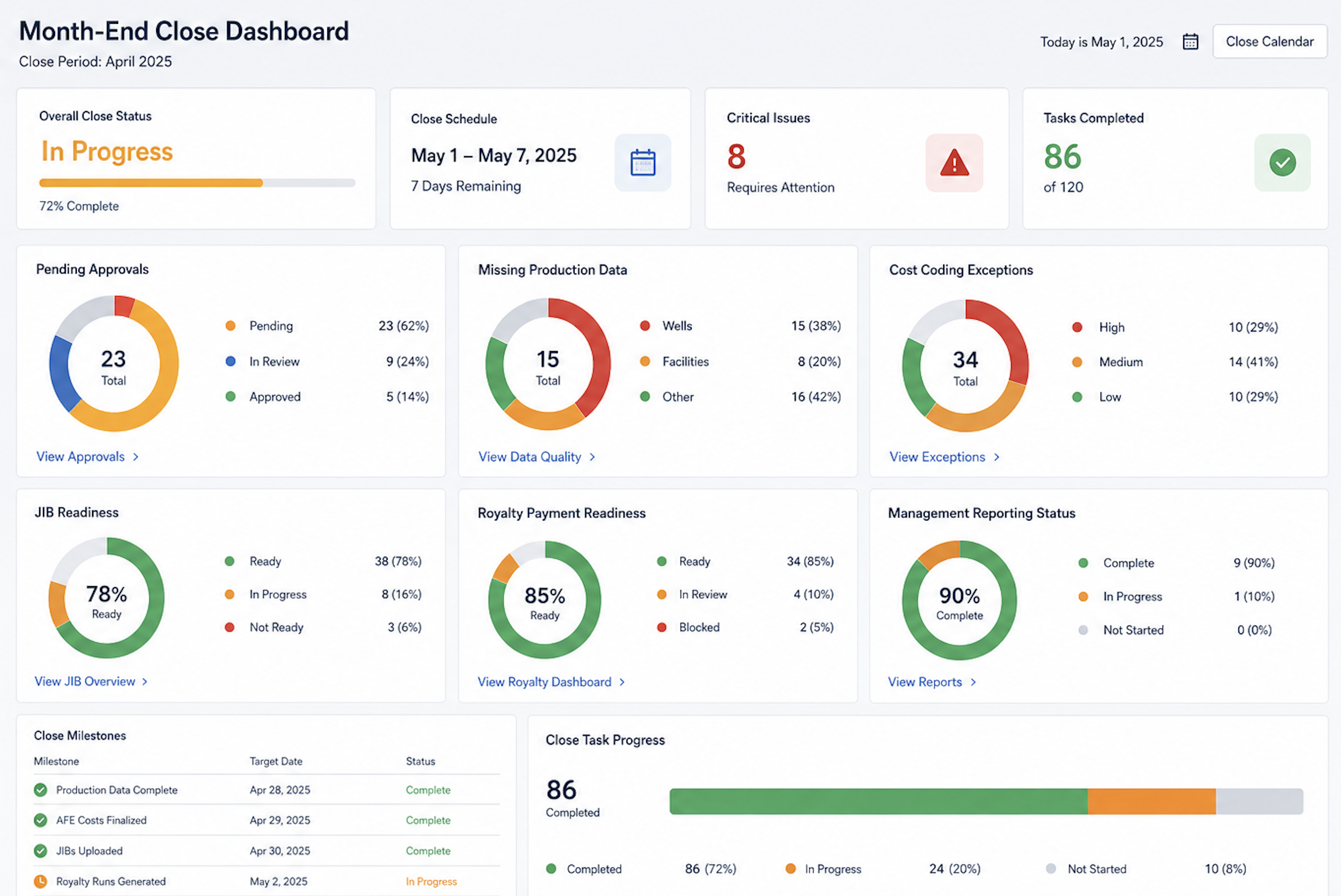
Month-end close is one of the best tests of whether software fits an operator’s needs. The system should help teams collect costs, verify coding, review approvals, reconcile production or revenue data, prepare reports, and identify open exceptions. If the software does not make month-end easier, the operator should question whether it is solving a core business problem.
For small and mid-sized teams, month-end pressure often comes from scattered data. Vendor invoices may sit in one place, field updates in another, production volumes in another, and JIB or owner-related records in separate spreadsheets. A good system should reduce the time spent searching, exporting, and reconciling.
Operators should ask vendors to demonstrate a month-end scenario. The demo should show what data is missing, which approvals are pending, which costs need review, and what reports are ready. This is much more useful than seeing a generic dashboard with clean sample data.
Confirm JIB, Royalty, and Owner Data Capabilities
Even if an operator is small, JIB and royalty workflows can become complex quickly. Multiple owners, changing working interests, division orders, decimal interest updates, payment holds, and owner questions all require clean data. Software should help control these processes rather than leaving them scattered across spreadsheets and email threads.
Operators should confirm whether the system can manage ownership data, generate JIB support, track payment status, and maintain records needed for owner communication. If royalty payments are part of the workflow, the system should support decimal interest accuracy, suspense tracking, and owner-level reporting. These details matter because owner-related errors can create payment delays, disputes, and avoidable accounting work.
The goal is not only to process transactions. The goal is to make owner-related workflows easier to explain, review, and defend. When the data is connected, teams can answer questions faster and reduce the risk of repeating the same research every month. In the independent oil and gas sector, modern owner relations management lives or dies by this predictive transparency. Transitioning away from fragmented historical lookup silos protects the operator’s reputation while transforming an administrative bottleneck into an ironclad trust shield.
Make Reporting Useful for Decisions
Good reporting should help operators run the business, not only export data. Small and mid-sized operators need visibility into costs, production, cash flow, exceptions, approvals, and owner-related activity. Reports should be easy to filter by well, lease, owner, cost category, project, entity, and period.
Management dashboards should show where attention is needed. A useful dashboard may show wells with rising operating costs, projects over AFE budget, missing production reports, delayed approvals, or owner records blocking payment. This kind of visibility helps managers act before issues turn into month-end surprises.
Operators should also check whether reports can be adjusted without custom development every time. Business questions change as the company grows. If every new report requires a technical project, the system may become a bottleneck. Continuous reliance on custom software development quietly inflates the total cost of ownership until the platform becomes financially non-viable. True scalable ERP systems empower lean energy operators with intuitive configuration tools, destroying legacy spreadsheet dependencies without creating a secondary technical deficit.
Useful reporting should include:
Cost visibility by well, lease, project, and cost category
AFE budget versus actual cost
JIB readiness and payment status
Royalty payment readiness and suspense status
Production trends and missing data
Pending approvals and exceptions
Management-level cash flow and operating dashboards
Check Cloud Access, Security, and No-Download Usage
Cloud-based software can be especially useful for small and mid-sized operators because teams may work across field locations, offices, home offices, and partner environments. Users should be able to access the system securely without complicated local installation. No-download usage can reduce IT overhead and make onboarding easier.
Security still matters. The system should support role-based access, user permissions, audit trails, data backup, and secure login options. Financial data, owner records, payment information, and operational data should not be treated as casual shared files. Treating sensitive energy infrastructure data like casual spreadsheets invites severe regulatory penalties and catastrophic insider-threat leaks. By embedding enterprise-grade cybersecurity in energy platforms, operators create an unbreachable firewall that shields proprietary drilling and financial data from competitive exploitation.
Operators should ask how the system handles user access for accounting staff, field users, executives, external accountants, or consultants. A flexible permission model helps the company collaborate without exposing sensitive data unnecessarily. This is particularly important when small teams rely on outside support.
Avoid Over-Customization
Customization can be valuable when it supports real business needs. However, too much customization can create long implementation timelines, higher maintenance effort, and upgrade difficulty. Small and mid-sized operators should be careful not to turn every internal preference into a custom requirement.
A better approach is to separate needs into three groups: must-have workflows, configurable preferences, and future enhancements. Must-have workflows are essential to daily operations, such as accounting, JIB, production reporting, or owner data. Configurable preferences can be adjusted without custom development, while future enhancements can wait until the team has adopted the core system.
Operators should ask vendors to classify each requirement as standard, configurable, or custom. This simple step makes proposals clearer and reduces surprises later. It also helps the operator choose a system that fits the business without becoming too heavy to maintain. Vague software RFPs frequently hide astronomical consulting fees under the generic umbrella of seamless integration. Forcing this three-tier classification onto vendor evaluation rubrics strips the smoke and mirrors from software sales, ensuring independent producers secure maximum operational control without locking themselves into a perpetual legacy tech tax.
Where Petrofly Can Help
Petrofly is designed for oil and gas teams that need connected workflows without unnecessary system complexity. For small and mid-sized operators, the value is strongest when software improves daily control across accounting, operations, production, JIB, royalty, owner data, reporting, and approvals without requiring a heavy internal IT structure.
Petrofly can support this need through:
Oil and gas workflow fit: Connect wells, costs, production, JIB, royalty, owner records, and reporting in a more practical operating structure.
Modular rollout: Start with priority workflows such as accounting, JIB, reporting, production, or owner relations, then expand as the team is ready.
Cloud-based access: Support secure browser-based use without complicated local installation or scattered files.
Customer-specific configuration: Adjust fields, reports, dashboards, approvals, and workflows around how the operator actually works.
Dedicated support: Get help with onboarding, data setup, training, workflow refinements, and post-go-live questions.
Cost-conscious fit: Improve the workflows that matter most first, without overbuilding the software environment from day one.
For lean operators, Petrofly’s practical value is not having the longest feature list. It is giving teams a clearer way to control daily work, reduce spreadsheet dependency, and make decisions with better operational visibility. True digital transformation isn't about collecting features; it's about engineering an agile, single source of truth where production and finance flow seamlessly together. By anchoring daily workflows in intuitive automation, Petrofly proves that operational simplicity is the ultimate sophistication in modern asset management.
What to Ask Before Buying
Before buying software, small and mid-sized operators should ask focused questions that reveal real fit. These questions should test workflow support, implementation effort, reporting flexibility, adoption risk, and long-term scalability. Modern software selection is no longer about checking static feature boxes; it is about stress-testing a platform’s dynamic data spine under evolving operational paradigms. This proactive diagnostic checklist serves as the ultimate shield for your corporate capital, guaranteeing your digital architecture scales seamlessly with every new asset acquisition.
Key questions include:
Which oil and gas workflows are supported without custom development?
How long does implementation usually take for a small or mid-sized operator?
What data do we need to prepare before the project starts?
Can reports be filtered by well, lease, owner, cost category, and period?
Does the system support ownership data, JIB, royalty, division orders, or suspense?
What training is provided for accounting, operations, and management users?
Is the system browser-based, and does it require local installation?
Does the system support role-based access and audit trails?
Can we add more wells, owners, users, entities, or modules later?
What support is available after go-live?
These questions can be used as a quick screening tool before a demo. If a vendor cannot answer them clearly, the operator should slow down the selection process. Clear answers before purchase usually lead to cleaner implementation after purchase. In the energy sector, software selection errors are notoriously difficult and expensive to reverse once data migration has already begun. Demanding empirical evidence and unevasive transparency during pre-demo vetting serves as an ironclad risk mitigation strategy that protects both your administrative sanity and corporate capital.
Practical Takeaway
Small and mid-sized oil and gas operators should look for software that fits their workflow, team capacity, and growth plans. The right system should connect accounting, operations, production, JIB, royalty, owner data, reporting, and approvals without forcing the company into unnecessary complexity. It should make daily work easier, month-end clearer, and management decisions faster.
The best software is not always the largest system or the one with the longest feature list. It is the system that helps the operator control work with fewer spreadsheets, fewer delays, and better operational visibility. For lean teams, practical fit is the strongest measure of long-term value.
To discuss how a practical oil and gas software workflow could support your team’s operations, contact our team for a focused conversation. Generic platforms force your business to bend around rigid engineering limitations; our experts are ready to map a seamless transition that mirrors your exact upstream reality. Let us demonstrate how Petrofly can eliminate your daily administrative bottlenecks and unlock predictable profitability across your entire asset portfolio.