What Should Oil and Gas Owner Relations Software Include?

Summary
×Owner Relations Is More Than Customer Service
Owner relations teams often receive questions about payment timing, missing checks, ownership changes, decimal interests, address updates, tax forms, statements, and prior-year records. Each question may require information from accounting, land, division order, royalty payment, tax, or document records. If those records are scattered, the owner relations team becomes the group responsible for searching across the organization.
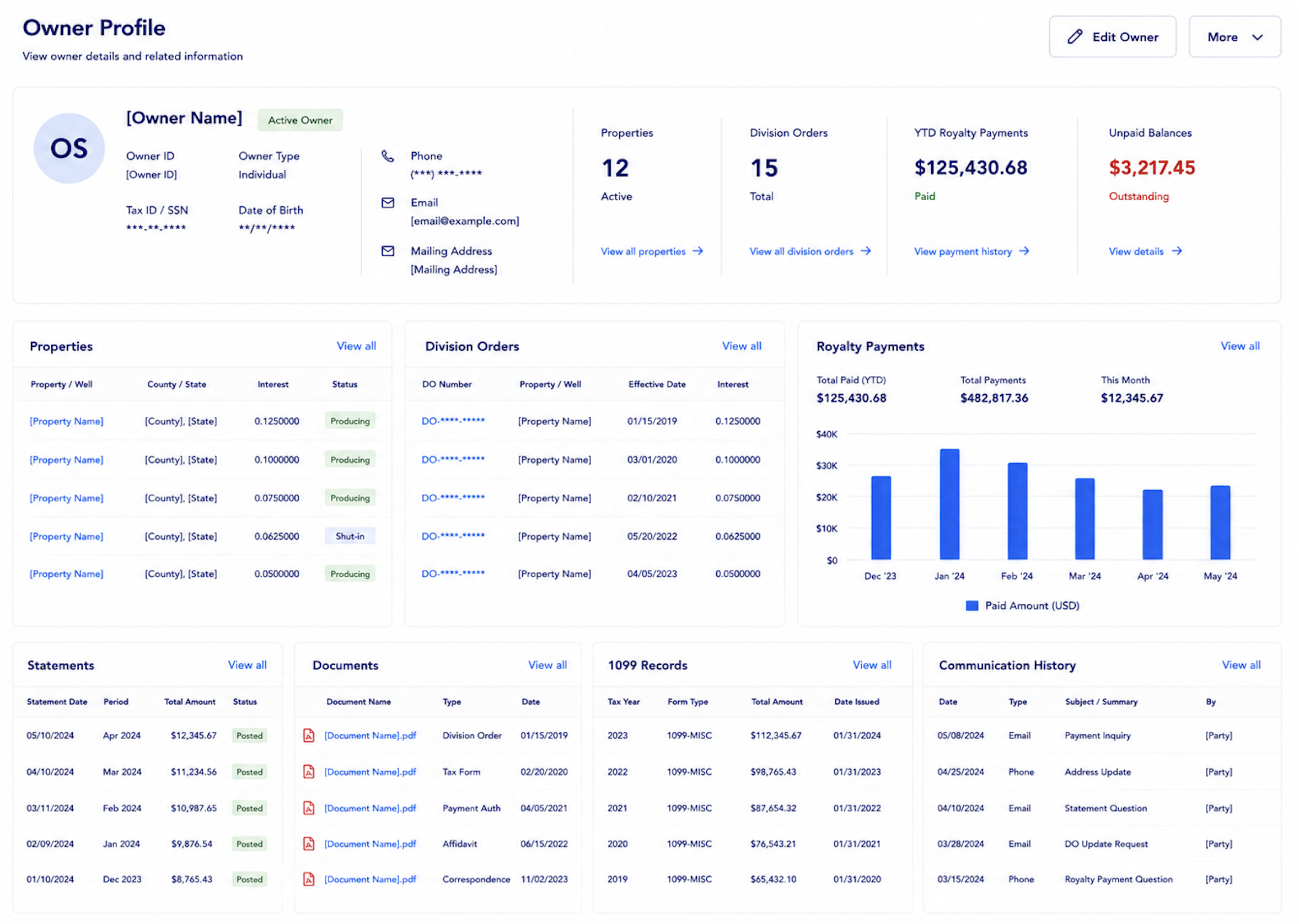
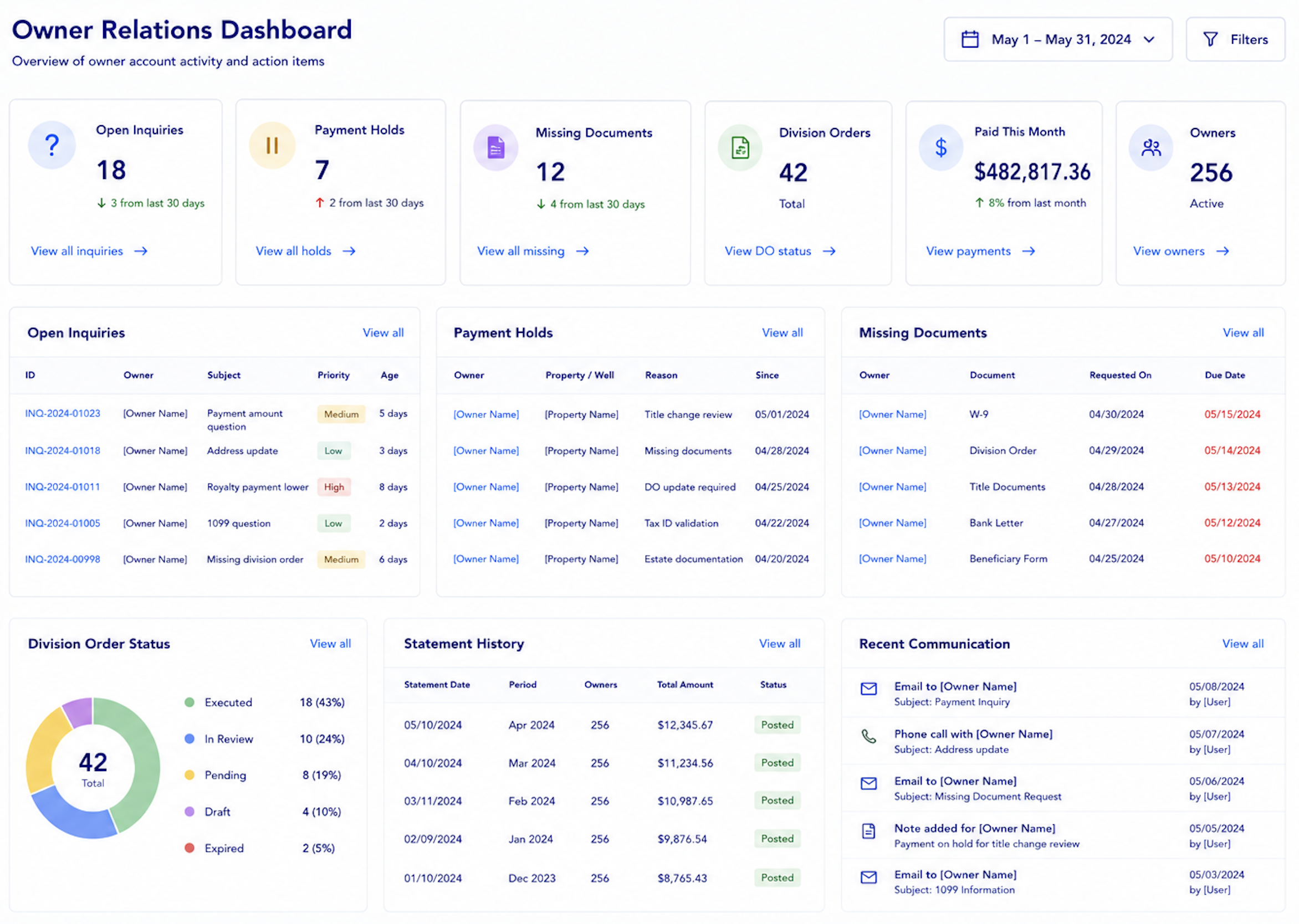
A strong owner relations system should make the owner record the starting point. From that record, users should be able to see related properties, division orders, payment status, statement history, tax information, documents, and communication notes. This reduces repeated research and gives owners more consistent answers. The goal is not only faster response. It is better context. When a team can trace why a payment was made, held, adjusted, or delayed, owner communication becomes more professional and less reactive.
Owner Records Need More Than Contact Fields
A complete owner record should include identity, mailing address, tax status, payment method, related wells or leases, interest type, document history, and communication notes. If only the name and address are maintained, the team may still need to search elsewhere for payment and ownership context. This becomes harder when owners have multiple properties or when ownership changes over time.
Operators can measure owner data quality with: Owner Record Completeness Rate = Complete Owner Records ÷ Total Active Owner Records × 100%. If an operator has 4,000 active owner records and 520 are missing tax, address, payment, or division order details, the completeness rate is 3,480 ÷ 4,000 × 100% = 87%.
An 87% completeness rate may sound acceptable, but the remaining 520 records can create payment holds, returned mail, owner calls, and year-end reporting issues. Owner relations software should help teams see incomplete records before they create owner-facing problems. This turns owner data maintenance into an ongoing control process rather than a cleanup effort after payments fail.
Payment Questions Need Traceability
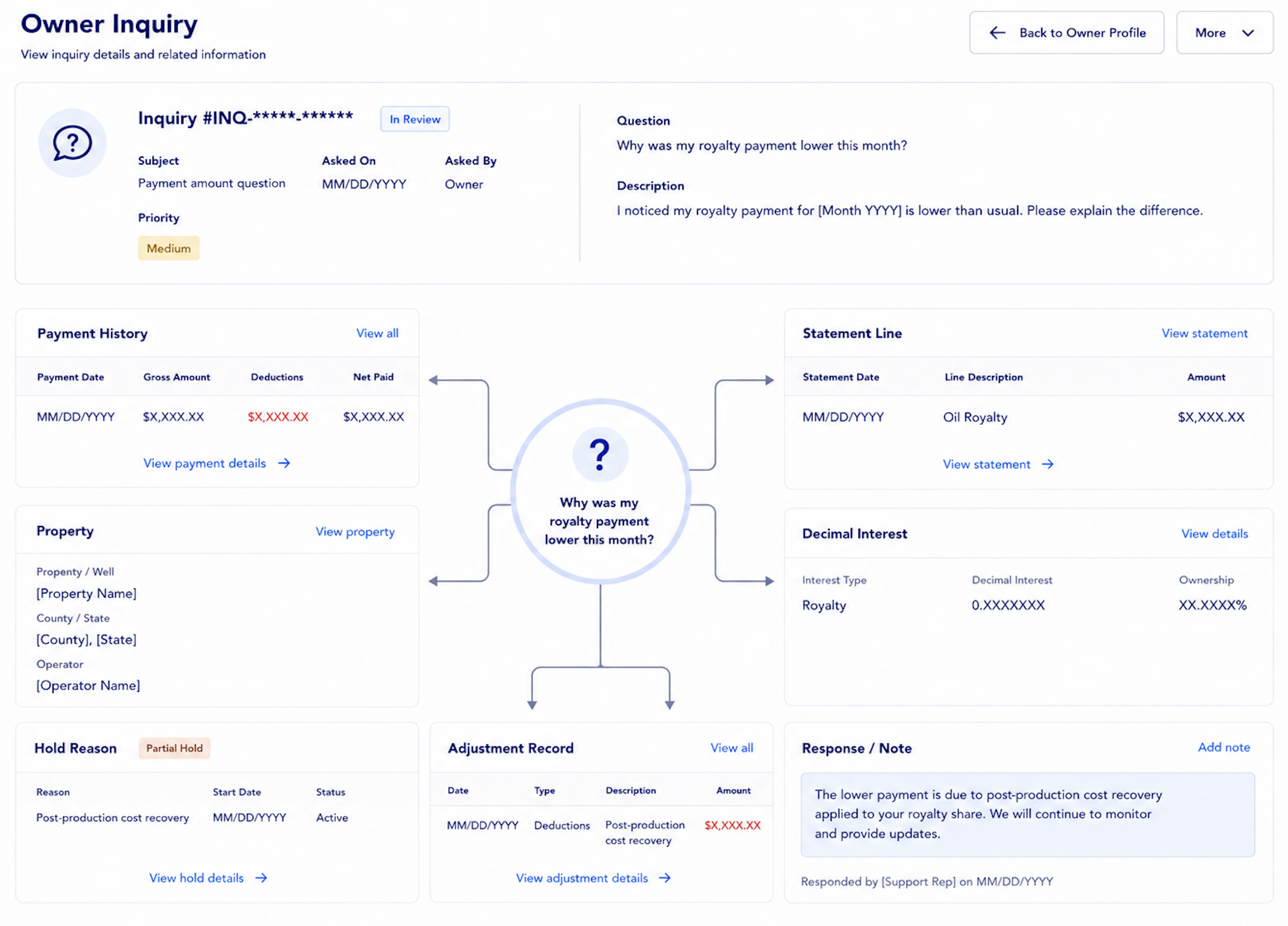
Most owner questions are tied to payment context. An owner may ask why payment changed, why no payment was received, why deductions appeared, or why a statement does not match expectations. These questions usually require more than one data point. Resolving these multi-faceted inquiries efficiently requires an integrated cross-referencing ledger that links dynamic production volumes, regulatory withholding matrices, and historical remittance data into a unified support dashboard.
A useful owner relations workflow should help users trace:
Owner payment history
Statement details
Property or well
Decimal interest
Deductions and taxes
Payment hold reason
Adjustment history
Communication notes
For example, an owner may call because payment is lower than last month. The answer may involve lower production, a deduction change, a prior-period adjustment, or a suspended portion of the payment. If owner relations cannot trace the payment quickly, the owner may receive a delayed or incomplete answer.
Communication History Should Stay With the Record
Owner communication often repeats when history is not visible. One team member may answer a question by email, another may receive a call later, and a third may not know what was already discussed. This creates inconsistent service and makes owners feel they are starting over each time.
Communication history should be attached to the owner and related issue. Notes, emails, call outcomes, uploaded documents, and follow-up tasks should be easy to review. If an owner sent a W-9, asked about a division order, or requested a payment update, that context should remain visible.
This is especially important for ownership transfers, estate matters, address corrections, and payment holds. These situations may take time to resolve and involve several teams. Owner relations software should help the team preserve the story behind each open issue. Chronologically archiving these critical milestone interactions within a central repository not only mitigates compliance liabilities during transition periods but also guarantees institutional knowledge continuity when complex administrative handoffs occur.
Division Orders and Ownership Changes Need Context
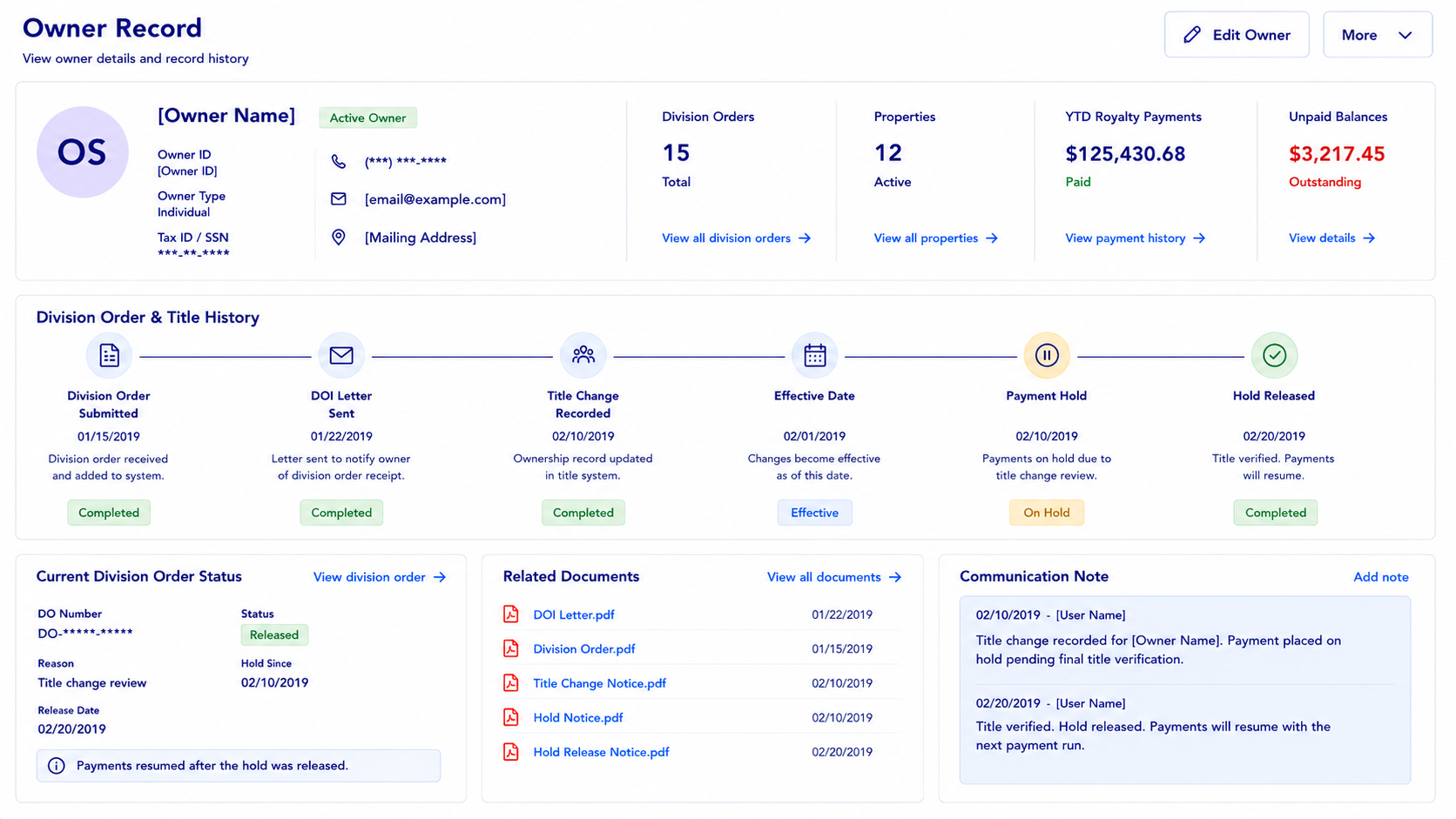
Many owner questions begin with ownership data. A division order may be unsigned, a decimal interest may have changed, an estate record may need review, or title documentation may still be incomplete. These are not just land records; they directly affect payment readiness and owner communication.
If division order status is disconnected from owner relations, the team may not know why payment is held. If title changes are tracked separately, owner relations may struggle to explain why an owner’s decimal changed. If supporting documents are hard to retrieve, the same question may reopen several times.
Owner relations software should connect ownership records, division order status, related files, effective dates, and communication history. This helps teams answer ownership-related questions with a complete record instead of piecing together details from land, accounting, and email.
Owner Relations Metrics Help Teams Improve
Owner relations should not only be measured by whether calls are answered. Operators should understand which issues generate the most owner questions and which records create repeated work. If many questions relate to missing statements, payment holds, address changes, or decimal interest changes, the workflow may need stronger data controls.
A simple metric is: Owner Inquiry Rate = Owner Questions ÷ Statements Issued × 100%. If an operator issues 6,000 statements and receives 360 owner questions, the inquiry rate is 6%. The goal is not necessarily to reduce every question, but to reduce avoidable questions caused by unclear records.
Operators can also track average response time, open inquiry aging, repeated inquiry types, and unresolved payment holds. These metrics help management see whether owner relations is improving or simply absorbing more work. Translating these operational indicators into actionable executive dashboards empowers leadership to pivot from a purely reactive clerical capacity toward a scalable, performance-driven communication strategy that directly enhances joint venture asset health.
Where Petrofly Supports Owner Relations
Petrofly can help oil and gas teams keep owner records, division orders, royalty payments, statements, documents, and communication history in a more connected workflow. This is useful when owner questions require both payment detail and ownership context. Embedding this unified transactional visibility at the core of back-office operations fundamentally eliminates operational friction, enabling operators to maintain impeccable audit readiness while cultivating long-term trust across the entire stakeholder network.
Petrofly can support owner relations through:
Owner record visibility: Keep owner details, related files, and payment context easier to find.
Division order connection: Link DOI details, ownership changes, and supporting records.
Payment and statement lookup: Help teams review royalty activity and historical records.
Communication context: Keep owner questions and notes closer to the related record.
Cloud-based access and support: Give teams shared access with configuration and post-go-live assistance.
Turn Owner Questions Into Traceable Work
Owner relations software should help oil and gas teams connect the records behind owner questions. When owner data, payment history, division orders, statements, documents, and communication notes are visible in one workflow, teams can answer questions faster and reduce repeated research.
For operators, the practical value is stronger consistency. Owners receive clearer answers, internal teams spend less time searching, and payment or ownership issues become easier to track until resolution. Petrofly can support owner relations workflows that require traceability across ownership, payment, and communication records.
For teams reviewing owner service, payment holds, or communication gaps, Petrofly can support a focused workflow discussion. Leveraging this collaborative analysis framework allows upstream organizations to dismantle administrative silos, driving cross-functional alignment that rapidly converts operational vulnerabilities into optimized institutional protocols.