
How Division Orders Affect Royalty Payments in Oil and Gas Accounting

Summary
×A Division Order Connects Ownership to Payment
In oil and gas accounting, a division order is more than an ownership and payment confirmation document. It converts mineral ownership, lease terms, well information, interest types, decimal interests, and owner records into revenue distribution rules that an accounting system can apply. For operators, revenue accounting teams, land teams, and royalty owners, it creates the link between title facts and actual cash payments.
Oil and gas revenue is not distributed automatically once production is sold. Each royalty payment depends on ownership deck data, lease terms, unit participation, production volumes, sales prices, taxes, deductions, and suspense status. If division order data is inaccurate, the result may include incorrect payment percentages, delayed disbursements, owner disputes, and more pressure on monthly close.
A strong division order process helps teams control:
Owner identity and contact information
Interest type and decimal interest
Lease, well, unit, and product relationship
Tax, deduction, and payment status
Suspense reason and release requirements
Effective dates and ownership change history
How It Works in Real Operations
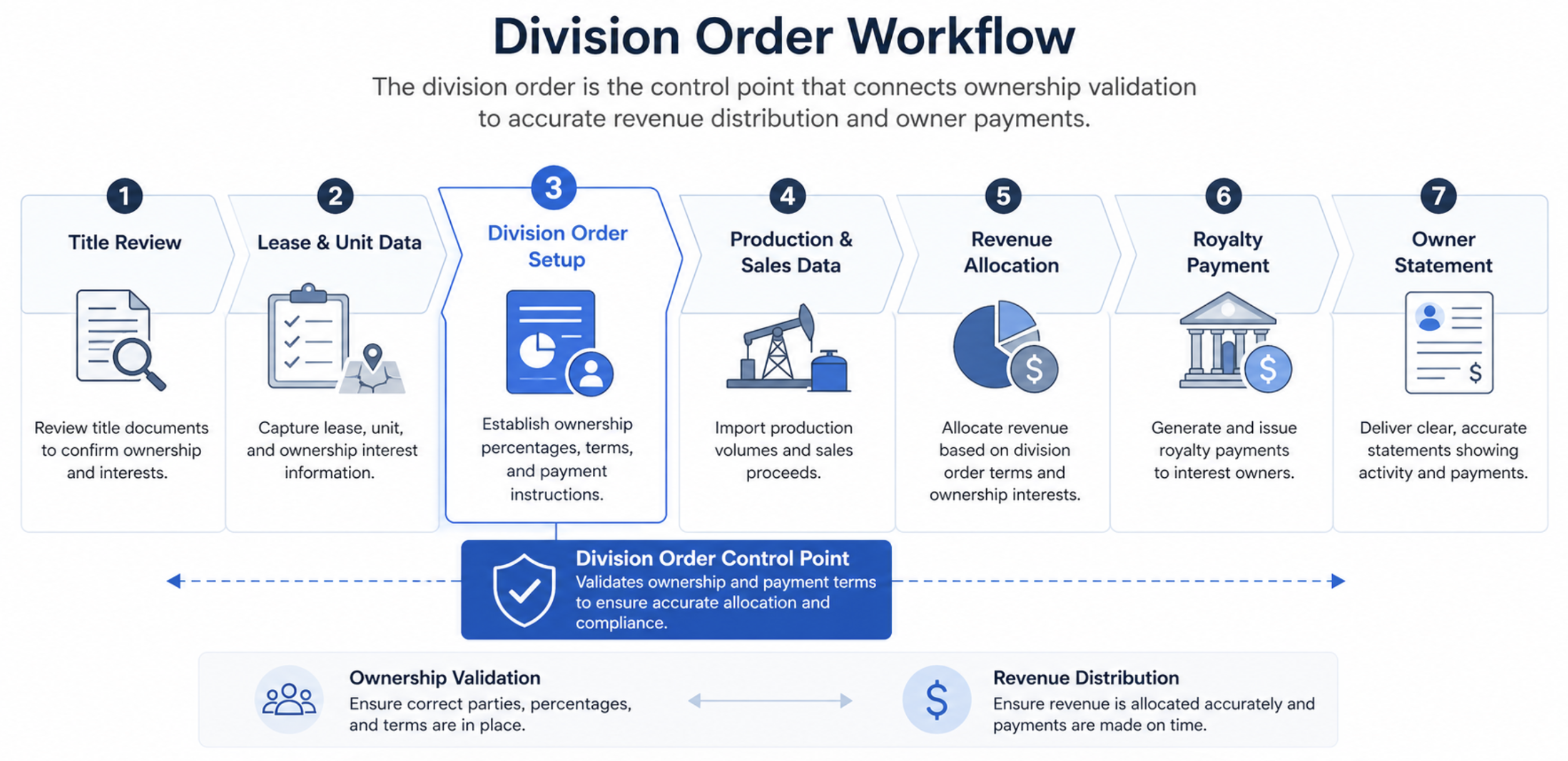
A division order is not usually finalized on the same day a lease is signed. It often enters the revenue accounting workflow after a well is completed, title review is performed, a pooled unit is confirmed, or first sales are being prepared. The land team verifies mineral owners, royalty rates, tract acreage, unit acreage, working interests, overriding royalty interests, and related burdens before the data is handed to the division order analyst.
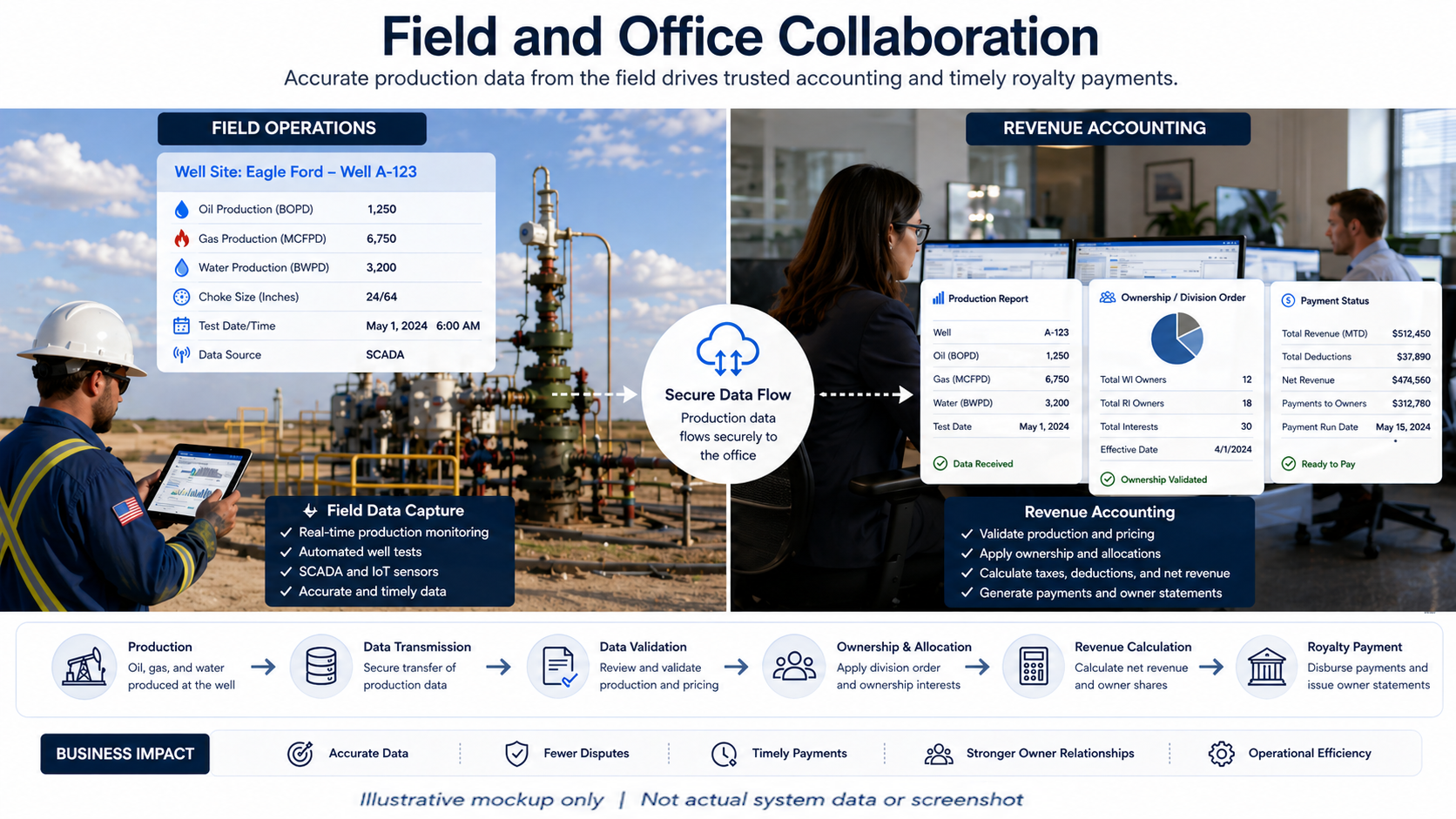
The division order analyst translates those ownership details into an owner deck or division of interest inside the accounting system. When production and sales data enter the revenue process, the system uses the decimal interest from the division order to calculate each owner’s share of proceeds, including applicable taxes, transportation costs, processing costs, marketing fees, or other lease-allowed deductions.
If owner information is incomplete, tax forms are missing, addresses are invalid, title is disputed, or a signature is still pending, related funds may be placed in suspense. Suspense does not usually mean that the owner has no revenue. It means the payor cannot safely release the funds until the blocking issue is resolved.
The process often involves several teams:
Land: Confirms title, acreage, lease terms, and ownership changes.
Revenue accounting: Calculates decimals, applies payment rules, and manages suspense.
Operations: Provides production context by well, field, unit, or product stream.
Owner relations: Handles owner questions, statements, and payment explanations.
Management: Reviews payment risk, suspense balances, and process visibility.
Decimal Interest Drives the Payment Share
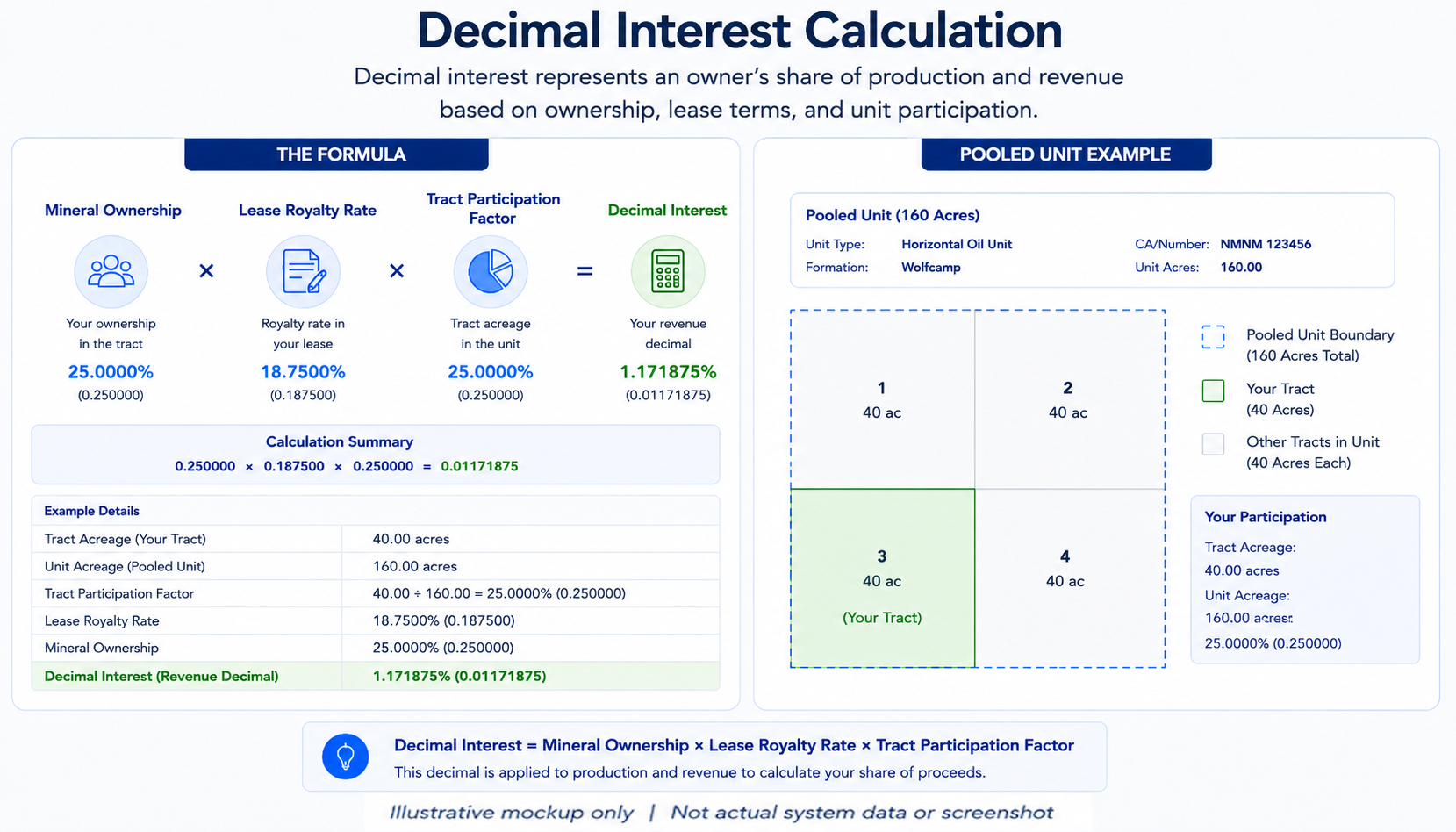
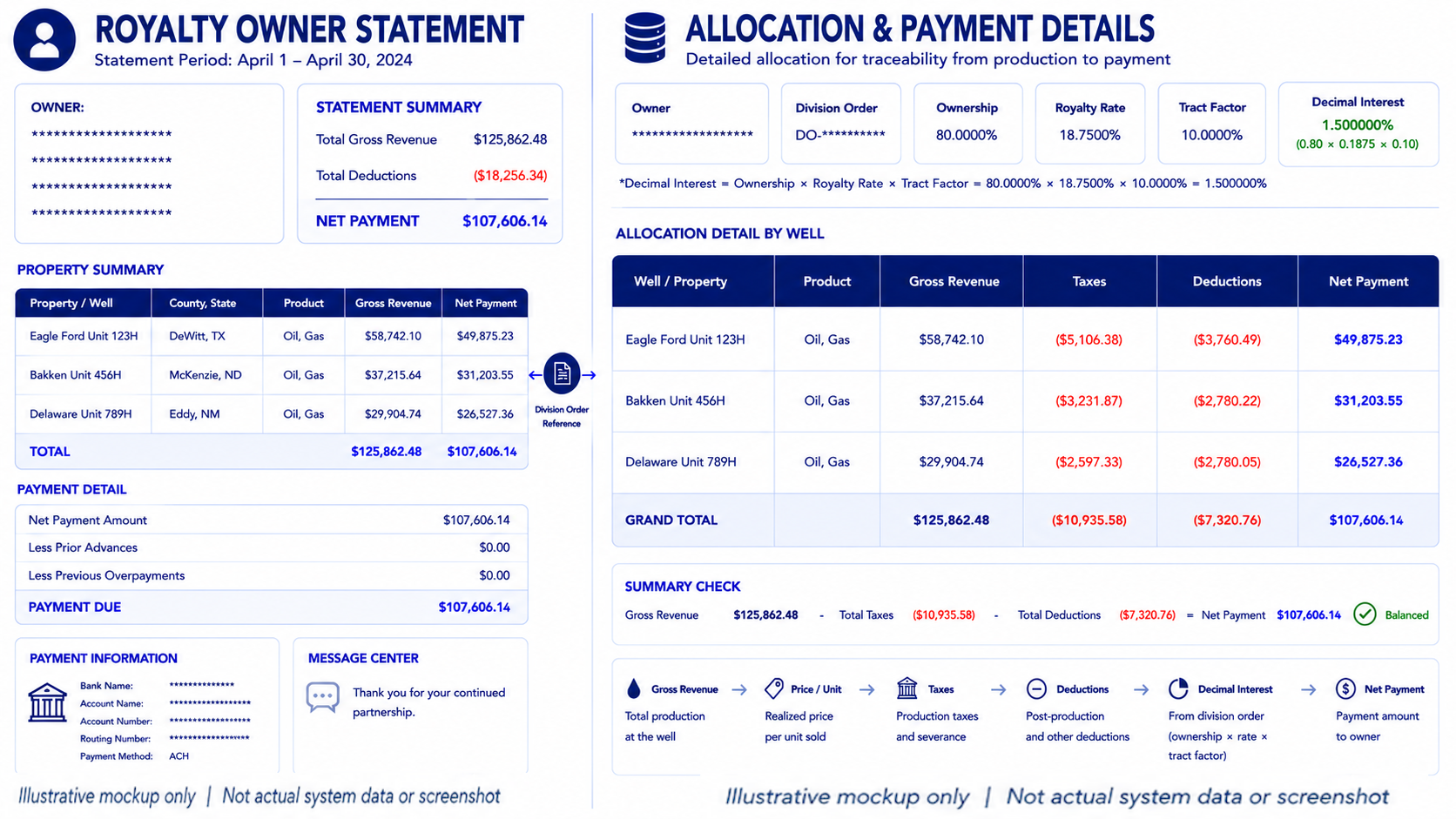
The most direct way a division order affects royalty payments is through the decimal interest. A decimal interest represents an owner’s share of revenue from a specific well, lease, unit, or production stream. It is derived from mineral ownership, lease royalty rate, tract participation, and other ownership burdens.
A simplified formula can be stated as: Royalty Decimal = Mineral Ownership × Lease Royalty Rate × Tract Participation Factor. For example, if an owner holds 25% of the minerals in a 40-acre tract, that tract is included in a 160-acre pooled unit, and the lease royalty rate is 25%, the simplified royalty decimal would be 25% × 25% × 40/160 = 0.015625. In practical terms, that owner would receive 1.5625% of the applicable revenue stream under those assumptions.
Real assets are often more complex than this example. A property may involve multiple leases, partial acreage, depth limitations, inheritance splits, NPRIs, ORRIs, working interest adjustments, unit revisions, or multi-well development. This is why division order accuracy depends on reliable source documents, review controls, and change history, not just data entry.
Small Decimal Errors Can Create Long-Term Payment Gaps
A small decimal-interest error can create a recurring payment issue across many accounting periods. For high-producing wells, multi-well pads, or assets exposed to commodity price volatility, even a minor decimal difference can lead to meaningful overpayment or underpayment. When the error continues over time, correction becomes harder for accounting teams and more frustrating for owners.
These issues are often caused by process gaps rather than simple clerical mistakes. A new assignment may reach the land team before the revenue system is updated, inheritance documents may arrive while the owner master still reflects the prior owner, or unit acreage may change before the owner deck is recalculated.
Common causes of recurring payment gaps include:
Ownership transfers not reflected in the owner deck
Decimal updates entered without effective-date control
Probate or inheritance changes outside the accounting workflow
Unit revisions not connected to royalty calculation rules
Owner master records that conflict with title records
Manual corrections without a clear review trail
Signature Status Affects Payment Timing
Division orders also influence when royalty payments can begin or be released. Operators or payors usually need to confirm owner identity, tax information, mailing address, payment method, ownership status, and signature status before payment can be issued safely. From the payor’s perspective, this is a financial control; from the owner’s perspective, it directly affects cash timing.
When a division order has not been signed, tax documents are missing, mail has been returned, probate is incomplete, or an ownership dispute exists, the funds may be suspended. This does not eliminate the owner’s entitlement to revenue. It means the accounting process cannot complete payment until the issue is resolved.
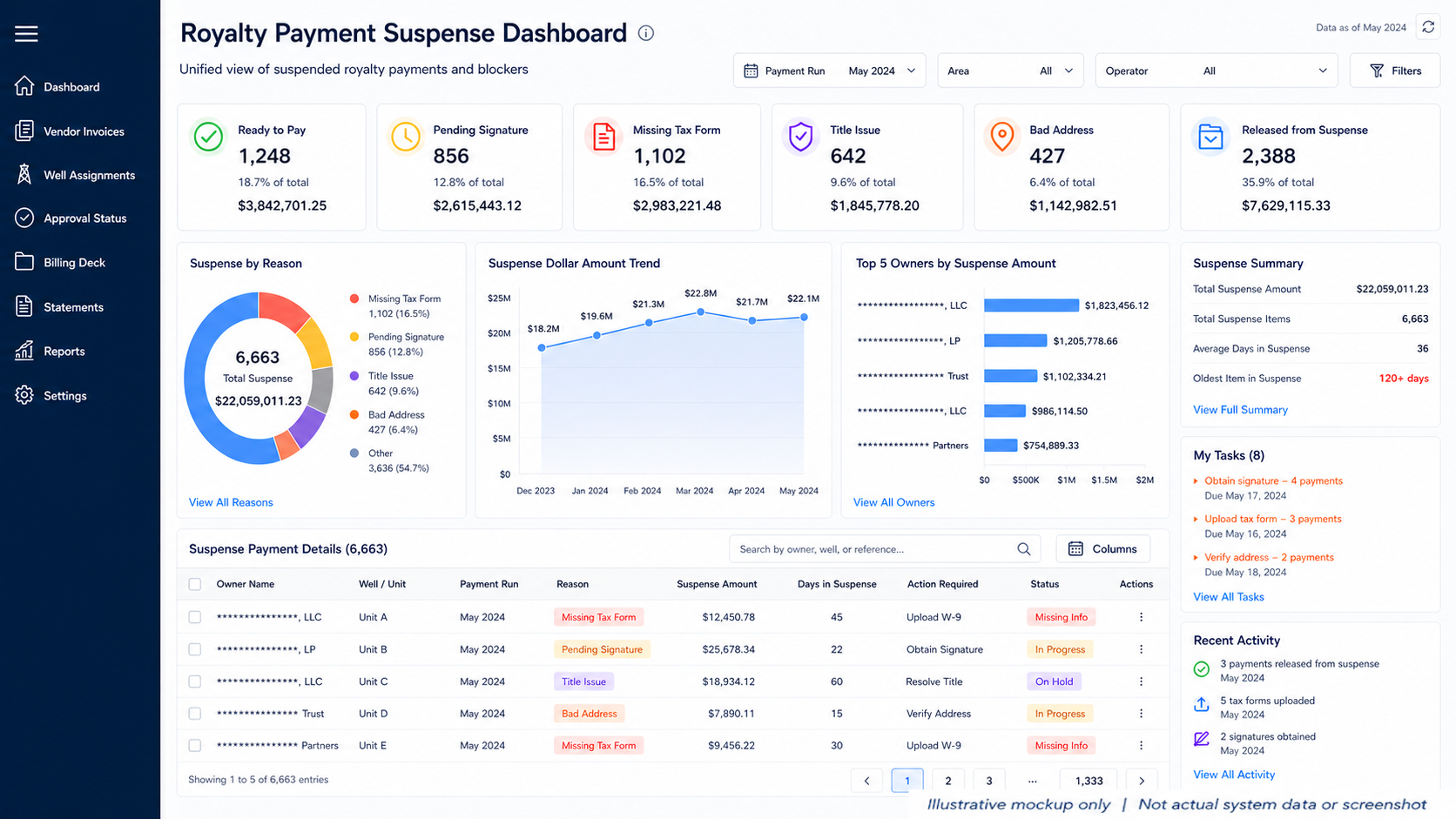
A mature team should be able to explain why each amount is suspended, how long it has been held, which owner or asset is affected, and what action is needed for release. Without that visibility, suspense balances can grow quietly and become harder to clean up later.
A practical suspense review should show:
Suspense reason
Owner and asset affected
Amount held and aging status
Required release action
Responsible team or user
Communication history
Next review or resolution step
Revenue Accounting Depends on a Clean Owner Deck
In monthly revenue accounting, the owner deck is the foundation for payment calculations, and the division order is a key source for building and maintaining it. Each owner’s interest type, decimal interest, effective date, pay status, tax status, and suspense reason should remain consistent across the system. Accurate master data allows production revenue to be allocated correctly among royalty owners, working interest owners, and other interest holders.
The biggest challenge is often ongoing change management. Oil and gas assets may go through ownership transfers, inheritance changes, trust updates, company mergers, lease amendments, purchaser changes, unit expansions, or acquisitions. If the division order process does not absorb these changes quickly, the owner deck can drift away from the actual ownership position.
That data drift can slow monthly close, complicate audits, increase owner inquiries, and create uncertainty in financial reporting. Before payments are released, teams should check:
Correct owner name and payee setup
Current decimal interest
Valid effective date
Updated tax and address status
Applicable lease, well, unit, or product relationship
Current suspense or release status
Supporting documents and change history
Complex Operating Scenarios Require Stronger Controls
Multi-well pad development creates additional division order complexity. One surface location may support several horizontal wells, and each lateral may cross different tracts, units, or allocation areas. In this environment, a division order must support detailed rules by well, product, interest type, effective date, and revenue stream.
Acquisitions create another layer of complexity. A buyer receives not only wells and production volumes, but also owner masters, historical payment records, suspense balances, title defects, unclaimed property exposure, and owner correspondence. If division order data is incomplete during transition, the first payment cycles after closing may generate suspense, owner inquiries, and revenue adjustments.
Owner relations also depend heavily on division order visibility. Owners may ask why a payment decreased, why a specific well did not pay, why a decimal changed, or why certain deductions appeared on the statement. Teams can answer professionally only when they can trace the payment back to production volumes, prices, deductions, decimals, effective dates, and suspense reasons.
Complex scenarios often require tighter controls around:
Multi-well and multi-product allocation
Unit revisions and effective-date changes
Acquisition data migration and validation
Historical suspense balances
Owner communication records
Prior-period revenue adjustments
Audit-ready calculation history
Good Division Order Management Creates Business Value
Strong division order management does more than prevent payment errors. It aligns land, accounting, operations, and owner relations teams around the same ownership data. It also helps management identify which payments are suspended, which title issues need attention, and which assets carry long-term owner-data risk.
A more mature approach treats division orders as part of a controlled workflow, not just a document archive. Companies can standardize suspense codes, approval paths, change logs, owner communication records, and monthly exception reporting. With these controls in place, royalty payment becomes a monitored and explainable revenue distribution process.
Cleaner division order data can reduce payment disputes, shorten suspense resolution cycles, improve owner trust, support faster close processes, and strengthen audit readiness. For oil and gas companies managing complex assets, division order management is a core operating control connecting production, ownership, revenue, and cash flow.
Where Petrofly Can Help
Petrofly can support division order management by keeping ownership records, decimal interests, payment status, suspense reasons, and owner communication closer to the same workflow. This helps teams treat division orders as active payment controls rather than static documents.
Relevant support areas include:
Division order visibility: Track deck setup, signature status, ownership changes, effective dates, and supporting documents.
Payment traceability: Connect decimal interests, royalty calculations, suspense status, and payment history.
Owner communication support: Keep statements, questions, and document follow-up closer to the payment record.
Flexible rollout: Teams can begin with division orders, owner relations, or royalty payment workflows before expanding further.
Dedicated support after implementation: Petrofly’s support team can help with workflow adjustments, reporting refinements, data questions, and faster response when ownership or payment issues need clarification.
This gives oil and gas teams a more practical way to maintain division order accuracy without turning the project into a broad system replacement all at once.
Why Division Order Management Matters
Division orders may sit quietly behind the monthly revenue cycle, but their impact shows up in every royalty payment, suspense balance, owner inquiry, and audit review. When ownership data is clean, current, and traceable, revenue accounting becomes more than a calculation process. It becomes a controlled operating discipline that connects production, title, revenue, and cash flow.
For oil and gas companies, the key question is whether the division order process can keep pace with changing assets, complex ownership structures, new wells, acquisitions, and growing expectations for payment transparency. As operations become more data driven, division order management will continue to move from a back-office task to a strategic control point in oil and gas revenue management.
To explore how better division order management could improve royalty payment accuracy, contact our team for a focused discussion.