
Decimal Interest Errors in Division Orders: How Small Data Mistakes Delay Royalty Payments

Summary
×What Decimal Interest Controls
Decimal interest is the ownership share used to calculate an owner’s royalty payment. It may look like a technical accounting field, but it directly controls how revenue is distributed. If the number is wrong, the payment amount will be wrong, even when production volume, sales revenue, and tax calculations are correct.
In simple terms, the calculation is: Royalty Payment = Net Revenue × Decimal Interest. For example, if monthly net revenue is $500,000 and the correct decimal interest is 0.01250000, the owner’s royalty payment should be $6,250. If the decimal is entered incorrectly as 0.01025000, the payment becomes $5,125. That creates a $1,125 underpayment in one month.
If no one catches the error for six months, the underpayment becomes $6,750, plus correction work, owner calls, and possible payment adjustments. This is why decimal interest should not be treated as a small back-office detail. It is a payment control point that affects owner trust, accounting workload, and revenue distribution accuracy.
Where Decimal Interest Errors Usually Start
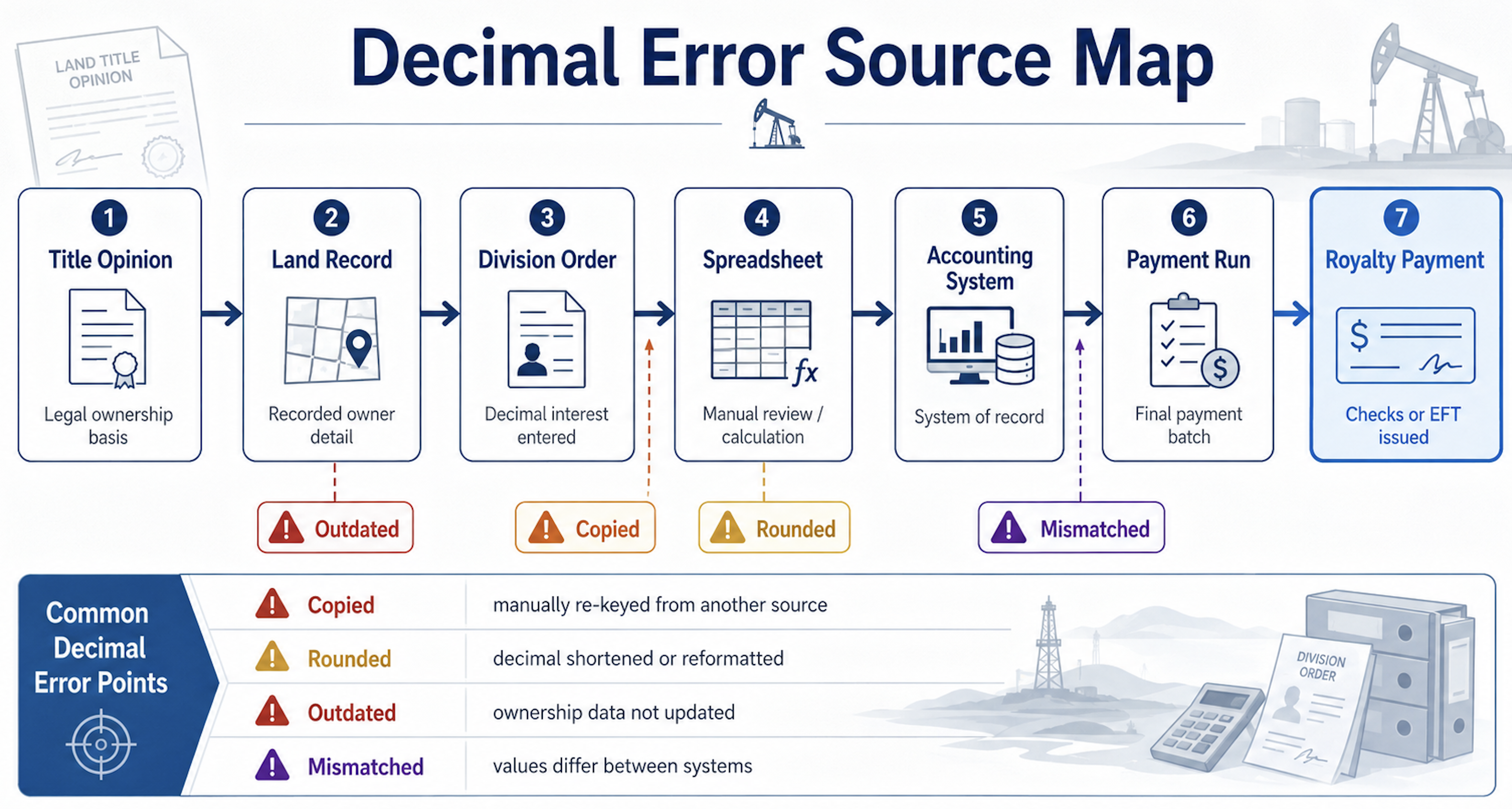
Most decimal interest errors come from ordinary workflow gaps, not unusual mistakes. The number may be copied from a title opinion, spreadsheet, division order file, land system, or accounting system. Every handoff creates risk if the decimal is not connected to the source record and approval trail.
Common error sources include:
Manual entry: 0.01562500 becomes 0.01652500
Outdated ownership record: transfer, inheritance, or title update is not reflected
Spreadsheet rounding: decimal gets shortened or reformatted
System mismatch: land, division order, and accounting records show different values
Wrong property link: correct owner is tied to the wrong well or lease
Missing approval: updated decimal is not approved before the payment run
The issue is rarely just the decimal itself. The real problem is that the decimal is often disconnected from the documents and approvals that prove it is correct. When accounting, land, and division order records do not match, payment teams may need to hold the payment until the correct basis is confirmed.
How One Wrong Decimal Delays Payment
When accounting finds a questionable decimal before payment, the safest response is often to place the owner in suspense or hold the payment. That protects the company from paying the wrong amount, but it also creates a delay for the owner. The longer the issue stays unresolved, the more likely it is to become an owner relations problem rather than a simple data correction.
A typical delay may look like this:
Division order decimal does not match the accounting record
Payment is held or moved to suspense
Owner asks why the check stopped
Accounting checks revenue records
Land or division order team checks title support
Decimal is corrected and approved
Payment is released or adjusted
This is why small data issues become operational problems. The delay involves accounting, land, owner relations, and sometimes management approval. One wrong decimal can interrupt a payment cycle even when production revenue has already been calculated correctly.
Example: Small Difference, Real Payment Impact
A decimal difference does not need to be large to create a meaningful payment issue. If the correct decimal interest is 0.01875000, the incorrect decimal interest is 0.01785000, and monthly net revenue is $320,000, the correct payment should be $320,000 × 0.01875000 = $6,000. With the incorrect decimal, the payment becomes $320,000 × 0.01785000 = $5,712.
That creates a difference of $288 per month for one owner on one property. The monthly amount may look small at first, but over 12 months it becomes $3,456. If the same ownership update affects multiple owners or multiple wells, the correction process becomes much larger.
The real cost is not only the underpayment. It also includes research time, adjustment processing, owner communication, and audit support. This is why decimal interest review should happen before payment release, not after owners begin asking questions. Institutionalizing this preemptive auditing gate ensures that transactional accuracy is hardcoded into the initial distribution run, thereby shielding the corporate back-office from compounding administrative overhead and long-term regulatory non-compliance risks.
Overpayment Is Also a Problem
The strongest review process is usually built around exceptions. Instead of rereading every line manually, owners can focus on large variances, unusual categories, duplicate-looking invoices, unsupported charges, or costs that appear to belong to another well or phase. Deploying this automated exception-driven logic promotes shorter internal cycle times while mitigating the financial leaks that routinely bypass traditional human sampling methods.
For example, if the correct decimal is 0.00625000, the incorrect decimal is 0.00825000, and net revenue is $750,000, the correct payment should be $750,000 × 0.00625000 = $4,687.50. With the incorrect decimal, the payment becomes $750,000 × 0.00825000 = $6,187.50. That creates an overpayment of $1,500.
Now the operator may need to recover the overpayment, offset future payments, issue adjustments, and explain the correction to the owner. That process can be more difficult than preventing the error in the first place. Decimal validation should happen before the payment run, not after checks are issued.
What Operators Should Check Before Releasing Payment
Operators should not treat decimal interest as a loose data field. It should be validated before it affects royalty distribution. A clean payment process should confirm not only the decimal number, but also the owner, property, title support, approval history, and payment readiness.
Key checks include:
Match decimal to title support: confirms the ownership basis
Match division order to accounting record: prevents system mismatch
Confirm owner name and tax ID: avoids payment hold
Confirm property, well, lease, or unit: prevents wrong-property allocation
Review recent ownership changes: catches transfers, inheritance, sales, or corrections
Confirm suspense reason: makes sure the real issue is the decimal
Check approval history: confirms the decimal is cleared for payment use
A useful control formula is: Total Allocated Interest = Sum of All Owner Decimal Interests. If a property should allocate 1.00000000, but owner decimals total 0.99750000, revenue may be underallocated. If they total 1.00300000, the system may overallocate revenue. This type of control helps teams catch issues before payments are released.
What Owners Should Check Before Signing a Division Order
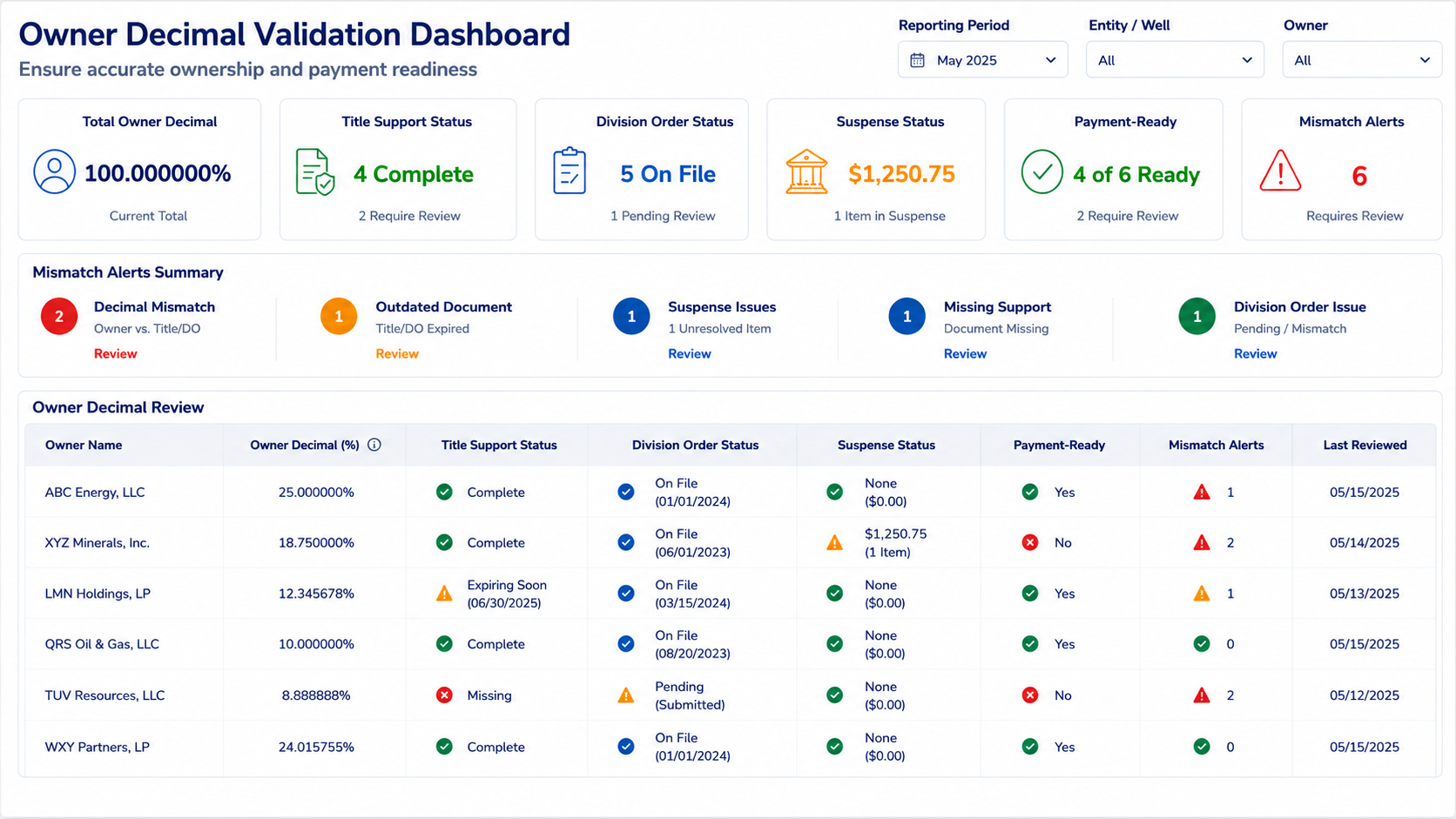
Royalty owners should review the division order before signing, especially the decimal interest and property details. Once the signed document enters the payment workflow, correcting mistakes can take longer. A quick review before signing can prevent payment delays, incorrect statements, and later disputes.
Owners should check:
Owner name: spelling, entity name, trust name, or estate name
Property name: correct well, lease, or unit
Legal description: matches the property tied to the interest
Decimal interest: matches lease, deed, mineral ownership, or prior records
Address: correct mailing address
Tax information: correct W-9 or tax ID details
Payment method: check or ACH instructions are correct
A correct decimal with the wrong owner address can still delay payment. A correct owner name with the wrong property can still create a revenue allocation problem. Division order review should be about the full owner record, not only one number. Establishing a comprehensive, multi-dimensional verification protocol across land data, ownership percentages, and payee contact details remains a highly reliable method to strengthen upstream revenue accuracy while minimizing preventable administrative backlogs.
How Software Reduces Decimal Interest Errors
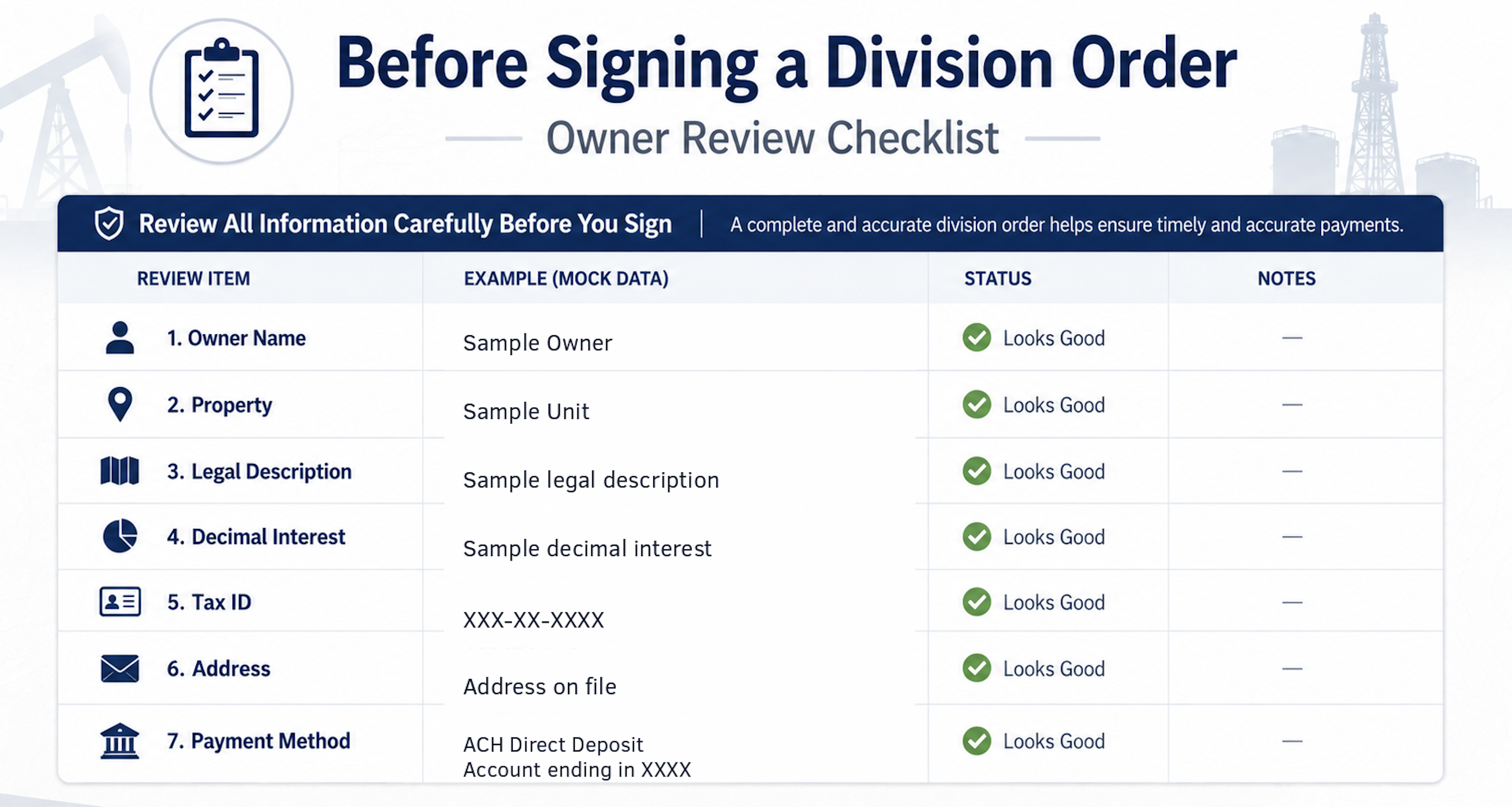
The value of oil and gas software is not simply storing decimal interest. The value is controlling how that number is created, changed, approved, and used in payment. Decimal interest should be part of a connected workflow, not a number copied between disconnected files. Integrating this critical variable within a unified data pipeline substantially strengthens internal compliance mechanisms while reducing the operational risks frequently associated with manual data handling across fragmented accounting platforms.
A strong system should help operators:
Connect owner records, division orders, title support, and payment status
Flag mismatches between land, division order, and accounting records
Prevent unapproved decimal changes from entering payment runs
Keep a change history for decimal updates
Identify suspense caused by owner data issues
Compare total allocated interest before releasing payment
This matters because decimal interest is not just a calculation input. It is a financial control point. When the data is connected, accounting teams can catch errors before they become delayed checks, owner complaints, or adjustment cycles. Bridging these operational datasets provides a more resilient oversight infrastructure, allowing upstream enterprises to stabilize distribution cycles and maintain a high standard of back-office efficiency.
What Petrofly Can Bring
Petrofly helps operators move decimal interest control out of disconnected spreadsheets and into a more connected royalty workflow. Instead of treating decimal interest as a loose number copied between files, Petrofly helps teams connect the decimal to the owner record, division order, title support, suspense status, approval history, and payment activity. This gives accounting, land, division order, and owner relations teams a clearer way to see whether an owner is ready for payment before the royalty run begins.
With Petrofly, operators can better manage:
Owner and property records in one connected place
Division order details tied to the correct well, lease, unit, or owner
Decimal interest review before payment release
Supporting documents such as title files, signed division orders, and owner records
Suspense and payment status with clearer visibility
Change history and approvals for ownership or decimal updates
Owner questions with faster access to the records behind each payment
The benefit is not only faster data entry. The bigger value is better control. When royalty information is connected, teams can identify issues earlier, reduce manual research, and avoid payment delays caused by mismatched or incomplete owner data. For operators, this can mean fewer last-minute payment holds, fewer spreadsheet checks, fewer owner calls about missing or incorrect payments, and a more reliable royalty payment process. For owners, it can mean clearer answers, better visibility into payment status, and more confidence that their interest is being handled carefully.
Final Thoughts
Decimal interest may be a small field, but it carries significant financial and operational impact. One incorrect digit can affect royalty payments, delay checks, create suspense balances, and damage owner trust. The best way to reduce these issues is to treat decimal interest as part of a connected payment control process, not as an isolated accounting entry. Operators need a clear way to connect ownership records, division orders, supporting documents, approval history, and payment readiness before revenue is distributed.
Petrofly helps bring those pieces together so teams can work with cleaner records, stronger visibility, and greater confidence before payments go out. Utilizing this structured oversight framework assists operators in maintaining consistent audit readiness while fostering collaborative alignment across multiple stakeholders in the joint venture ecosystem.