
How Oil and Gas Companies Can Reduce Royalty Payment Delays with Better Owner Data

Summary
×Payment Delays Usually Start Upstream
Royalty payment delays are often noticed at the payment stage, but the cause usually begins earlier. Missing owner information, outdated addresses, incomplete tax records, unsigned division orders, unclear decimal interests, and unresolved ownership changes can all slow down payment processing. By the time a payment is delayed, several upstream data issues may already have accumulated.
For oil and gas companies, the challenge is not only calculating royalty payments. It is maintaining the owner, property, division order, tax, communication, and payment information that supports the calculation. If those records are disconnected, the royalty accounting team may spend too much time resolving exceptions instead of completing accurate payments.
Better owner data does not eliminate every payment issue, but it reduces preventable delays. When owner records are complete, current, and connected to payment workflows, accounting teams can identify problems earlier and explain payment decisions with more confidence. That creates a more controlled process for royalty payments, owner relations, and reporting.
Common data issues behind payment delays include:
Missing or outdated owner contact information
Incomplete tax records
Unsigned or untracked division orders
Decimal interests under review
Ownership transfers not fully reflected in payment records
Payment holds without clear release requirements
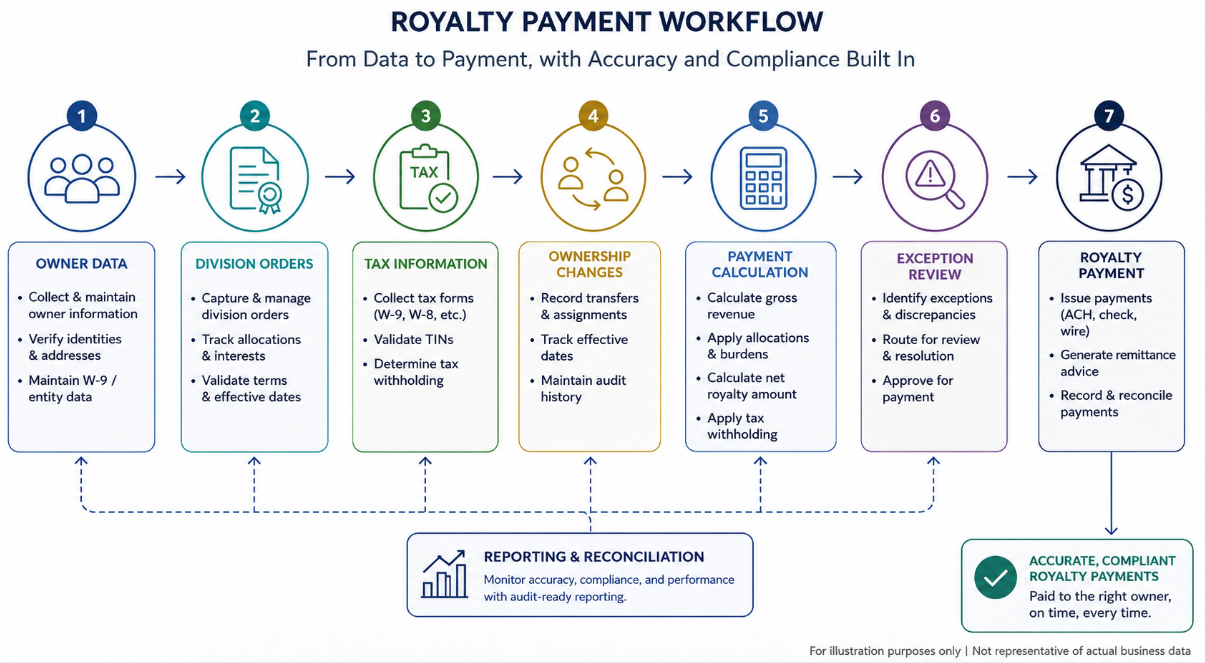
Owner Data Is the Control Point
Owner master data is the foundation of reliable royalty payment management. It should include owner name, owner number, mailing address, contact information, tax information, payment preference, interest type, property relationship, and relevant documentation. If this foundation is incomplete or outdated, payment accuracy and communication quality both suffer.
A small data issue can create a large operational burden. An outdated address may cause returned checks or owner inquiries, while missing tax information may create payment holds or reporting problems. A name mismatch may delay ownership updates, division order processing, or year-end documentation.
This is why owner data should not be treated as a static administrative record. It is a live control point that affects payment timing, owner trust, and back-office efficiency. Companies that manage owner data proactively can reduce preventable exceptions before they reach the payment cycle.
A stronger owner record should help teams quickly confirm:
Who the owner is
Which properties and interests are connected to the owner
Whether tax, address, and payment details are complete
Which documents support the current payment status
Whether any open issue may block payment
Division Orders Need Connected Records
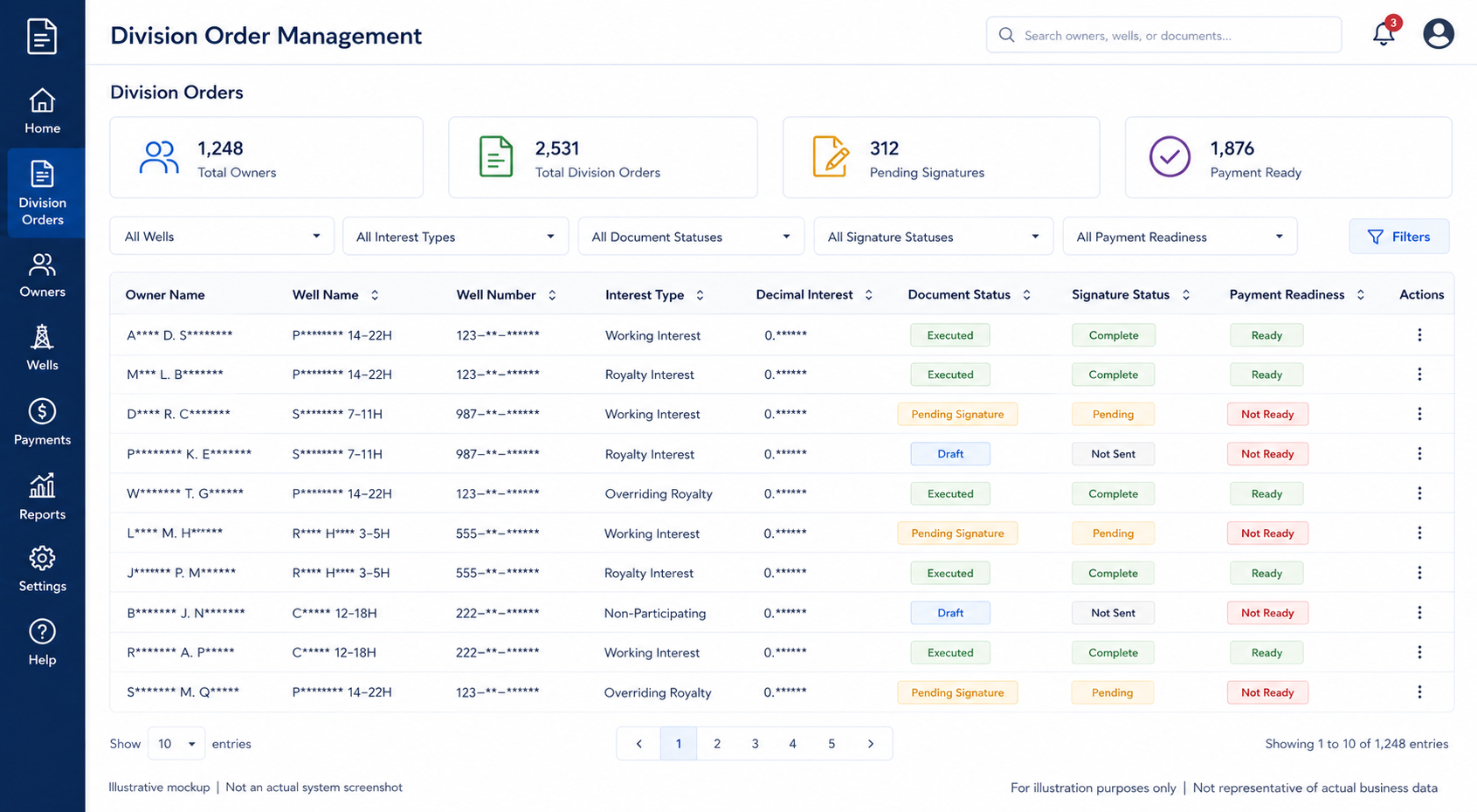
Division orders play a central role in royalty payment accuracy because they record an owner’s interest in a specific well, including well information, interest type, and decimal interest. If the division order is not connected to the owner record, property record, title support, and payment setup, the payment process becomes harder to control. A signed document sitting in a folder is useful, but it is not enough if accounting teams cannot easily connect it to the payment workflow.
The decimal interest on a division order may look like a small number, but it has direct payment impact. If the decimal interest is wrong, missing, outdated, or under review, the company may need to hold payment, correct records, or respond to owner questions. Even a temporary issue can create extra work for accounting, land, and owner relations teams.
A stronger process keeps division orders connected to the records they support. Teams should be able to see whether the division order has been issued, signed, reviewed, updated, or placed into exception status. This visibility helps prevent payment delays caused by missing or disconnected ownership documentation.
Ownership Changes Create Exception Pressure
Ownership records do not stay still. Interests may transfer through sales, inheritance, trust changes, company restructuring, name changes, or address updates. Each change can affect who should be paid, which documents are required, and whether payments should continue, pause, or be redirected.
When these changes are handled through email chains and separate spreadsheets, exception pressure increases. One team may receive transfer documents, another may update the owner record, and another may handle payment status. If the process is not connected, the royalty accounting team may not have the latest information when payment is processed.
A better workflow makes ownership changes visible before they become payment exceptions. It should show what changed, which documents were received, which records still need review, and which payments are affected. This gives accounting and owner relations teams a shared view of the issue instead of forcing each team to reconstruct the history separately.
Payment Holds Need Clear Reasons
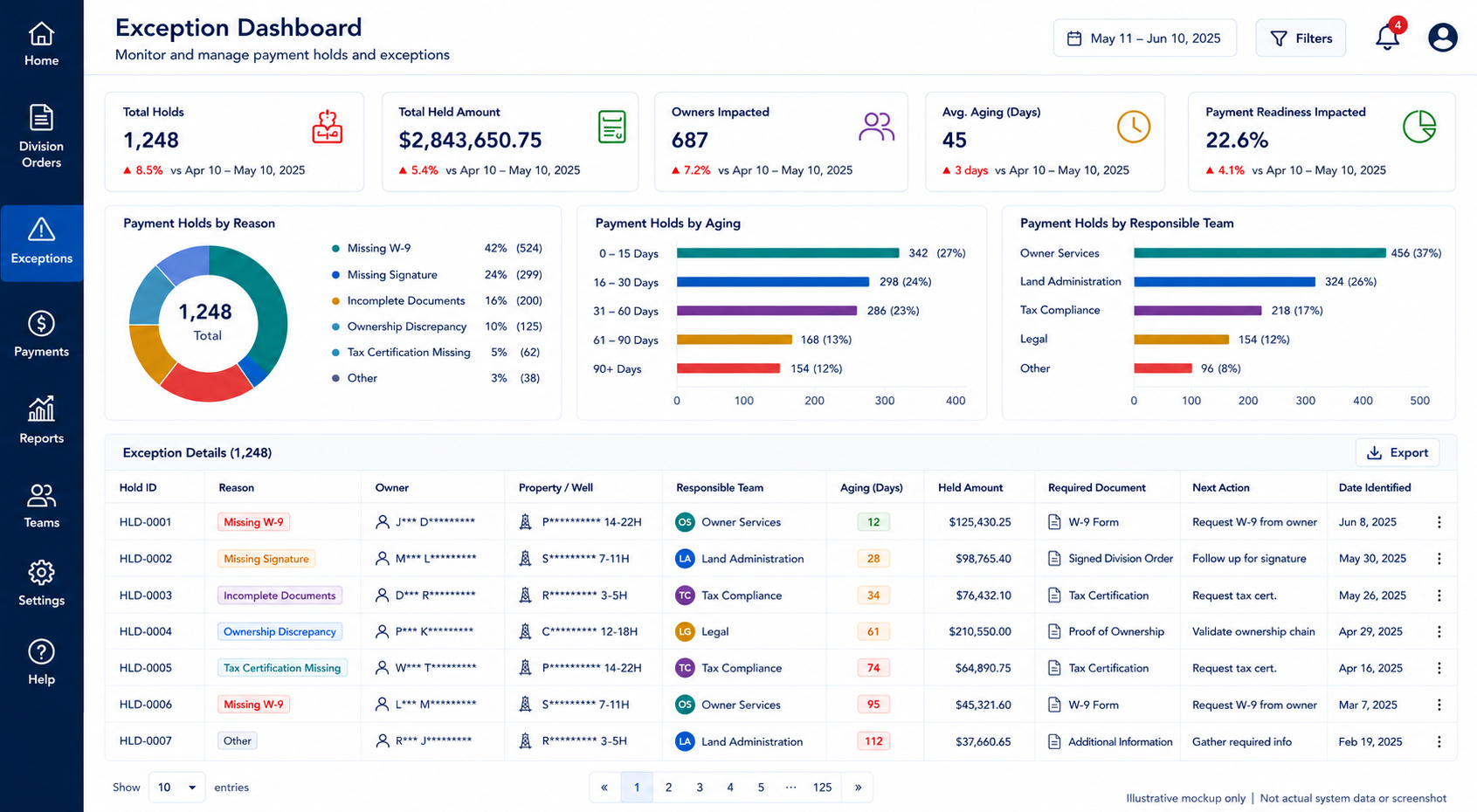
Payment holds are sometimes necessary, but unclear holds create frustration for both companies and owners. If a payment is held because of missing tax information, an unsigned division order, title review, address issue, ownership transfer, or minimum payment threshold, the reason should be visible and easy to explain. Without that context, owner inquiries take longer and internal teams may duplicate work.
A payment hold should not be just a status code. It should be connected to the underlying issue, required action, responsible team, supporting document, and communication history. This helps teams understand what needs to happen before the hold can be released.
Clear hold reasons also improve owner communication. When an owner asks why payment has not been received, the team can provide a specific answer rather than a vague update. That improves trust and reduces repeated follow-up.
A useful hold review should show:
Hold reason
Owner and property affected
Required document or action
Responsible team
Aging days
Communication history
Release status
Owner Communication Belongs in the Payment Workflow
Owner relations is not separate from royalty accounting. It is one of the practical workflows that supports payment accuracy. Owner questions about address changes, tax forms, ownership transfers, division orders, payment details, and unclaimed property all depend on the quality of connected owner records.
If communication history is separated from payment data, teams lose context. An owner may have already submitted a document, asked a question, or received an explanation, but that information may not be visible to the person handling the next inquiry. This creates repeated conversations and slows issue resolution.
A connected process makes communication part of the owner record. Emails, notes, uploaded documents, call outcomes, and open requests should be visible alongside payment status and division order information. This helps teams respond faster and gives owners a more consistent service experience.
Cleaner Data Supports Reporting and Close
Royalty payment accuracy also affects reporting and period-end work. When owner records are incomplete, payment exceptions can carry into reconciliation, accrual review, tax reporting, and management reporting. Small data gaps become larger reporting issues when they remain unresolved across multiple periods.
Clean owner data helps accounting teams close with fewer surprises. Payment holds can be reviewed by reason, division order status can be tracked, ownership changes can be monitored, and unresolved owner issues can be escalated before they create reporting delays. This creates a stronger control environment for both payment processing and financial operations.
The value is not only speed. Better data improves explainability. When teams can show why a payment was made, held, corrected, or adjusted, they are better prepared for owner questions, internal review, and external reporting needs.
Where Petrofly Can Help
Petrofly can help oil and gas teams reduce payment delays by keeping owner records, division orders, tax status, documents, payment holds, and communication history closer to the same workflow. This is useful when delays come from incomplete records or unclear follow-up rather than the payment calculation itself.
Practical support areas include:
Cleaner owner records: Maintain owner, address, tax, document, and payment-related information in a more organized structure.
Division order readiness: Track DOI details, signature status, supporting documents, and payment impact.
Payment hold visibility: Show why a payment is held, what action is needed, and who should follow up.
Cloud-based teamwork: Help accounting, land, and owner relations teams work from more consistent records.
Dedicated support and faster follow-up: Petrofly’s team can assist after rollout with data cleanup, workflow updates, document organization, and payment-related questions.
The result is a more controlled owner-data process that helps teams reduce avoidable delays without making implementation unnecessarily large.
Software Turns Owner Data into Payment Discipline
Royalty management software should do more than calculate payments. It should help companies maintain owner records, manage division orders, track payment holds, connect documents, support communication, and monitor exceptions. Without that workflow discipline, payment delays can continue even when the calculation itself is correct.
A useful system should connect owner master data, property records, decimal interests, document status, tax information, payment preferences, communication history, and reporting outputs. This creates one operational view for accounting, land, owner relations, and management teams. It also reduces the risk of one team working from a record that another team has already updated.
For oil and gas companies, better owner data is not only an administrative improvement. It is a payment control strategy. When owner records are clean, connected, and visible, companies can reduce avoidable delays, answer owner questions faster, and protect trust in the royalty payment process.
To explore how cleaner owner data could reduce payment delays, contact our team for a focused discussion.