
What Should Oil and Gas Royalty Management Software Include?

Summary
×Royalty Management Is More Than Payment Calculation
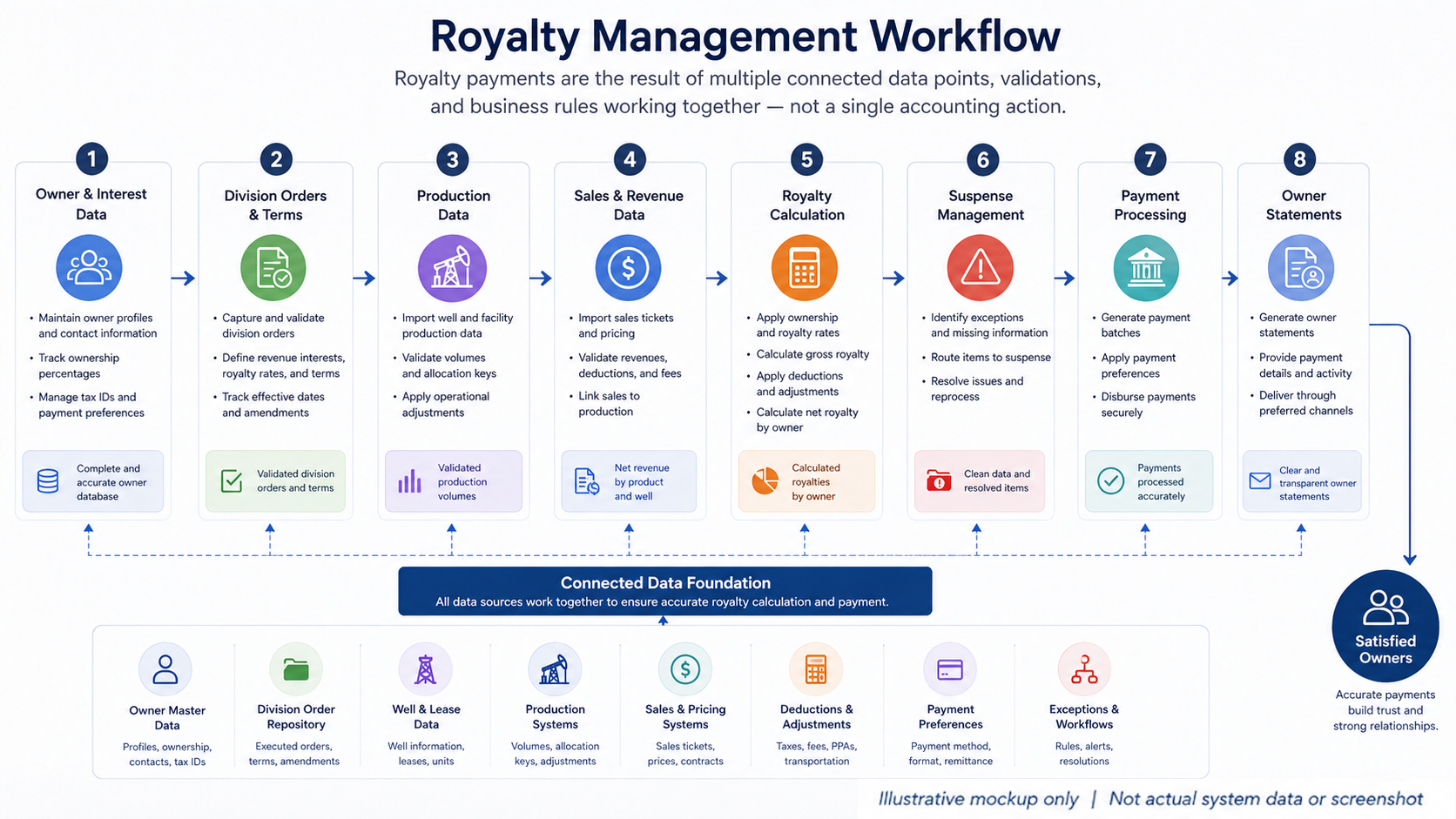
In oil and gas operations, a royalty payment may look like the final result of a monthly accounting process, but it depends on a much larger data chain. Behind each payment are owner records, division orders, decimal interests, production volumes, sales revenue, taxes, deductions, suspense status, and owner statements. When one part of that chain is incomplete or disconnected, the issue often appears later as a payment delay, owner inquiry, suspense item, or audit explanation.
Many teams do not struggle because payments cannot be calculated. The harder problem is explaining the result when ownership, production, and revenue records are not connected. A new well may already be producing sales revenue while division order status is incomplete, or an owner’s tax information may be updated while the payment record still carries an old mailing address.
A mature royalty management system should answer several practical questions before payments are released:
Who should be paid?
Why does a specific decimal interest apply?
Which amounts should remain in suspense?
Where does the payment basis come from?
Can the owner statement be traced back to source records?
Can the team explain changes without searching across emails and spreadsheets?
The real product value is not only automation. It is the ability to turn royalty management from a fragmented monthly task into a visible, controlled, and auditable operating process. That visibility matters for accounting teams, land teams, owner relations, management, and royalty owners who expect clearer payment explanations.
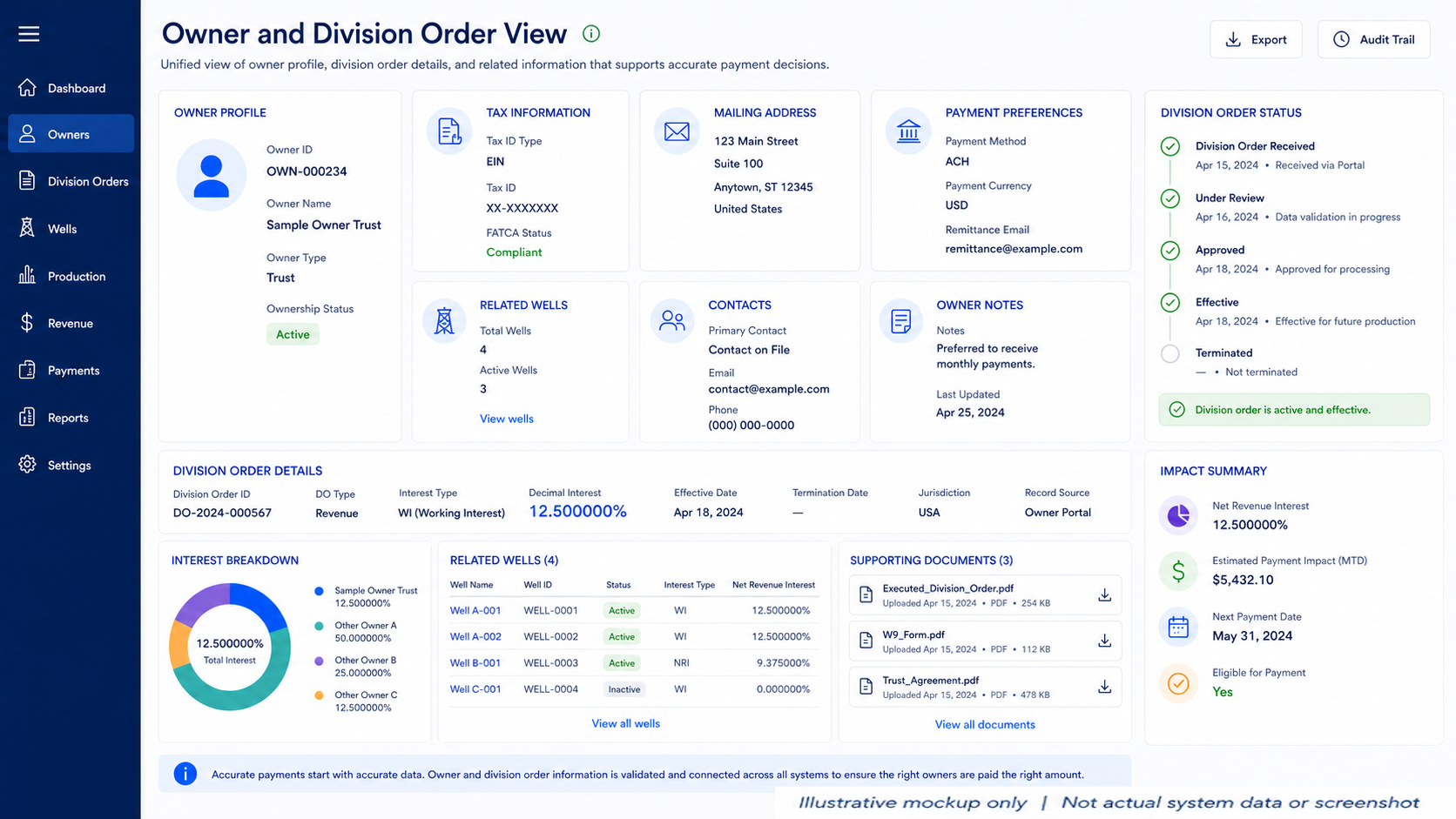
Ownership and Division Orders Should Support Payment Logic
The foundation of royalty management is clean owner and ownership data. The system should maintain owner profiles, tax status, mailing addresses, payment preferences, legal entity information, communication history, and related interests. Storing only the owner’s name and address is not enough, because royalty payments depend on how each owner connects to wells, leases, units, tracts, interest types, effective dates, and payment status.
Owner data changes constantly through address updates, tax information changes, ownership transfers, acquisitions, and data migrations. After an acquisition, for example, the new operator may receive producing wells along with historical owner records, payment history, and suspense balances. If migrated data includes duplicate owner profiles, invalid mailing addresses, missing tax forms, or inconsistent effective dates, the first payment cycle can quickly create delays, returned statements, additional suspense, and difficult owner explanations.
Division orders should also be managed as part of the workflow, not as static files stored separately from revenue accounting. The system should support division order creation, review, approval, signature tracking, document attachment, effective-date management, and version history. Each division order should connect the owner, well, lease, unit, interest type, decimal interest, and supporting title information, so payment logic remains clear when new wells come online, units change, or owners ask how their interest was calculated.
A practical owner and division order workflow should include:
Owner profile and entity information
Tax, address, and payment status
Related wells, leases, units, and interests
Division order status and signature tracking
Decimal interest and effective date
Supporting documents and title references
Ownership change and version history
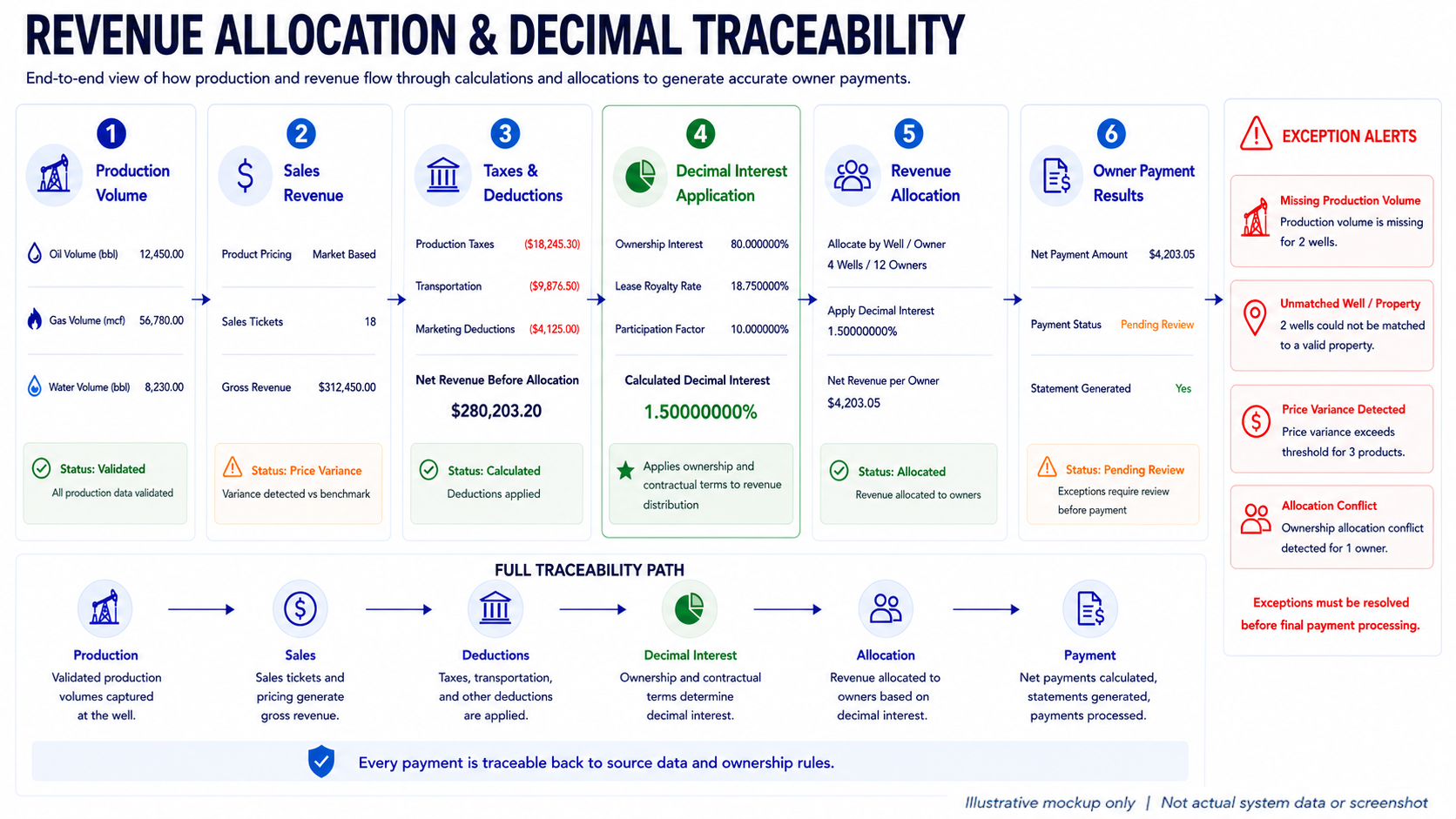
Production, Revenue, and Decimals Must Stay Connected
Royalty payment calculation depends on production volumes and sales revenue. The system needs to connect production data for oil, gas, NGLs, and other products with purchaser statements, sales prices, taxes, deductions, and adjustments. When these data points are spread across separate systems or spreadsheets, revenue accounting teams often have to reconcile them manually at month-end, which increases workload and error risk.
A strong royalty management system should support production and revenue data integration. It should identify wells, products, production periods, sales volumes, gross revenue, taxes, deductions, net revenue, and owner allocation rules. It should also check for exceptions before payment processing, including missing volumes, unmatched wells, unusual price variances, incomplete deduction details, or revenue records that do not match the owner deck.
Decimal interest should be transparent within the same workflow. The system should not only store the final decimal number; it should show the source and logic behind it, including the related lease, tract, unit, ownership percentage, royalty rate, participation factor, and effective date. This is especially important for pooled units, multi-well pads, partial interests, ORRIs, NPRIs, and ownership transfers, where decimal changes may involve land, division order, and revenue accounting teams.
Before royalties are processed, teams should be able to review:
Production period, product, and sales volume
Gross revenue, taxes, deductions, and net revenue
Owner deck and decimal interest
Lease, tract, unit, and well relationship
Allocation rules and effective dates
Exceptions such as missing volume or allocation conflicts
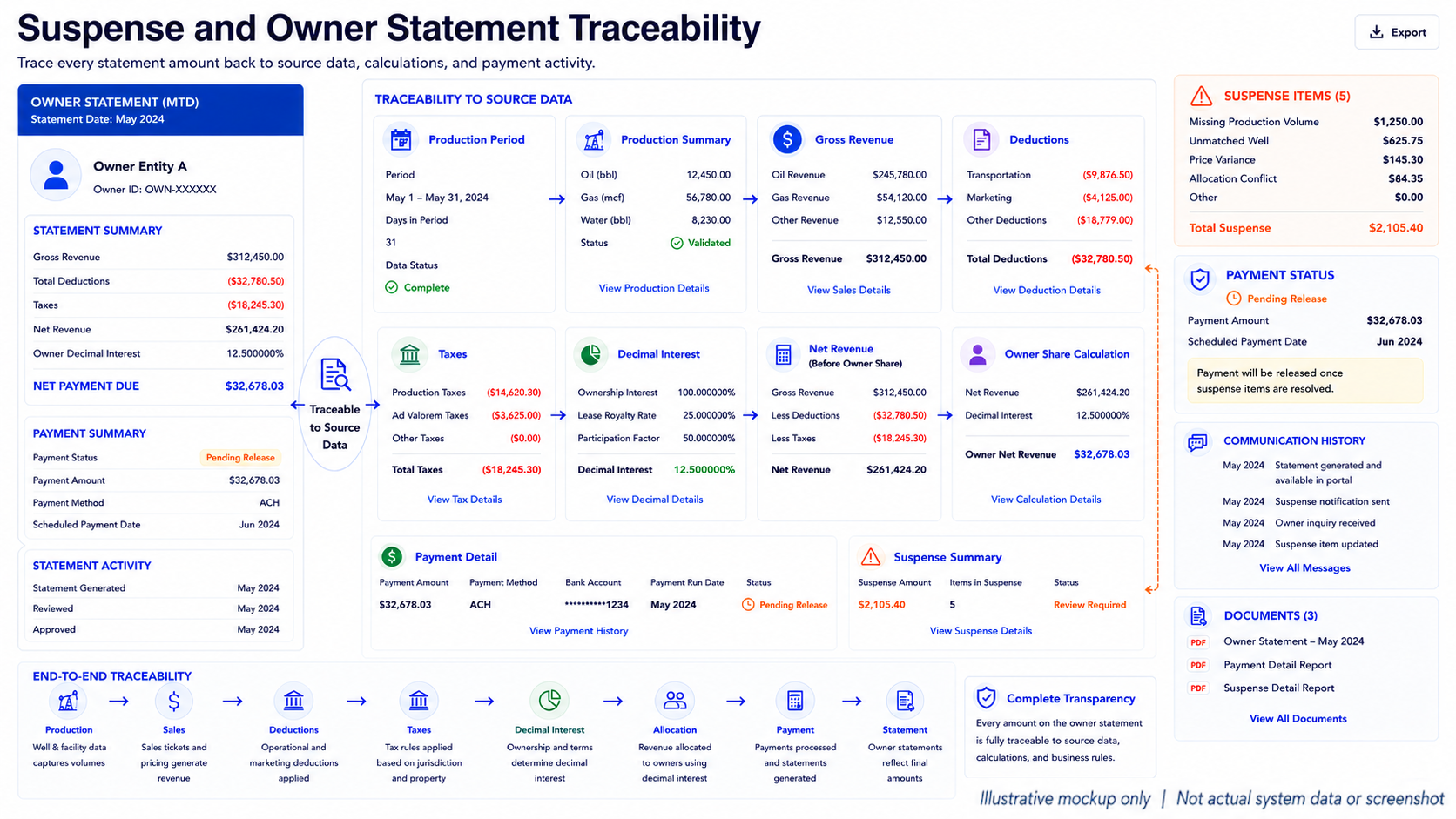
Suspense and Owner Questions Need Traceability
Suspense is one of the most important areas in royalty management because it directly affects payment timing, owner trust, and accounting visibility. Funds may be suspended because of a missing tax form, unsigned division order, bad address, title issue, minimum payment threshold, ownership uncertainty, or another unresolved condition. If the system only shows the suspense balance without explaining the reason, owner, aging, responsible team, and release requirement, the team has limited ability to move the issue forward.
A mature system should manage suspense as an actionable workflow. Each suspense item should include the owner, well, production period, amount, reason code, aging, responsible team, supporting notes, required action, and release status. When missing documents are received, division orders are signed, addresses are updated, or title issues are cleared, the system should identify which suspended amounts are ready for release and preserve the release history.
Owner statements and communication records should connect back to the same data trail. Each statement line should trace to source production, sales revenue, deduction detail, division order, owner record, and suspense history. When owners ask why a payment decreased, why a well did not pay, why a deduction appeared, or why a decimal interest changed, owner relations and accounting teams should be able to work from reliable records instead of scattered emails, spreadsheets, and folders.
A useful suspense and owner statement workflow should show:
Suspense reason and aging
Owner, well, and production period affected
Required release action
Communication and document history
Statement line detail
Payment status and release history
Source data behind each owner-facing amount
Reporting and Configuration Decide Practical Value
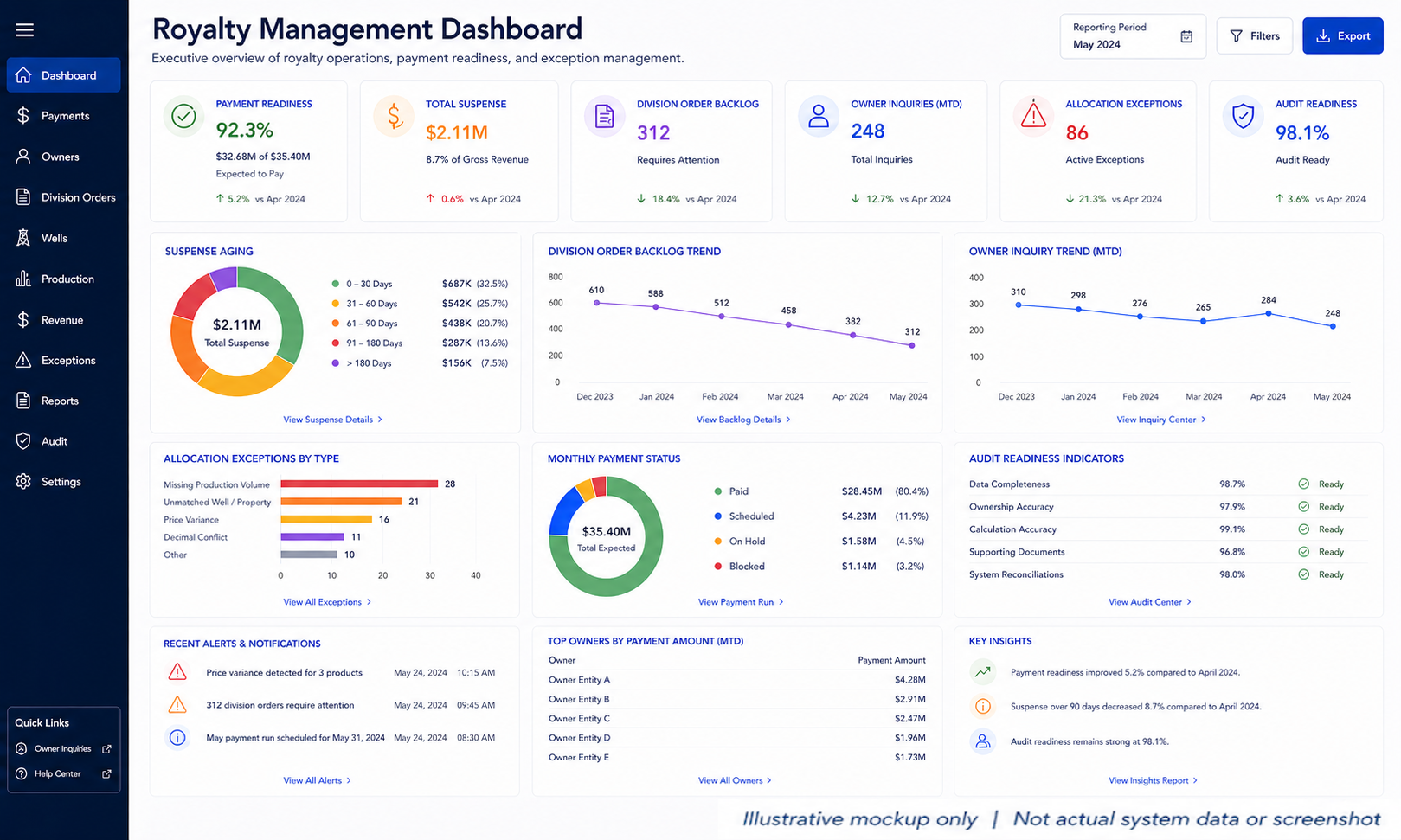
Royalty management software should provide reporting that helps teams act before problems reach owners. It should not only generate payment summaries; it should show which issues may affect the current payment cycle, which suspense items are growing, which division orders remain incomplete, which owner records are missing information, and which payment batches are not ready. Knowing what happened at month-end is useful, but knowing what may block payments before month-end is more valuable.
Different teams need different views. Revenue accounting teams need payment readiness reports, allocation exception reports, statement status reports, and adjustment review reports. Land and division order teams need division order backlog, unsigned order lists, ownership change reports, and title issue tracking, while management needs visibility into suspense aging, payment cycle performance, owner inquiry trends, revenue distribution risk, and audit readiness.
The system also needs configuration, integration, and access control. Royalty workflows vary by operator, asset type, ownership complexity, basin, internal controls, and existing software environment, so the system should support configurable workflows, role-based access, approval rules, exception handling, document management, audit logs, and integration options. It should connect with land systems, production accounting, revenue accounting, ERP, document management systems, or payment platforms where needed to reduce duplicate entry and close gaps between teams.
Key reporting and system capabilities should include:
Payment readiness and batch status
Suspense aging and release tracking
Division order backlog and unsigned orders
Owner record exceptions
Allocation and deduction exceptions
Owner inquiry trends
Role-based access and audit logs
Configurable workflows and integrations
Where Petrofly Can Help
Petrofly fits this type of royalty management need by connecting owner relations, royalty payments, division orders, interest partner records, reconciliation, reporting, and payment tracking in a more unified workflow. The value is not just faster payment output, but clearer control over the records behind each payment.
Petrofly can help with:
Royalty payment workflow: Connect allocation, payment tracking, statements, thresholds, and payment status.
Owner and partner records: Keep owner, partner, DOI, document, title, and division order information easier to maintain.
Suspense and reconciliation visibility: Help teams review payment blockers, aging, release status, and reconciliation history.
Cloud-based modular adoption: Start with priority workflows such as royalty payments, owner relations, division orders, or reconciliation.
Customer-specific setup and support: Configure reports, fields, workflows, and exceptions around real operating needs, with post-go-live support for data questions, reporting refinements, and workflow changes.
For operators, Petrofly provides a focused way to improve royalty management without building more system complexity than the team needs.
Where Royalty Management Goes Next
Royalty management software is gradually moving from a back-office accounting tool to a platform for managing revenue quality. It connects not only payment results, but also ownership accuracy, production data integrity, revenue allocation logic, suspense resolution, owner trust, and audit readiness. For operating teams, these connected records answer a deeper question: does the company truly understand where its revenue is going?
The future of royalty management will not be defined only by faster statement generation or fewer manual calculations. The more important question is whether companies can maintain clear, stable, and explainable revenue distribution as assets change, ownership structures become more complex, owner expectations rise, and audit requirements increase. When every payment can be traced, every suspense item has a resolution path, and every owner inquiry can be answered from reliable records, royalty management becomes more than a monthly task.
To explore how a more connected royalty management workflow could support payment accuracy and owner transparency, contact our team for a focused discussion.