
Oil and Gas Royalty Reconciliation: How Operators Can Connect Purchase Statements, Production Months, and Owner Payments

Summary
×Reconciliation Explains the Payment Story
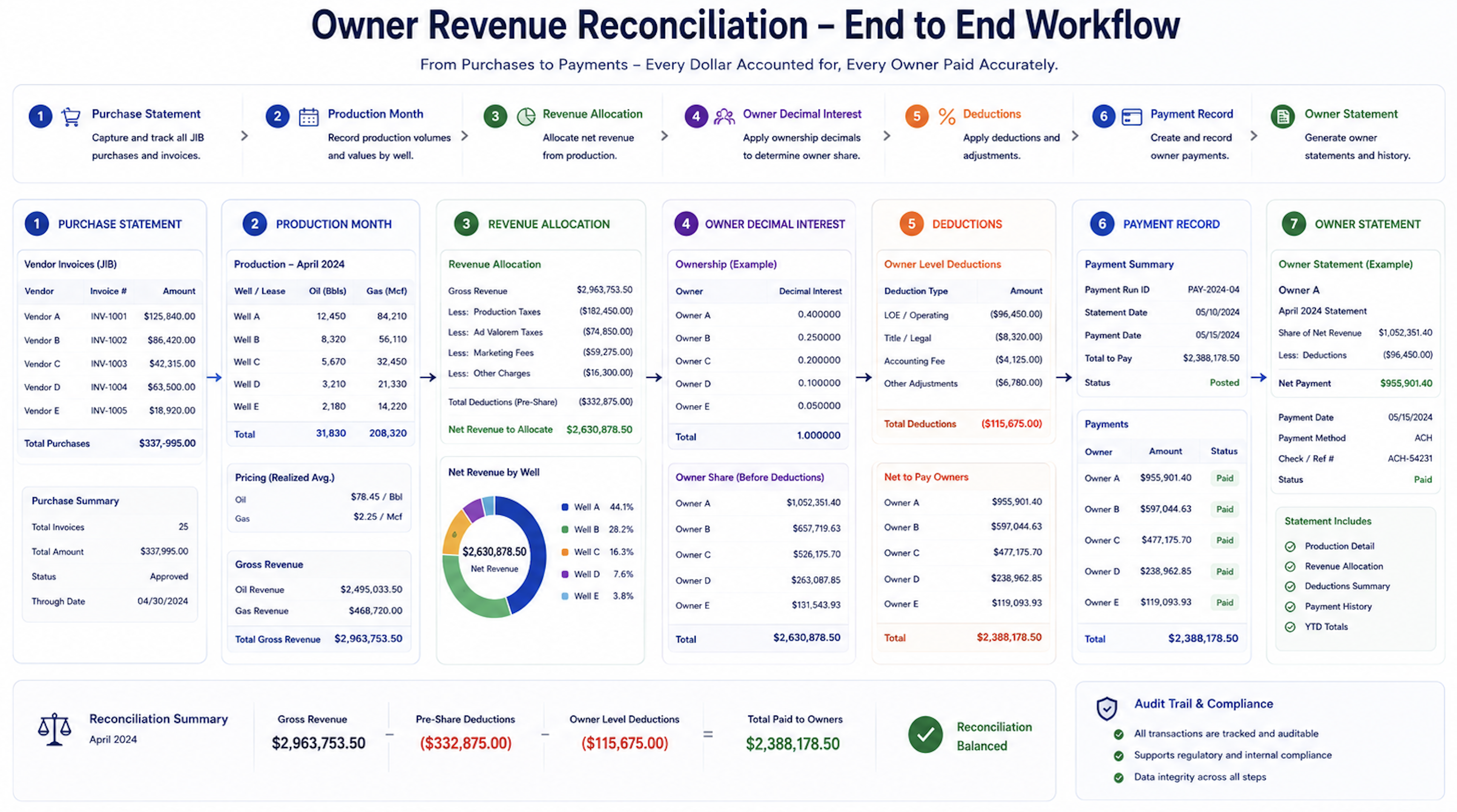
Royalty payments are created from several connected records. Production volumes, purchase statements, prices, deductions, taxes, owner decimals, suspense status, and adjustments all affect the final payment. If these records are disconnected, payment teams may calculate amounts but still struggle to explain why they changed. Royalty reconciliation helps connect source revenue to the owner payment. It gives accounting and owner relations teams a clearer way to review differences before owners ask questions. It also supports historical lookup when payment changes need to be explained later.
A strong reconciliation process should answer one practical question: can the team trace the payment from purchase statement to production month to owner statement without rebuilding the record manually? If the answer is no, reconciliation will remain too dependent on spreadsheets, emails, and individual knowledge.
Variance Needs a Clear Explanation
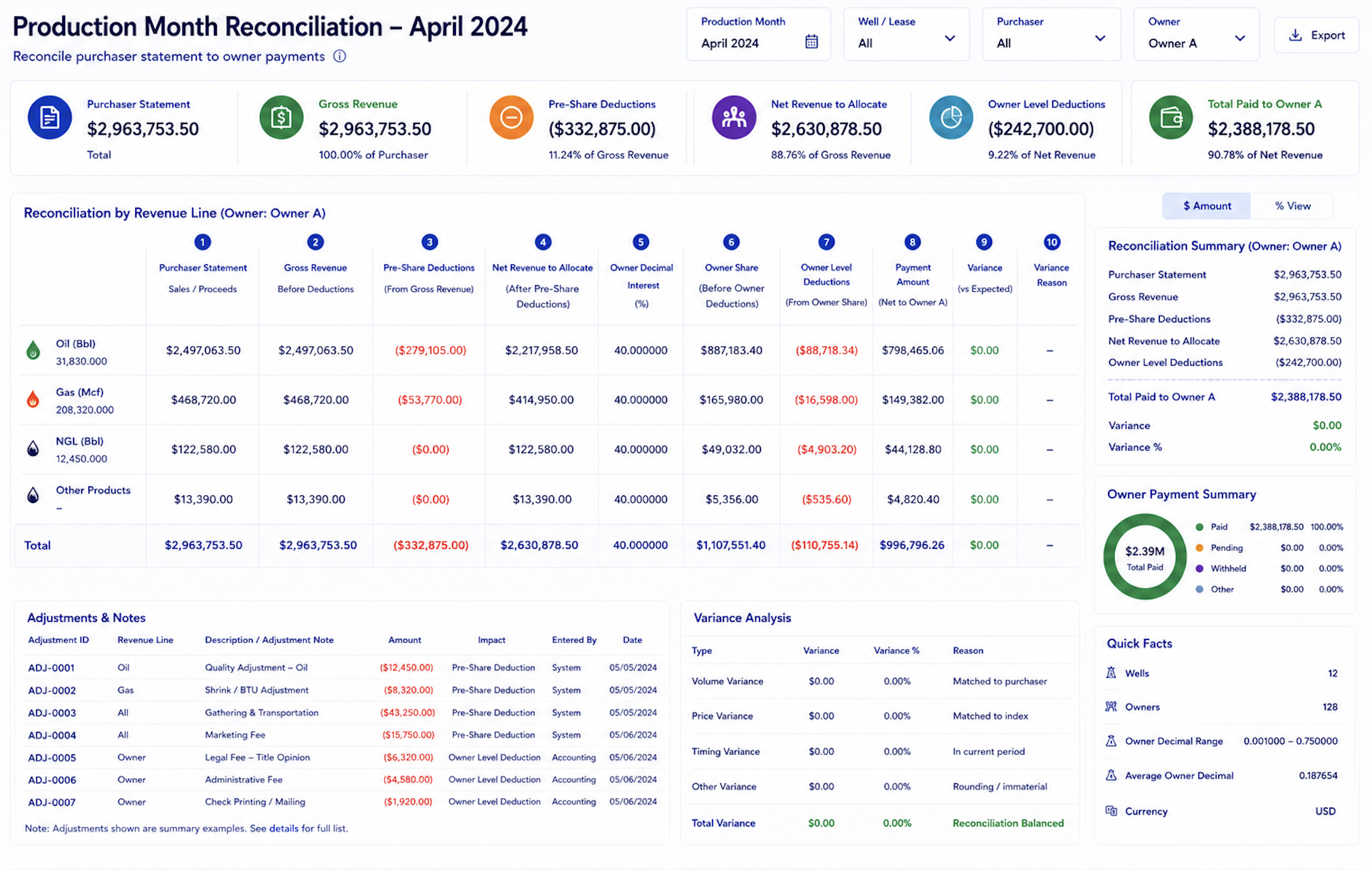
A simplified formula is: Royalty Reconciliation Variance = Allocated Royalty Amount − Expected Royalty Amount. If the expected royalty amount for a production month is $145,000 and the allocated amount is $141,800, the variance is −$3,200. This does not automatically mean the payment is wrong, but the difference must be explainable.
The variance may come from deductions, timing differences, owner status changes, price adjustments, prior-period corrections, or production month allocation. Without a reconciliation view, the team may need to search purchase statements, owner records, and spreadsheets to explain it. That delay can create owner frustration and internal rework.
Operators should review both dollar amount and cause. A small variance may still matter if it repeats every month. A large variance may be acceptable if the reason is clearly documented and tied to approved adjustments. Establishing this granular evaluation standard ensures that joint venture accounting teams maintain strict operational compliance, enabling organizations to detect structural abnormalities early while smoothly facilitating authorized financial remediations.
Production Month Matters
Royalty payments often depend on production month alignment. A payment made this month may relate to production from an earlier period. If production month, sales month, payment month, and statement month are not clearly connected, owner questions become harder to answer. For example, an owner may ask why payment declined in April. The answer may be tied to February production, March purchaser statement timing, deductions, or a prior-period adjustment. The payment date alone does not explain the issue.
Reconciliation software should help teams review:
Production month
Purchaser statement
Product type
Gross revenue
Deductions and taxes
Owner decimal interest
Payment amount
Prior-period adjustments
Statement history
Owner Questions Become Easier to Answer
Owner relations teams often need to explain why a payment changed, why a deduction appeared, or why a prior-period adjustment was included. These answers require reconciliation context. If the team cannot connect the statement to source revenue and calculation records, response time increases.
A useful metric is: Owner Payment Question Rate = Owner Payment Questions ÷ Statements Issued × 100%. If an operator issues 5,000 statements and receives 250 payment-related questions, the question rate is 5%. Reducing repeated questions often depends on better statement traceability and clearer reconciliation records.
Royalty reconciliation is therefore not only an accounting control. It is also an owner communication control. The more traceable the payment record, the easier it is to support consistent answers. Implementing this integrated verification structure allows land and revenue teams to handle inquiry cycles more efficiently, significantly reducing administrative overhead while sustaining a high level of trust among royalty interest holders.
Deductions and Adjustments Need Their Own Trail
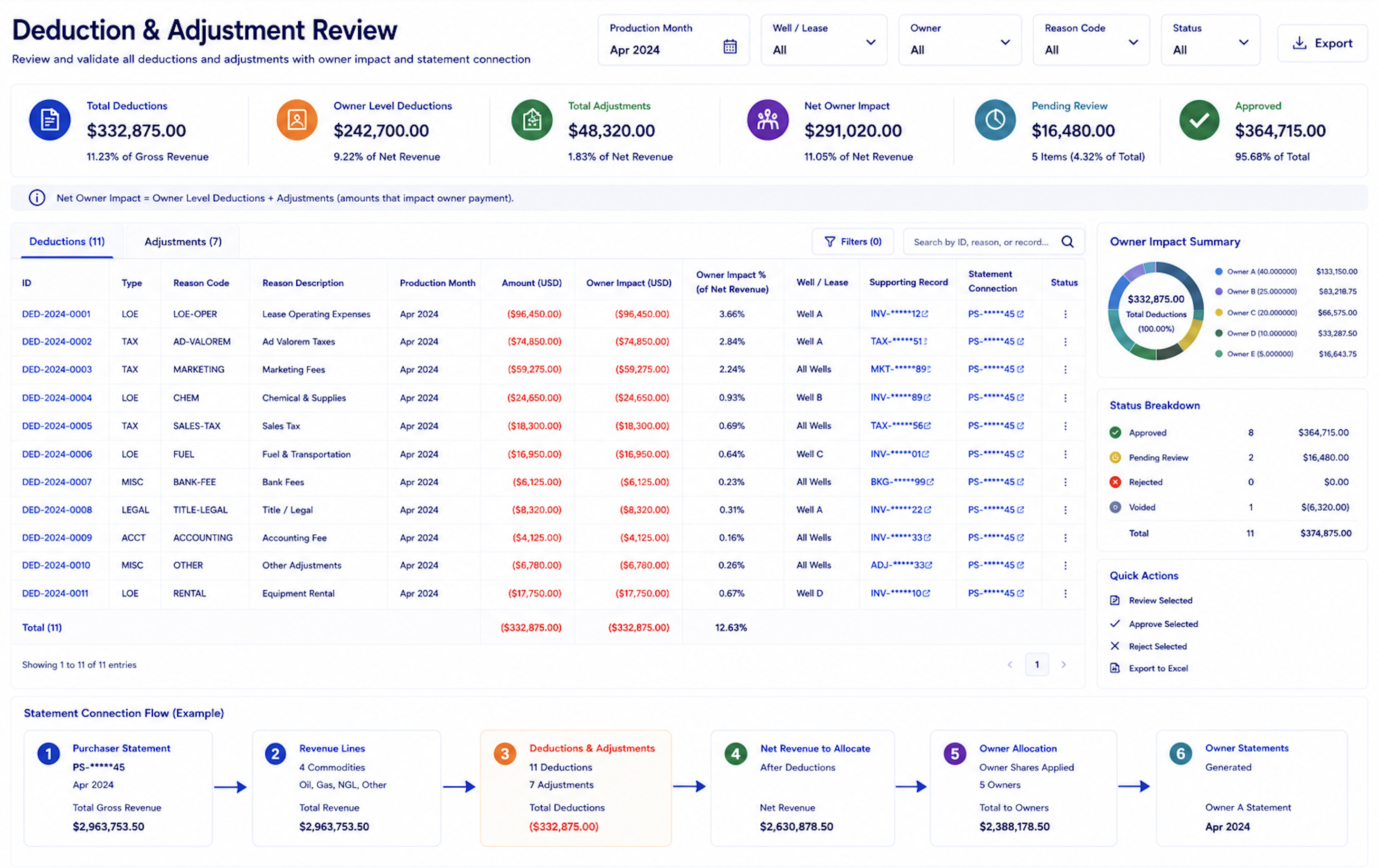
Deductions and adjustments often drive owner questions. An owner may understand production volume but still ask why deductions increased or why an adjustment appeared on the statement. If deduction basis and adjustment reason are not clearly recorded, the team may struggle to explain the payment.
Operators should track deduction type, amount, period, property, owner impact, and supporting basis. Adjustments should include reason, effective period, payment impact, and approval record. Without these details, a valid adjustment can still create confusion. Maintaining this high degree of granular documentation helps upstream financial teams establish an immutable audit trail, which substantially improves multi-party reporting clarity and simplifies complex revenue reconciliation cycles.
Historical Lookup Supports Audit and Owner Trust
Royalty reconciliation is not only about the current payment cycle. Owners may ask about prior periods, corrected payments, annual totals, or historical statement differences. Auditors or internal teams may also need to trace how a payment was formed. A reconciliation workflow should preserve history. The team should be able to see what source record created the payment, what calculation logic was applied, whether an adjustment changed the result, and which statement was issued. This helps reduce repeated research when old questions return.
Strong historical lookup supports both control and trust. Owners may not need to see every internal record, but they benefit when the operator can answer questions consistently. Teams also benefit because they do not need to rebuild payment history from scratch. Securing this long-term data continuity offers energy enterprises a dependable reference baseline, which materially enhances institutional knowledge retention and streamlines transactional verification during complex asset transitions.
How Petrofly Supports Royalty Reconciliation
Petrofly can help operators connect purchase statement allocation, production month, royalty calculation, payment records, statement generation, and owner history in a more organized workflow. This supports teams that need reconciliation to become part of routine royalty operations rather than after-the-fact research.
Petrofly can support reconciliation through:
Purchase statement allocation: Connect source revenue with royalty calculation.
Production month context: Review payments by production period.
Royalty calculation support: Keep owner interests, deductions, and payment records closer together.
Statement and history lookup: Help teams retrieve payment context when owners ask questions.
Cloud-based and configurable workflow: Support shared review, custom fields, and reporting needs with post-go-live assistance.
Make Every Royalty Payment Easier to Explain
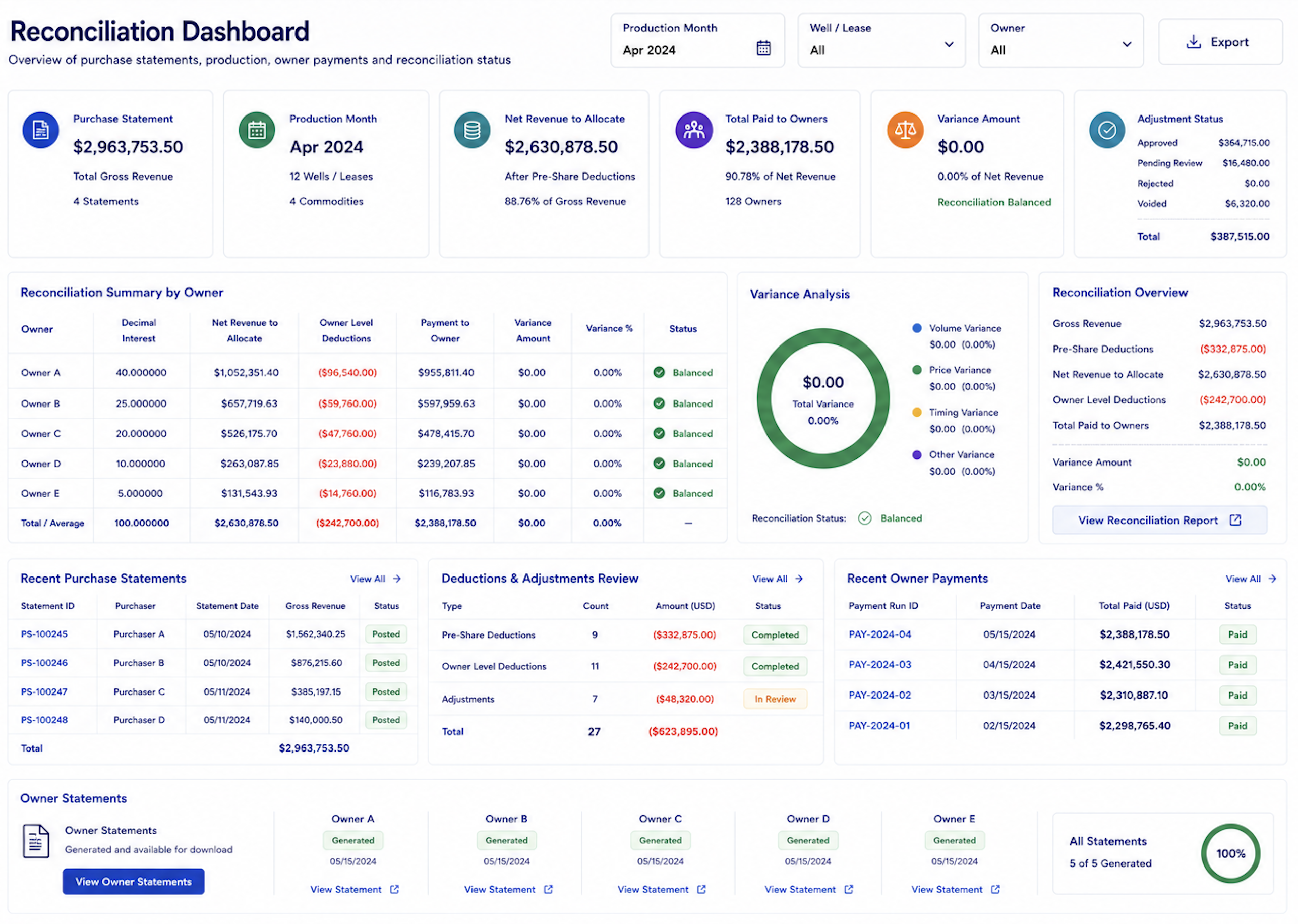
Royalty reconciliation helps operators connect source revenue with owner payment records. When purchase statements, production months, deductions, decimal interests, adjustments, and owner statements are traceable, teams can explain payment changes more clearly and reduce avoidable owner questions.
The practical value is confidence. Accounting can review payment logic, owner relations can answer questions with better context, and management can see whether payment records are supported by traceable source data. Petrofly can support operators that want reconciliation to become part of a more controlled royalty workflow.
For teams reviewing royalty reconciliation, production-month payment questions, or owner statement traceability, Petrofly can support a focused workflow discussion. Engaging with this specialized advisory review assists oil and gas operators in identifying structural data alignment opportunities, ensuring that asset management teams can effectively mitigate reporting discrepancies while fostering stronger financial transparency with interest holders.