
Oil and Gas ERP vs Oil and Gas Accounting Software: What Small Operators Should Know

Summary
×The Label Does Not Tell the Whole Story
ERP and accounting software are often discussed as if they solve the same problem. In reality, they usually serve different purposes. A general ERP may offer broad business process coverage, while accounting software may focus on financial transactions, ledgers, payables, receivables, and reporting.
Oil and gas operators need more than generic financial processing. They may need JIB statements, royalty payments, division orders, owner records, working interest data, production reporting, AFEs, field activity, and well-level reporting. If these workflows are not supported naturally, teams may still rely on spreadsheets and manual work.
The right question is not “Do we need ERP or accounting software?” Instead, the better question is “Which system supports the oil and gas workflows that create the most work and operational risk for our team?” Shifting to that mindset naturally leads to a much more practical software selection process.
Generic Accounting May Leave Industry Work Outside the System
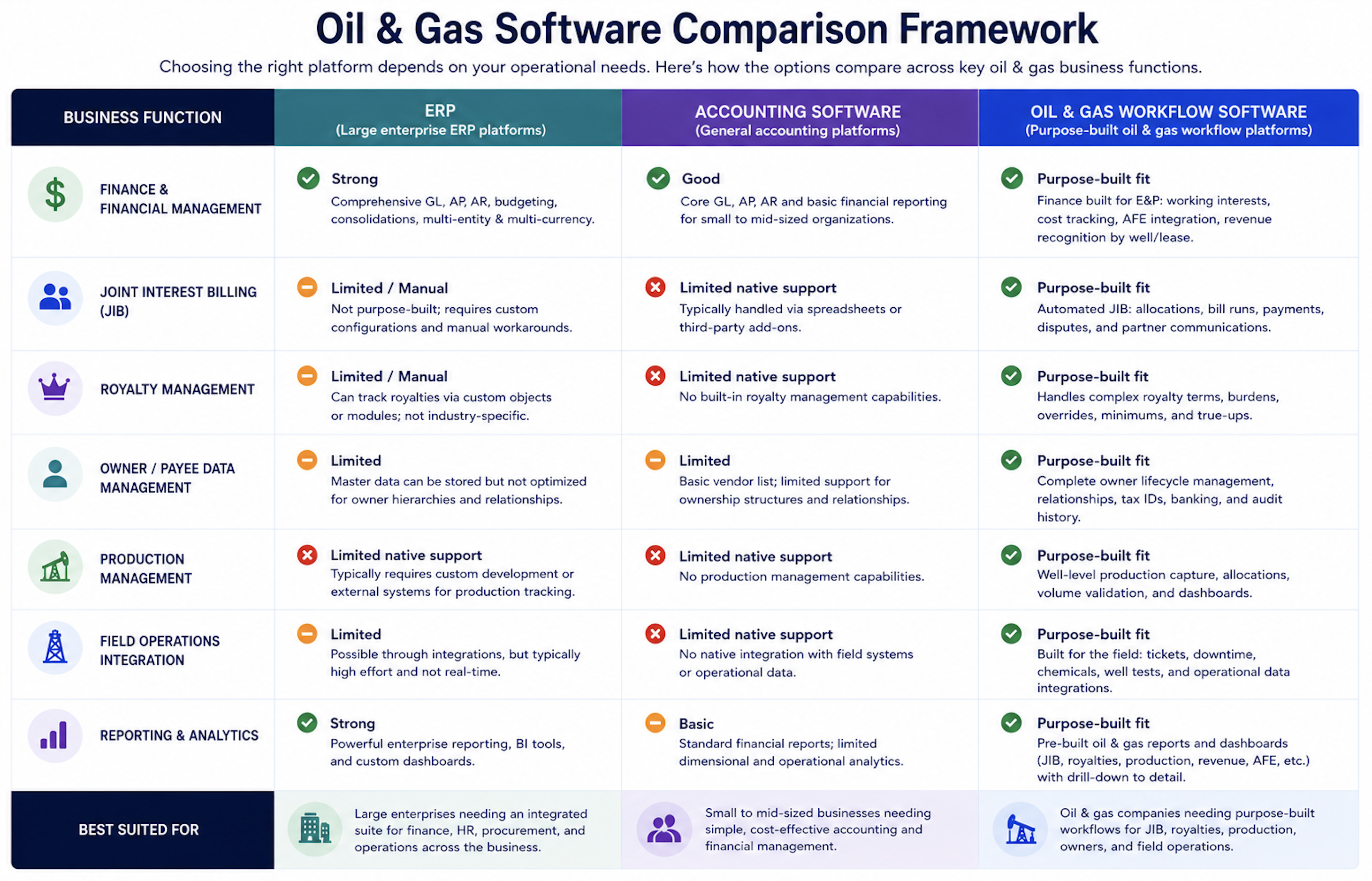
General accounting software can be highly useful for managing core finance processes. It efficiently handles vendor bills, accounts payable, accounts receivable, bank reconciliation, and standard financial reporting. For some small operators, that level of functionality may be completely enough at the beginning.
The limitation appears when oil and gas-specific workflows grow. JIB charges need working interest allocation. Royalty payments need owner decimals, division orders, suspense logic, and statements. Production reporting needs well or lease context. These are not always natural structures in general accounting systems. When industry work stays outside the system, teams often build parallel spreadsheets. That can work temporarily, but it creates fragmented records as the company grows. The accounting system may hold the transaction, while the operational logic behind the transaction sits somewhere else.
ERP Can Be Powerful but Heavy
ERP systems can offer broad coverage across finance, procurement, inventory, operations, projects, and reporting. For larger organizations, this wide scope creates strong operational standardization. For smaller operators, however, ERP often introduces implementation complexity that quickly exceeds team capacity.
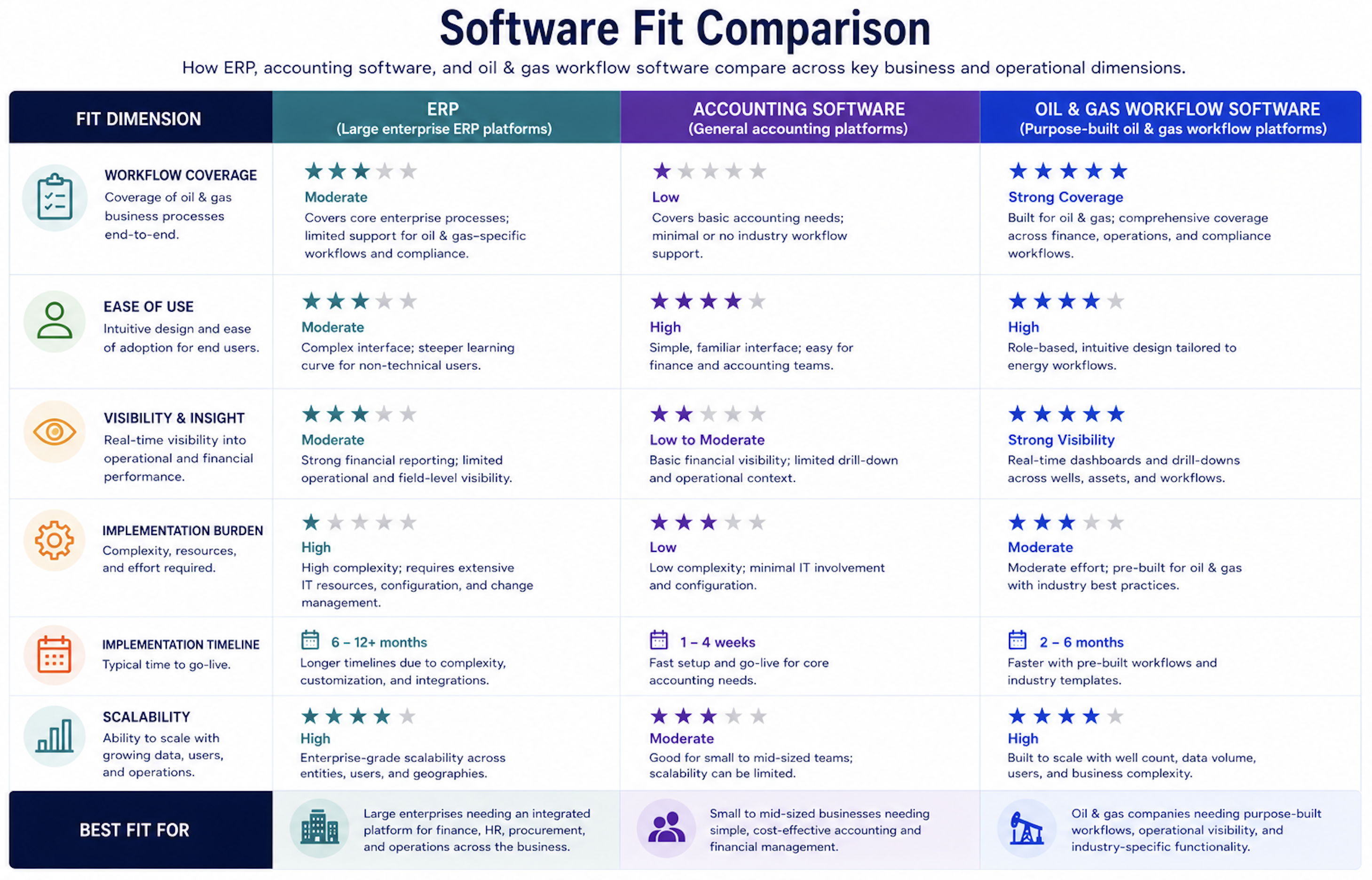
A practical comparison is: Software Fit = Workflow Coverage + Usability + Visibility − Implementation Burden. A large system may score high on coverage but also high on burden. A focused industry system may provide stronger practical fit if it solves the most painful workflows faster.
Operators should evaluate:
Implementation timeline
Data migration effort
Training burden
Customization needs
Internal administration requirements
Industry workflow coverage
Reporting flexibility
Post-go-live support
Industry-Specific Software Should Reduce Workarounds
Oil and gas workflow software should reduce the need for workarounds in high-value processes. It should understand wells, leases, owners, interest partners, division orders, JIB, royalty payments, production periods, and cost categories. These structures help teams work in the language of the business.
For example, a JIB workflow should not require the team to manually calculate partner allocation in Excel before entering results into accounting. A royalty workflow should not require owner decimals and payment holds to be tracked separately from statements. A production reporting workflow should not exist only as an exported file that finance sees weeks later.
Top-tier platforms do more than automate daily bookkeeping and transactions. True operational control happens when you bridge field operational records with real-time financial visibility. This unified data connection is where lean small operators capture the highest return on investment.
A Practical Scenario for Small Operators
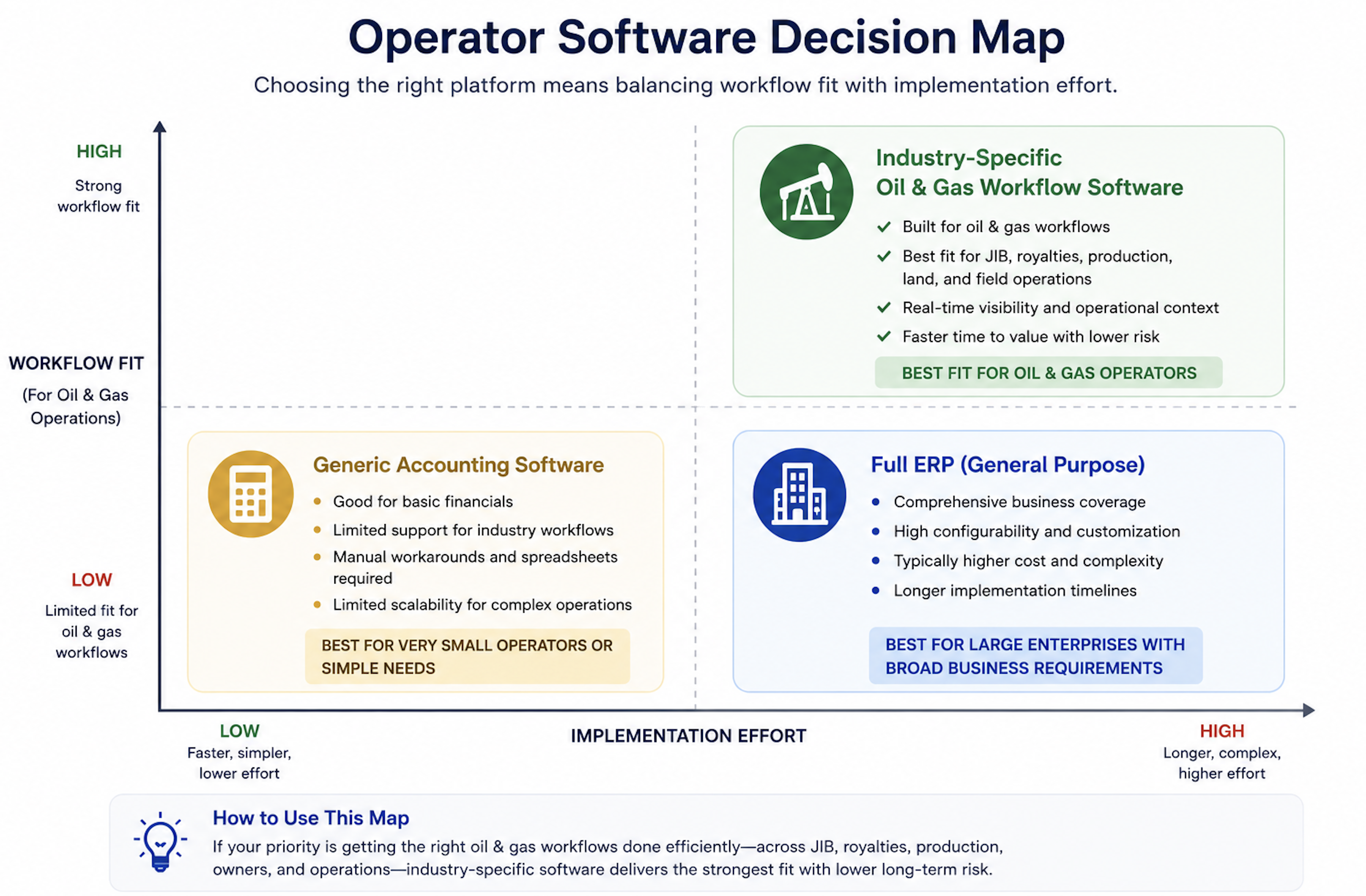
Consider a small operator with 35 wells, several working interest partners, monthly JIB activity, royalty payments, and basic production reporting needs. A generic accounting tool may manage vendor bills and financial statements, but JIB allocations, owner records, and production reporting may remain in spreadsheets. That creates risk as activity grows.
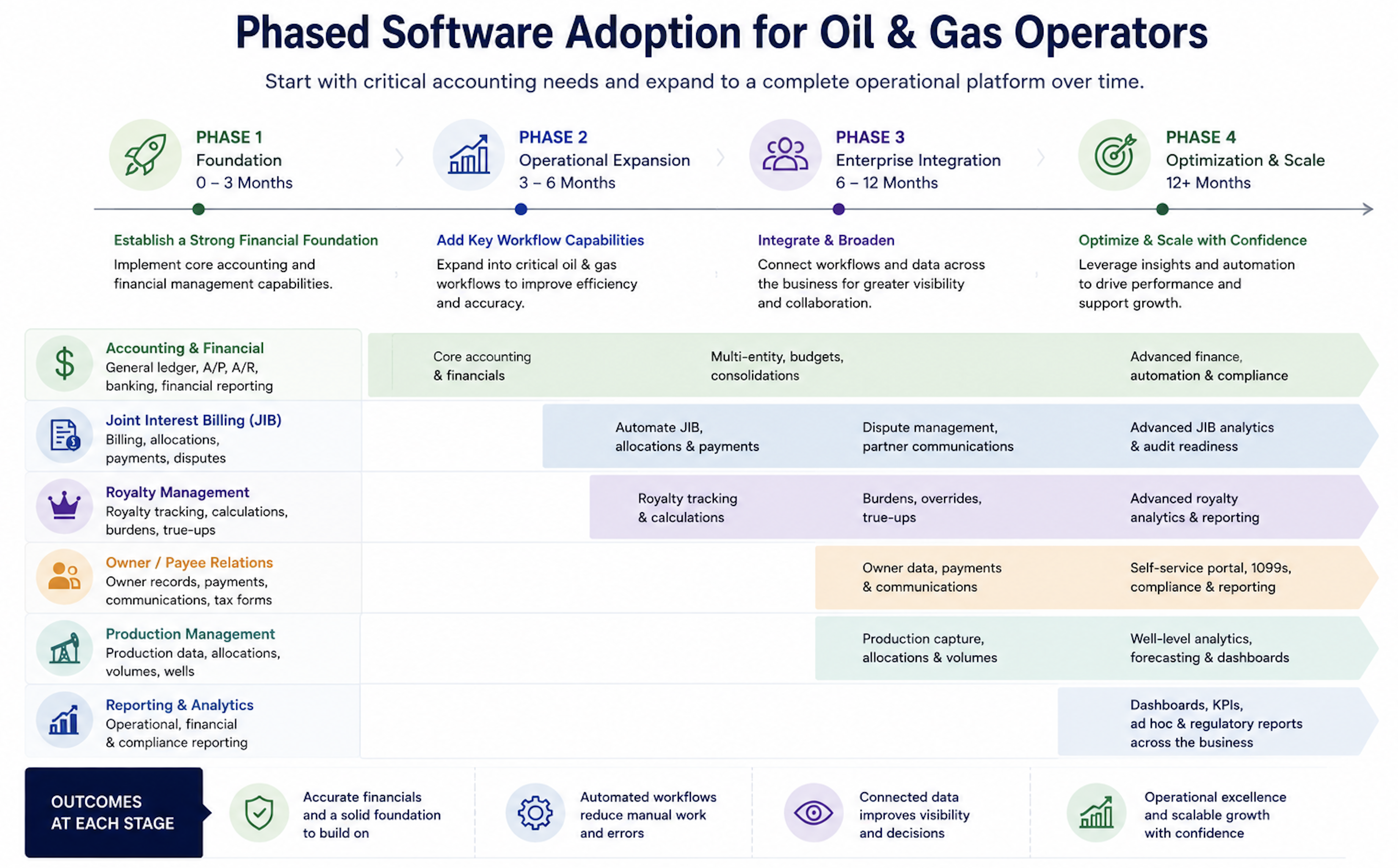
A full ERP may solve many issues, but it may also require a long rollout, extensive setup, and more internal administration than the team can support. A focused oil and gas workflow system may allow the operator to start with JIB, royalty, owner data, and reporting first. This phased approach can reduce implementation burden while improving the workflows that create the most monthly pressure.
The optimal approach to enterprise software procurement always hinges on an operator's specific size, immediate operational pain points, internal technical capacity, and long-term growth plans. Far too many growing oil and gas teams fall into the trap of purchasing expensive systems simply because they carry a prestigious ERP label. Success in the field is never defined by marketing buzzwords, but rather by how seamlessly a platform matches the real-world workflow automation your business demands today.
Questions to Ask Before Choosing
Small operators should ask vendors to show real workflows, not only screens. A software demo should show how a cost enters the system, how it connects to a well, how JIB or royalty records are created, how owner information is maintained, and how management reporting works. This makes selection more practical.
Useful questions include:
Does the system support JIB and royalty workflows directly?
Can records be organized by well, lease, owner, partner, and period?
Can production data connect to reporting?
How much configuration is required before go-live?
Can we start with priority workflows and expand later?
What support is available after implementation?
Which processes may still require Excel?
Asking these critical questions prevents lean management teams from investing in legacy systems that show beautifully in a structured software demo. True digital transformation must solve real-world operational silos, ensuring that high-risk daily activities are never left fragmented and disconnected.
How Petrofly Fits the Software Decision
Petrofly can support small and mid-sized oil and gas operators that need industry-specific workflows without starting with an overly heavy software environment. The fit is strongest when teams need connected JIB, royalty, owner relations, production, accounting-related workflows, and reporting visibility.
Petrofly can support the decision through:
Oil and gas workflow structure: Organize records around wells, leases, owners, partners, payments, and operating periods.
Modular rollout: Start with the workflows that matter most, then expand.
Cloud-based access: Support browser-based usage without heavy local installation.
Customer-specific configuration: Adjust fields, reports, dashboards, and workflows around actual operations.
Dedicated support: Assist with setup, training, workflow refinement, and post-go-live questions.
Choose by Workflow Fit, Not Category Label
Small oil and gas operators should compare ERP, accounting software, and industry-specific systems based on workflow fit, not software category alone. The right system should reduce spreadsheet work, support oil and gas data structures, and provide practical visibility without overwhelming the team.
For many operators, the best path is not choosing the largest platform. It is choosing a system that solves current pain points, supports phased adoption, and can grow as operational needs expand. Petrofly can support operators that want a more focused, configurable, cloud-based workflow foundation for daily operations.
When management teams are caught evaluating the pros and cons of traditional ERP versus generic accounting software, Petrofly steps in to anchor your procurement in operational reality. We empower operators to shift their evaluation from flashy software demos to a practical analysis of the specific oil and gas workflows that mitigate cost and financial risk.