
How Working Interest Owners Can Audit JIB Statements and Supporting Documents

Summary
×Audit Below the Total Due
For working interest owners, the total amount due on a JIB statement is only the starting point. A statement may look reasonable at the summary level while still containing line-item issues that affect cost allocation, ownership share, AFE exposure, or later reconciliation. The real audit work begins when the owner reviews how the amount was built and whether the supporting documents explain the charge clearly enough.
The basic line-item check is gross charge × working interest percentage. If a gross line item is $80,000 and the owner’s working interest is 12.5%, the expected owner share is $10,000. That confirms the math, but it does not confirm whether the gross charge is valid, whether the right ownership deck was applied, or whether the charge belongs to the correct well, AFE, or cost category.
A useful JIB audit should answer a few practical questions before payment is approved:
Does the charge belong to the correct well, lease, project, or operating period?
Was the owner billed using the correct working interest or participation basis?
Is the charge supported by invoices, field tickets, AFE references, or adjustment notes?
Does the cost type match the activity behind the charge?
Can the charge be explained later if management or the operator asks about it?
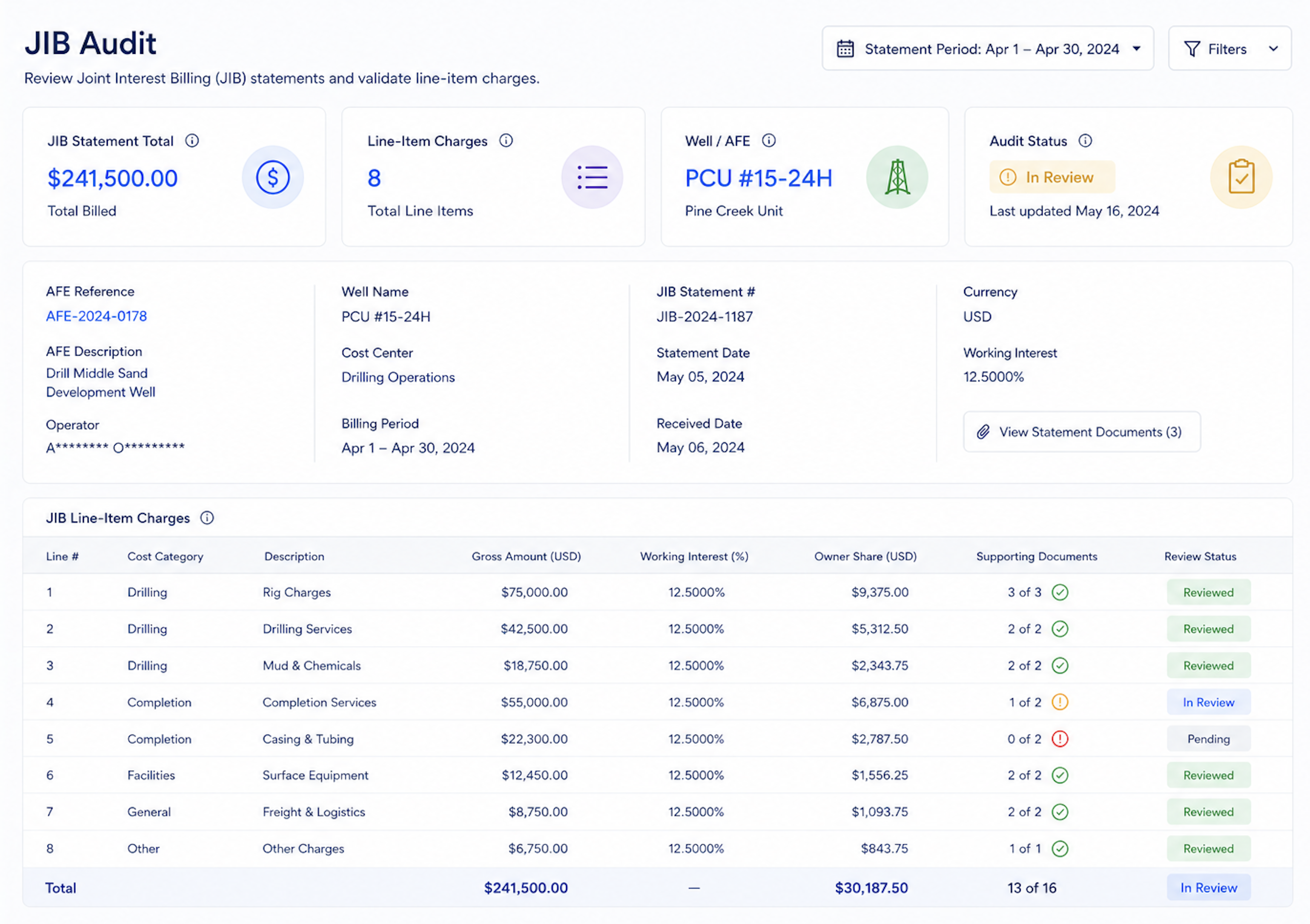
Check Business Accuracy, Not Just Math
A JIB statement can be mathematically correct and still require questions. The operator may calculate the owner share correctly, but the charge may be tied to the wrong well, wrong period, wrong cost category, or wrong participation group. This is why working interest owners should not limit the audit to percentage calculations.
For example, assume a compressor repair invoice is billed at $40,000 gross, and the owner’s working interest is 10%. The owner share of $4,000 may be calculated correctly, but the audit is incomplete until the owner confirms whether the repair belongs to a jointly owned well, whether it should be treated as LOE, whether the invoice date matches the billing period, and whether a work ticket explains the repair. A correct calculation based on the wrong business context can still create an incorrect billing result.
The same logic applies to asset assignment. A $24,000 roustabout invoice may include work across several wells. If the backup only shows the vendor name and invoice total, the owner cannot confirm whether the full amount belongs to one asset or should be allocated across multiple wells. In that case, the reviewer should ask for field ticket detail, work descriptions, location references, or allocation support.
Verify Ownership and Participation
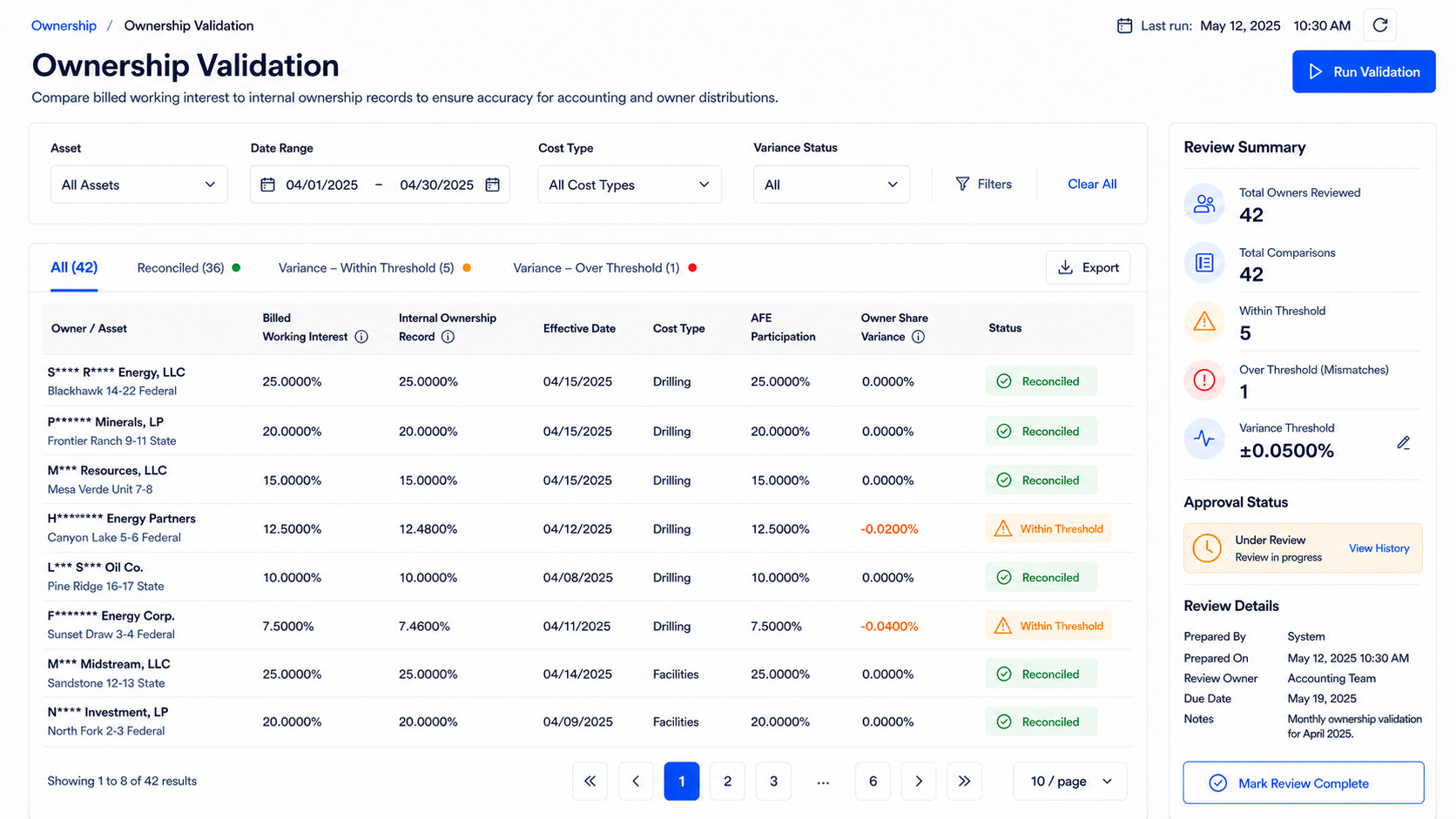
Ownership percentage is one of the easiest numbers to accept without enough review. A working interest owner may have different percentages across wells, projects, formations, units, or effective dates. The audit should confirm that the billed percentage matches the correct ownership basis for the specific charge.
The expected owner amount should be tested as gross charge × correct working interest percentage. If a gross charge is $120,000, the difference between 8% and 9% ownership is $1,200 on one line item. Across a full statement with operating and capital charges, that difference can become material.
Participation can also differ by activity. A working interest owner may participate in routine LOE but not in a specific workover, recompletion, or non-consent operation. If the charge relates to AFE-controlled activity, the reviewer should confirm whether the owner approved or elected into that project before accepting the billed share.
Key ownership checks include:
Does the billed percentage match the owner’s internal ownership record?
Does the effective date apply to the statement period?
Is the charge tied to an activity where the owner participated?
Does the billing deck differ between LOE, capital, workover, or AFE costs?
Are ownership changes reflected correctly in prior-period adjustments?
Tie AFE Costs Back to Approval
Capital and workover charges usually need a deeper audit than routine operating expenses. If a JIB line item relates to drilling, completion, recompletion, facility construction, or a major workover, the reviewer should connect the charge back to the approved AFE. The question is not only whether the cost was billed, but whether it fits the approved scope, budget, and participation record.
A useful AFE review compares cumulative billed cost with expected AFE exposure. The owner’s expected exposure is approved gross AFE × working interest percentage. If the approved gross AFE is $1,500,000 and the owner’s working interest is 10%, the expected exposure is $150,000.
If cumulative JIB charges for that AFE reach $138,000, the project may still be within expected exposure. If they reach $172,000, the owner should not treat the variance as routine without support. The excess may be valid, but it should be tied to a revised AFE, scope change, cost overrun explanation, or timing difference.
Before approving AFE-related JIB charges, the owner should check:
Does the line item reference the correct AFE?
Does the cost fit the approved project scope?
Are cumulative billed charges still within expected exposure?
If charges exceed exposure, is there a revised AFE or overrun explanation?
Does the backup show what work was performed and when?
Review Supporting Documents for Audit Value
Supporting documents should do more than prove that an invoice exists. They should help the owner understand what was done, where it was done, when it was done, and why the charge belongs on the JIB statement. A PDF invoice without asset detail may not be enough for a meaningful audit.
For example, an invoice labeled “equipment rental” may require more explanation. The owner may need to know whether the equipment was used for drilling, completion, routine maintenance, water handling, or a workover. The same vendor description can lead to different accounting treatment depending on the operating context.
Good supporting documentation usually includes:
Vendor invoice with amount and service date
Field ticket or work order showing location and work performed
Well, lease, or project reference
AFE number when applicable
Cost category or account coding
Explanation for unusual, high-value, or prior-period charges
Missing support does not always mean the charge is wrong, but it should change the review status. The owner may approve with a note, request backup before payment, or hold the disputed portion depending on materiality and company policy. The important point is that the decision should be recorded so the same question does not reappear during later reconciliation.
Review Adjustments, Credits, and Cash Calls
Prior-period adjustments, reversals, credits, and rebills can be difficult to audit because they affect the current statement while relating to earlier activity. A useful adjustment review compares the revised charge with the original charge. If an owner was originally billed $12,000 and a later statement reverses $12,000 but rebills $9,500, the net correction is a $2,500 credit.
The reviewer should confirm whether that credit appears in the owner balance and whether the reason is documented. Adjustments should explain what changed, why it changed, which period was affected, and whether the correction relates to ownership, cost classification, wrong asset assignment, or vendor credit. A credit may reduce the balance, but it should still be traceable.
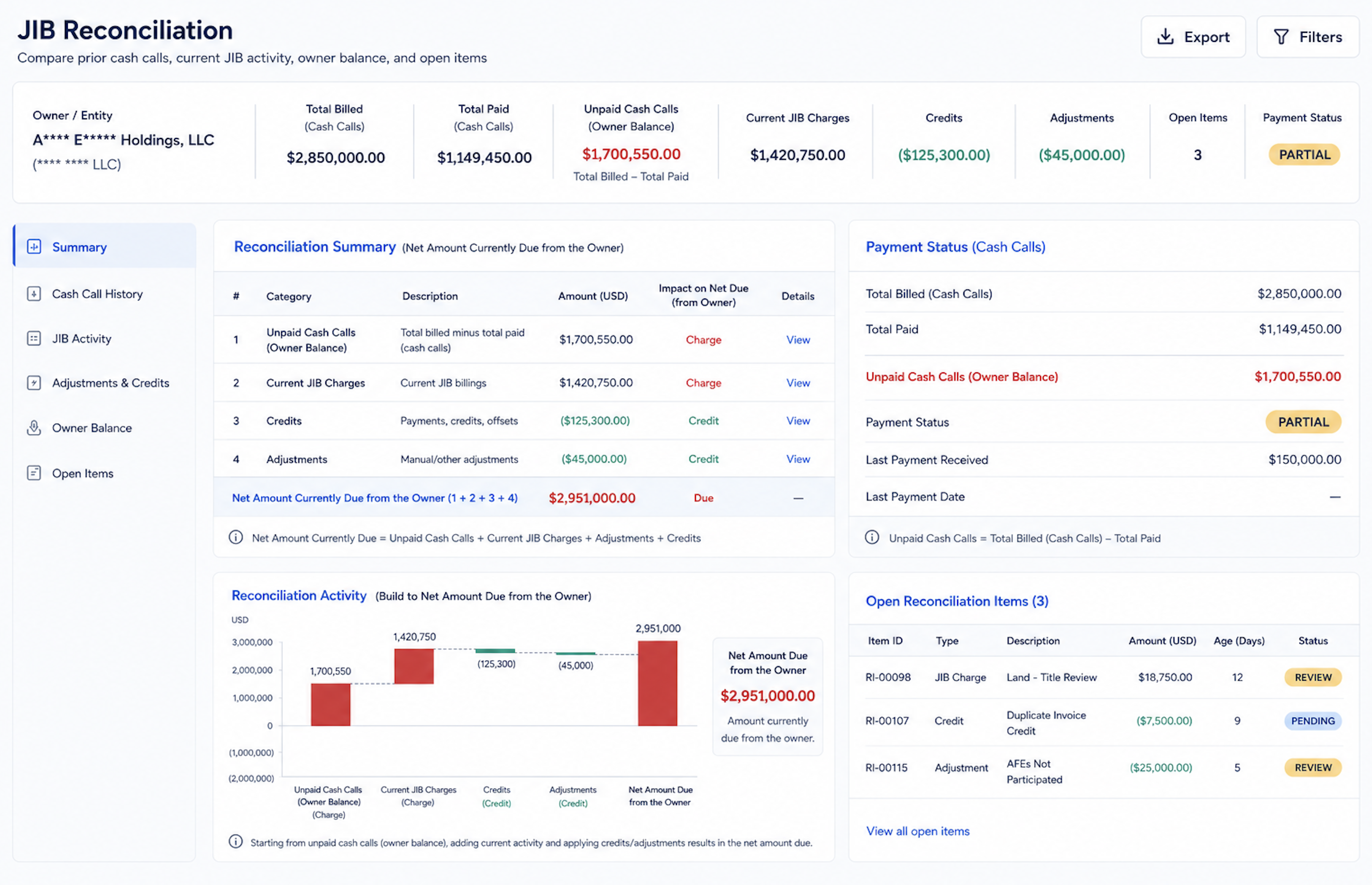
Working interest owners should also compare JIB charges with earlier cash calls and payments. If the owner paid $100,000 in cash calls and later receives $92,000 in related JIB charges, the $8,000 difference may represent a prepaid balance, timing difference, future billing item, or unreconciled amount. The JIB should not be reviewed in isolation when prior funding has already been sent.
Use Materiality and Ask Clear Questions
Not every JIB line item needs the same level of review. A small recurring utility charge may not need the same attention as a six-figure workover charge, an ownership adjustment, or an AFE overrun. Working interest owners should define materiality rules so the audit process is consistent and practical.
A practical JIB audit policy may classify items as:
Routine: supported, expected, and within normal range
Needs note: minor variance or incomplete but low-risk support
Needs backup: missing invoice, ticket, AFE, or explanation
Needs clarification: amount, ownership, classification, or timing does not match expectations
Disputed or held: material issue unresolved before payment
When a charge needs clarification, the question should be specific. Instead of asking the operator to “explain this charge,” a stronger note might say that a $36,000 gross workover charge was billed at 10% working interest, but the owner’s internal record shows 8% participation for that AFE before the service period. That gives the operator a clear issue to review and gives the owner a record of why the item was questioned.
How a Connected Workflow Helps
Software can help. Here’s how Petrofly does it. JIB audit becomes difficult when statements, invoices, ownership records, AFE files, cash call history, payment notes, and operator emails are managed in different places. Petrofly supports this process by bringing those records into one connected oil and gas workflow, so working interest owners can review charges with more context and less manual reconstruction.
For JIB statement review, Petrofly can help teams:
Link JIB items to all related records in one system.
Review charges, interests, shares, adjustments, credits, balances - no spreadsheets.
Keep support documents, operator notes, internal comments, and review decisions attached to the relevant statement or line item.
Flag charges, ownership, AFE, variances, adjustments, disputes for follow-up.
Compare JIB charges to prior cash calls, payments, credits, and balances to simplify reconciliation.
Configure audit fields, review steps, approval status, dispute categories, and reports to fit each customer’s JIB review process.
Support cloud access with no download, so all teams review the same records.
Provide a simple user experience for checking statements, attaching backup, updating status, and reviewing reports without complexity.
Responsive support for setup, reports, workflow, and daily queries.
The practical value is that JIB statements, backup documents, ownership percentages, AFE context, cash calls, payments, review comments, and dispute status can be handled within one system. For working interest owners, this reduces time spent searching across disconnected records and makes the audit easier to control, explain, and maintain as the number of assets, operators, and monthly statements grows.
Test the Audit Before Payment
A strong JIB audit process should be tested with real statements. The team should take a recent JIB package and see whether it can trace material charges from statement line item to supporting document, ownership share, AFE record, prior payment, adjustment history, and final payment decision. If that review requires searching multiple inboxes, folders, spreadsheets, and accounting exports, the process is probably carrying unnecessary risk.
Useful test questions include:
Can the team identify which well, lease, project, or AFE each material charge belongs to?
Can the owner share be recalculated from gross amount and working interest percentage?
Can the correct ownership basis and effective date be confirmed?
Can AFE-related charges be compared with approved exposure and cumulative billed cost?
Can supporting documents explain what was done, where it was done, and when it was done?
Can adjustments and credits be traced back to the original charge?
Can JIB charges be compared with prior cash calls and payments?
Can disputed items be tracked until they are resolved, credited, rebilled, or approved?
JIB audit is not about challenging every charge. It is about knowing which charges are supported, which items need explanation, and which variances matter before payment is released. When the audit trail is clear, working interest owners can pay with more confidence and handle operator questions with better records.
To discuss how Petrofly can support a more controlled JIB audit workflow, contact our team for a focused conversation. Try these audit steps in a free Petrofly demo. Exploring this integrated digital platform firsthand provides non-operating partners and accounting professionals with a practical approach to structured variance analysis, helping teams streamline communication and maintain reliable financial alignment across shared upstream assets.