
JIB Disputes in Oil and Gas: How Non-Operators Can Track Questions Before Payment

Summary
×Disputes Usually Start as Questions
For non-operators, a JIB dispute rarely begins as a formal disagreement. It usually starts as a question about a line item, an ownership percentage, an AFE reference, a missing invoice, or a prior-period adjustment that affects the current balance. If these questions are not tracked clearly before payment, they can quickly turn into repeated emails, delayed approvals, partial payments, and unresolved balances.
The first step is to separate a question from a dispute. A question asks for context, such as why compressor repair costs increased this month or why a workover cost appeared later than expected. A dispute is stronger: it means the non-operator believes a charge may be unsupported, misallocated, incorrectly calculated, outside participation, or not ready for payment.
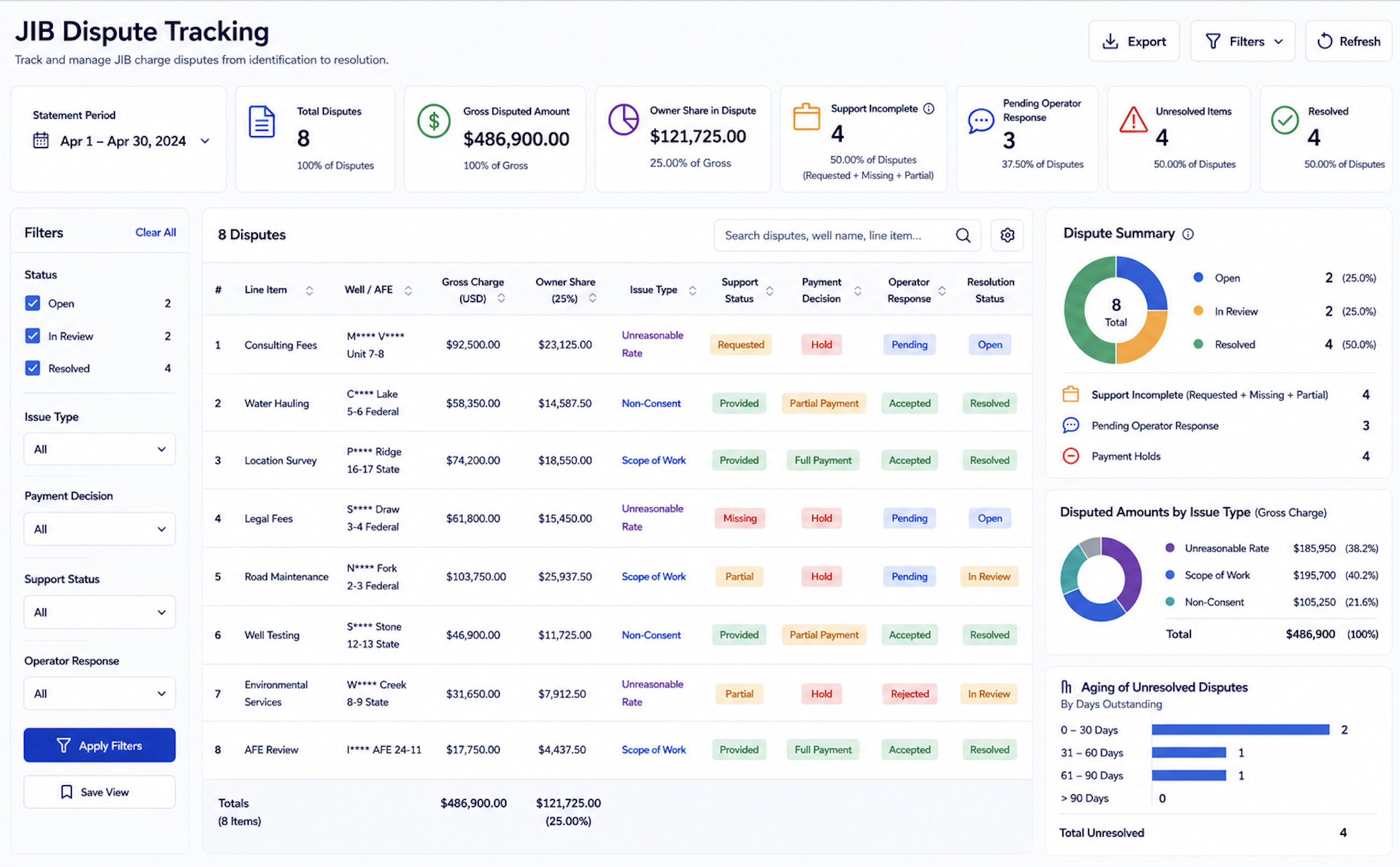
A basic dispute tracker should capture:
Statement period and statement number
Well, lease, project, or AFE reference
Line-item description and gross amount
Billed owner share and expected owner share
Question or dispute reason
Supporting documents requested or received
Payment decision: pay, hold, partially pay, or approve with note
Operator response and resolution status
Confirm the Amount at Risk
Before deciding how to handle a JIB question, the non-operator should confirm the amount at risk. The gross line-item amount may look large, but the owner’s actual exposure depends on working interest percentage and participation basis. A dispute should be evaluated based on billed owner share and variance, not only gross charge.
A simple exposure check is gross charge × correct working interest percentage. If a workover charge is $90,000 gross and the owner’s correct participation is 8%, the expected owner share is $7,200. If the statement bills the owner at 10%, the billed share becomes $9,000, creating a $1,800 variance.
That variance should be recorded as the disputed amount. Instead of writing “ownership looks wrong,” the reviewer can state that the billed share appears $1,800 higher because the statement used 10% instead of the expected 8% participation. This gives the operator a clearer issue to review and helps the non-operator decide whether to hold the full line item, hold only the disputed portion, or pay with a note.
Classify the Dispute Type
JIB questions become harder to manage when they stay as loose email threads. Once questions are grouped by category, the team can see whether issues are mainly related to ownership, missing backup, AFE variance, cost classification, prior-period adjustments, or cash call reconciliation. Classification is not about adding complexity; it helps each issue move into the right review path.
Common dispute categories include:
Missing invoice, field ticket, or work order
Wrong well, lease, or project assignment
Incorrect working interest percentage
AFE-related charge exceeding expected exposure
LOE vs. capital or workover classification issue
Prior-period adjustment without explanation
Credit, reversal, or rebill not flowing into the balance correctly
Cash call payment not reflected against related JIB charges
Charge tied to an activity where the owner did not participate
For example, a $45,000 gross roustabout invoice may not be questioned because the work never happened. The real issue may be that the backup does not show which wells received the service. That is a documentation and allocation question, not necessarily a cost validity question.
Tie Every Question to a Line Item
One common problem is that non-operators raise questions at the statement level instead of the line-item level. Saying “the March JIB needs review” does not give the operator enough information to act. Without line-item detail, the issue becomes harder to resolve and easier to lose before the next statement arrives.
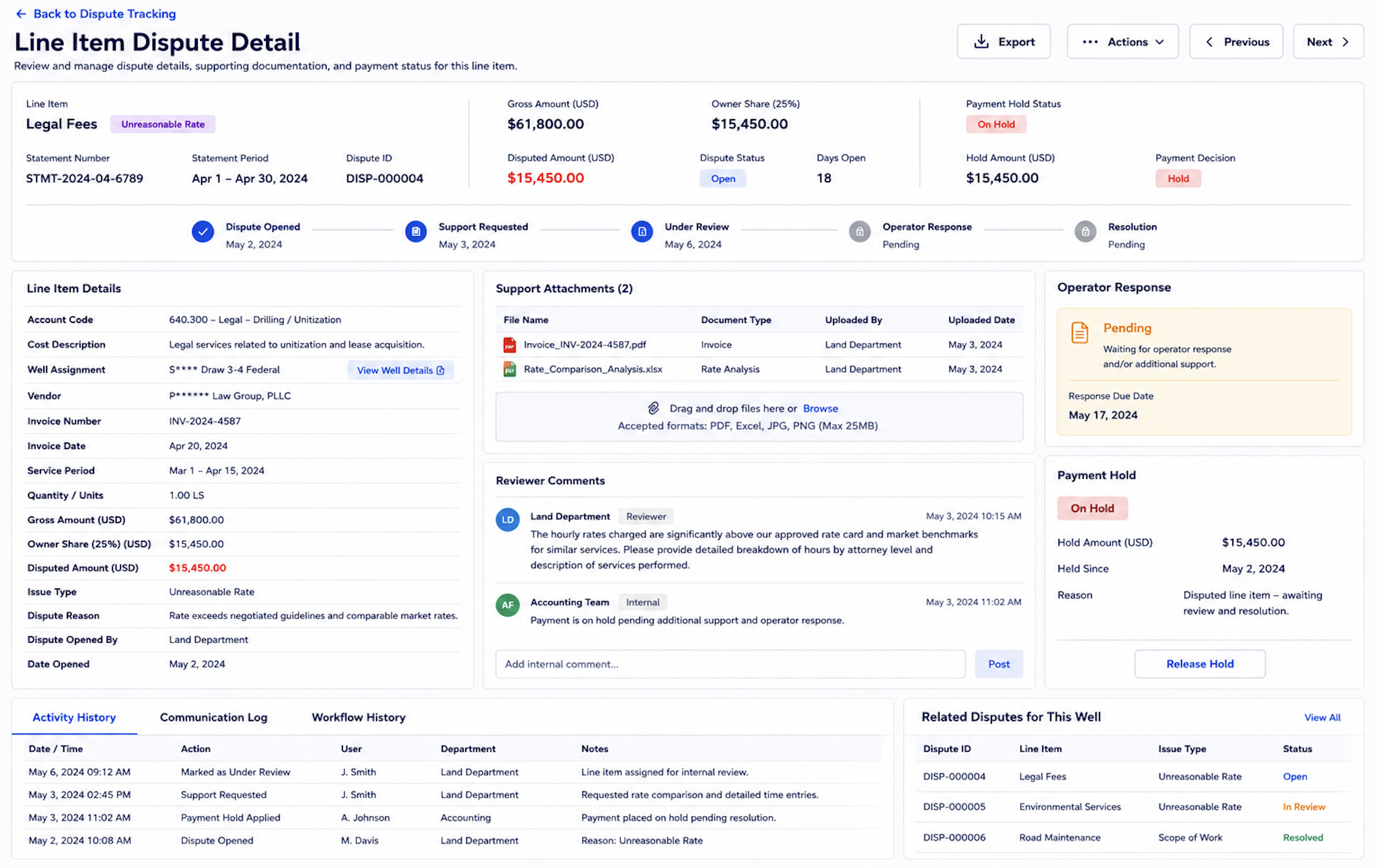
Each question should point to a specific charge. The record should include statement period, line item or account code, cost description, gross amount, owner share, well or project reference, and question reason. This turns the review from a broad complaint into a specific request the operator can answer.
A stronger question might say: The April statement includes a $36,000 gross equipment rental charge for Well A, but the invoice backup shows service dates for Well B. This gives the operator a clear path: confirm the asset, correct the allocation, or provide additional support. It also gives the non-operator a clear record of why the item was questioned before payment.
Separate Support Gaps From Billing Errors
Not every missing document means the charge is wrong. A vendor invoice may be valid, but the operator may not have included enough backup in the JIB package. Non-operators need to separate support gaps from true billing errors, otherwise they may either delay payment unnecessarily or overlook real exposure.
A support gap means the reviewer needs more information before completing the review. Examples include a missing invoice, unclear field ticket, incomplete service description, or backup that does not show the well, location, or work performed. A billing error is more serious and may involve the wrong ownership percentage, wrong asset assignment, duplicate billing, incorrect cost classification, or a charge applied to a non-participating owner.
This distinction affects the payment decision. A low-dollar routine item with a support gap may be paid with a note while backup is requested. A material billing error should usually be held or partially paid until the operator provides a correction or clear explanation. Implementing this tiered risk-mitigation logic allows joint venture accounting teams to balance operational momentum with fiscal discipline, reducing exposure to substantial capital overpayments while facilitating steady vendor relationships.
Use Materiality Before Holding Payment
Non-operators should not handle every question the same way. Holding payment on a small routine charge may create unnecessary friction, while paying a large unsupported capital charge may create real financial exposure. Materiality helps the team decide when a note is enough, when backup should be requested, and when an item should be held or escalated.
For example, if the owner’s internal records show an expected owner share of $18,000 but the statement bills $22,500, the $4,500 difference should be recorded as the disputed amount. Depending on the operating agreement and internal policy, the owner may pay the undisputed $18,000 and hold the $4,500 until the operator responds.
A practical handling policy may include:
Low-risk item: support is mostly complete and payment can proceed with a note
Documentation gap: backup should be requested and response date tracked
Ownership mismatch: expected share should be recalculated and the disputed difference held
Material variance: payment should be held or escalated until explained
Unsupported AFE overrun: revised AFE, cost explanation, or payment instruction should be requested
Repeated issue: escalation may be needed even if each individual amount is small
Treat Operator Responses as Evidence
A dispute is not resolved simply because the operator replies. The response must answer the specific question and provide enough support for the non-operator to decide whether the item can be paid, adjusted, credited, rebilled, or kept open. A vague response may reduce pressure temporarily, but it can create problems later during reconciliation or audit review.
For example, when the owner questions an ownership percentage, a response that says “charge is correct” is usually not enough. A stronger response would explain whether the ownership deck changed, when the effective date began, how the participation basis was determined, and whether the billing will remain as issued or be adjusted on a future statement.
Response tracking should show:
Question sent date
Operator contact or responsible party
Response date
Explanation received
Supporting documents received
Decision after response
Credit, rebill, adjustment, or no-change outcome
Remaining open action
The key value is preserving the decision trail. Months later, if accounting, management, or another reviewer asks why a charge was paid or held, the team should be able to find the explanation without searching through old email threads. Archiving these localized administrative annotations directly within the transaction ledger significantly enhances institutional memory, providing a reliable reference architecture that simplifies future internal reviews and external cost audits.
Review Cash Calls and JIB Disputes Together
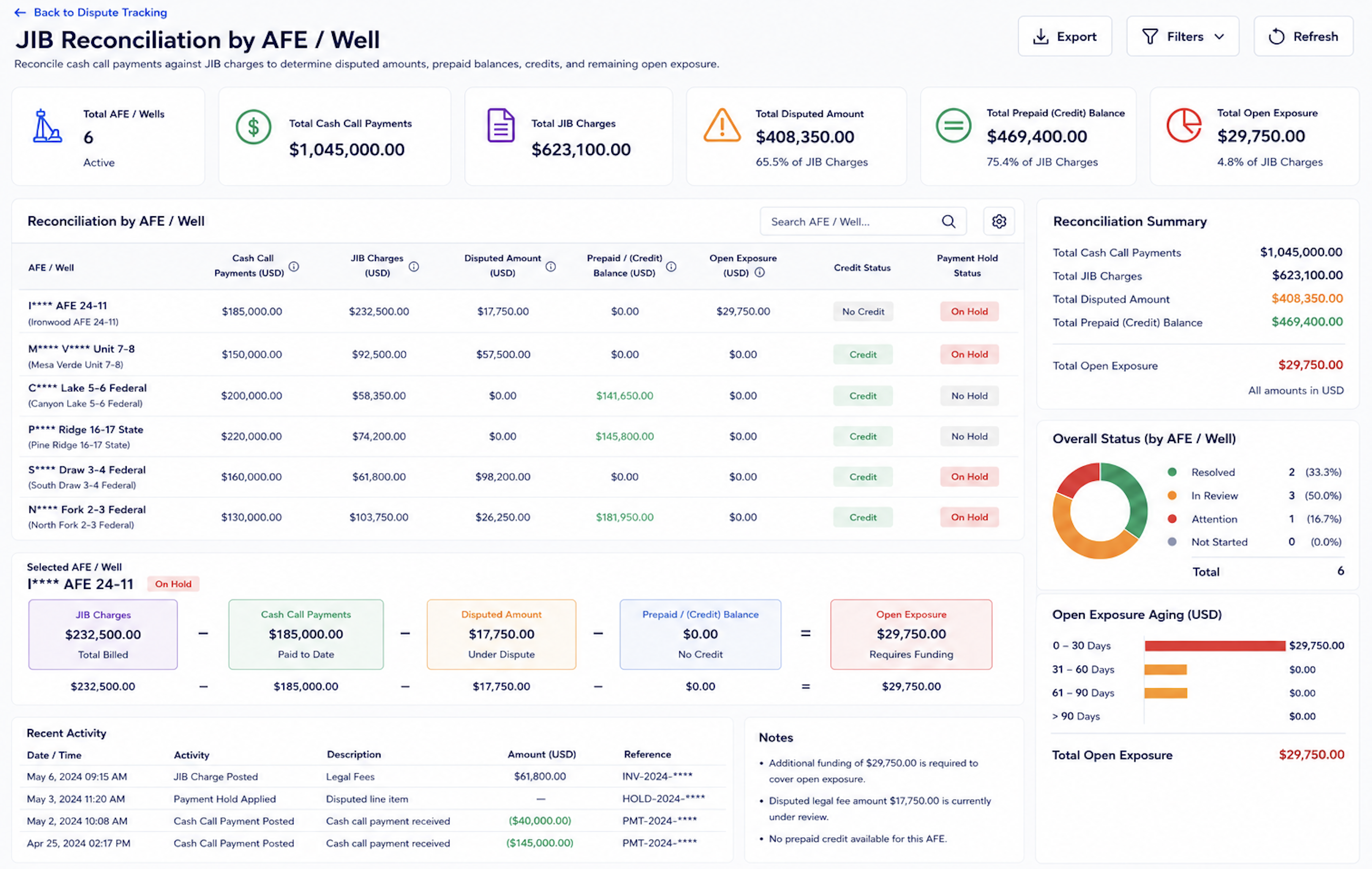
Cash calls can make JIB dispute tracking more complicated because the non-operator may have already funded part of the project before the JIB statement arrives. If the later JIB charge appears unsupported, misallocated, or higher than expected, the question is not only whether to pay the current statement. The team also needs to understand how prior funding has been applied.
A useful comparison is prior cash calls paid minus related JIB charges applied. If the owner has already paid $100,000 in cash calls and related JIB charges currently total $84,000, there is a $16,000 difference. That difference may represent a prepaid balance, timing difference, or unreconciled funding.
If the next JIB includes a disputed $20,000 owner share for the same AFE, the owner needs to know whether the charge is new exposure, use of prior funding, or an amount that should already be covered. This matters because a JIB dispute can be hidden by prior funding. The owner may not need to send more money immediately, but the charge can still affect project exposure, prepaid balance, future credit treatment, or management reporting.
Build a Reviewable Dispute Record
The purpose of JIB dispute tracking is not simply to record that a question was asked. It is to make each question reviewable, explainable, and closeable. A strong dispute record should show which line item was questioned, why it was questioned, how much money was affected, how the operator responded, what payment decision was made, and whether a credit, rebill, adjustment, or follow-up action is still needed.
This matters more than saving emails alone. Emails may show that someone asked a question, but they do not always show which charge was affected, what the disputed amount was, whether the issue was resolved, or whether the current balance is still impacted. For non-operators, the value comes from keeping the question, support, decision, and resolution in the same record.
A clear dispute record should answer:
Which charge was questioned?
Why was it questioned?
What is the disputed amount?
Which supporting documents were received?
What explanation did the operator provide?
Was the payment decision pay, hold, partial pay, or approve with note?
Does the item require a credit, rebill, adjustment, or continued follow-up?
When these details are complete, non-operators can pay undisputed charges with more confidence and prevent unresolved items from disappearing into the next billing cycle. More importantly, the team can turn dispute handling from email-based communication into a reviewable financial control process.
How a Connected Workflow Helps
Software can help. Here’s how Petrofly does it. JIB dispute tracking becomes inefficient when statements, supporting documents, ownership records, AFE details, cash calls, payment notes, and operator responses are managed in different places. Petrofly brings these records into one connected oil and gas workflow so non-operators can track questions before payment with clearer context and less manual reconstruction.
For JIB dispute tracking, Petrofly can help teams:
Link disputed items to all related records in one system.
Track amounts, variances, decisions, and status without spreadsheets.
Attach all documents, notes, approvals, and actions to the dispute.
Flag key issues: backup, ownership, AFE, cost, cash call, adjustments.
View disputes by operator, period, amount, type, and status.
Tailor dispute fields, steps, reports, and labels to each workflow.
Support cloud access with no download, so all teams work from the same record.
Provide a simple user experience for updating status, attaching support, reviewing open items, and generating reports without complexity.
Offer responsive post-launch support for workflow setup, reporting, configuration changes, and daily review questions.
The practical value is that dispute tracking no longer depends on scattered emails and separate files. JIB statements, line-item questions, backup documents, ownership percentages, AFE context, cash calls, payments, operator responses, and resolution status can be handled within one system. For non-operators, this makes it easier to decide what can be paid, what should be held, and what still needs operator follow-up.
To discuss how Petrofly can support a more controlled JIB dispute tracking workflow, contact our team for a focused conversation. Try these dispute tracking steps in a free Petrofly demo. Evaluating these integrated functional capabilities firsthand offers joint venture operators a practical methodology to modernize audit tracking, align multi-party communication, and strengthen overall cost containment strategies across their development portfolios.