
Oil and Gas Accounting Software for Non-Operators: What Working Interest Owners Should Look For

Summary
×Non-Operators Need More Than Basic Bookkeeping
For working interest owners, oil and gas accounting is not only about recording payments and expenses. The more important challenge is understanding whether each charge is correctly allocated, properly supported, tied to the right asset, and consistent with ownership participation. A non-operator may not control the field activity, but it still needs enough visibility to review JIB statements, cash calls, AFE costs, credits, adjustments, and payment status with confidence.
Basic bookkeeping can record that money was paid, but it may not explain why the payment was needed or how it connects to a well, lease, operator, AFE, or prior cash call. This is where non-operators often run into friction. A statement arrives, the total amount is entered, and the payment is processed, but the supporting business trail is left in emails, PDFs, spreadsheets, or separate folders.
A stronger software setup should help answer practical questions before payment. Which well does the charge belong to? Which operator issued the statement? Was the owner billed at the correct working interest percentage? Has the owner already funded part of the same project through a cash call? Is the charge routine LOE, capital, workover, or AFE-related? If those questions cannot be answered from one reviewable record, the accounting process is still carrying avoidable risk.
JIB Review Should Be Line-Item Based
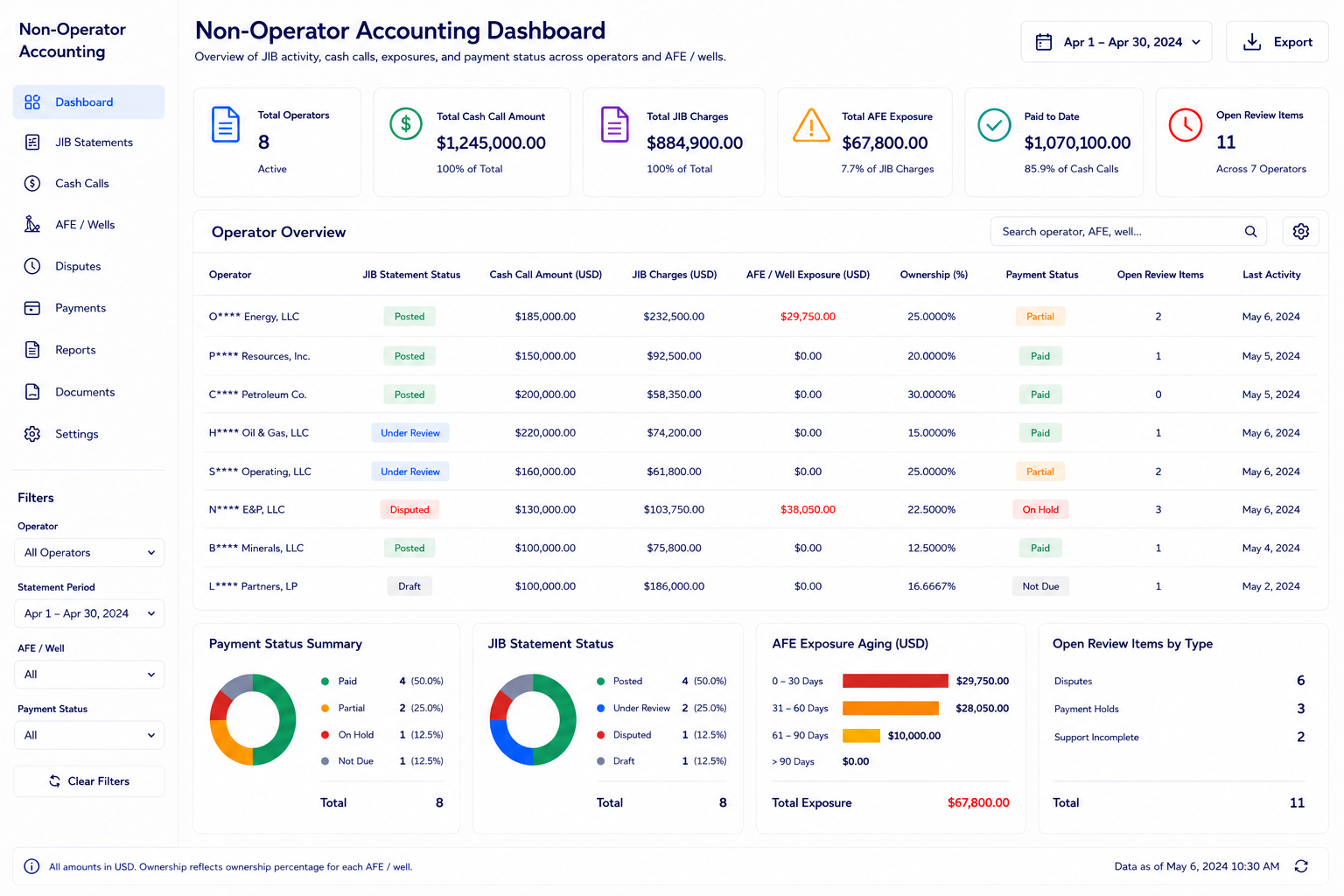
A useful oil and gas accounting system should help non-operators review JIB statements below the total amount due. The statement total may look reasonable, but individual charges may still require review because of asset assignment, ownership percentage, cost category, missing support, or prior-period adjustments. Non-operators need a system that can track those line-item questions before the payment decision is made.
The basic calculation is gross charge × working interest percentage. If a gross charge is $80,000 and the owner has a 12.5% working interest, the expected owner share is $10,000. That confirms the math, but it does not prove that the charge belongs to the right well, that the correct ownership deck was used, or that the cost should be billed under that activity.
The software should make it easy to connect each JIB line item to the related well, lease, project, AFE, invoice, field ticket, operator explanation, and payment decision. Without that connection, reviewers may spend more time searching for backup than actually evaluating the charge. For a non-operator with multiple operators or assets, that search time can quickly become a recurring monthly problem.
Cash Calls Need Exposure Tracking
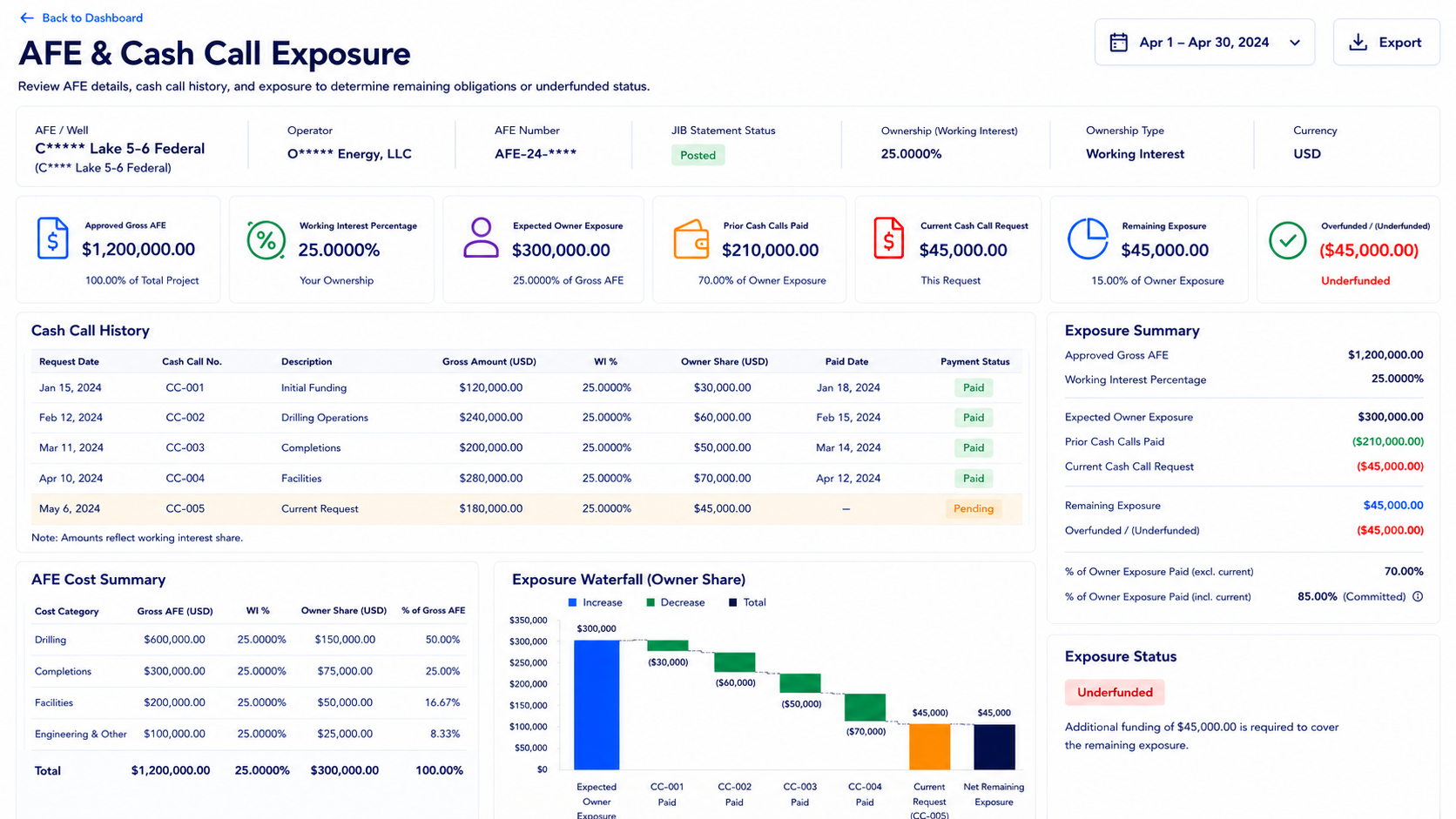
Cash calls are another area where non-operators need more than payment recording. A cash call is often a funding request based on expected spending, while the final costs may appear later through JIB statements. If the accounting system does not connect cash calls with AFE exposure, prior payments, and later JIB charges, the owner may lose track of whether it is underfunded, overfunded, or waiting for reconciliation.
A practical review starts with approved gross AFE × working interest percentage. If an approved AFE is $1,200,000 and the owner has a 10% working interest, the expected exposure is $120,000. If the owner has already paid $90,000 in cash calls and receives another request for $40,000, total funding would become $130,000, which is $10,000 above the original expected exposure.
That does not automatically mean the request is wrong. There may be a scope change, timing difference, service cost increase, or revised AFE. But the system should make that variance visible before payment, not after the next statement arrives. Good software should help non-operators see prior cash calls, current requests, expected exposure, remaining balance, and later JIB reconciliation in one place.
Ownership Data Must Be Easy to Validate
Working interest percentages can change by well, lease, unit, project, effective date, or participation election. A non-operator may have one percentage for routine LOE, another for a workover, and a different participation basis for a specific AFE. If ownership data is stored separately from accounting records, small errors can repeat across statements.
For example, if a gross charge is $300,000, the difference between 8% and 9% working interest is $3,000 on one charge. Across several months, multiple wells, or capital activity, the impact becomes material. Non-operators should not have to rely on memory or scattered spreadsheets to confirm whether the billed percentage is correct.
The software should support ownership validation by asset, project, cost type, and effective period. It should also make ownership differences visible when reviewing JIB charges, cash calls, adjustments, and payments. This matters because a charge can be mathematically correct and still be wrong if it is calculated against the wrong ownership basis.
Supporting Documents Should Stay Attached to the Record
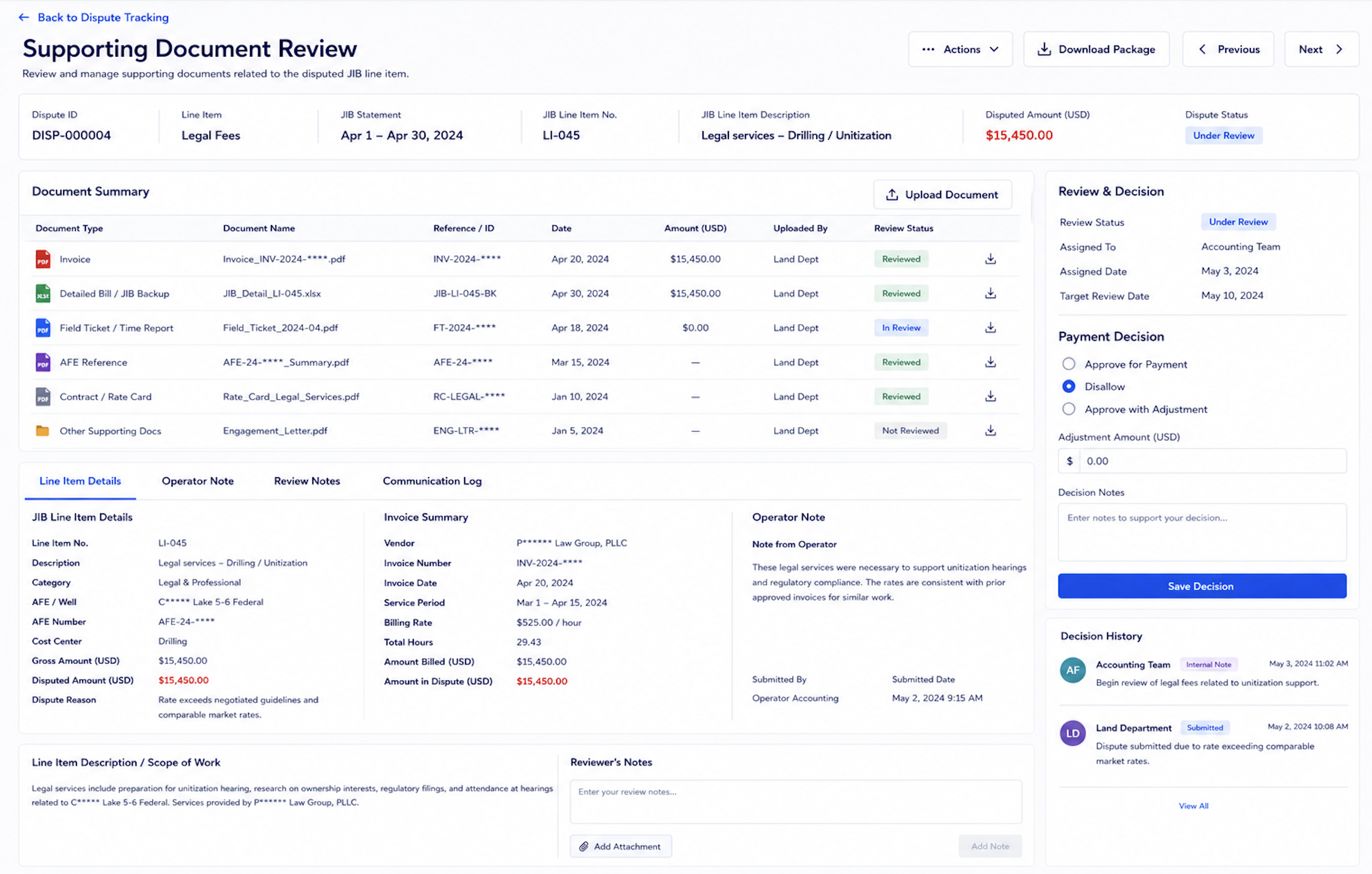
Non-operators often need supporting documents to understand whether a charge is reasonable. A vendor invoice may show the amount, but it may not explain where the work happened, which well was affected, or whether the cost belongs to LOE, capital, workover, or AFE activity. Field tickets, work orders, AFE references, operator comments, and adjustment notes can be just as important as the invoice itself.
A strong accounting workflow should keep supporting documents attached to the related JIB line item, cash call, AFE, adjustment, or payment record. This reduces the need to search through email threads when a question appears. It also helps preserve the review trail for future reconciliation or management reporting.
Missing support does not always mean a charge is wrong, but it should change the review status. The team may approve with a note, request backup, hold a disputed portion, or wait for operator clarification. The system should make that status visible so unresolved questions do not disappear after payment.
Reporting Should Connect Costs, Payments, and Exposure
Non-operators need reports that do more than summarize expenses. A useful report should show what has been billed, what has been paid, what remains open, which items are disputed, which costs are tied to AFEs, and whether cash calls have been reconciled against later JIB charges. This is especially important when owners need to explain exposure to management, investors, or accounting teams.
A practical monthly view should show JIB charges by operator, well, cost category, and review status. It should also show cash calls paid, AFE exposure remaining, credits, adjustments, open balances, and payment decisions. When these items are reported separately, the owner may understand each piece but still miss the full financial position.
The software should also help identify patterns. If one operator repeatedly sends missing support, if one well shows rising LOE, or if AFE charges are consistently approaching exposure limits, the team should see that trend without rebuilding reports manually. For non-operators, better reporting means fewer surprises and stronger control over monthly review.
How a Connected Workflow Helps
Software can help. Here’s how Petrofly does it. Non-operator accounting becomes difficult when JIB statements, cash calls, AFE files, ownership records, payments, supporting documents, and operator emails are managed in different places. Petrofly brings these records into one connected oil and gas workflow so working interest owners can review financial activity with clearer context and less manual reconstruction.
For non-operator accounting review, Petrofly can help teams:
One system for JIB, AFEs, ownership, documents, payments, reviews.
Review all owner financials and disputes without spreadsheets.
Track cash calls against AFE exposure and JIB charges to clarify funding positions.
Attach all docs, notes, and approvals to the record.
Flag issues: support, ownership, AFE, disputes, balances.
Configure fields, reports, steps, and labels to fit each non-operator workflow.
Cloud access, no download, shared information across teams.
Provide a simple user experience for reviewing records, updating status, attaching support, and checking reports.
Offer responsive post-launch support for setup, reporting changes, workflow refinements, and daily questions.
The practical value is that non-operators can handle accounting review in one system rather than across scattered files. Petrofly helps connect the records that explain why money was requested, how charges were allocated, what has been paid, and what still needs attention. That makes accounting review easier to control, easier to explain, and easier to maintain as assets, operators, and monthly statements increase.
Make the Software Fit the Review Process
The best oil and gas accounting software for non-operators should fit the way the team actually reviews financial activity. Some companies focus heavily on JIB audit and dispute tracking. Others need stronger cash call reconciliation, AFE exposure reporting, or ownership validation. A rigid system may create extra work if it cannot reflect those review priorities.
Before choosing software, working interest owners should ask whether the system can support their real workflow. Can it track JIB questions by line item? Can it connect cash calls to later JIB charges? Can it show ownership basis by asset and effective date? Can it keep support files attached to the right record? Can reports be adjusted when review needs change?
Non-operators do not need software that simply stores accounting data. They need a workflow that helps them understand exposure, explain payment decisions, and preserve a clear review trail. When the system connects JIB, AFE, cash call, ownership, document, and payment records, accounting becomes less reactive and more controlled.
To discuss how Petrofly can support non-operator accounting review, contact our team for a focused conversation. Try these review steps in a free Petrofly demo. Passive non-operators frequently find themselves at a severe information disadvantage, blindly rubber-stamping complex joint interest billings without proper context. Launching this interactive sandbox environment proves how Petrofly levels the playing field, giving your team the exact analytical leverage needed to fast-track routine costs while instantly auditing suspicious line items.