
How Oil and Gas Operators Can Reduce JIB Errors Before Month-End Close

Summary
×JIB Errors Start Before the Billing Run
For oil and gas operators, Joint Interest Billing pressure usually becomes visible at month-end. The accounting team starts preparing statements, then finds that a vendor invoice has no clear well reference, a workover cost is missing its AFE number, or an ownership change has not been reflected in the billing workflow. By the time these issues appear in the statement process, the team is already dealing with rework, adjustments, partner questions, and close delays.
The cost is not only administrative. A mid-size operator can lose 18 hours of reconciliation time in a month because JIB exceptions are found too late, and a large share of those adjustments often traces back to missing field cost classification, incomplete ownership context, or unsupported AFE references. Every unclear charge becomes a potential rebill, partner inquiry, delayed payment, or post-close correction.
Evaluating any JIB accounting platform must center on a definitive test: can the system natively trace and bill every line-item expense without offline cross-referencing? If resolving partner billing disputes still relies on manual verification, tracking down emails, or digging through spreadsheets, you are managing a reactive workflow filled with hidden month-end accounting risk.
Field Costs Need a Classification Gate
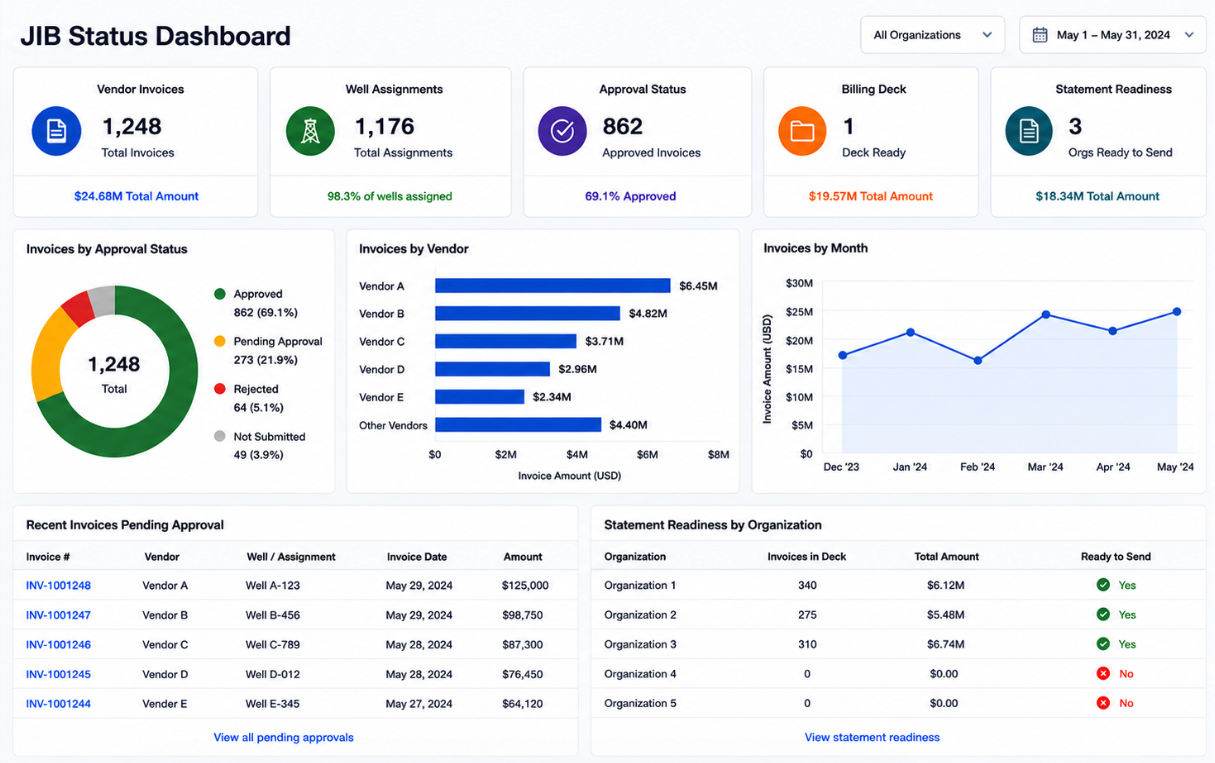
Many JIB errors begin when field costs enter the workflow without enough operating context. An invoice labeled “field service and equipment repair” is not enough for clean JIB review. Accounting still needs to know whether the cost belongs to routine LOE, workover expense, capital activity, or an AFE-controlled project.
A cost classification gate should stop unclear charges before they reach billing readiness:
Require asset assignment: Do not allow a field cost to move toward JIB review without a well, lease, field, or asset group.
Separate cost type early: Classify the charge as LOE, capital, workover, AFE-related, or another controlled category before billing.
Connect the operating period: Tie each cost to the production month or service period it belongs to.
Attach support at entry: Keep invoice detail, vendor description, field notes, and approval records with the cost.
Block incomplete billing status: Prevent any cost from being marked ready for JIB when asset, period, cost type, or approval status is missing.
Real efficiency in modern energy accounting generally declines when teams must rely on offline email threads, field memory, or separate spreadsheets for transaction confirmation. This heavy reliance on off-system manual workarounds significantly raises the probability of disputes during the month-end financial close. A truly robust digital platform ensures that all validation happens naturally within the continuous operational workflow, mitigating audit exposure and protecting the operator from unnoticed revenue leakage.
Billing Decks Need Effective-Date Control
JIB allocation is not always a simple working interest calculation. One lease may include several wells with different participation, one workover may involve only certain partners, and an ownership change may become effective mid-month. If billing decks are not controlled by asset, cost type, partner participation, and effective date, the statement can look complete while the allocation logic is wrong.
Effective-date control should make the correct allocation basis visible before statements are generated:
Match cost to the correct deck: Apply the billing deck based on well, lease, asset group, cost type, and operating period.
Control ownership effective dates: Prevent old ownership percentages from being applied after a new ownership structure becomes effective.
Separate AFE participation: Use partner participation rules for AFE or workover activity instead of assuming standard operating interest.
Flag allocation conflicts: Mark costs where ownership, cost type, or effective date does not match the intended billing basis.
Hold statement readiness: Keep statement batches from moving forward when billing deck conflicts remain unresolved.
This shift defines the clear boundary between simply running basic equity allocation calculations and maintaining proactive control over your underlying billing logic. While traditional accounting tools focus primarily on dividing expenses mathematically, modern energy solutions prioritize the validation of complex joint venture contracts and AFE rules before any entries are finalized. By shifting the internal focus toward billing logic control, oil and gas operators can ensure that their back-office ledger naturally mirrors the exact commercial terms agreed upon by all working interest partners.
AFE and Workover Costs Need a Variance Hold
Workover and capital-related costs often create the most sensitive JIB questions. A pump replacement, recompletion, tubing job, or facility repair may have been approved under an AFE, but vendor invoices do not always arrive with complete AFE references. If those costs are not matched to the correct AFE during entry, the statement becomes difficult to defend later.
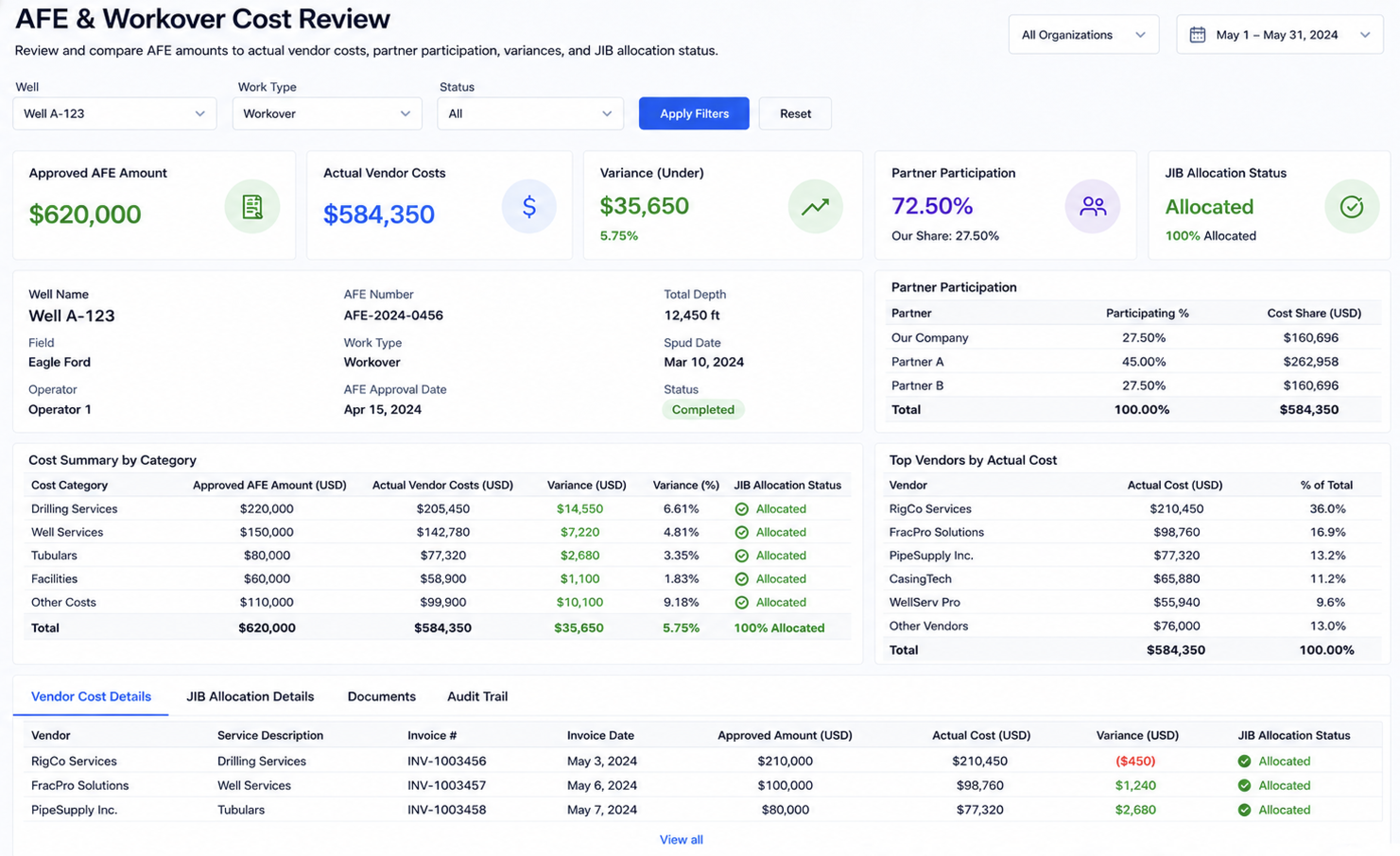
An AFE variance hold should keep workover costs from entering allocation before approval, participation, and variance status are clear.
Require AFE linkage: Hold workover or capital-related costs when the AFE number, project reference, or approval context is missing.
Compare approved and actual cost: Show variance between approved AFE amount and actual vendor costs.
Confirm partner participation: Apply the correct election or participation basis before the cost is billed.
Route variance review: Send over-budget or unclear workover costs to accounting, operations, or management before statement release.
Preserve review evidence: Keep AFE approval, workover description, invoice detail, variance notes, and allocation status in one trail.
Block period close: Block period close when any AFE variance remains unresolved without an owner and disposition.
Establishing this granular transparency gives your energy accounting professionals a clear and reliable path for resolving joint venture billing disputes. If a partner requests clarification regarding a recent workover charge, the team can confidently reference the original AFE, signed approvals, real-time actual costs, participation bases, variance decisions, and allocation logs within a single platform.
Adjustments and Exceptions Need Pre-Billing Clearance
JIB adjustments are part of real operations. A vendor may issue a credit memo, a field team may correct the well assignment, land may update an ownership effective date, or accounting may need to reverse and rebill a prior-period charge. The problem is not that adjustments happen. The problem is when adjustments and exceptions reach billing without a reason, owner, approval, or statement impact.
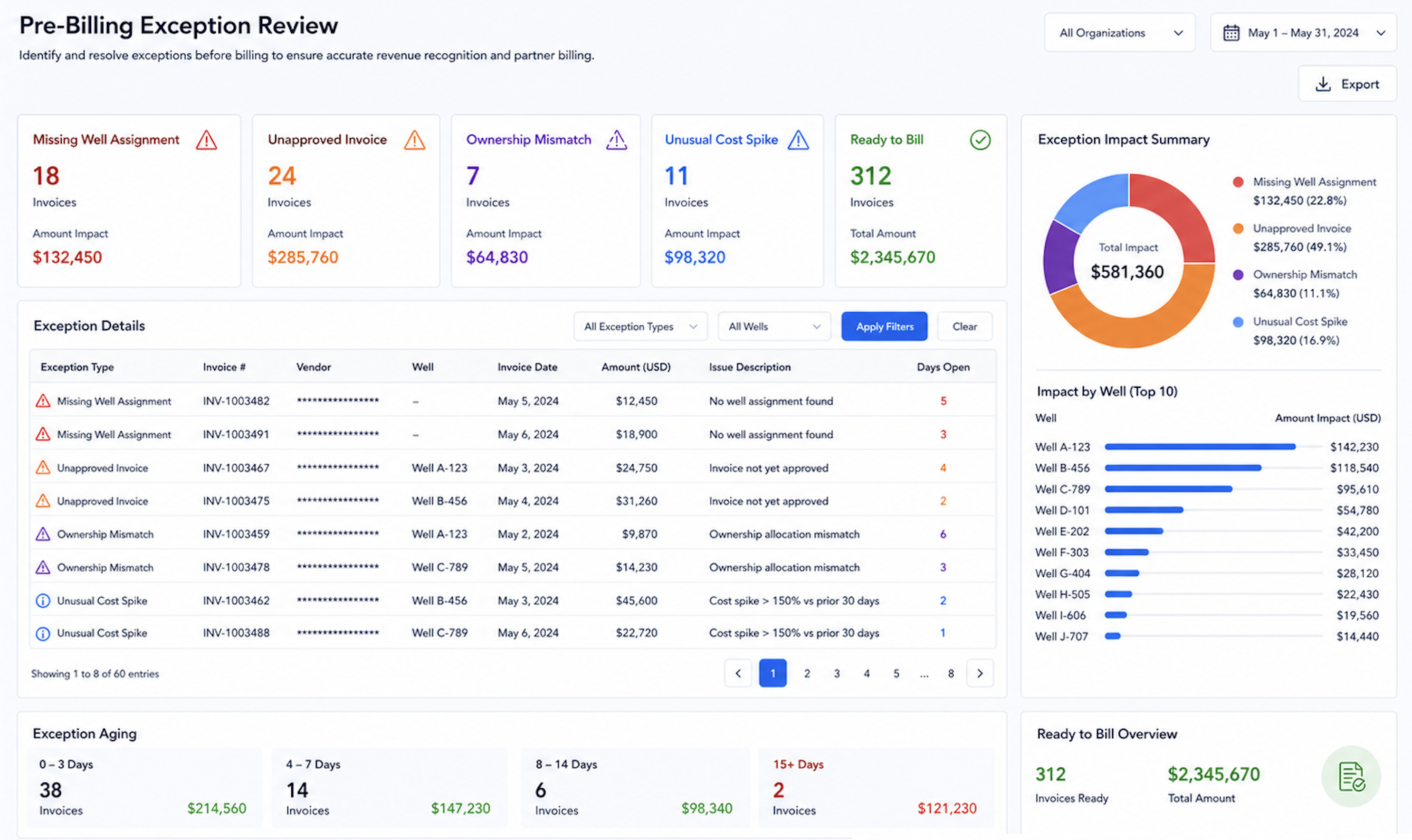
Pre-billing clearance should make exceptions visible before the statement batch is released.
Keep the original charge: Do not overwrite the initial cost record when an adjustment is created.
Require adjustment reason: Capture whether the change came from wrong well assignment, ownership update, vendor credit, prior-period correction, or cost category review.
Find missing assignments: Flag costs without well, lease, field, or billing deck linkage.
Hold unapproved invoices: Prevent unapproved vendor costs from entering statement readiness.
Check ownership mismatches: Mark records where cost period, ownership effective date, or partner participation does not align.
Prevent statement release: Make it impossible to release a JIB statement batch while any cost has missing well assignment, unapproved invoice, or ownership mismatch.
This proactive process successfully turns billing adjustments and data exceptions into routine, controlled review items rather than stressful month-end surprises. In energy accounting, preventing a single inaccurate charge from ever reaching a working interest partner carries far more commercial value than issuing complex statements that later require embarrassing corrections.
Partner Questions and Recovery Need One Evidence Trail
After JIB statements are issued, partner questions are usually specific. A partner may ask which well a water hauling charge belongs to, whether a workover cost had AFE approval, why their share increased this month, or when a prior-period adjustment was created. If accounting has to search invoice folders, email threads, spreadsheets, and payment records, JIB becomes a reactive explanation process.
Maintaining this continuous visibility helps accounting teams monitor the real-time recovery status of all distributed expenses. Operating under the philosophy that statement generation is not the finish line allows operators to keep unliquidated, disputed, or aging partner balances closely tied to their original cost history.
A connected JIB evidence trail should support:
Trace cost from entry to statement: Connect invoice entry, approval, asset assignment, billing deck, statement generation, and partner balance.
Link AFE and approval support: Keep AFE references, workover approvals, and variance notes attached to the billed cost.
Show adjustment history: Make prior-period corrections, reversals, rebills, and credit memos easy to review.
Connect payment status: Show whether the partner paid, partially paid, disputed, or remains overdue.
Record follow-up action: Keep collection notes, partner responses, and next action dates in the same workflow.
This complete data trail should also clearly show whether those billed costs have been successfully recovered from your owners. In joint interest operations, statement generation is never the actual finish line because a partner balance may still remain unpaid, partially paid, disputed, or aging.
Management Needs a JIB Readiness and Recovery View
Relying solely on basic software metrics like total statements printed often leaves oil and gas executives in an operational blind spot. True financial visibility generally requires tracking unbilled pipeline costs, identifying specific approval bottlenecks, monitoring outstanding partner balances, and flagging critical owner tasks that must be resolved prior to closing the ledger.
A useful JIB readiness and recovery view should answer:
Which invoices are missing well, lease, or field assignment?
Which workover costs are missing AFE support or variance disposition?
Which ownership records have unresolved effective-date issues?
Which costs are tied to billing deck conflicts?
Which adjustments lack a clear reason or approval trail?
Which statement batches are blocked by high-impact exceptions?
Which partner balances remain unpaid, partial, disputed, or overdue?
Which owner must act today to protect close timing and cost recovery?
This fundamental distinction highlights the operational gap between merely calculating partner percentage shares and maintaining proactive control over your underlying billing logic. While basic accounting platforms excel at simple mathematical division, they often lack the operational depth required to validate intricate joint venture contract terms and dynamic AFE rules before entries are finalized. Transitioning toward full billing logic control allows the back office to automatically align live ledger entries with the exact commercial agreements approved by working interest partners. This systematic approach generally ensures that subsequent statement generation reflects true contractual obligations rather than raw financial formulas.
How Petrofly Helps Operators Reduce JIB Errors Before Close
Petrofly helps progressive energy companies bring critical JIB reviews much earlier into the financial month by seamlessly unifying field costs, well information, and AFE references within a single software platform. By consolidating billing decks, partner records, manager approvals, and proactive exception reviews under one continuous oil and gas workflow, the system naturally reduces month-end friction while steadily accelerating your final payment recovery.
Petrofly supports the control points that reduce JIB errors:
Cost classification gates before billing: Petrofly helps ensure field costs carry well, lease, field, operating period, cost type, approval status, and supporting context before they enter JIB readiness.
AFE matching for workover costs: Petrofly connects AFE references, approved amounts, actual vendor costs, partner participation, variance review, and allocation status in one review trail.
Ownership and billing deck checks: Petrofly helps flag ownership effective-date mismatches, partner participation issues, and billing deck conflicts before statement release.
Pre-billing exception control: Petrofly helps identify missing well assignments, unapproved invoices, unusual cost spikes, unresolved adjustments, and allocation issues before billing.
Connected evidence and recovery tracking: Petrofly links vendor invoices, AFEs, approvals, adjustments, partner balances, payment follow-up, and recovery status for faster review and explanation.
Modular rollout and configuration: Operators can start with JIB, accounting, reporting, owner relations, or payment follow-up workflows, then expand as operations mature.
Cloud-based access and dedicated support: Petrofly supports accounting, operations, land, management, and owner relations teams with cloud-based visibility, customer-specific configuration, workflow refinements, reporting changes, and ongoing support after go-live.
Without this structure, JIB teams spend month-end rebuilding evidence, explaining charges, correcting allocations, and chasing payment status. With Petrofly, operators can control the cost trail before billing begins and make each allocated charge easier to review, explain, and recover.
Operating JIB without integrated system control typically reduces the entire accounting process to a reactive, post-close reconciliation exercise. Conversely, embedding controlled workflows directly into your oil and gas operations transforms joint interest billing into a distinct cost recovery advantage that protects your cash flow.