
How Division Orders Affect Royalty Payments in Oil and Gas Accounting

Summary
×Division Orders Turn Ownership Into Payment Control
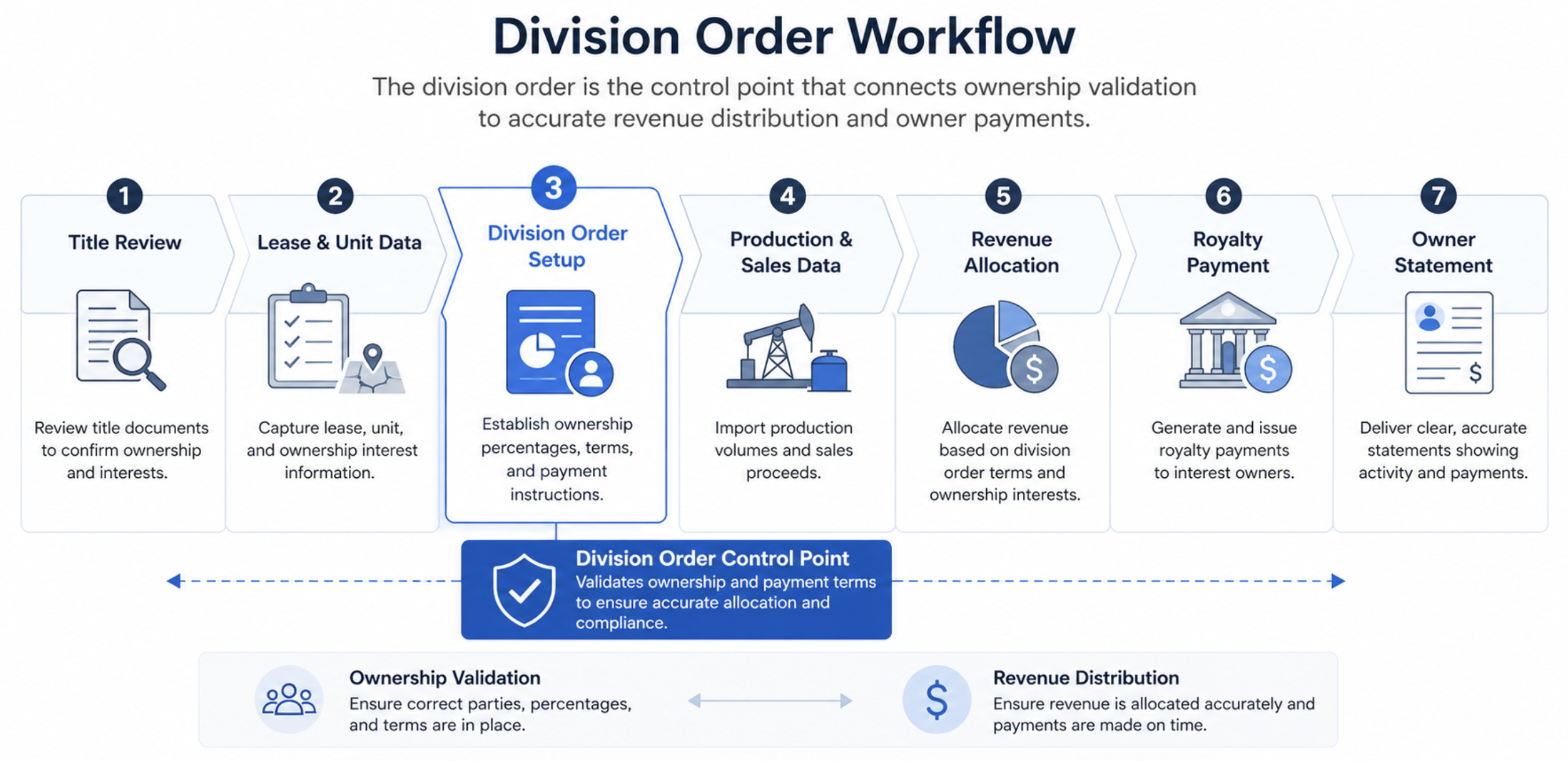
In oil and gas accounting, a division order is more than a document sent to an owner for confirmation. It is the point where title facts become payment rules. Mineral ownership, lease royalty rates, tract participation, interest type, owner status, tax records, and effective dates all need to translate into a decimal that the revenue accounting system can apply.
The risk becomes costly when this control is weak. A mid-size operator may spend 10 to 15 hours in a payment cycle reviewing owner inquiries, suspense releases, decimal corrections, and prior-period adjustments that trace back to incomplete division order records. Even a small decimal issue can repeat across multiple wells, owners, and payment months before the team identifies the source.
The sharper question is: can this owner be paid from a clean, current, and supported division order record? If the answer depends on title files, email threads, spreadsheets, or someone remembering a recent ownership change, the royalty payment process is already carrying risk.
A division order setup gate should make payment readiness visible before revenue is distributed:
Owner identity and payee setup
Interest type and decimal interest
Lease, well, unit, and product relationship
Tax, deduction, and payment status
Suspense reason and release requirement
Effective dates and ownership change history
Real Operations Need a Payment-Readiness Gate
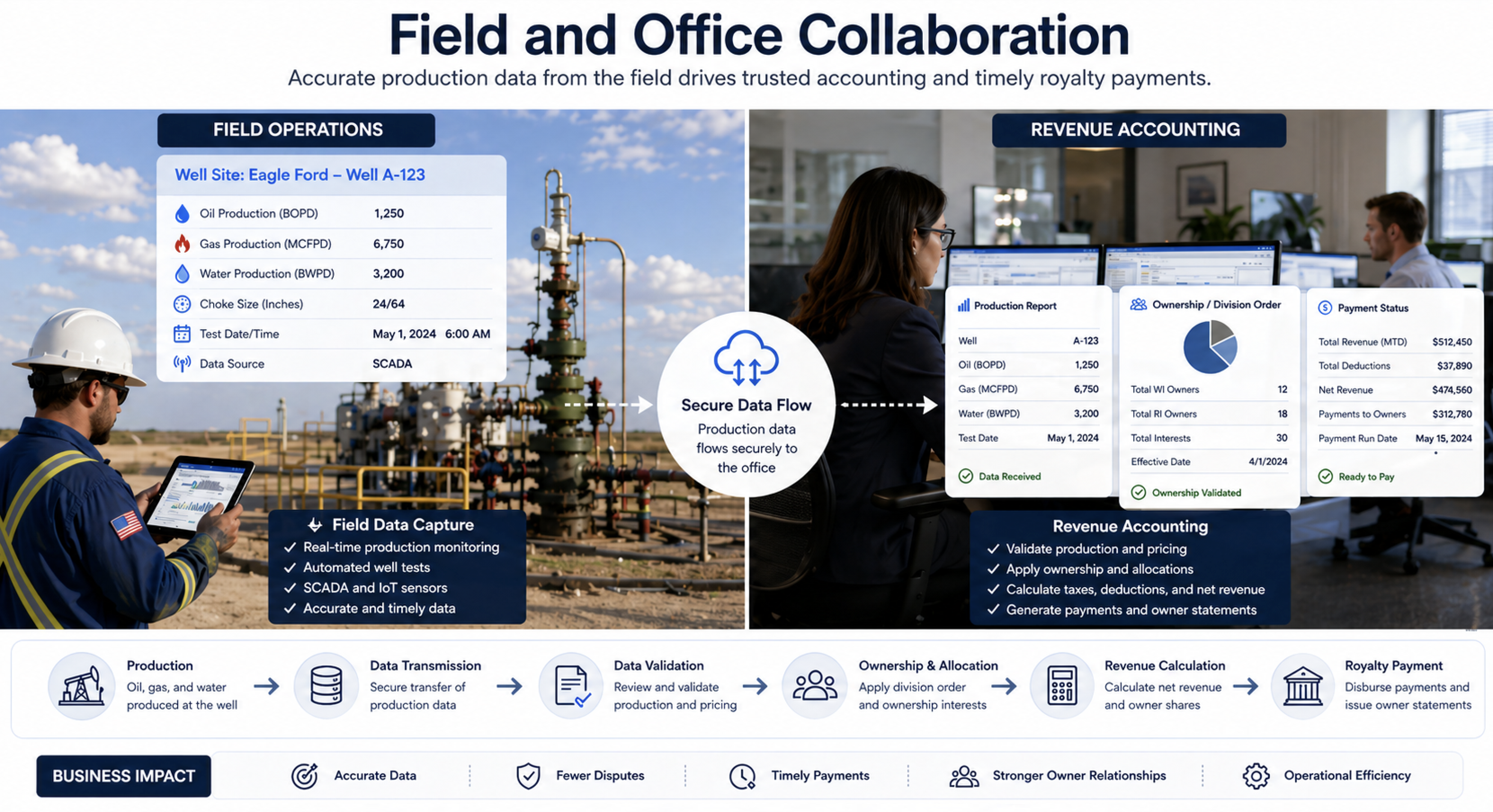
A division order is rarely finished the day a lease is signed. It often becomes active after title review, well completion, pooling confirmation, first sales preparation, or an ownership update. By then, several teams may already be involved. Land confirms title and acreage. Revenue accounting calculates decimals and pay status. Operations provides production context by well, unit, field, or product stream. Owner relations handles questions, missing documents, and payment explanations.
This is where payment risk often begins. A new well may be ready for revenue distribution, but one owner record still has missing tax information. A pooled unit may be approved, but tract participation needs final confirmation. A payee address may be invalid. A title defect may require suspense.
A payment-readiness gate should show which owner records are ready to pay, which are blocked, and who owns the next action. The team should not wait until the payment run to discover that an owner record lacks a signed division order, current tax form, valid address, or resolved title issue.
Decimal Interest Needs a Calculation Lock
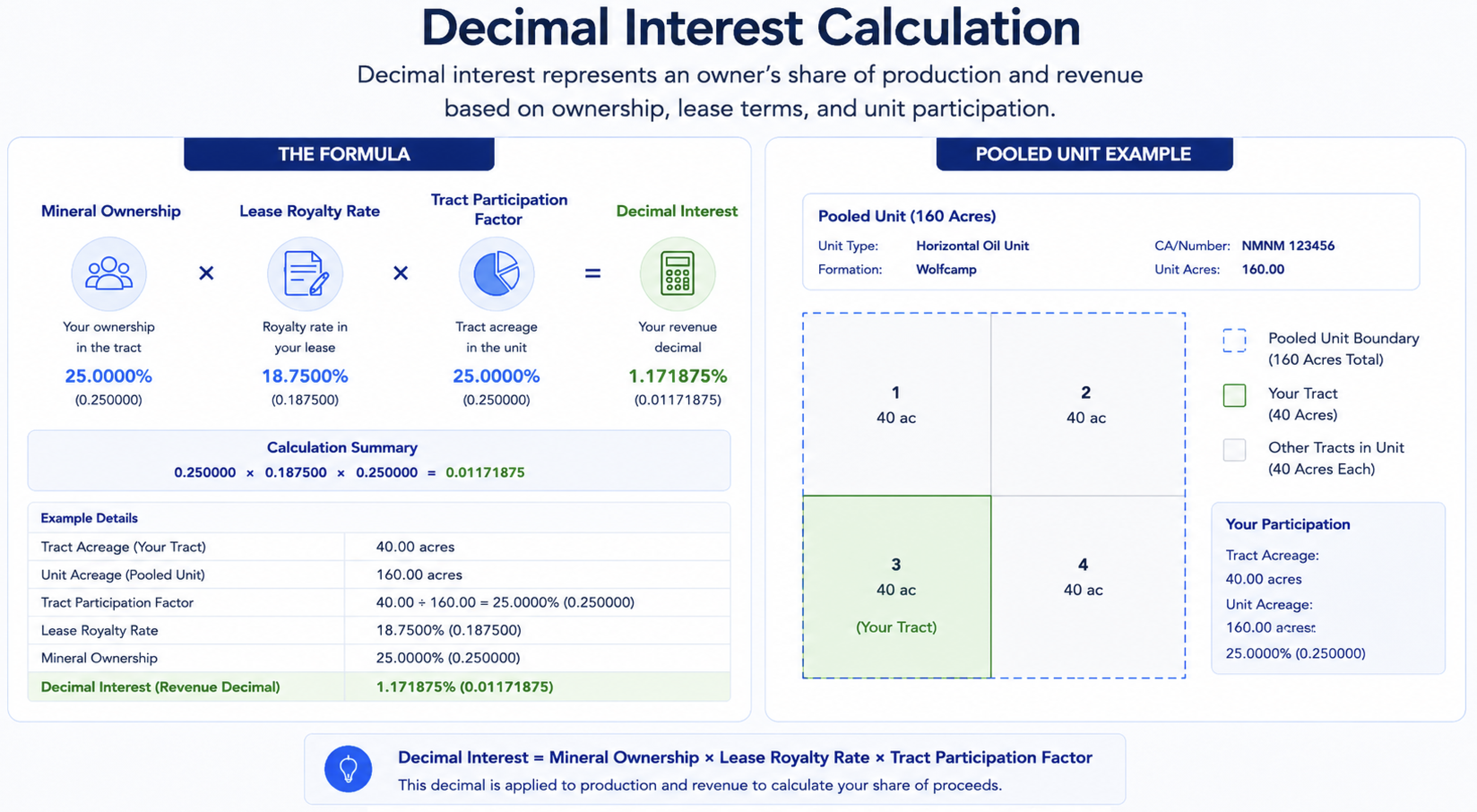
The decimal interest is the most direct way a division order affects royalty payments. It determines the owner’s share of revenue for a specific well, lease, unit, product stream, or accounting period. A simplified royalty decimal may be calculated from mineral ownership, lease royalty rate, and tract participation, but real assets often involve far more complexity.
A clean decimal should not be treated as just a number in the owner deck. It should have a traceable basis. Revenue accounting should be able to see which source documents, lease terms, unit acreage, owner interest, effective date, and ownership burden created the decimal.
For example, a simplified formula may be: Royalty Decimal = Mineral Ownership × Lease Royalty Rate × Tract Participation Factor. If an owner holds 25% of the minerals in a 40-acre tract, that tract is included in a 160-acre pooled unit, and the lease royalty rate is 25%, the simplified royalty decimal would be: 25% × 25% × 40/160 = 0.015625.
That owner would receive 1.5625% of the applicable revenue stream under those assumptions. In real operations, the calculation may also need to reflect partial interests, depth limitations, unit revisions, NPRIs, ORRIs, working interest burdens, inheritance splits, or multi-well development.
A decimal calculation lock should prevent unsupported decimal changes from reaching payment. When a decimal changes, the workflow should show what changed, why it changed, which effective date applies, which owner records are affected, and whether prior-period adjustments are required.
Decimal Errors Need an Effective-Date Hold
A small decimal error may look minor during one payment cycle, but it can become significant when it repeats across high-producing wells, multi-well pads, or long periods of commodity price movement. The issue may not be discovered until an owner questions a statement, an audit review identifies a mismatch, or revenue accounting compares historical payments against updated ownership records.
These errors are often caused by change timing, not simple carelessness. A new assignment may reach land before the revenue system is updated. Probate documents may arrive while the owner master still reflects the prior owner. A unit revision may change tract participation before the owner deck is recalculated. If the workflow does not connect those events, the decimal in the system can drift away from the ownership reality. An effective-date hold should stop payment logic from moving forward when the ownership basis is incomplete. Decimal updates should not be released into the payment workflow without source support, effective date, review owner, and approval history.
Common recurring payment gaps include:
Ownership transfers not reflected in the owner deck
Decimal updates entered without effective-date control
Probate or inheritance changes outside the accounting workflow
Unit revisions not connected to royalty calculation rules
Owner master records that conflict with title records
Manual corrections without a clear review trail
Suspense Needs a Release Lock
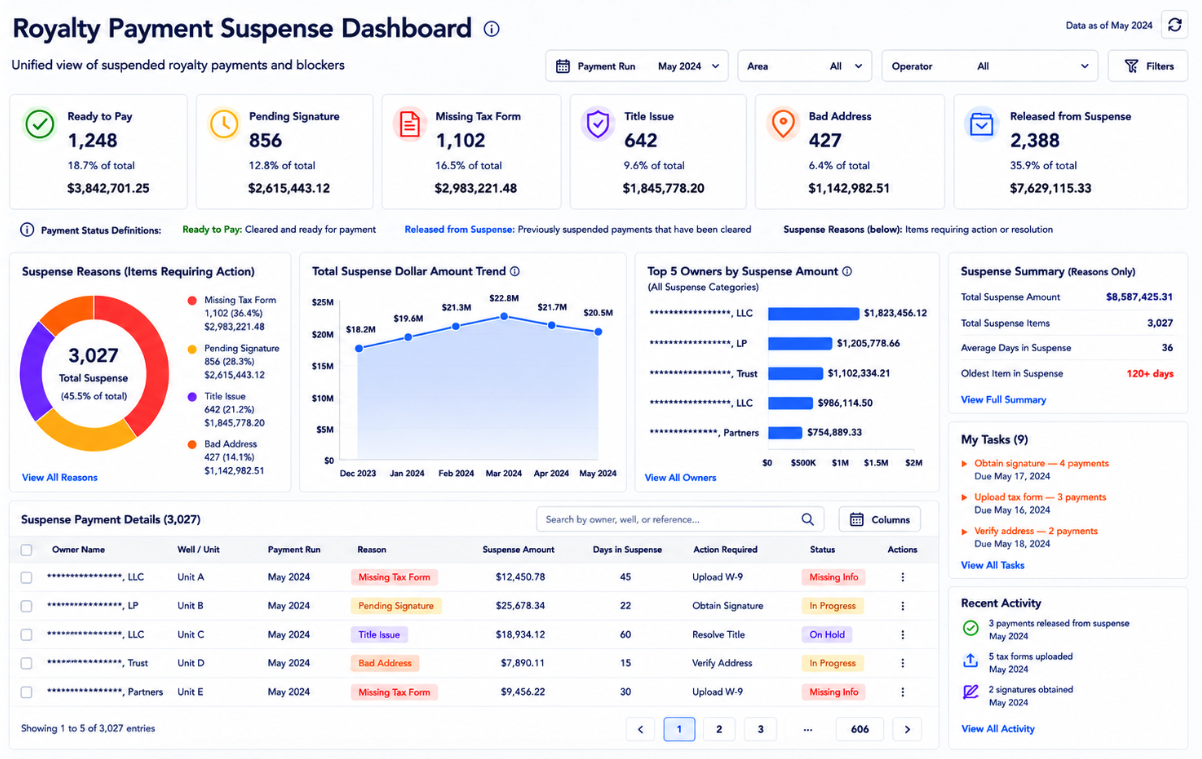
Division orders also affect when royalty payments can begin or be released. From the owner’s perspective, a suspended payment may feel like a missing payment. From the operator or payor’s perspective, suspense is often a control step that prevents funds from being released before owner identity, tax records, signature status, address, title position, or payment eligibility is clear.
The problem is not that suspense exists. The problem is when suspense balances are hard to explain or hard to resolve. A missing tax form, bad address, unsigned division order, title dispute, incomplete probate file, or ownership conflict should not sit in a vague suspense category without an owner and next step. A suspense release lock should make it impossible to release suspended funds while the owner record lacks a documented release reason, required document status, approval owner, and review date.
A strong suspense workflow should answer:
Why is the amount suspended?
Which owner, well, unit, or payment period is affected?
How much is held, and how long has it been aging?
What document, signature, tax form, or title action is required?
Which team or user owns the release step?
What communication has already happened?
When should the item be reviewed again?
Without this visibility, suspense becomes a hidden operational backlog. With it, revenue accounting, owner relations, land, and management can see which balances are ready to release, which need owner follow-up, and which require title or legal resolution. Orchestrating this cross-functional transparency accelerates capital velocity while ensuring that regulatory escrow obligations are meticulously maintained across the entire asset portfolio.
Owner Decks Need a Change-Control Gate
The owner deck is the foundation for monthly revenue allocation. Each owner’s interest type, decimal interest, effective date, pay status, tax status, and suspense reason should stay consistent with the division order record. When those records drift apart, revenue accounting becomes harder to review, owner statements become harder to explain, and monthly close becomes more exposed to corrections.
The biggest challenge is ongoing change. Oil and gas assets can move through assignments, inheritance changes, trust updates, company mergers, lease amendments, purchaser changes, unit expansions, acquisitions, and ownership disputes. If the division order workflow cannot absorb those changes quickly, the owner deck may remain technically usable but operationally outdated.
An owner deck change-control gate should keep key records aligned before payment is released. The team should be able to confirm:
Correct owner name and payee setup
Current decimal interest
Valid effective date
Updated tax and address status
Applicable lease, well, unit, or product relationship
Current suspense or release status
Supporting documents and change history
This is where division order management becomes more than document administration. It becomes the operating control that keeps title, ownership, revenue calculation, and payment status aligned. Elevating this function into a central compliance architecture fundamentally secures upstream revenue streams while protecting the enterprise from systemic transactional inaccuracies.
Complex Assets Need an Allocation Traceability Lock
Complex operating scenarios make division order control more important. Multi-well pad development can involve several horizontal wells, different laterals, different allocation areas, and product-level revenue streams. A single surface location may generate payment calculations that vary by well, product, interest type, and effective date.
Acquisitions create another layer of risk. A buyer receives wells and production volumes, but also owner masters, historical payment records, suspense balances, title defects, and owner correspondence. If division order data is incomplete during transition, the first payment cycles after closing can generate owner questions, suspense growth, and revenue adjustments.
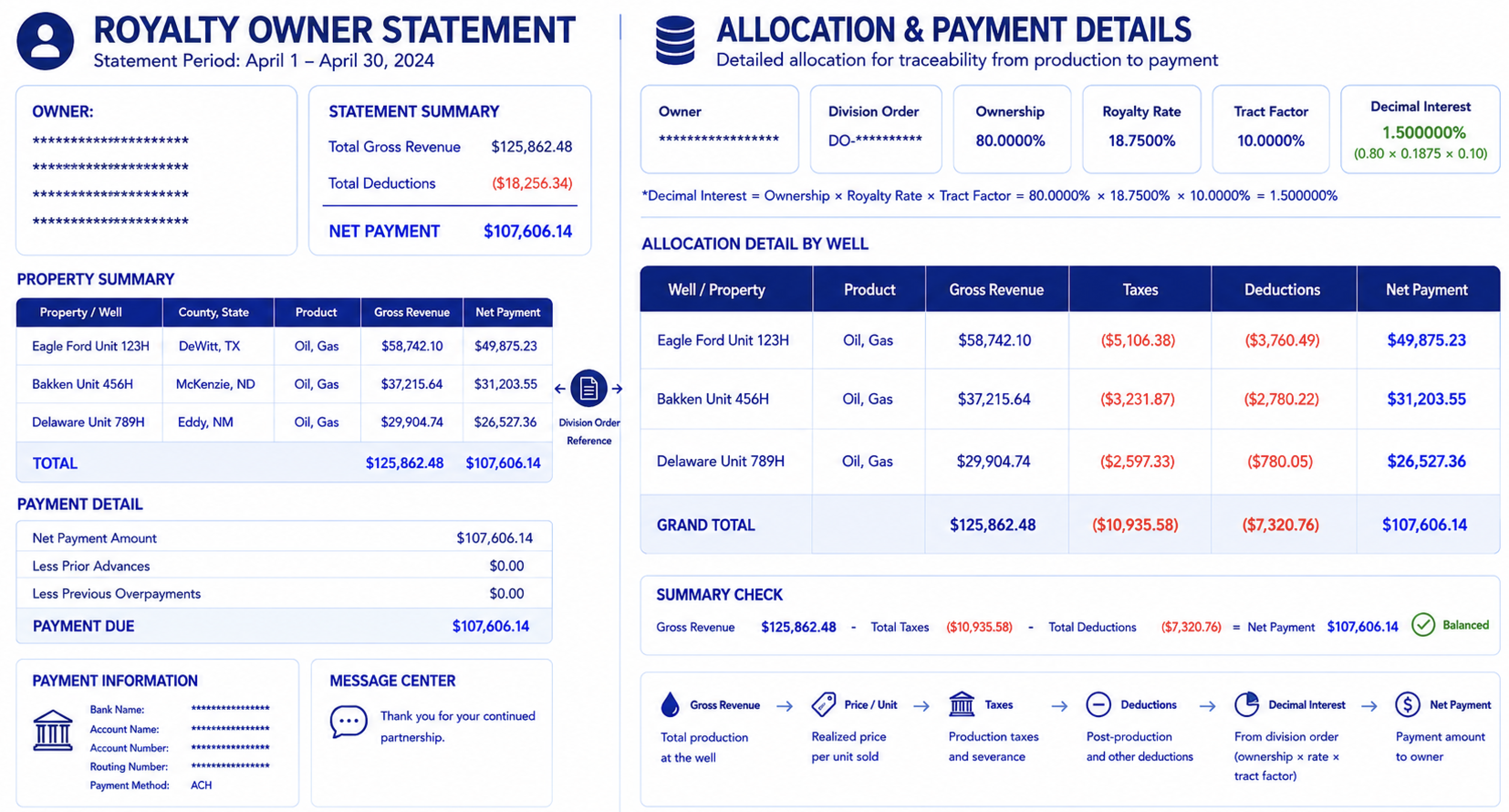
Owner relations also depends on traceability. Owners may ask why a payment decreased, why one well did not pay, why a decimal changed, or why certain deductions appeared on the statement. The team can respond professionally only when it can trace the payment from production volume to price, deduction, decimal, suspense status, and final net payment.
An allocation traceability lock should keep the calculation history connected to each owner statement. Complex scenarios require stronger controls around:
Multi-well and multi-product allocation
Unit revisions and effective-date changes
Acquisition data migration and validation
Historical suspense balances
Owner communication records
Prior-period revenue adjustments
Audit-ready calculation history
Management Needs a Division Order Risk View
Management does not need only the number of division orders created or the total royalty paid. Leaders need to see which owner records are not ready for payment, which suspense balances are aging, which assets carry decimal risk, and which ownership changes may affect the next payment cycle.
A useful division order risk view should answer:
Which owners are missing tax forms, signatures, or valid addresses?
Which decimal changes are waiting for review?
Which wells, units, or product streams have unresolved ownership issues?
Which suspense balances are aging without a next action?
Which acquisition records still need validation?
Which owner inquiries are tied to decimal, deduction, or suspense questions?
Which payments are blocked by title, owner master, or documentation gaps?
Which owner or asset issue must be cleared before the next payment run?
Without this view, teams discover owner payment issues after statements are questioned or balances have aged. With it, management can see which records need action before royalty payments, suspense balances, and owner trust are affected. Implementing this proactive oversight mechanism drastically reduces compliance exposure while fortifying corporate reputation and stakeholder alignment across the entire leasehold asset network.
How Petrofly Supports Division Order Management
Petrofly helps oil and gas teams manage division orders as active payment controls rather than static documents. By connecting ownership records, decimal interests, suspense reasons, payment status, owner communication, and supporting documents in one workflow, Petrofly helps teams keep royalty payment logic easier to review and explain.
Petrofly supports division order management through five core capabilities:
Division order setup visibility: Track deck setup, signature status, ownership changes, effective dates, and supporting documents.
Decimal and owner deck control: Connect decimal interests, effective dates, royalty calculations, owner deck changes, and payment history.
Suspense release workflows: Help teams review missing tax forms, pending signatures, title issues, bad addresses, release requirements, and aging balances.
Owner communication and payment traceability: Keep statements, questions, document follow-up, allocation details, and owner notes closer to the payment record.
Flexible rollout with dedicated support: Start with division orders, owner relations, suspense review, or royalty payment workflows, while Petrofly supports configuration, reporting refinements, workflow adjustments, and faster response when ownership or payment issues need clarification.
Without this structure, division order teams spend more time searching for support, explaining payment changes, and cleaning up suspense after the fact. With Petrofly, teams can keep ownership, decimals, suspense, communication, and payment history closer to the same operating record.
Division orders without control become payment risk; division orders with connected workflows become a stronger foundation for owner trust and revenue accuracy. Embedding these intelligent operational pathways into the core accounting ledger systematically immunizes the enterprise against capital leakage while setting a benchmark for modern asset fiduciary stewardship.