
What Should Oil and Gas Royalty Management Software Include?

Summary
×Royalty Management Is a Payment-Control Workflow
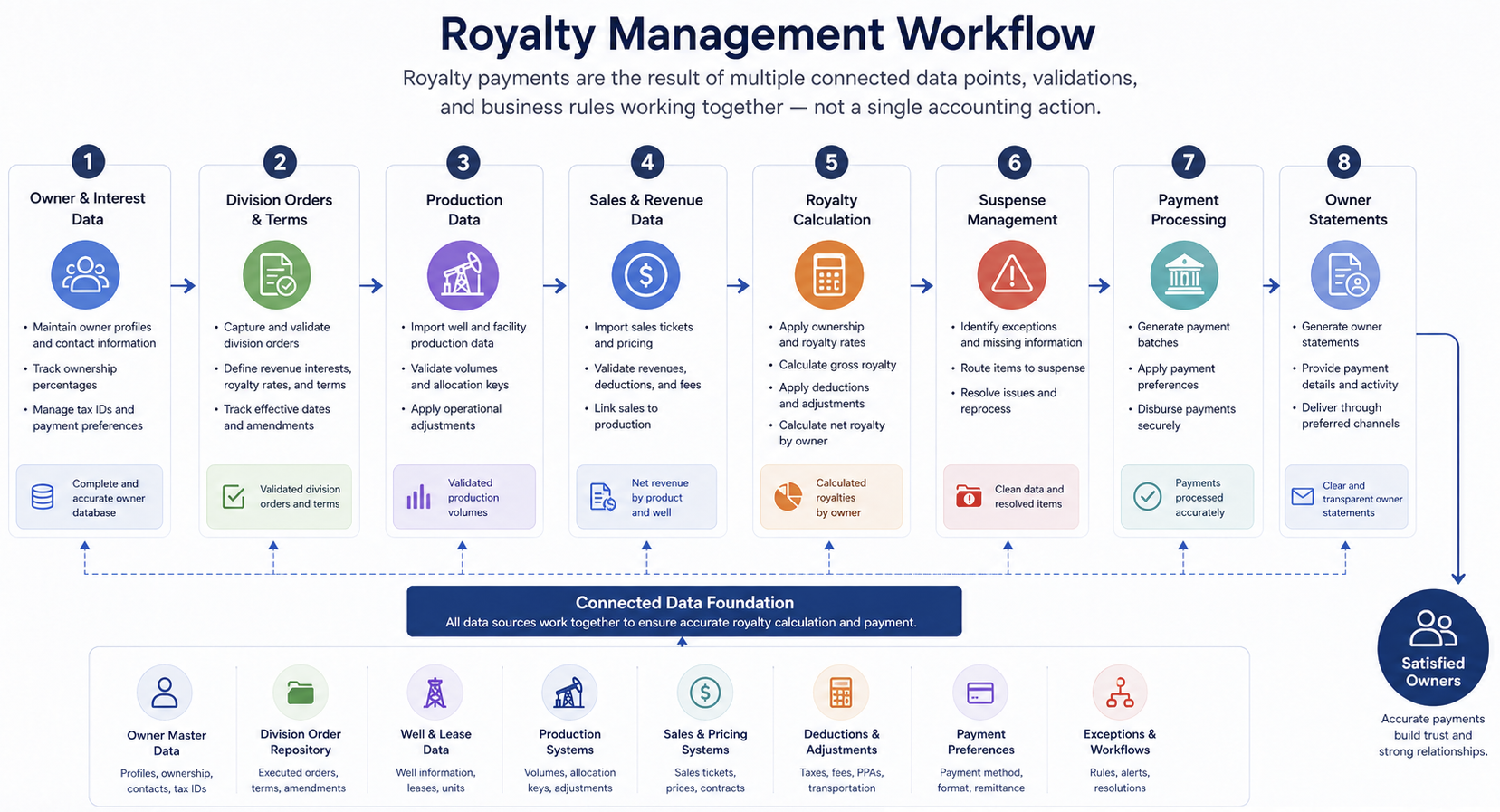
A royalty payment may look like the final output of monthly accounting, but it depends on a long chain of records. Behind each payment are owner profiles, division orders, decimal interests, production volumes, purchaser revenue, taxes, deductions, suspense reasons, payment status, and statement details. If one part of that chain is incomplete, the problem may not appear until an owner asks a question or a payment batch is delayed.
The issue is not that accounting teams cannot calculate royalties. The harder problem is proving that the payment is ready to release. A new well may already be producing revenue while division order status is incomplete. An owner may have updated tax information while the payment record still carries an old address. A decimal may be correct in the owner deck but difficult to trace back to the title or unit data that created it.
A mid-size operator can lose 10 to 15 hours in a payment cycle answering owner questions, reviewing suspense items, and checking payment exceptions that started with incomplete owner records or disconnected division order data. Royalty management software should reduce that pressure by showing what is ready, what is blocked, and what evidence supports each payment.
Before payments are released, the system should answer:
Who is eligible to be paid?
Why does this decimal interest apply?
Which amounts must remain in suspense?
What production and revenue records support the payment?
Can the owner statement be traced back to source records?
Can the team explain changes without searching emails, spreadsheets, or folders?
The real value is not only automation. It is turning royalty management into a visible, reviewable, and auditable revenue distribution process for accounting, land, owner relations, management, and royalty owners. Establishing this unified transparency matrix across organizational boundaries allows energy companies to significantly minimize operational bottlenecks, providing a standardized information repository that simplifies multi-party alignment and strengthens strategic compliance frameworks.
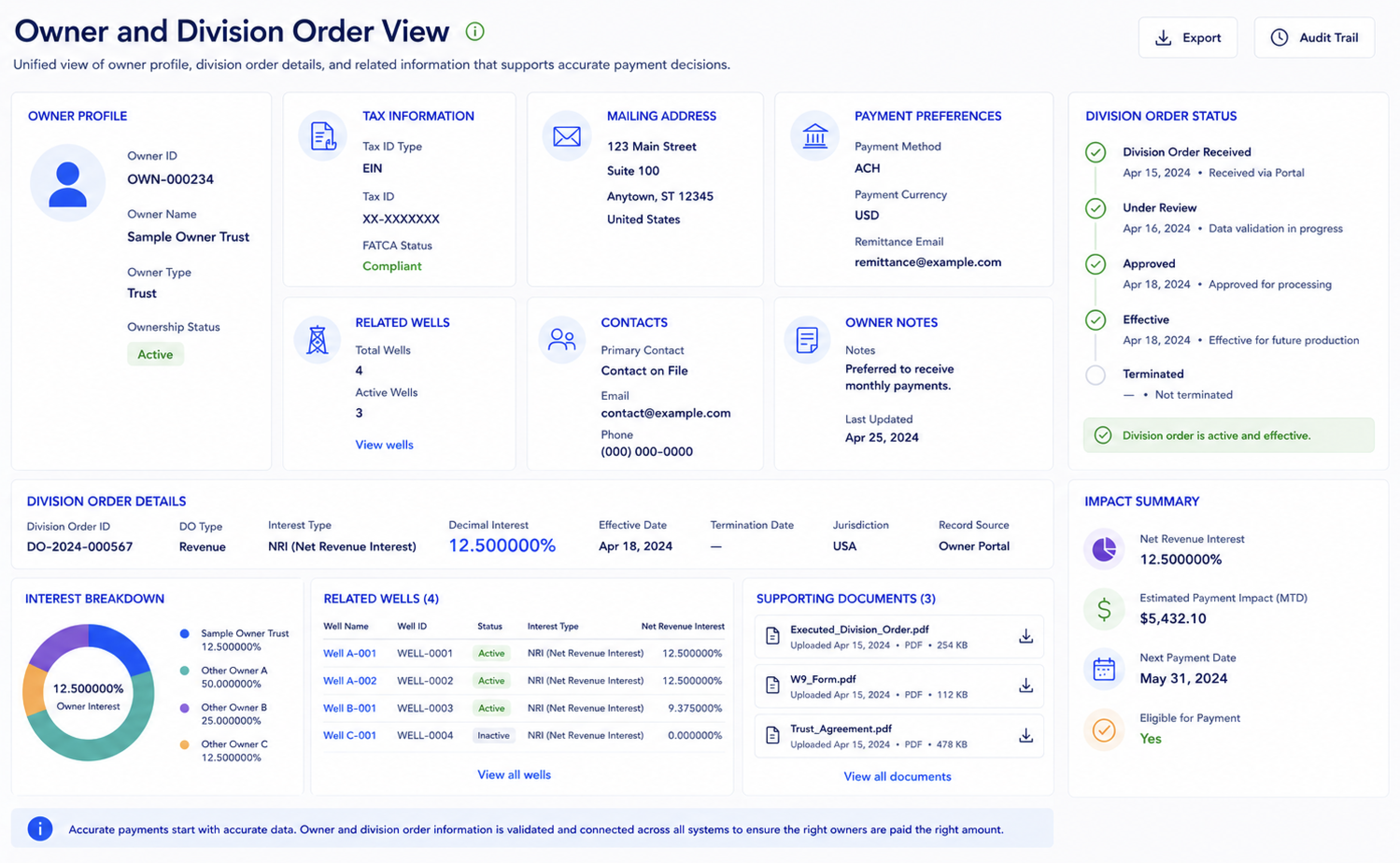
Owner and Division Order Records Should Prove Payment Readiness
The foundation of royalty management is clean owner and ownership data. Storing an owner’s name and mailing address is not enough. Royalty payments depend on how each owner connects to wells, leases, units, tracts, interest types, decimal interests, effective dates, tax status, and payment status.
This becomes especially important after acquisitions, ownership transfers, address changes, title updates, and data migrations. A new operator may inherit producing wells along with historical owner records, suspense balances, returned mail, duplicate profiles, and inconsistent effective dates. If those issues are not cleaned up before the next payment cycle, the team may face delayed payments, returned statements, added suspense, and difficult owner explanations.
Division orders should therefore be managed as active payment controls, not static documents. Each division order should connect the owner, well, lease, unit, interest type, decimal interest, effective date, supporting title information, signature status, and review history. When a new well comes online or a unit changes, the system should show whether the division order record is ready to support payment.
A practical owner and division order workflow should include:
Owner profile and legal entity information
Tax, address, and payment status
Related wells, leases, units, and interests
Division order status and signature tracking
Decimal interest and effective date
Supporting documents and title references
Ownership change and version history
The strongest rule is simple: make it impossible to release royalty payments when an owner record has unresolved tax, signature, address, or title status without an assigned owner and release path. This keeps owner readiness from becoming a payment-cycle surprise. Integrating these programmatic compliance validations directly into the revenue distribution framework assists upstream organizations in mitigating financial risk exposure, ensuring that data-governance guidelines are systematically enforced prior to any transactional settlement.
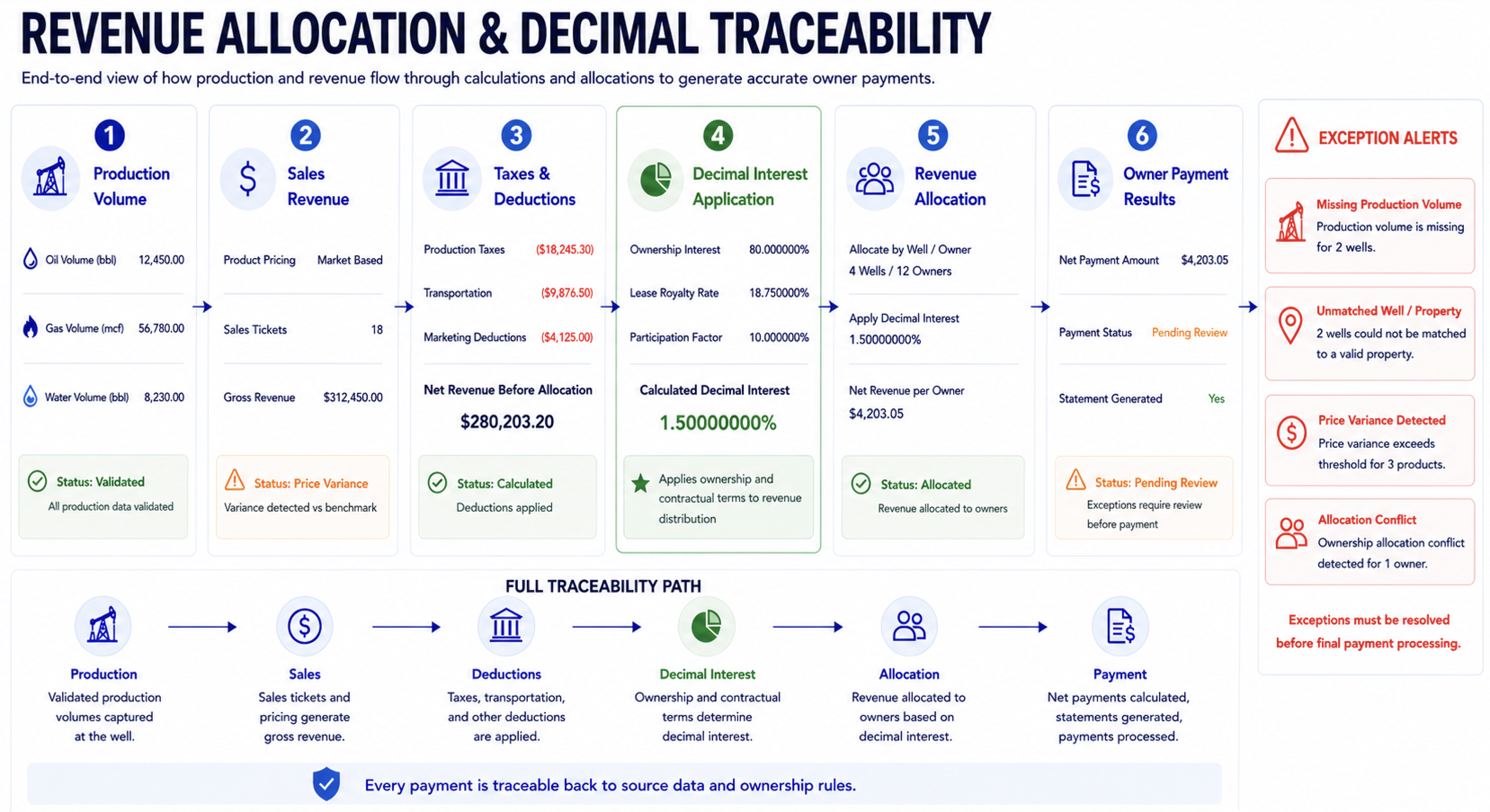
Production, Revenue, and Decimal Interests Must Stay Traceable
Royalty payment calculation depends on production and sales revenue, but the calculation is only reliable when the inputs stay connected. Oil, gas, NGL, and other product volumes need to align with purchaser statements, prices, taxes, deductions, adjustments, net revenue, owner decks, and decimal interests. When those records sit in separate spreadsheets or disconnected systems, revenue accounting teams have to rebuild the payment basis during close.
The decimal interest also needs to be more than a stored number. The system should show where it came from: lease, tract, unit, ownership percentage, royalty rate, participation factor, interest type, and effective date. This is critical for pooled units, multi-well pads, partial interests, NPRIs, ORRIs, ownership transfers, and acquisition data conversion.
Before royalties are processed, teams should be able to review:
Production period, product, and sales volume
Gross revenue, taxes, deductions, and net revenue
Owner deck and decimal interest
Lease, tract, unit, and well relationship
Allocation rules and effective dates
Exceptions such as missing volume, unmatched well, price variance, or allocation conflict
The system should also prevent weak calculations from reaching payment. If a production record is missing, a well does not match the owner deck, a price variance exceeds review tolerance, or the decimal basis lacks support, the payment batch should stay in review. This is where royalty management becomes a control process, not just a calculation engine.
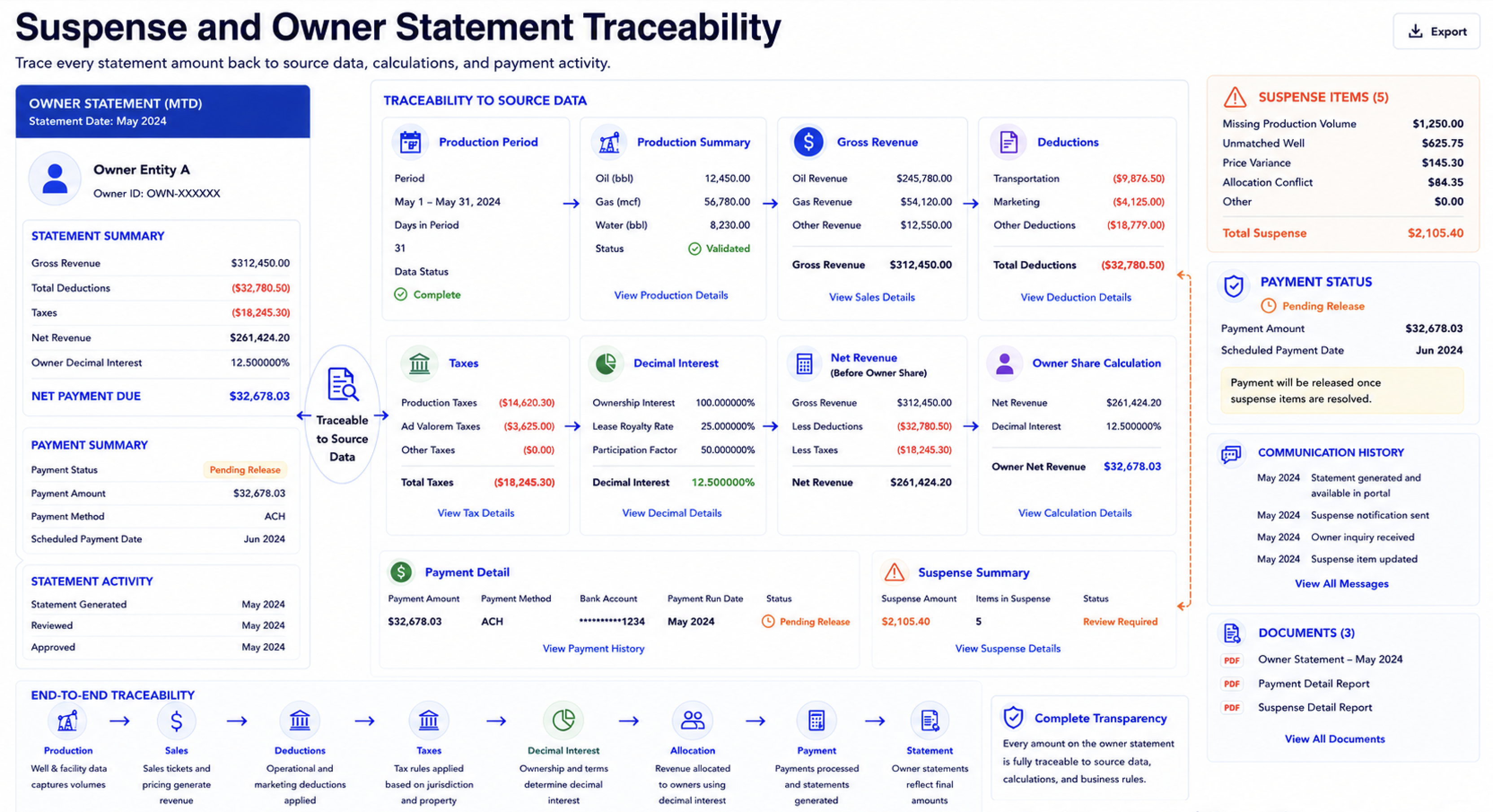
Suspense and Owner Questions Need One Evidence Trail
Suspense directly affects payment timing, owner trust, and accounting visibility. Funds may be suspended because of a missing tax form, unsigned division order, bad address, title issue, minimum payment threshold, ownership uncertainty, or another unresolved condition. If the system only shows a suspense balance, the team still has to ask why it is held, who owns the issue, and what needs to happen next.
A mature royalty management system treats suspense as an action workflow. Each suspense item should show the owner, well, production period, amount, reason code, aging, responsible team, required action, supporting notes, release status, and communication history. When documents arrive, tax records are updated, or a title issue is cleared, the system should identify which suspended funds are ready to release and preserve the release trail.
Owner statements should connect to the same evidence. When owners ask why a payment decreased, why a well did not pay, why a deduction appeared, or why a decimal changed, accounting and owner relations should not rebuild the answer from scattered files. They should be able to trace the statement line back to production, sales revenue, deductions, taxes, decimal interest, division order status, suspense history, and payment status.
A useful suspense and owner statement workflow should show:
Suspense reason and aging
Owner, well, and production period affected
Required release action
Communication and document history
Statement line detail
Payment status and release history
Source data behind each owner-facing amount
Without this trail, owner relations becomes reactive. With it, the team can explain payment details from records and reduce repeated questions, delayed releases, and unresolved suspense balances. Implementing this structured historical documentation strategy allows revenue accounting and land departments to maintain optimal administrative alignment, which materially improves multi-party stakeholder trust while streamlining monthly financial reconciliation efforts.
Reporting Should Show What Blocks Payment Before the Cycle Ends
Royalty management reporting should help teams act before issues reach owners. Payment summaries are useful, but they do not tell the team which payment batch is blocked, which owner record is incomplete, which division order is unsigned, which suspense item is aging, or which revenue allocation exception needs review.
Different teams need different views. Revenue accounting needs payment readiness, allocation exceptions, adjustment review, and statement status. Land and division order teams need unsigned order lists, ownership change reports, title issue tracking, and owner deck exceptions. Owner relations needs inquiry history, statement details, document follow-up, and suspense release status. Management needs visibility into payment-cycle risk, suspense aging, owner inquiry trends, revenue distribution quality, and audit readiness.
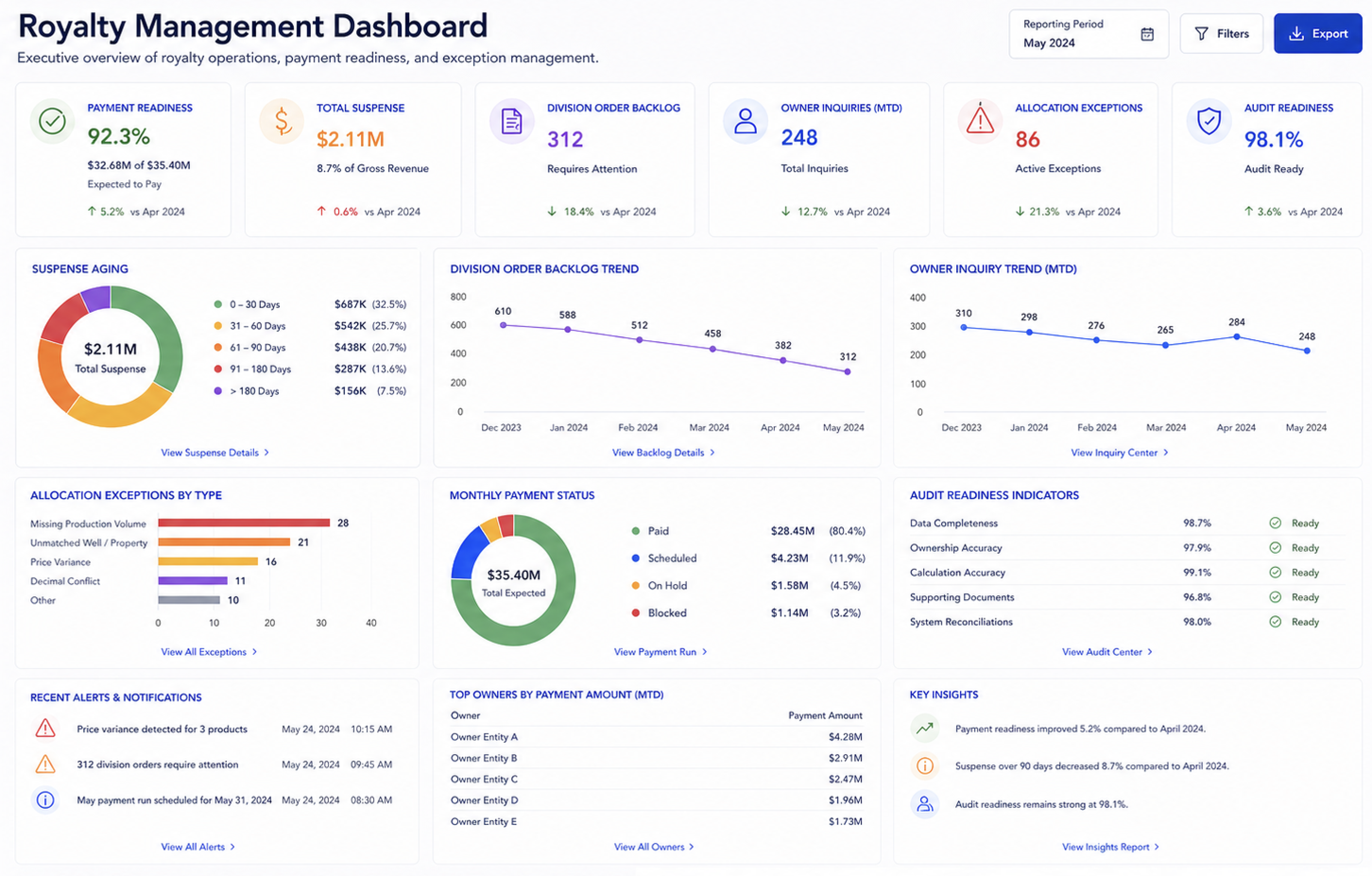
A useful royalty management dashboard should answer:
Which payment batches are ready, blocked, or under review?
Which owner records are missing tax, address, signature, or payment information?
Which division orders are unsigned or waiting for review?
Which suspense items are aging without a next action?
Which revenue records have missing volume, unmatched well, or allocation conflicts?
Which owner inquiries are increasing by asset, issue type, or payment cycle?
Which records need review before the next payment run?
Configuration and access control are part of the value. Royalty workflows vary by operator, asset complexity, basin, internal controls, and existing systems. The software should support configurable workflows, role-based access, exception handling, document management, audit logs, integrations, and dashboards that reflect how the team actually works.
How Petrofly Supports Royalty Management
Petrofly supports royalty management by helping oil and gas teams connect owner records, division orders, decimal interests, production revenue, suspense, payment tracking, owner statements, and communication history in one workflow. The value is not only faster payment output. It is clearer control over the records behind each payment.
Petrofly can help through five core capabilities:
Keep owner profiles, DOI records, tax status, signatures, effective dates, documents, and ownership changes for easy review.
Connect decimal interests, production revenue, deductions, suspense, payment history, and statement details for royalty traceability.
Review blockers, aging balances, release requirements, history, and issues.
Adapt reports, fields, approvals, exceptions, dashboards, and views to actual operations.
Start with royalties, owners, DOIs, or reconciliation on a cloud-based modular system, with dedicated support to expand later.
Without this structure, royalty management depends on manual review, disconnected files, and after-the-fact explanations. With Petrofly, teams can keep payment logic, owner records, suspense status, and statement evidence connected before payments are released. Royalty management without control is just payment processing; controlled royalty management becomes a stronger foundation for owner trust, cash visibility, and revenue accuracy.
Where Royalty Management Goes Next
Royalty management software is moving from a back-office accounting tool to a platform for managing revenue quality. It connects not only payment results, but also ownership accuracy, production data integrity, allocation logic, suspense resolution, owner trust, and audit readiness. For operating teams, these connected records answer a deeper question: does the company truly understand where its revenue is going?
The future of royalty management will not be defined only by faster statement generation or fewer manual calculations. The more important question is whether companies can maintain clear, stable, and explainable revenue distribution as assets change, ownership structures become more complex, owner expectations rise, and audit requirements increase.
When every payment can be traced, every suspense item has a resolution path, and every owner inquiry can be answered from reliable records, royalty management becomes more than a monthly task. It becomes a controlled operating discipline that protects payment accuracy and owner transparency.