
How Oil and Gas Companies Can Reduce Royalty Payment Delays with Better Owner Data

Summary
×Payment Delays Usually Start Before the Payment Run
Royalty payment delays are often discovered at the payment stage, but the cause usually begins earlier. An owner address may be outdated. A tax form may be missing. A division order may be unsigned. A decimal interest may still be under review. An ownership transfer may have reached land, but not the payment workflow. By the time accounting sees the payment delay, several upstream records may already be incomplete.
The issue is not only whether royalty payments can be calculated. The harder question is whether the owner record is ready to support payment. A mid-size operator can lose several hours in a payment cycle reviewing holds, returned statements, owner inquiries, and document follow-up that trace back to incomplete owner data. These delays are avoidable when owner records, division orders, tax details, ownership changes, and payment status are connected early.
The sharper question is: can this owner be paid without checking another file, email, or spreadsheet? If the answer is no, the payment process is already carrying data risk. Mitigating these localized operational dependencies helps upstream enterprises establish a more resilient treasury and distribution architecture, providing financial teams with the single source of truth necessary to strengthen transactional compliance and scale revenue operations efficiently.
Common data issues behind payment delays include:
Missing or outdated owner contact information
Incomplete tax records
Unsigned or untracked division orders
Decimal interests under review
Ownership transfers not fully reflected in payment records
Payment holds without clear release requirements
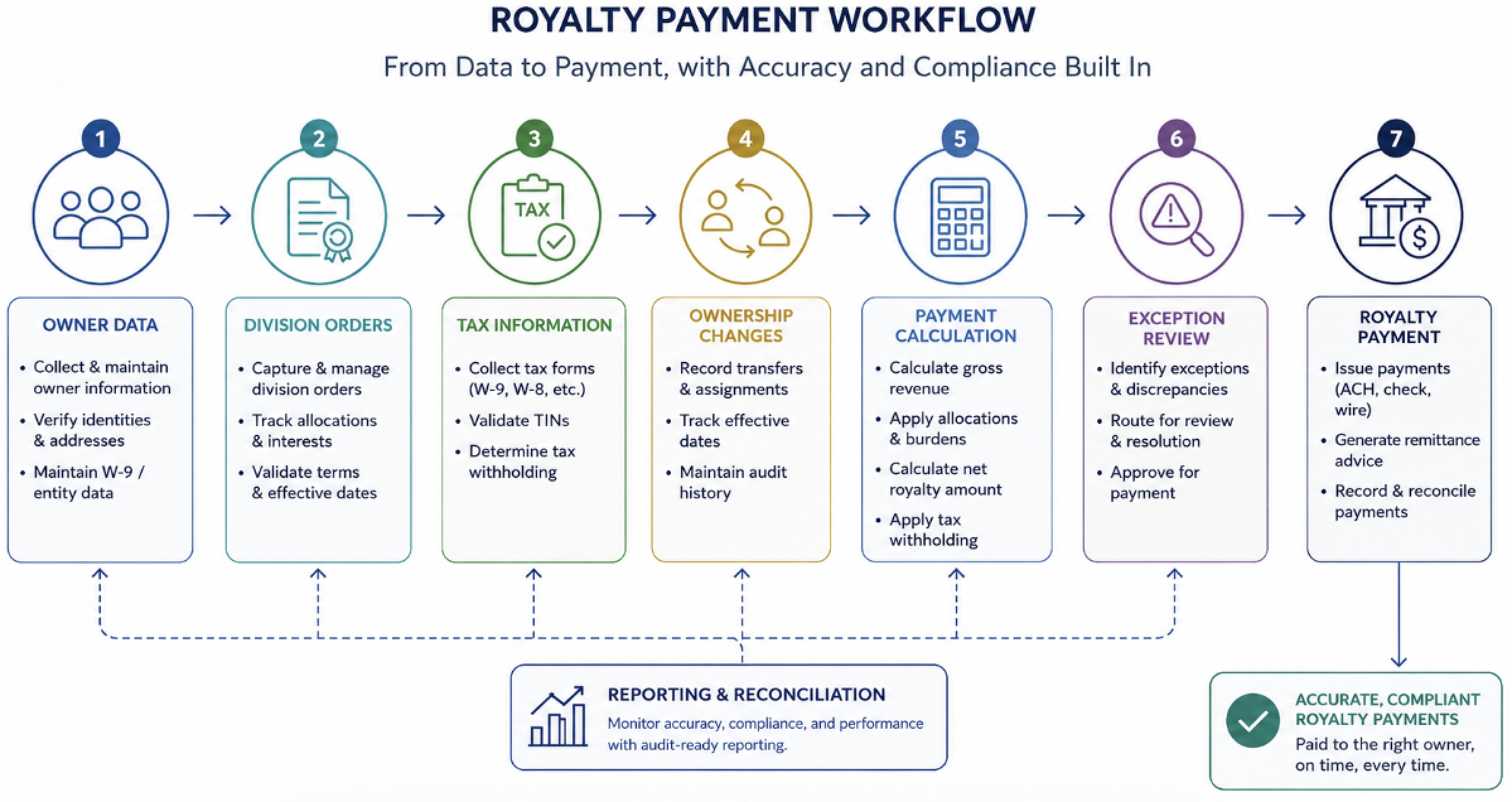
Owner Records Should Act as Payment-Readiness Controls
Owner master data is the foundation of reliable royalty payment management. It should not be treated as a static name-and-address file. A useful owner record should show who the owner is, which properties and interests are connected to that owner, whether tax and payment details are complete, and whether any open issue may block payment.
A small data problem can become a larger payment issue. An outdated mailing address can create returned checks or repeated owner inquiries. A missing tax form can place funds on hold. A name mismatch can delay ownership updates, division order processing, or year-end documentation. None of these issues begin as payment calculation problems, but each one can delay payment release.
A stronger owner record should help teams confirm:
Who the owner is
Which properties and interests are connected to the owner
Whether tax, address, and payment details are complete
Which documents support the current payment status
Whether any open issue may block payment
Who owns the next follow-up action
This where better owner data becomes a royalty payment control. The system should show whether an owner is ready to pay, not only whether the owner exists in the database. Transitioning from basic record keeping to dynamic verification gating helps upstream enterprises optimize their revenue distribution workflows, providing financial and land teams with a reliable framework to sustain compliance and mitigate transactional errors across the asset portfolio.
Division Orders Need Connected Payment Records
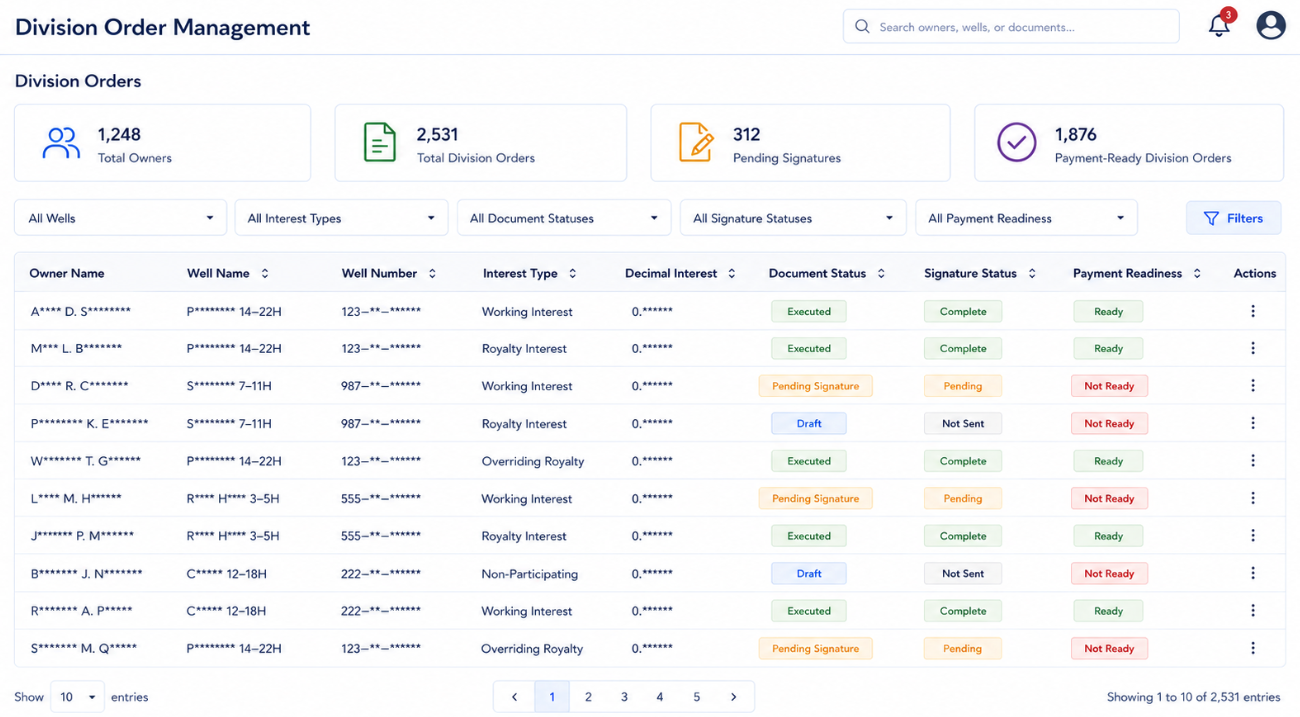
Division orders play a central role in royalty payment accuracy because they connect an owner’s interest to a specific well, lease, unit, or production stream. A signed division order sitting in a folder is useful, but it does not provide enough control if accounting cannot connect it to the owner record, property record, decimal interest, title support, and payment status.
The decimal interest on a division order may look like a small number, but it directly affects payment. If the decimal is missing, outdated, under review, or disconnected from effective-date history, the company may need to hold payment, correct records, or respond to owner questions. Even a temporary gap can create extra work for accounting, land, and owner relations teams.
A connected division order workflow should show:
Owner name and owner number
Well, lease, unit, or property relationship
Interest type and decimal interest
Effective date and version history
Document status and signature status
Supporting title or ownership documents
Payment readiness status
The strongest rule is simple: make it impossible to release a royalty payment when the owner’s division order is unsigned, unlinked, or missing a supported decimal without an assigned owner and release path. This keeps division order gaps from becoming payment-cycle surprises.
Ownership Changes Should Not Become Hidden Exceptions
Ownership records do not stay still. Interests can transfer through sales, inheritance, trust changes, company restructuring, name changes, address updates, or acquisition data migration. Each change can affect who should be paid, which documents are required, and whether payments should continue, pause, or be redirected.
When these changes are handled through email chains and separate spreadsheets, exception pressure grows quickly. Land may receive transfer documents, owner relations may communicate with the owner, and accounting may process payment from an older record. If the workflow is not connected, no one has a reliable view of what changed, what is missing, and which payments are affected.
A better ownership-change workflow should:
Record what changed and when it became effective
Attach transfer, probate, trust, or entity documents
Identify affected owners, wells, leases, and payment records
Route review to land, accounting, or owner relations
Hold affected payments when documentation or approval is incomplete
Preserve the change history for owner questions and audit review
This helps teams control ownership change before it becomes a payment exception. The goal is not just to update a record; it is to protect payment accuracy while the ownership record changes. Enforcing this dynamic operational oversight allows land and revenue accounting departments to maintain seamless transactional continuity, providing a dependable validation structure that reduces revenue leakage and enhances multi-party trust during complex title transitions.
Payment Holds Need Clear Release Paths
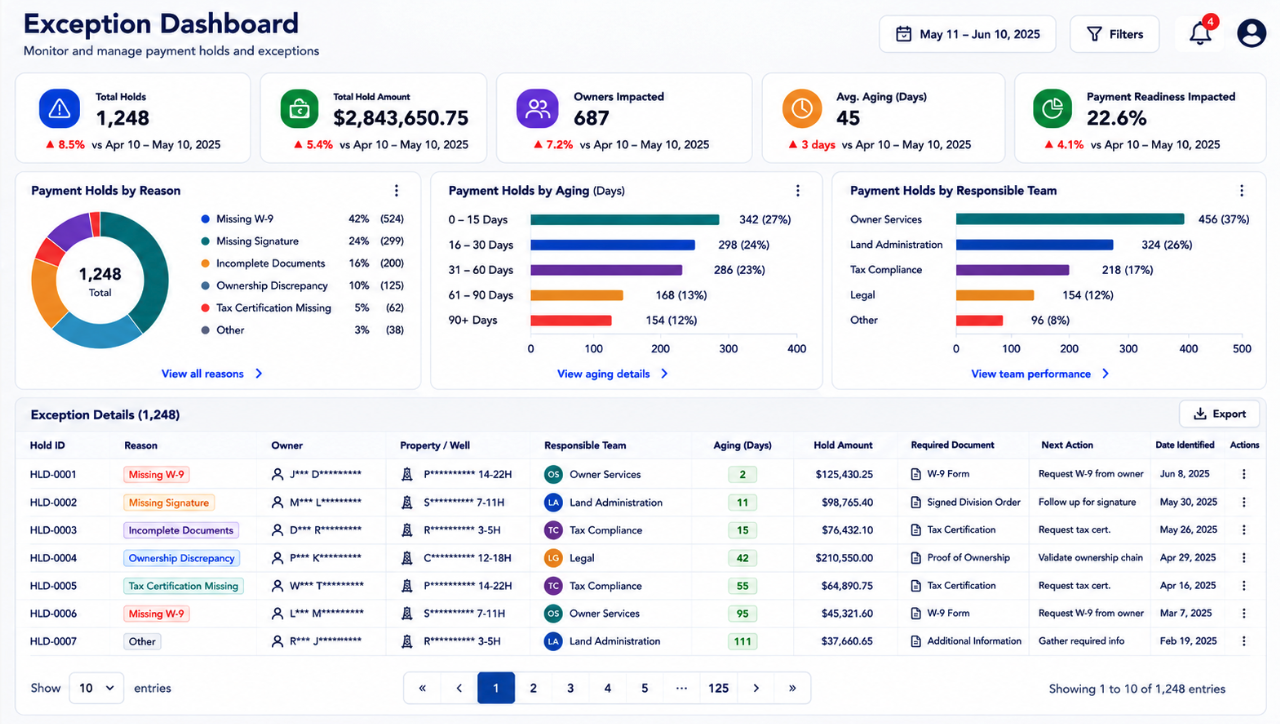
Payment holds are sometimes necessary, but unclear holds create frustration for both companies and owners. If a payment is held because of missing tax information, an unsigned division order, a title issue, an address problem, ownership transfer, or minimum payment threshold, the reason should be visible and easy to explain.
A payment hold should not be just a status code. It should connect to the underlying issue, required action, responsible team, supporting document, communication history, and release status. When an owner asks why payment has not been received, the team should be able to answer from the payment workflow instead of searching through disconnected records.
A useful hold review should show:
Hold reason
Owner and property affected
Required document or action
Responsible team
Aging days
Communication history
Release status
A clear rule improves discipline: make it impossible to release a held payment when the release reason, required document, responsible owner, or approval trail is missing. This prevents vague payment holds from becoming recurring owner questions. Embedding this systematic audit gate into the treasury workflow helps energy operators significantly improve internal controls, providing financial and land teams with a reliable framework to maintain documentation completeness and strengthen revenue governance.
Owner Communication Belongs inside the Payment Workflow
Owner relations is not separate from royalty accounting. It is one of the workflows that protects payment accuracy and owner trust. Owner questions about address changes, tax forms, ownership transfers, division orders, payment details, and unclaimed property all depend on connected owner records.
If communication history is separated from payment data, teams lose context. An owner may have already submitted a document, asked a question, or received an explanation, but that information may not be visible to the next person handling the issue. This creates repeated conversations, slower resolution, and inconsistent owner experience.
A stronger owner communication workflow should keep emails, notes, uploaded documents, call outcomes, and open requests close to payment status and division order records. When owner relations, accounting, and land teams work from the same record, the company can respond faster and explain payment decisions more consistently.
This matters because payment delay is not only a financial issue. It is also a trust issue. Owners expect the company to know what is missing, who is reviewing it, and what must happen before payment can be released. Establishing this transparent tracking matrix helps upstream operators optimize stakeholder communications, providing a standardized reporting foundation that systematically mitigates multi-party friction and reinforces institutional accountability.
Cleaner Owner Data Supports Reporting and Close
Royalty payment accuracy also affects reporting and period-end work. When owner records are incomplete, payment exceptions can carry into reconciliation, accrual review, tax reporting, suspense review, and management reporting. Small owner-data gaps become larger reporting issues when they remain unresolved across multiple periods. Clean owner data helps accounting teams close with fewer surprises. Payment holds can be reviewed by reason. Division order status can be tracked. Ownership changes can be monitored. Unresolved owner issues can be escalated before they delay payment or reporting.
Management does not need only a list of delayed payments. It needs a payment-readiness view that answers:
Which owners are missing tax, address, or payment details?
Which division orders are unsigned or disconnected from payment records?
Which ownership changes are waiting for review?
Which payment holds are aging without action?
Which owner issues may affect the next payment cycle?
Which team must act today to release payment or protect close timing?
Without this view, teams discover owner-data issues when payments fail to release. With it, companies can clear blockers before the payment run begins. Implementing this preventative validation process allows revenue accounting teams to streamline the monthly distribution cycle, providing upstream enterprises with a reliable operational structure that mitigates transactional delays and enhances overall data governance efficiency.
How Petrofly Helps Reduce Royalty Payment Delays
Petrofly can help oil and gas teams reduce payment delays by keeping owner records, division orders, tax status, documents, payment holds, and communication history closer to the same workflow. This is useful when delays come from incomplete records or unclear follow-up rather than the payment calculation itself.
Petrofly supports royalty payment control through:
Maintain owner, address, tax, documents, payment preferences, and status in a more organized structure.
Track DOI details, signatures, documents, interests, effective dates, and payment impact.
Show why a payment is held, what action is needed, who follows up, and whether it is ready for release.
Cloud-based teamwork with consistent owner and payment records.
Petrofly assists after rollout with data cleanup, workflow updates, document organization, reporting refinements, and payment questions.
Without this structure, royalty teams spend more time chasing owner data, explaining payment delays, and resolving holds after the payment run has already slowed. With Petrofly, teams can control owner data earlier and reduce avoidable payment delays before they reach owners. Owner data without control creates payment friction; connected owner data becomes a foundation for faster payment release and stronger owner trust.
Software Turns Owner Data into Payment Discipline
Royalty management software should do more than calculate payments. It should help companies maintain owner records, manage division orders, track payment holds, connect documents, support communication, and monitor exceptions. Without that workflow discipline, payment delays can continue even when the calculation itself is correct.
A useful system should connect owner master data, property records, decimal interests, document status, tax information, payment preferences, communication history, and reporting outputs. This creates one operational view for accounting, land, owner relations, and management. It also reduces the risk of one team working from a record that another team has already updated.
For oil and gas companies, better owner data is not only an administrative improvement. It is a payment control strategy. When owner records are clean, connected, and visible, companies can reduce avoidable delays, answer owner questions faster, and protect trust in the royalty payment process.