
How Working Interest Owners Can Review JIB Charges Before Payment

Summary
×JIB Review Starts with Confidence, Not Delay
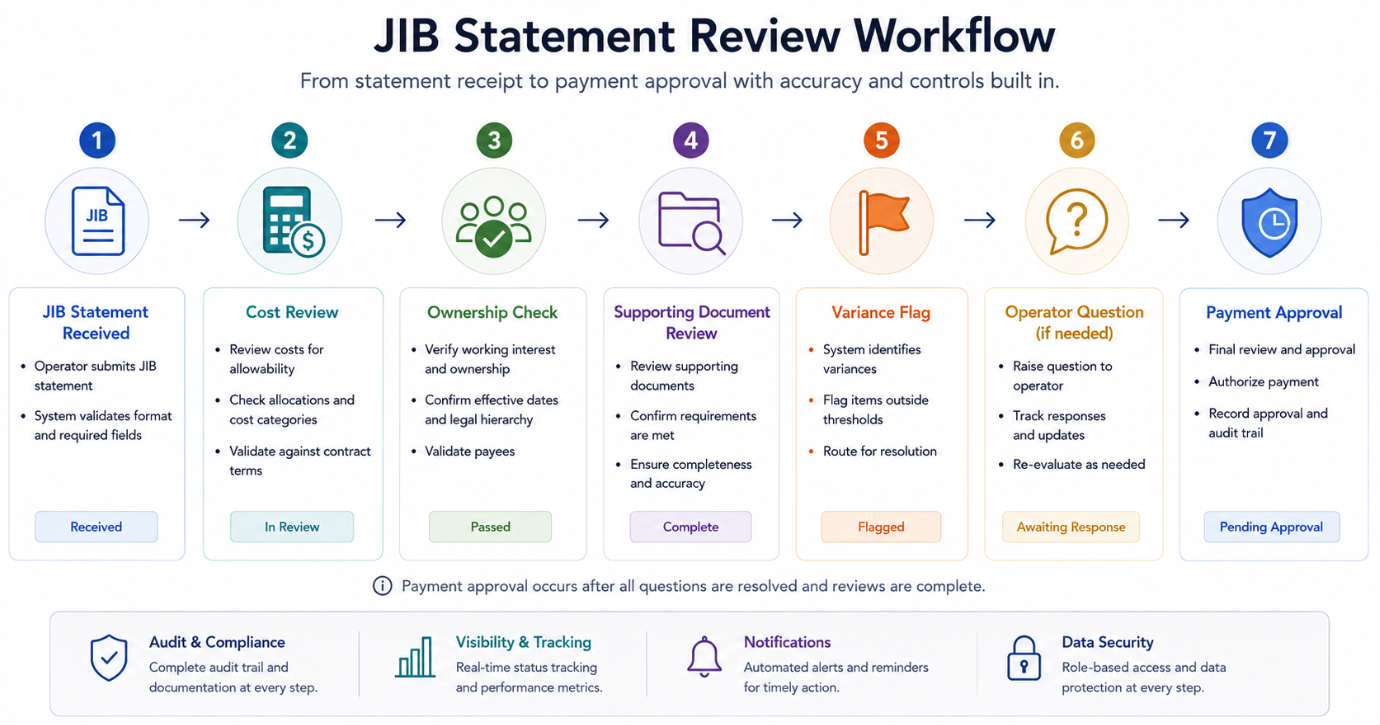
For non-operator working interest owners, a Joint Interest Billing statement is more than a monthly invoice from the operator. It is a view into field activity, vendor work, lease operating expense, workover activity, repair events, and ownership exposure on operated assets. Because the owner is not managing the field directly, JIB review becomes the control point for deciding whether a cost is ready to pay.
The goal is not to challenge every charge. Many JIB charges are routine, valid, and expected. The real goal is to identify the few charges that need more context before approval: a sharp cost increase, a missing invoice, a confusing cost category, a questionable working interest percentage, or a charge that does not match the expected well or period.
A mid-size working interest owner reviewing multiple operated wells may lose hours every month moving between PDF statements, spreadsheets, invoice folders, email threads, and operator responses. The review becomes slower not because the owner is being difficult, but because the evidence behind the charge is not connected.
A practical review should answer:
Which well and period does the cost belong to?
Which working interest percentage was applied?
Is the charge supported by invoice or operator detail?
Has the cost changed significantly from prior months?
Is the charge ready for payment, or does it need clarification?
Ownership Position Should Be Confirmed Before Cost Review
Working interest is one of the most important fields in JIB review because it determines how much of a shared cost belongs to each owner. A small decimal difference may look minor on one line, but it can become meaningful when operating costs are high or when the same percentage is applied across multiple months.
Before reviewing detailed charges, owners should confirm that the statement uses the correct working interest for the correct well and accounting period. This is especially important after acquisitions, divestitures, farmouts, title updates, or effective-date changes. If one file reflects the new ownership position but the JIB review still uses the old percentage, the owner may approve a payment that does not match the actual obligation.
A strong review process should preserve ownership history, not only current ownership. The owner should be able to see when a working interest changed, which well it applied to, which effective date controls the statement, and which prior JIB statements may be affected.
Ownership review should confirm:
Current working interest by well
Effective date of ownership changes
Whether the statement period matches the correct ownership percentage
Any recent acquisition, divestiture, farmout, or title update
Prior JIB statements affected by the same change
The strongest rule is simple: make it impossible to approve a JIB payment when the working interest applied to the statement does not match the ownership record for that well and period. By enforcing this programmatic gate, joint venture accounting shifts from a game of catch-up to absolute risk prevention. This keeps ownership review from becoming a costly, retrospective after-payment correction.
Charge-Level Review Explains What the Total Hides
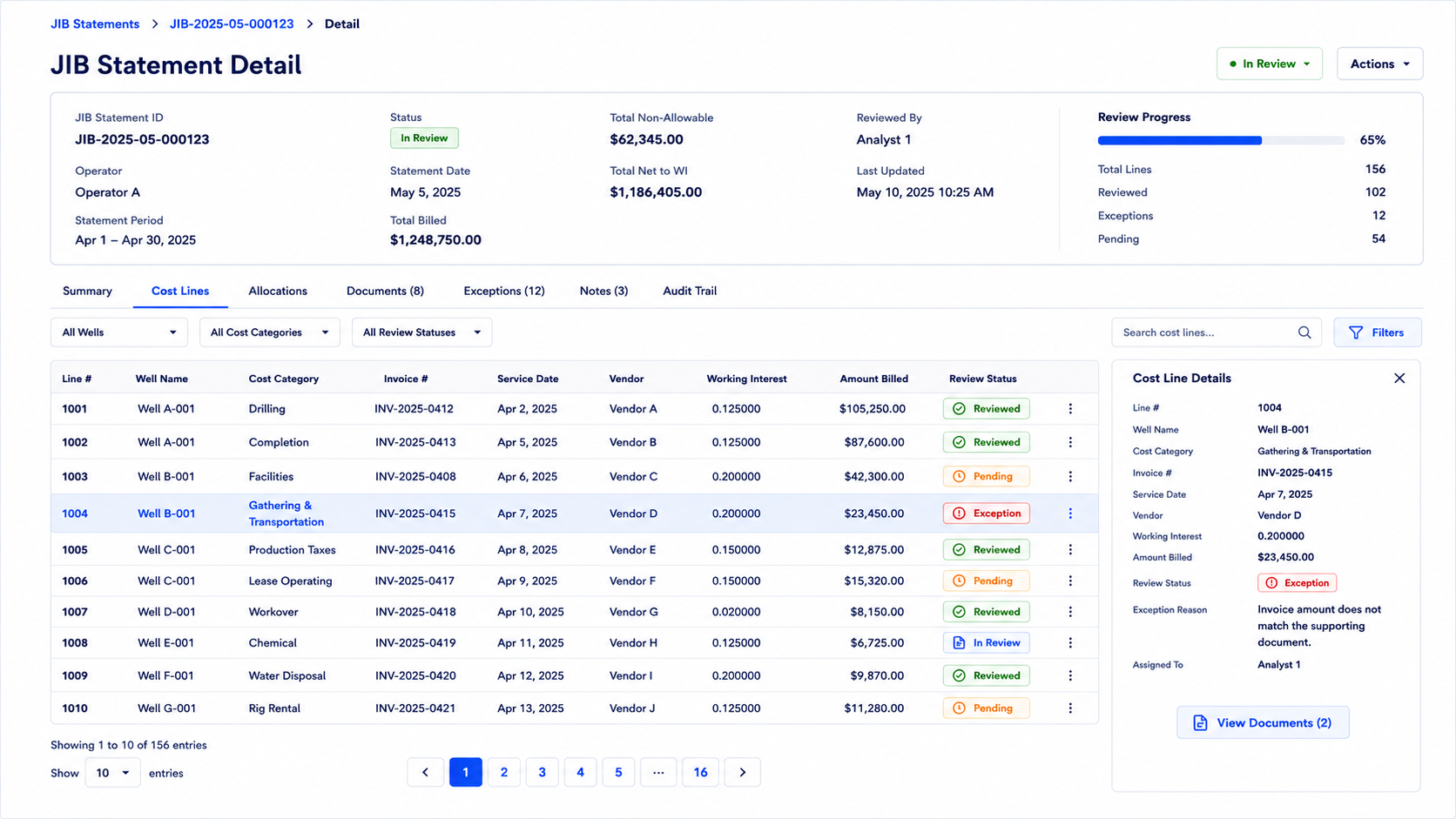
A high monthly JIB total may attract attention, but the total alone rarely explains the issue. The useful review happens at the charge level. Owners need to know which cost category moved, which well was affected, what service was performed, whether the invoice is attached, and whether the operator’s explanation matches the charge.
A statement may show a large increase in field services, compression, water disposal, repairs, chemical treatment, or equipment rental. The increase may be valid if it reflects a workover, emergency repair, production issue, seasonal field activity, or deferred maintenance. Without supporting detail, however, the owner cannot tell whether the charge is expected, duplicated, misclassified, or allocated to the wrong asset.
A better review process moves the owner from a broad question to a precise one. Instead of asking, “Why is this month so high?” the review should make it possible to ask, “Why did compressor repair on Well 12 increase by this amount for this service period, and where is the invoice support?”
Variance Checks Should Point to the Exact Driver
Variance review helps owners focus attention where it matters. A cost increase can be measured by dollar amount, percentage change, or both. A small percentage increase on a large recurring charge may matter more than a large percentage increase on a small one-time item. Without this dual-threshold filtering, teams often drown in accounting noise and suffer from audit fatigue. By automating this intelligence, energy companies can insulate their bottom line from silent revenue leakage while maximizing operational efficiency.
A simple formula can help: JIB Change % = (This Month JIB - Last Month JIB) ÷ Last Month JIB × 100%. If last month’s JIB was USD 8,000 and this month’s JIB was USD 18,000, the increase is 125%. That does not automatically mean the operator made an error. It means the movement deserves review, especially if the change is not tied to a known workover, repair event, field issue, or operator note. The best variance review does not stop at the total. It identifies the exact well, cost category, vendor, invoice, and period driving the change. That turns a vague concern into a reviewable question.
Useful variance checks include:
Month-over-month change by well
Cost category movement
Vendor or invoice-level increase
One-time workover or repair charges
Repeated charges that appear unusual
Costs that increased without operator explanation
This kind of review helps working interest owners avoid two common mistakes: approving unusual costs too quickly or delaying routine costs because the total looks high without context. Stripping away the contextual data behind joint interest billing leads to reactive decision-making that strains operator relations. By embedding automated materiality logic, non-operators gain the precise clarity needed to fast-track legitimate expenses while instantly flagging true anomalies.
Support Documents Should Follow the Charge
Many JIB questions happen because the charge is visible but the support is not. A statement may show “repairs” or “field services,” but the owner may need the vendor invoice, service date, work description, well reference, and operator explanation before approving payment. A valid cost can still create delay if the support is difficult to find.
Excel can record that a support file exists, but it does not always keep the file attached to the exact line item. A PDF may sit in an email thread, an invoice may remain in a shared folder, and the explanation may live in someone’s message. Months later, reconstructing the context can take longer than the original review.
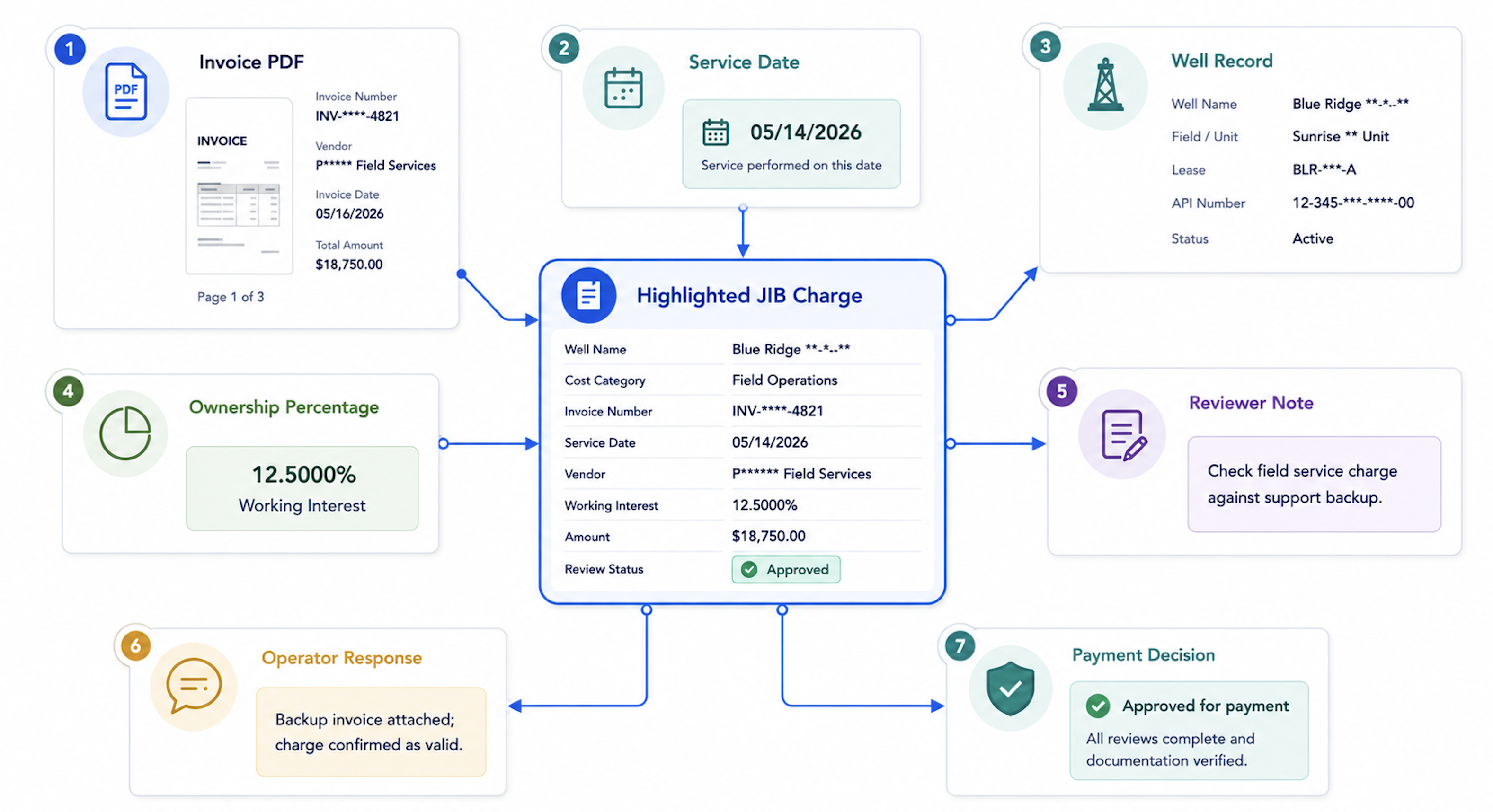
A stronger workflow keeps support close to the cost. When the reviewer opens a JIB line item, the invoice, service date, well record, ownership percentage, reviewer note, operator response, and payment decision should be visible in the same place. That makes the review faster and also creates a better audit trail if the same charge is questioned later.
Operator Questions Should Be Specific and Preserved
When a JIB charge is unclear, the quality of the question matters. A broad question such as “Why is this so expensive?” can force the operator to investigate from the beginning. A specific question with well name, invoice number, service period, cost category, working interest, and variance amount is easier to answer and easier to track.
The question itself should become part of the review record. If a charge is questioned, the question, operator response, supporting document, final decision, and payment status should remain connected to the original line item. This prevents the same issue from being reopened later without context.
A useful operator question may include:
Well name and statement period
Cost category and invoice number
Amount billed and ownership percentage applied
Prior-period comparison or variance amount
Specific document or explanation requested
This preserves a professional relationship with the operator. The goal is not unnecessary friction. The goal is to resolve uncertainty with enough detail to support payment, reporting, and future reference. In the energy sector, endless joint interest billing disputes can cripple strategic alliances and stall critical asset development. Transforming the verification process into a transparent, data-driven workflow protects the owner’s capital while fostering a culture of mutual trust and operational alignment.
JIB Review Should Connect Cost to Revenue
JIB review becomes more useful when it is connected to revenue. A charge may be reasonable on its own, but the owner still needs to understand how the cost affects the well’s cash position. If JIB is tracked separately from revenue, the owner may miss the larger performance pattern.
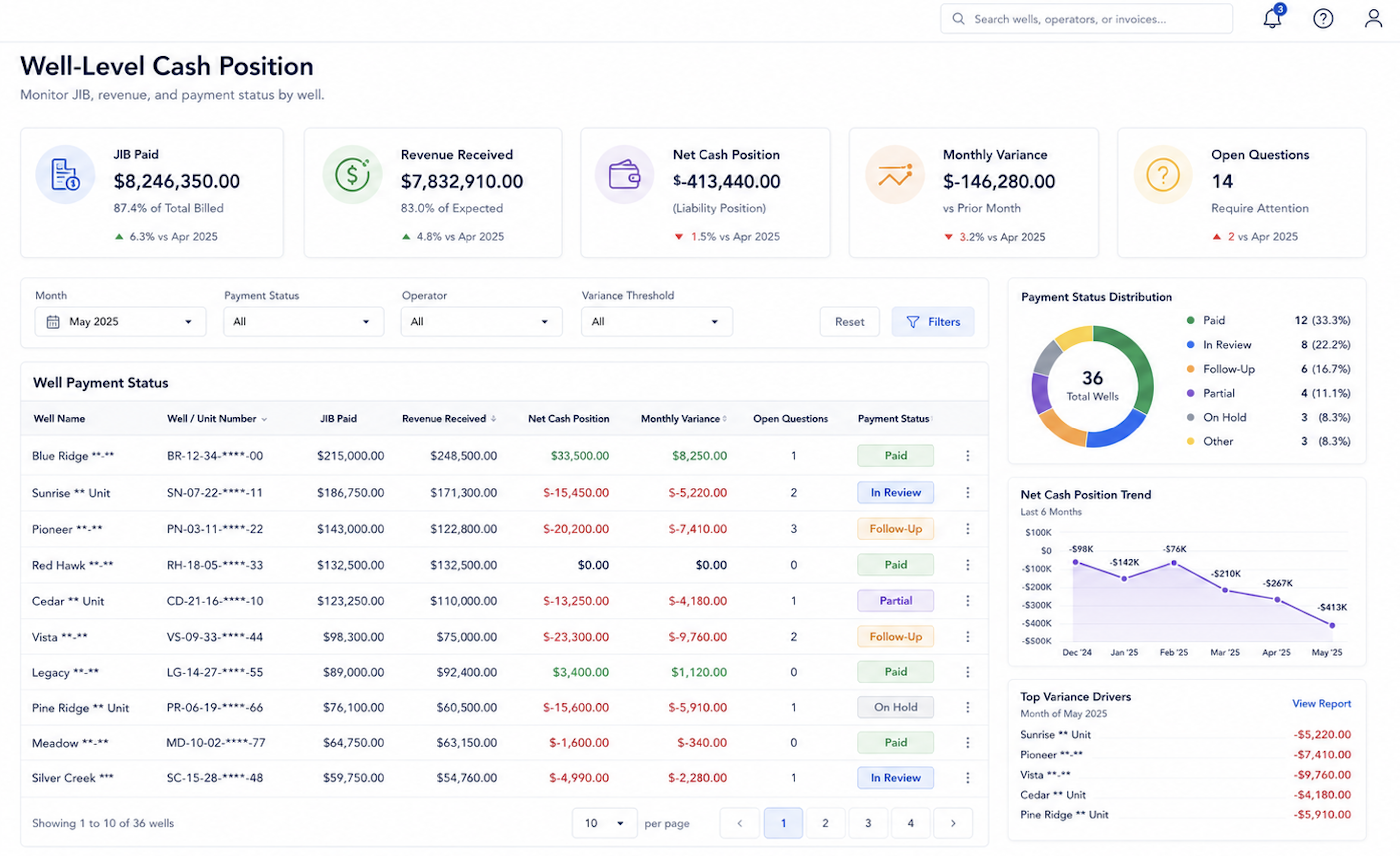
A simple view is: Net Cash Position = Revenue Received - JIB Paid. If a well generated USD 15,000 in revenue and the owner paid USD 9,000 in JIB, the monthly net cash position is USD 6,000. This does not replace full economic analysis, but it helps owners see whether the well’s cost and revenue are moving in a healthy direction.
For working interest owners, JIB is not only an expense record. It is part of asset intelligence. If JIB keeps rising while revenue keeps falling, the owner may need to review production decline, downtime, commodity price movement, field activity, repair patterns, or cost classification more closely.
Excel Can Record Review, but It Does Not Always Control It
Excel is useful for simple tracking. It can record statement dates, amounts, formulas, comments, and payment status. For a small number of wells and operators, that may be enough if the owner has strong file discipline and reliable support from operators. The limitation appears when review becomes multi-step. One person updates the spreadsheet, another asks the operator for support, a third approves payment, and the supporting invoice remains outside the file. Excel can store information, but it does not naturally control review ownership, document linkage, status changes, or historical explanations.
That is why spreadsheet problems are often workflow problems. The issue is not only whether a formula is correct. The issue is whether the owner can explain how a JIB charge was reviewed, which support was used, who approved it, whether the operator responded, and why payment was made.
Management Needs a JIB Payment-Decision View
Management does not need only a monthly total by operator. Leaders need to see which charges are ready to pay, which charges are waiting for support, which ownership records need review, which variances are unusual, and which wells are affecting cash flow. Relying on compressed monthly totals leaves c-suite executives flying blind during critical market shifts. Implementing grain-level visibility across these five focal points transforms financial data into proactive ammunition for instant cash flow optimization.
A useful JIB payment-decision view should answer:
Which JIB charges are ready for payment?
Which charges are missing invoice or operator support?
Which charges use working interest percentages that need review?
Which cost categories moved sharply from the prior month?
Which operator questions are open, answered, or overdue?
Which wells have rising JIB and declining revenue?
Which payment decisions are waiting on reviewer approval?
Which owner or reviewer must act today to avoid late payment or weak approval?
Without this view, teams approve payments from totals and reconstruct the evidence later. With it, working interest owners can separate routine charges from review items, pay with more confidence, and question operators with better context. Forcing staff to reverse-engineer an audit trail after cash outflow exposes the business to massive compliance penalties and systemic leakage. Transitioning to upfront accounting automation permanently shifts the leverage back to the investor, turning the verification process into an impregnable defensive line.
How Petrofly Helps Working Interest Owners Review JIB Charges
Petrofly helps working interest owners review JIB charges with more structure by connecting line items, ownership records, support documents, variance checks, operator responses, revenue context, and payment status in one workflow. This helps teams move beyond reviewing totals in one place and invoices somewhere else.
Petrofly supports JIB review through:
Line-item traceability: Connect JIB charges with wells, cost categories, invoices, service dates, notes, reviewer decisions, and payment status.
Working interest visibility: Keep ownership percentages and effective-date changes easier to review before payment approval.
Variance and support tracking: Flag unusual movement and keep invoice support, operator responses, and reviewer notes close to the related charge.
Revenue and payment context: Help owners compare JIB paid, revenue received, net cash position, open questions, and payment readiness by well.
Cloud-based review and dedicated support: Let office teams, management, and authorized reviewers work from the same information, while Petrofly helps configure fields, organize data, refine workflows, and respond when charge details or payment decisions need clarification.
Without this structure, working interest owners spend more time searching for support, reconciling spreadsheets, and asking broad questions. With Petrofly, JIB review becomes more traceable, more focused, and easier to connect to payment confidence. JIB review without control becomes month-end searching; connected JIB review becomes better payment discipline.
A Stronger Workflow Improves Payment Confidence
Better JIB review does not need to make payment slower. In many cases, it makes payment faster because the right information is available earlier. When charges, support files, review notes, working interest records, revenue context, and payment status are connected, owners spend less time searching and more time making decisions.
A stronger process helps working interest owners separate routine charges from items that require attention. It can flag unusual movement, preserve operator responses, connect documents to charges, and show the relationship between JIB and revenue. This gives owners a clearer view of both monthly payment obligations and longer-term asset performance.
For non-operator owners, the deeper value is control without direct operation. They may not manage daily field activity, but they still need reliable information to manage cash exposure, ownership records, and asset decisions. When JIB review becomes a connected workflow, working interest owners can pay with more confidence and question with better context.