
How Operators Can Reduce JIB Payment Delays and Protect Project Cash Flow

Summary
×JIB Delays Affect More Than Accounts Receivable
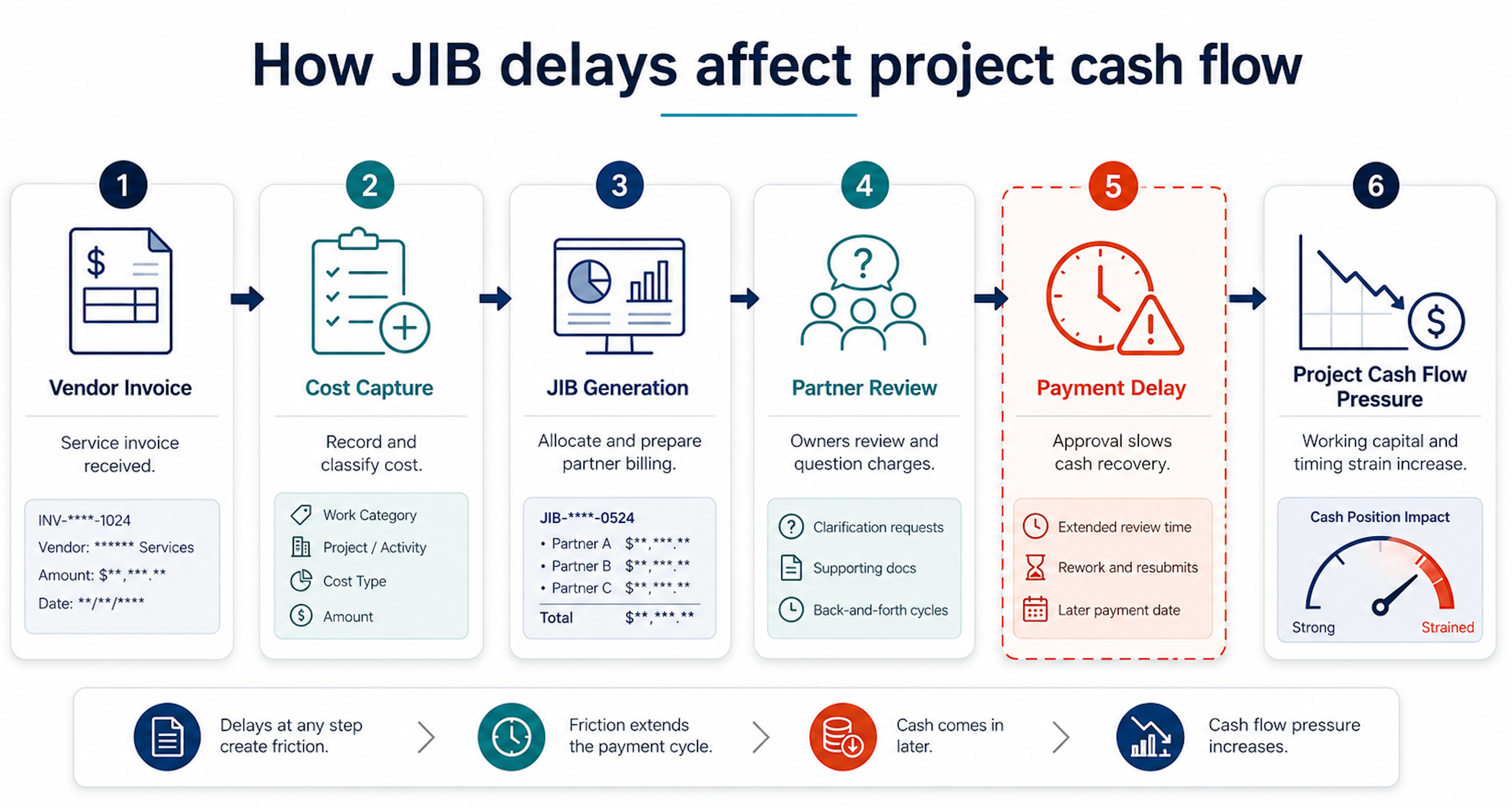
In joint oil and gas operations, the operator often pays or records operating costs first, then allocates billable expenses to non-operating partners based on working interest. When partner payment slows down, the operator may still need to fund field activity, vendor invoices, maintenance work, workovers, and future project execution. The delay is therefore not only an accounts receivable issue. It becomes a cash flow issue.
The visible problem may be an overdue JIB balance, but the real issue usually starts earlier. A partner may pause payment because a charge is unclear, a vendor invoice is missing, an AFE reference is weak, an ownership percentage looks outdated, or the statement does not explain why the cost is billable. A stronger follow-up email will not solve those problems if the billing record itself does not support fast review.
A mid-size operator billing USD 900,000 in monthly JV costs with an average 20-day partner delay may be carrying roughly USD 600,000 of working capital exposure during the delay period. That amount may eventually be recovered, but the cash pressure still affects planning, vendor timing, and internal project flexibility. The sharper question is: can this JIB statement be reviewed, approved, and paid without the partner asking for basic support? If the answer depends on emails, PDFs, spreadsheets, or manual explanation, the delay has already started before the due date.
Delay Reasons Should Be Classified Before Follow-Up Begins
JIB payment delays rarely come from one cause. In many cases, partners are not refusing to pay. They are pausing payment because the bill is unclear, support is incomplete, or the charge does not match what they expected. If the operator only sees “overdue,” the team cannot tell whether to follow up, explain, adjust, escalate, or wait for partner approval.
A useful JIB workflow should separate overdue balances by reason, not only by age. A 45-day balance caused by missing invoice support should not be managed the same way as a 45-day balance caused by partner cash flow constraints. A disputed AFE overrun needs a different response from a statement that has been approved but not scheduled for payment.
A practical delay view should classify:
Late billing
Cost disputes
AFE overrun questions
Ownership percentage questions
Missing invoice attachments
Slow partner approval cycles
Partner cash flow constraints
This turns aging from a static report into an action map. Relying on traditional dead-end ledger summaries frequently leaves back-office financial teams struggling to prioritize collections effectively during tight close timelines. By embedding this dynamic diagnostic layer directly over outstanding joint interest balances, the enterprise successfully eliminates the administrative inertia that typically delays monthly cash recoveries. This active prioritization ensures that every historical dispute is funneled into its proper resolution path from day one.
Billing Clarity Should Reduce Partner Review Time
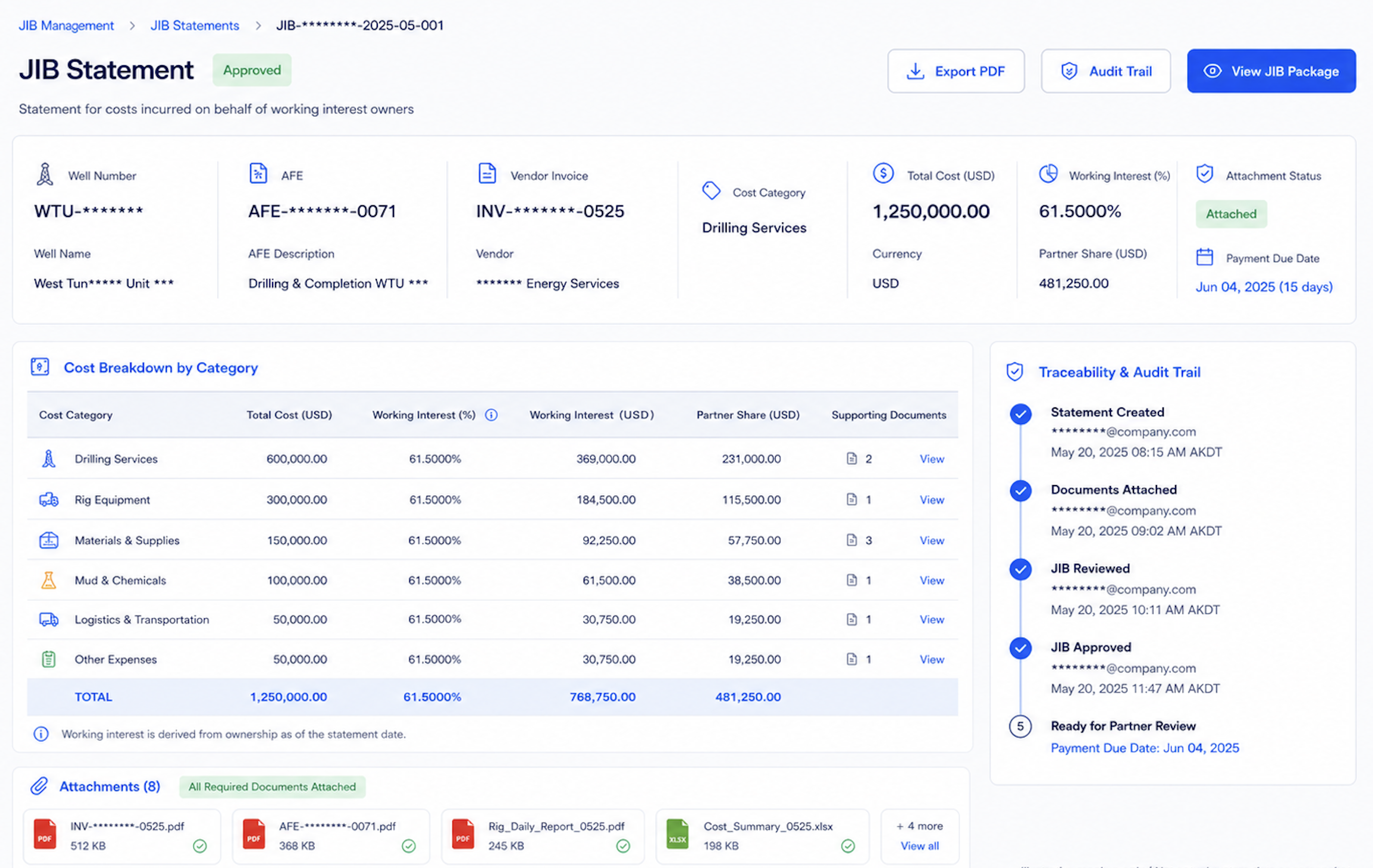
JIB clarity has a direct effect on payment speed. When a partner receives a statement that shows only amounts, dates, and broad cost categories, the partner may need to ask for invoice details, AFE references, cost sources, working interest percentages, and allocation logic. Each question creates another pause in the approval cycle.
A stronger JIB statement should help the partner understand three things quickly: where the cost came from, why it is billable, and how the partner share was calculated. For example, a USD 48,000 well service charge labeled only as “well service cost” can trigger follow-up. If the statement shows the well number, AFE number, vendor invoice, service date, cost category, total cost, working interest, partner share, attachment status, and due date, review becomes faster.
A clear billing record should show:
Well, lease, field, or project reference
AFE number or agreement basis when relevant
Vendor invoice and service date
Cost category and work description
Total cost and partner working interest
Partner share and payment due date
Attachment status and review notes
The goal is not to make every statement longer. Overloading joint interest billings with unnecessary document clutter frequently creates administrative confusion and slows down the validation process for working interest partners. By focusing internal energy on establishing an on-demand retrieval repository, accounting teams can maintain pristine document hygiene while keeping historical data perfectly accessible. This strategic filtering ensures that core accounting workflows remain highly efficient throughout the entire closing cycle.
Exceptions Should Be Cleared Before Statements Are Issued
Many JIB disputes do not begin on the due date. They begin before billing, when costs exceed expectations, cost categories are unclear, invoice support is missing, ownership changes affect allocation, or a charge may not match agreement rules. If these issues are only found after the JIB statement is issued, payment delay becomes much harder to avoid.
Pre-billing review should catch the items most likely to slow partner approval. The system should flag unusual cost movement, missing invoice support, charges without AFE linkage, ownership changes that affect allocation, duplicate vendor charges, and costs that may require agreement review. Finance can then resolve questions before the partner turns them into a dispute.
A simple exception check can use cost increase percentage: Cost Increase % = (Current Period Cost - Prior Period Cost) ÷ Prior Period Cost × 100%. If well service cost was USD 60,000 last month and USD 96,000 this month, the increase is 60%. That does not automatically mean the charge is wrong. It does mean the item deserves review before the statement reaches the partner.
Pre-billing review should focus on:
Cost spikes without explanation
Missing invoice or service support
Charges without AFE linkage
Ownership changes affecting allocation
Duplicate or unusual vendor charges
Costs that may not match agreement rules
The strongest rule is simple: make it impossible to issue a JIB statement while a high-impact charge has missing support, unresolved AFE linkage, or an ownership mismatch without an assigned owner and disposition. This keeps avoidable disputes from becoming payment delays.
Payment Status Should Be Visible After Billing
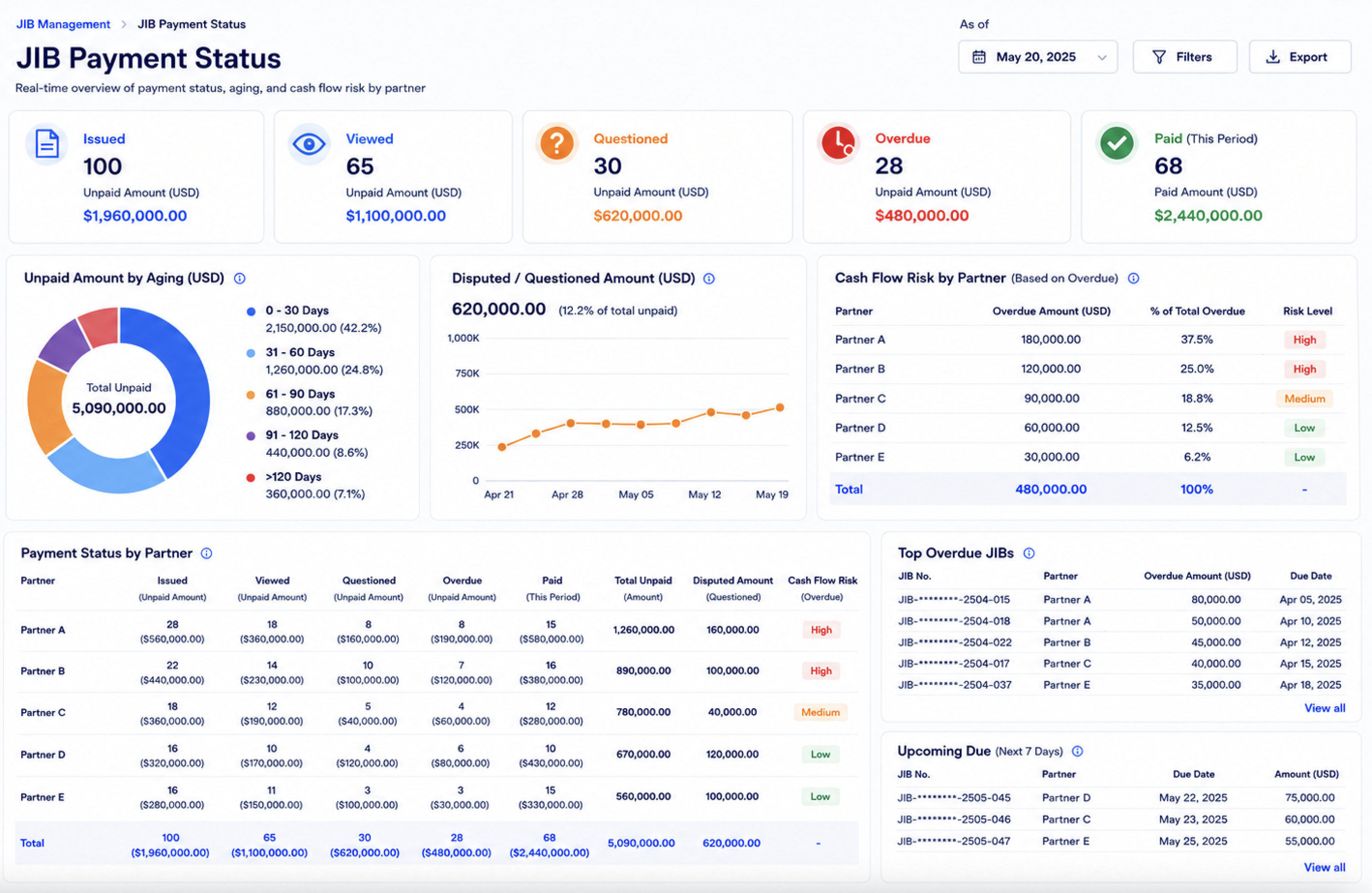
Many operators can generate JIB statements, but payment tracking still depends on emails, spreadsheets, and manual reminders. That makes it difficult to know whether a statement has been issued, viewed, questioned, approved, partially paid, overdue, or escalated. A statement may look complete in accounting while cash recovery remains unclear. A better approach is to manage JIB payment status as a structured workflow. Each statement should have a clear status and next action. The finance team should not wait until month-end to discover that a large partner balance has not moved.
A practical payment status workflow should show:
Draft
Issued
Viewed
Questioned
Approved
Partially paid
Paid
Overdue
Escalated
Automated reminders can help, but reminders should not only say “please pay.” Effective follow-up includes statement number, amount, due date, days overdue, support file links, contact information, dispute status, and cash flow impact. For partners with recurring delays, the system should prioritize follow-up by aging, amount, reason, and risk.
Partner Transparency Reduces Collection Effort
Payment delays often happen because non-operating partners need more information for their own internal approvals. They may need to verify costs, confirm allocation percentages, review attachments, compare AFE limits, and route the statement internally. If the operator does not provide enough information, the partner’s approval process slows down.
A shared partner view can reduce that friction. Partners can review JIB details, attachments, AFE references, prior statements, payment status, and dispute history. Operators can also see whether the partner has viewed the statement, submitted a question, or left an issue unresolved. Transparency does not mean exposing every internal record. It means placing the information required for payment in the right place. The easier partners can self-check, the fewer repeated questions the operator’s finance team needs to answer.
Agreement Mechanisms Need a Factual Record
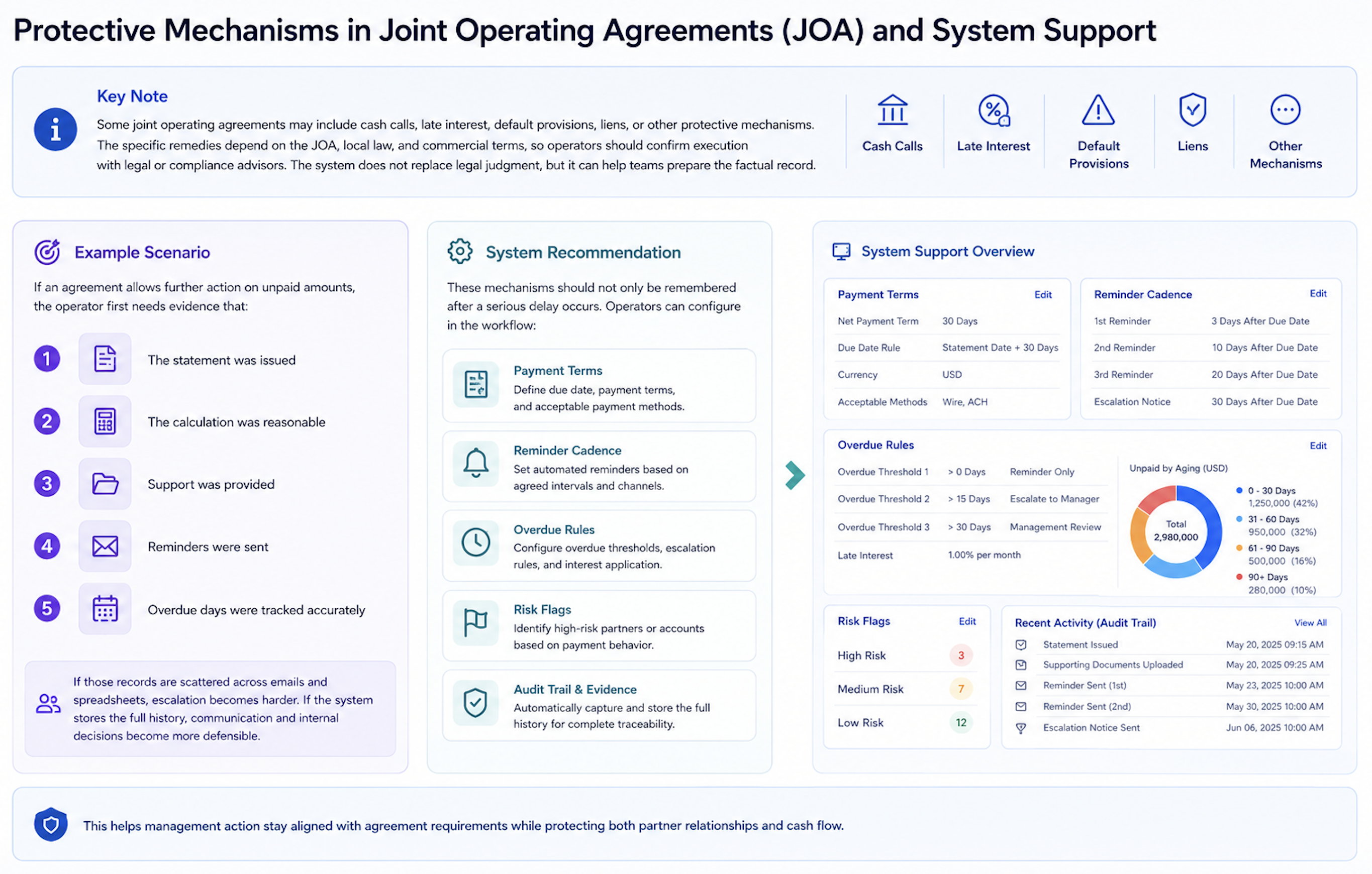
Some joint operating agreements may include cash calls, late interest, default provisions, liens, or other protective mechanisms. The exact remedies depend on the JOA, local law, and commercial terms, so operators should confirm execution with legal or compliance advisors. The system does not replace legal judgment, but it can help teams maintain the factual record needed for escalation.
If an agreement allows further action on unpaid amounts, the operator first needs evidence that the statement was issued, the calculation was reasonable, support was provided, reminders were sent, questions were answered, and overdue days were tracked accurately. If those records are scattered across emails and spreadsheets, escalation becomes harder. If they stay connected to the billing workflow, communication and internal decisions become more defensible.
These mechanisms should not only be remembered after a serious delay occurs. Payment terms, reminder cadence, overdue rules, escalation thresholds, and risk flags should be visible in the workflow. That keeps management action aligned with agreement requirements while protecting partner relationships and cash flow.
Management Needs a JIB Cash-Flow Risk View
Management does not need only an overdue balance total. Relying on traditional dead-end ledger summaries frequently leaves back-office financial teams struggling to prioritize collections effectively during tight close timelines. By embedding a dynamic diagnostic layer directly over outstanding joint interest balances, the enterprise successfully eliminates the administrative inertia that typically delays monthly cash recoveries. This active prioritization ensures that every historical dispute is funneled into its proper resolution path from day one.
A useful JIB cash-flow risk view should answer:
Which JIB statements are overdue, questioned, partially paid, or escalated?
Which unpaid amounts are delayed because of missing support, AFE questions, ownership issues, or partner approval cycles?
Which partners consistently fall below the average collection rate?
Which wells, projects, or cost categories create recurring disputes?
Which balances are over 30, 60, or 90 days?
Which unpaid amounts create the highest working capital exposure?
Which statement needs support, explanation, adjustment, escalation, or agreement-based follow-up?
Which owner must act today to protect cash recovery?
Without this view, operators chase overdue balances after cash pressure has already built. Relying on reactive accounting practices and manual spreadsheet tracking frequently leaves back-office financial teams struggling to identify systemic collection bottlenecks before they impact daily operations.
How Petrofly Helps Operators Reduce JIB Payment Delays
Petrofly can help operators bring more visibility to the JIB payment workflow by connecting billable costs, ownership data, support documents, and partner records. Managing these interconnected billing components within isolated spreadsheet systems or disconnected email threads frequently introduces severe administrative tracking gaps during the monthly close cycle.
Petrofly supports JIB cash-flow control through:
Clearer billing records: Link charges with wells, AFEs, invoices, working interest, partner share, due dates, and support status.
Earlier exception review: Identify missing support, cost spikes, ownership changes, allocation issues, and AFE questions before billing.
Payment follow-up visibility: Track issued, viewed, questioned, overdue, partially paid, paid, and escalated statements.
Partner communication support: Keep reminders, support files, questions, responses, and dispute notes close to the billing record.
Flexible adoption and cloud-based teamwork: Start with priority workflows, use cloud-based access, and adjust fields or reports around actual operating needs.
Dedicated support: Petrofly’s team can assist with setup, workflow refinements, data questions, reporting changes, and faster follow-up after go-live.
With Petrofly, operators can control billing clarity, exception review, partner follow-up, and payment status before delays become larger project cash flow issues. Ultimately, this comprehensive financial control design consistently helps energy companies improve administrative workflow predictability while steadily reinforcing long-term joint venture trust with working interest partners.
Reducing Delay Requires Execution Discipline
JIB payment delays rarely disappear because of one stronger follow-up email. Real improvement comes from execution discipline across the full workflow: timely cost capture, accurate AFE linkage, current ownership data, early exception review, clear statement generation, active payment tracking, and timely escalation of high-risk balances.
Operators can divide JIB control into three stages. Before billing, the focus is data accuracy and support completeness. After billing, the focus is partner review, question resolution, and payment status visibility. After the due date, the focus is risk classification, management escalation, and agreement-based support.
When these steps are systemized, JIB management shifts from reactive collection to proactive control. Relying on reactive accounting practices and manual spreadsheet tracking frequently leaves back-office financial teams struggling to identify systemic collection bottlenecks before they impact daily operations.
Behind Cash Flow Is the Quality of Partnership
JIB is a billing process, but it is never only a bill. It reflects how the operator records costs, explains costs, allocates costs, and builds trust with partners. Every late payment may point to unclear data, weak process control, slow communication, or uncertain responsibility boundaries.
Reducing JIB payment delays makes joint operations more sustainable. Partners are more likely to pay on time when they trust that charges are reasonable, calculations are accurate, support is transparent, and the process is consistent. Operators protect cash flow not only by collecting more firmly, but by making the entire JIB workflow more disciplined.
For oil and gas operators, stable cash flow is not achieved by finance teams alone. It depends on field activity, cost control, ownership management, partner communication, and system execution working together. Mature JIB management does more than bring money back faster; it makes every joint operating cost visible, explainable, and easier to act on.