
Oil and Gas 1099 Reporting: How Operators Can Prepare Owner Payment Records Before Year-End

Summary
×Year-End Pressure Starts with Records Created Months Earlier
Many operators focus on making royalty, partner, or owner payments throughout the year, then discover reporting gaps when 1099 preparation begins. Missing tax IDs, outdated mailing addresses, unclear payment classifications, incomplete owner records, returned mail, and disconnected payment history can all create concentrated pressure. These issues are easier to resolve during the year than during a compressed year-end reporting window.
1099 reporting depends on the quality of owner and payment data. If a payment record does not connect to the correct owner, tax status, mailing address, reportable category, payment type, and historical reporting record, the accounting team may need manual review before forms can be prepared. That review takes time, increases inconsistency risk, and often pulls owner relations into avoidable follow-up.
A stronger process treats 1099 readiness as part of payment operations. Each payment cycle should leave the reporting record cleaner, not create another exception to repair later. The sharper question is: can this owner’s reportable payment record be reviewed without searching across payment files, owner notes, spreadsheets, or prior-year folders?
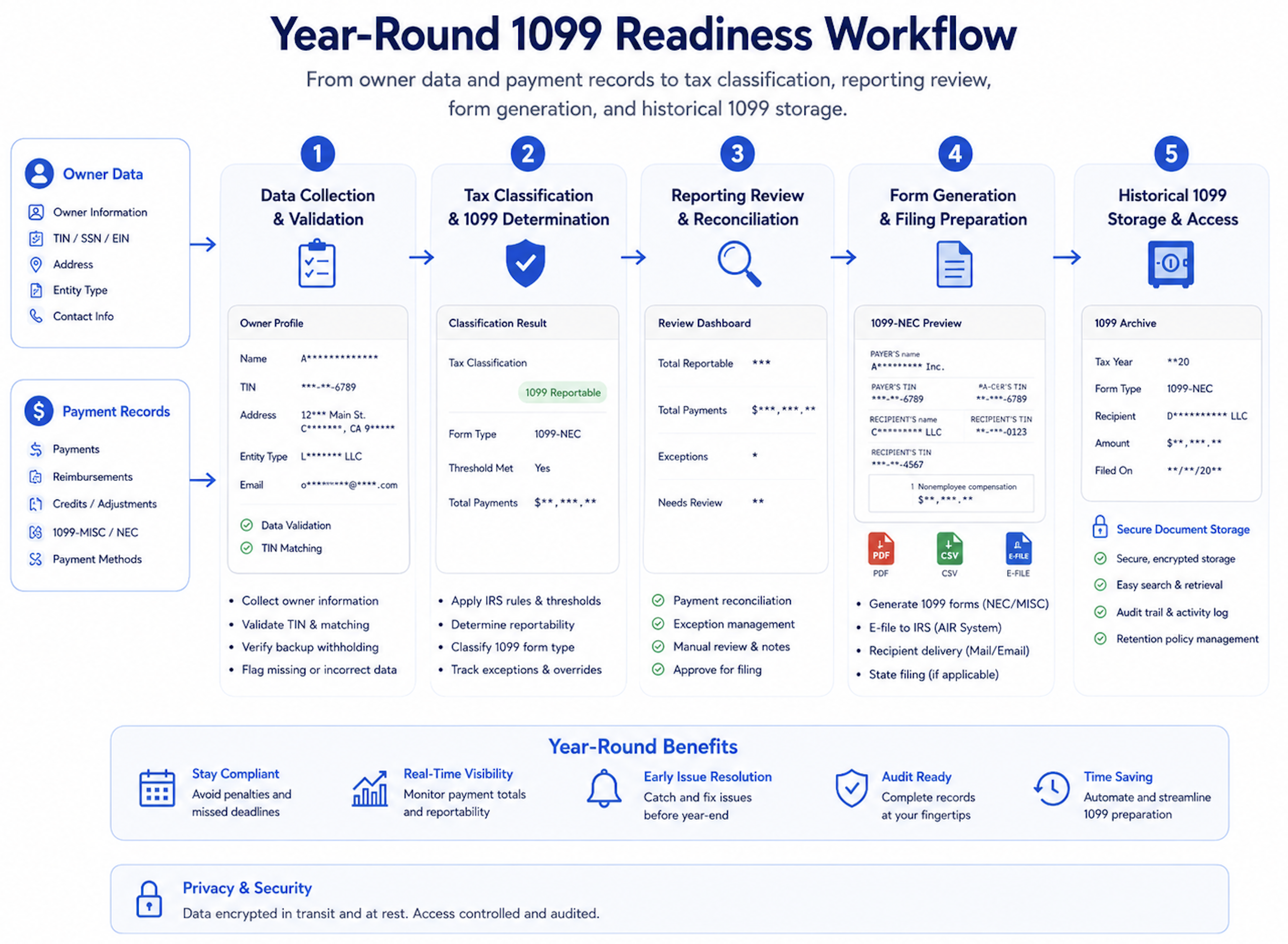
Readiness Should Be Measured Before Tax Season
Operators can use a simple readiness formula: 1099 Readiness Rate = Reportable Owners with Complete Tax and Payment Records ÷ Total Reportable Owners × 100%. If there are 2,200 reportable owners and 176 are missing tax ID, mailing address, payment classification, or reporting details, then the readiness rate is: 2,024 ÷ 2,200 × 100% = 92%.
A 92% readiness rate may look strong, but the remaining 176 exception records can create a large amount of manual work. If each exception takes 15 minutes to review and resolve, the team faces 44 hours of cleanup before reporting can be completed. That does not include owner calls, returned mail, payment history checks, correction review, or prior-year lookup.
The goal is not only to generate forms. It is to maintain owner and payment records so reporting is reviewable, explainable, and easier to reproduce if questions arise later. A strong workflow should show reporting exceptions before the year closes, not after the reporting team begins final preparation.
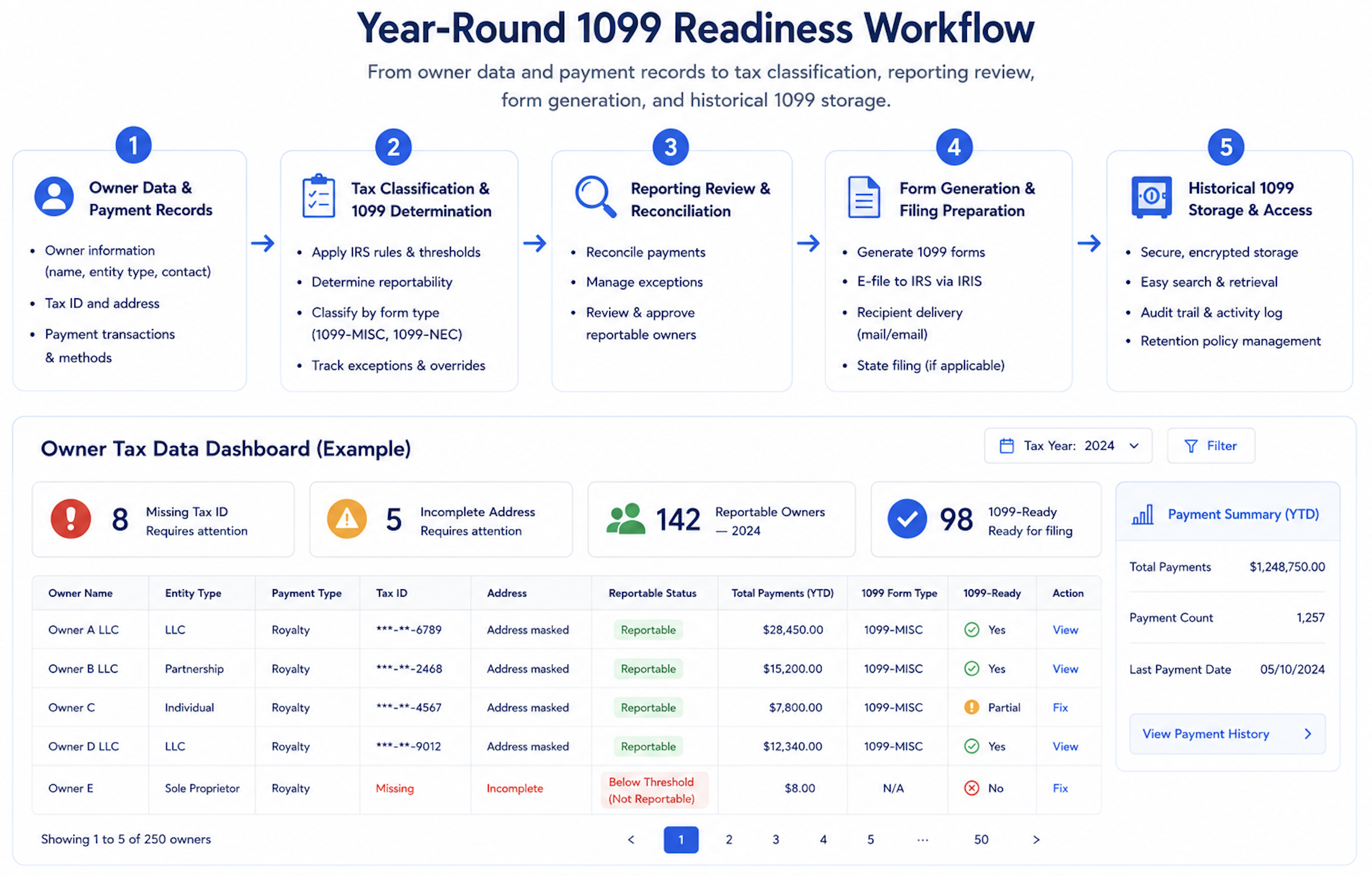
Owner Tax Data Needs a Reporting-Readiness Gate
1099 readiness does not start with form generation. It starts with whether the owner record is complete enough to support reporting. In oil and gas, an owner may be connected to multiple wells, leases, units, payment types, suspense releases, prior-period adjustments, corrected payments, and historical ownership changes. If the owner record is incomplete, the reporting issue may not appear until year-end, even if monthly payments were processed without obvious problems.
A reporting-ready owner record should confirm more than name and address. It should show tax ID status, entity type, mailing address, reportable payment classification, payment history, prior-year form status, correction history, and any unresolved communication or returned mail issue. When these records are separated from payment activity, accounting teams may need to rebuild the reporting basis manually during the busiest part of the year.
The control point is owner readiness before payment records accumulate. If an owner receives reportable payments during the year, the system should show whether that owner is clean for 1099 reporting or already carrying an exception. Waiting until year-end to identify missing tax IDs, invalid addresses, or unclear payment classifications turns a manageable data issue into a reporting bottleneck.
Key data checks include:
Tax ID status
Mailing address
Entity or owner type
Payment classification
Reportable payment amount
Prior-year reporting history
Missing or invalid owner records
Returned mail or communication issues
A practical rule is simple: make it impossible to mark an owner as 1099-ready when tax status, mailing address, reportable payment classification, or owner record validation is incomplete. Embedding this programmatic verification gate directly into the master data architecture assists upstream organizations in mitigating annual regulatory compliance risks, providing financial teams with a more reliable foundation to streamline year-end information reporting and reduce tax penalties.
Payment History Must Explain the Reporting Number
Payment history is not useful for 1099 reporting unless it can explain how the reportable amount was built. Oil and gas owners may receive royalty payments, working interest-related payments, suspense releases, adjustment payments, corrected payments, voided checks, reissued checks, or prior-period amounts during the same reporting year. If those records are not connected to the owner and reporting category, the year-end number becomes harder to defend.
This is where many reporting questions begin. An owner may compare a 1099 amount against bank deposits and see a difference. Accounting may need to explain whether the difference comes from timing, a correction, a void and reissue, a prior-period adjustment, a suspense release, or a payment that belongs to a different reportable category. Without traceable payment history, the team has to reconstruct the answer from payment files, owner notes, accounting exports, and historical folders.
A stronger process keeps the reporting basis close to the payment record. Each reportable payment should show the owner, payment date, payment type, amount, classification, property or account relationship, adjustment status, form status, and historical lookup path. That allows the team to answer not only what was reported, but why it was reported that way.
IRS materials identify Form 1099-MISC as a form used for items including royalties, while Form 1099-NEC is used for nonemployee compensation; operators should confirm current form usage, thresholds, filing rules, TIN handling, corrections, and recipient-statement requirements against the applicable IRS instructions and tax advisors before final filing.
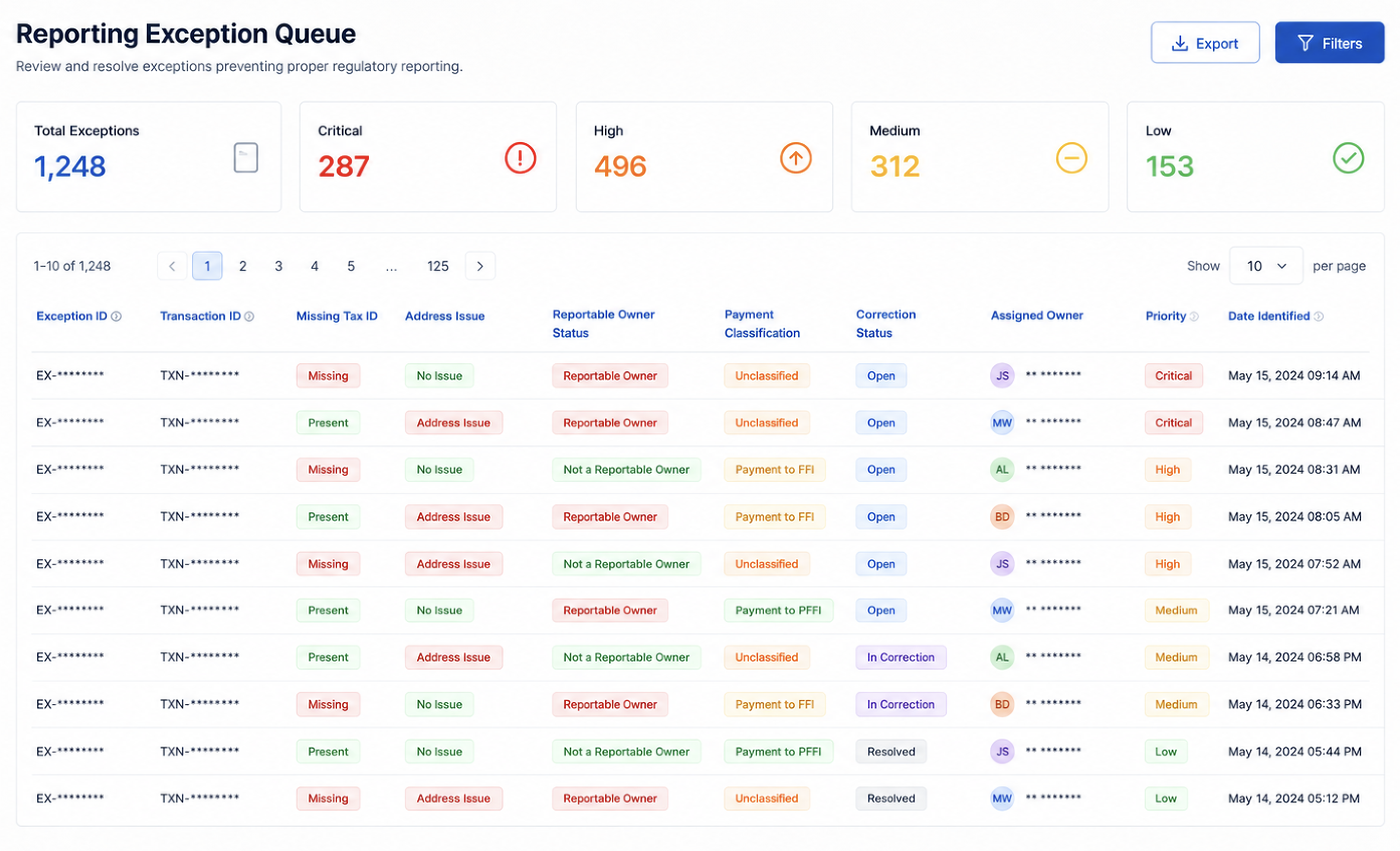
Reporting exceptions should be cleared before year-end close pressure
Year-end cleanup becomes expensive because small exceptions arrive in volume. One missing address may take only a few minutes to correct. Hundreds of missing tax IDs, unclear classifications, returned mail records, invalid owner profiles, payment history mismatches, or unresolved correction questions can consume days of accounting and owner relations time before forms are ready.
A stronger 1099 workflow should keep an exception queue open throughout the year. The queue should not simply list incomplete records. It should show the owner, missing field, related payment amount, reportable category, assigned team member, aging days, required action, communication history, and readiness status. That turns reporting preparation from a year-end scramble into a controlled review process.
A simple cleanup estimate shows why this matters: Cleanup Hours = Exception Records × Average Minutes per Exception ÷ 60. If 240 reporting records need review and each takes 12 minutes, the cleanup workload is: 240 × 12 ÷ 60 = 48 hours. That is more than one full workweek before forms can be finalized. The deeper issue is not only staff time. Late cleanup also increases the chance of inconsistent review, rushed corrections, owner confusion, and repeated questions after forms are issued.
1099 Records Should Support Corrections, Reissues, and Owner Questions
The reporting workflow does not end when forms are generated. Owners, accountants, and internal teams may still ask why a reported amount differs from expected payment history. A form may need to be corrected, reissued, archived, or compared with prior-year records. If the reporting record is not connected to payment history, the team may need to rebuild the explanation manually.
Oil and gas reporting can become especially complex when one owner has multiple properties, multiple payment types, prior-period adjustments, suspended amounts released during the year, or address and entity changes. The system should preserve not only the generated form, but also the payment basis, reporting category, correction status, reissue history, communication record, and prior-year lookup. That historical trail helps accounting teams explain the number without relying on individual memory.
The strongest 1099 workflow is therefore not only a form-generation workflow. It is a reporting evidence workflow. It helps the team explain the reported amount, reproduce the basis, manage corrections, and respond to owner questions without depending on disconnected folders.
Management Needs a 1099 Readiness View
Management does not need only a form-generation count. Leaders need to see which owner records are clean, which reporting exceptions are aging, which payment classifications need review, and which records could affect year-end timing. A summary that only shows “forms pending” is too late to prevent the pressure.
A useful 1099 readiness view should answer:
Which owners are missing tax ID, address, or classification details?
Which reportable owners are not yet 1099-ready?
Which payment records need classification review?
Which returned mail or owner communication issues remain open?
Which forms are pending, generated, corrected, reissued, or archived?
Which exceptions are assigned, aging, or blocking reporting completion?
Which prior-year records may need lookup or correction support?
Which team member must act before reporting pressure begins?
Without this view, 1099 preparation becomes a late-stage cleanup project. With it, operators can manage reporting readiness throughout the year and reduce the amount of manual repair needed during tax season. Establishing this continuous data auditing practice allows upstream accounting departments to optimize resource distribution, providing a more stable operational framework that enhances annual tax transparency and ensures consistent regulatory alignment.
How Petrofly Supports Year-End Readiness
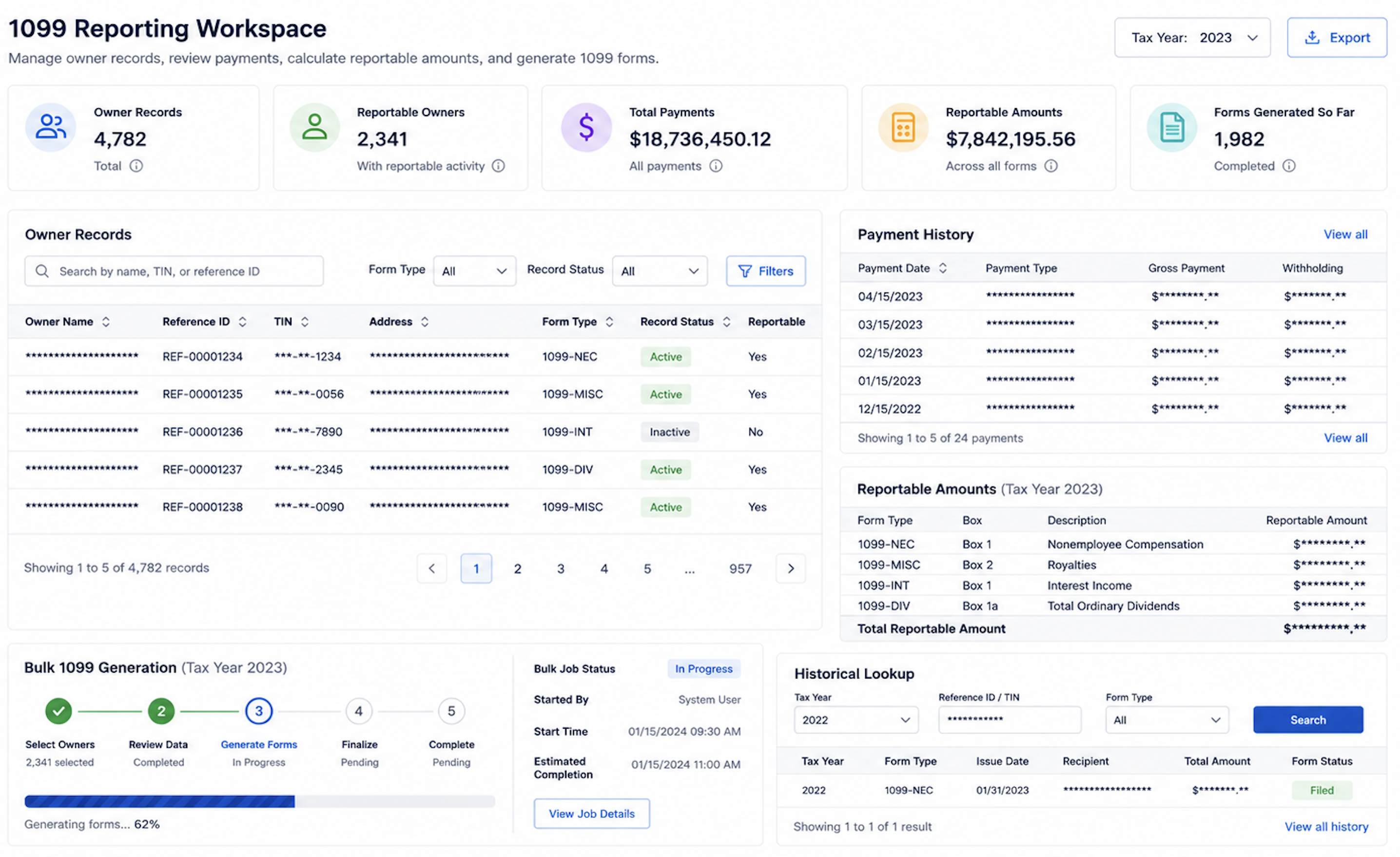
Petrofly helps oil and gas teams prepare 1099 records by connecting owner payment history, tax data, reportable payment classifications, form status, exception review, and historical lookup in one workflow. This helps operators manage reporting readiness throughout the year instead of treating 1099 preparation as a year-end cleanup project.
Petrofly supports 1099 readiness through five core capabilities:
Link tax status, address, entity, profile, and reporting to the payment record.
Review owner payments by period, payment type, property, adjustment status, and reporting cycle.
Organize 1099 forms, status, corrections, and historical reporting records.
Track missing tax data, addresses, classifications, returned mail, status, owner, and aging.
Provide bulk generation with flexible adjustments to reports, fields, review steps, and workflows for year-end processes.
Without this structure, 1099 reporting depends on manual cleanup, spreadsheet checks, and late-stage exception review. With Petrofly, operators can keep owner tax data, payment records, reportable amounts, generated forms, and historical lookup connected before tax season pressure arrives.
Prepare Reporting Records before the Deadline
Oil and gas 1099 reporting becomes more controlled when owner data and payment records are maintained before year-end. Operators should track tax information, mailing addresses, payment classifications, reportable amounts, generated forms, correction history, and historical records throughout the year. The practical value is not only faster form generation, but stronger confidence in the records behind each form.
Every payment cycle can either create future reporting evidence or create another exception to clean later. When payment history, owner tax records, generated forms, correction status, and prior-year records are connected, teams can answer questions faster and reduce deadline pressure. Petrofly can support operators that want 1099 preparation to become part of a connected owner payment workflow.
1099 readiness without control becomes year-end cleanup; connected reporting records turn tax preparation into a more predictable operating process. Cultivating this structured information visibility across the transactional lifecycle assists upstream financial teams in maintaining reliable owner compliance, providing a scalable regulatory framework that mitigates year-end operational friction and enhances data auditability.