
Oil and Gas Cost Control Software: From LOE, AFE, and Field Costs to Better Operating Visibility

Summary
×Cost Control Starts with the Reason Behind the Number
Oil and gas costs are rarely meaningful as isolated numbers. A repair invoice, disposal charge, chemical expense, compressor rental, hauling cost, or field service invoice may be reasonable in one operating context and questionable in another. The same USD 18,000 charge can mean necessary workover support, avoidable vendor overuse, duplicate billing, or a cost assigned to the wrong well.
The problem begins when cost records are reviewed only by amount, vendor, and accounting period. Finance may see that LOE increased, but not whether the increase came from pump failure, water handling, weather access, deferred maintenance, production decline, or coding error. Operations may know the field reason, but the explanation may stay in field notes, emails, or verbal updates instead of staying connected to the cost record.
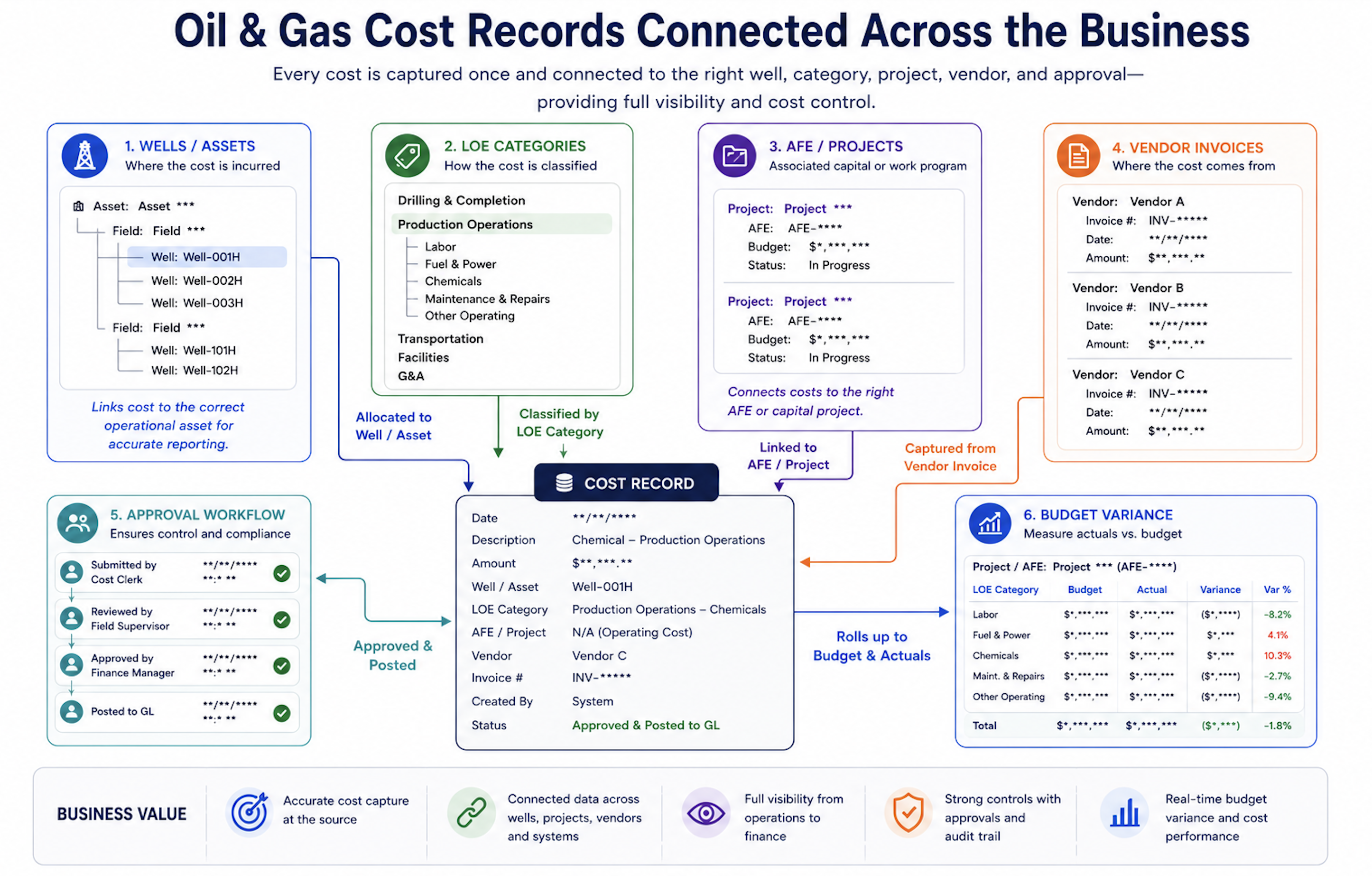
A stronger cost control workflow should help operators answer one practical question: does this cost have enough operating context to support action? If the team can see the well, category, vendor, invoice, AFE relationship, approval status, field note, and production context together, cost review becomes faster and more useful. If those pieces are scattered, cost control becomes a month-end explanation exercise.
LOE Variance Needs a Review Path, Not Just a Report
Lease operating expense can move for valid reasons. A well may need repair work after downtime, a lease may require additional water handling, or chemical usage may increase because field conditions changed. The goal is not to treat every LOE increase as a problem. The goal is to know which increases are expected, which are unexplained, and which require action.
A simple formula can show movement: LOE Variance Percentage = (Current LOE − Baseline LOE) ÷ Baseline LOE × 100%. If a lease normally runs at USD 42,000 per month and current LOE reaches USD 55,000, the variance is: (55,000 − 42,000) ÷ 42,000 × 100% = 31%. A 31% increase does not prove poor cost control. It does, however, deserve explanation. If the increase is tied to a compressor repair, temporary trucking, weather-related access, or a planned maintenance event, management can understand the movement. If the increase has no field note, invoice support, approval trail, or production context, it should become a review item.
Useful LOE review questions include:
Which category caused the increase?
Which vendor or invoice drove the change?
Did field conditions change?
Is the cost tied to the correct well or lease?
Is this a one-time item or a recurring pattern?
Does the cost align with production performance?
A practical rule is simple: make it impossible to mark a high-variance LOE record as reviewed when the cost has no field explanation, invoice support, approval owner, or asset assignment. Enforcing this programmatic validation gate embedding safeguards financial reporting integrity, rendering operational accountability an uncompromisable prerequisite rather than an afterthought.
AFE and Field Costs Should Not Be Separate Records
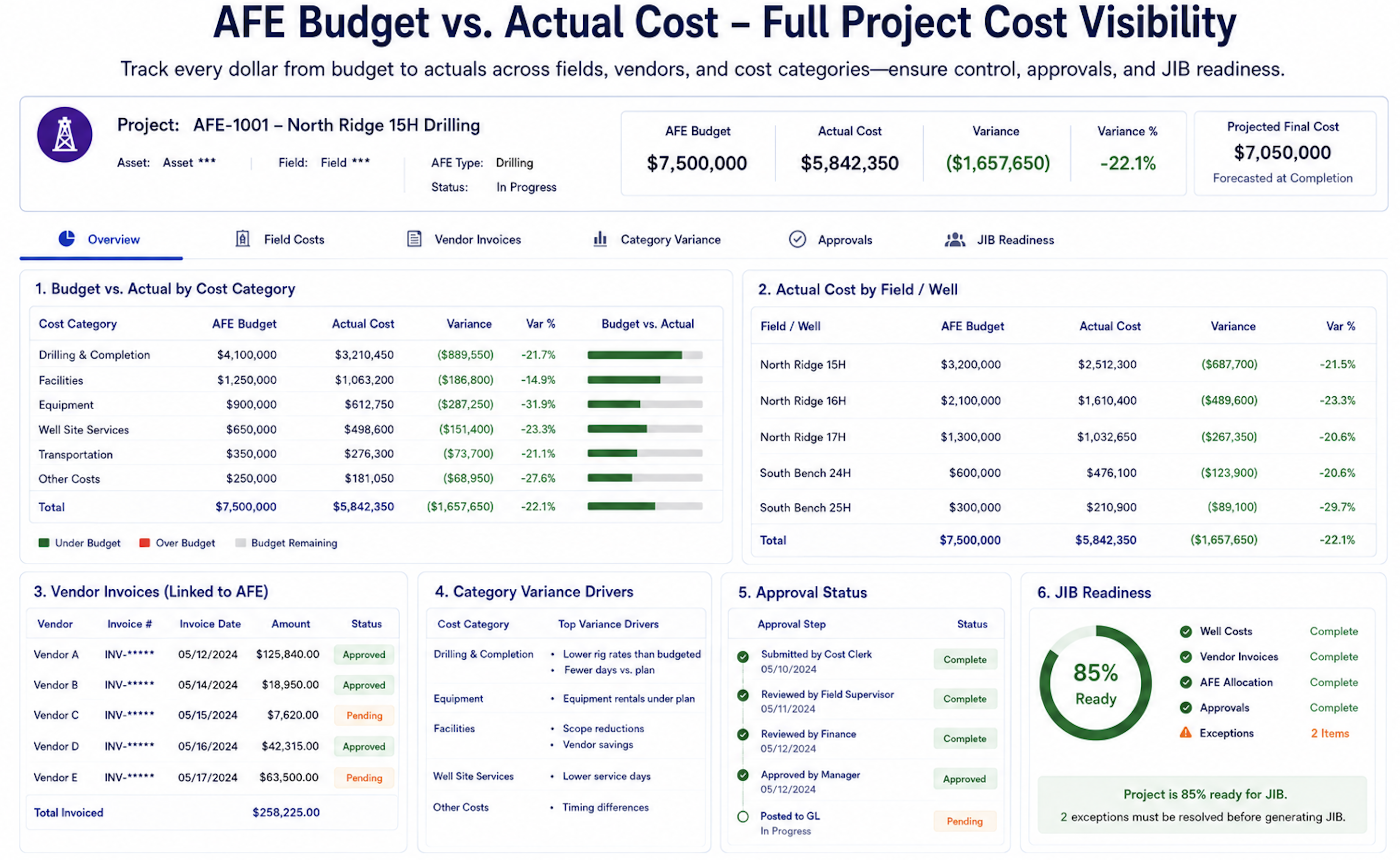
AFE-controlled work and routine field costs often interact in real operations. A workover may create vendor invoices, equipment rental, trucking, water handling, labor, materials, and follow-up lease activity. If these costs sit in separate records, management may see the approved AFE in one place and the actual field cost picture somewhere else.
This is where cost exposure becomes harder to understand. An AFE may be approved for equipment replacement, but related trucking, disposal, rental, or follow-up field labor may appear under routine cost categories. Those costs may be valid, but if they are not connected to the AFE or project context, the team may underestimate total project spend or miss the reason behind later LOE movement.
A stronger workflow should connect approved budget, actual invoices, cost categories, field notes, approval status, and JIB readiness. The team should be able to see whether actual spend is tracking within the approved scope, whether a cost belongs to the right phase, whether additional work needs explanation, and whether partner-billable items are supported before review or billing.
For example, if an AFE was approved for a USD 180,000 equipment replacement and actual field costs reach USD 212,000, the useful question is not simply whether the project is over budget. The useful question is which costs caused the overrun, whether they were part of the original scope, whether field conditions justified the change, and whether the supporting invoices are ready for internal review or partner explanation.
Cost Control Should Connect Spend to Production Behavior
A cost increase is easier to judge when it is compared with production behavior. A lease with rising LOE and rising production may show a very different operating story from a lease with rising LOE and falling production. Cost visibility becomes more useful when the team can see whether spend is supporting performance, responding to a known issue, or becoming disconnected from asset output.
For example, a well may show a 20% LOE increase while production declines 15%. That combination deserves a different level of review than a well where LOE increased because a planned repair restored production. In the first case, the operator may need to review equipment reliability, water handling, downtime, vendor activity, or whether the asset remains economically attractive. In the second case, the cost may be justified if the production recovery supports it.
Cost control software should help operators separate cost pressure from productive investment. Not every cost reduction is good. Cutting necessary maintenance can create larger problems later. The stronger operating view is not “which cost can be removed?” but which cost is justified by field condition, production response, budget approval, or asset strategy?
Operators should identify:
High-variance costs
Missing approvals
Unusual vendor activity
AFE overruns
Costs without field context
Repeated exceptions
Assets with rising cost and falling production
Vendor Invoices Need Charge-Level Traceability
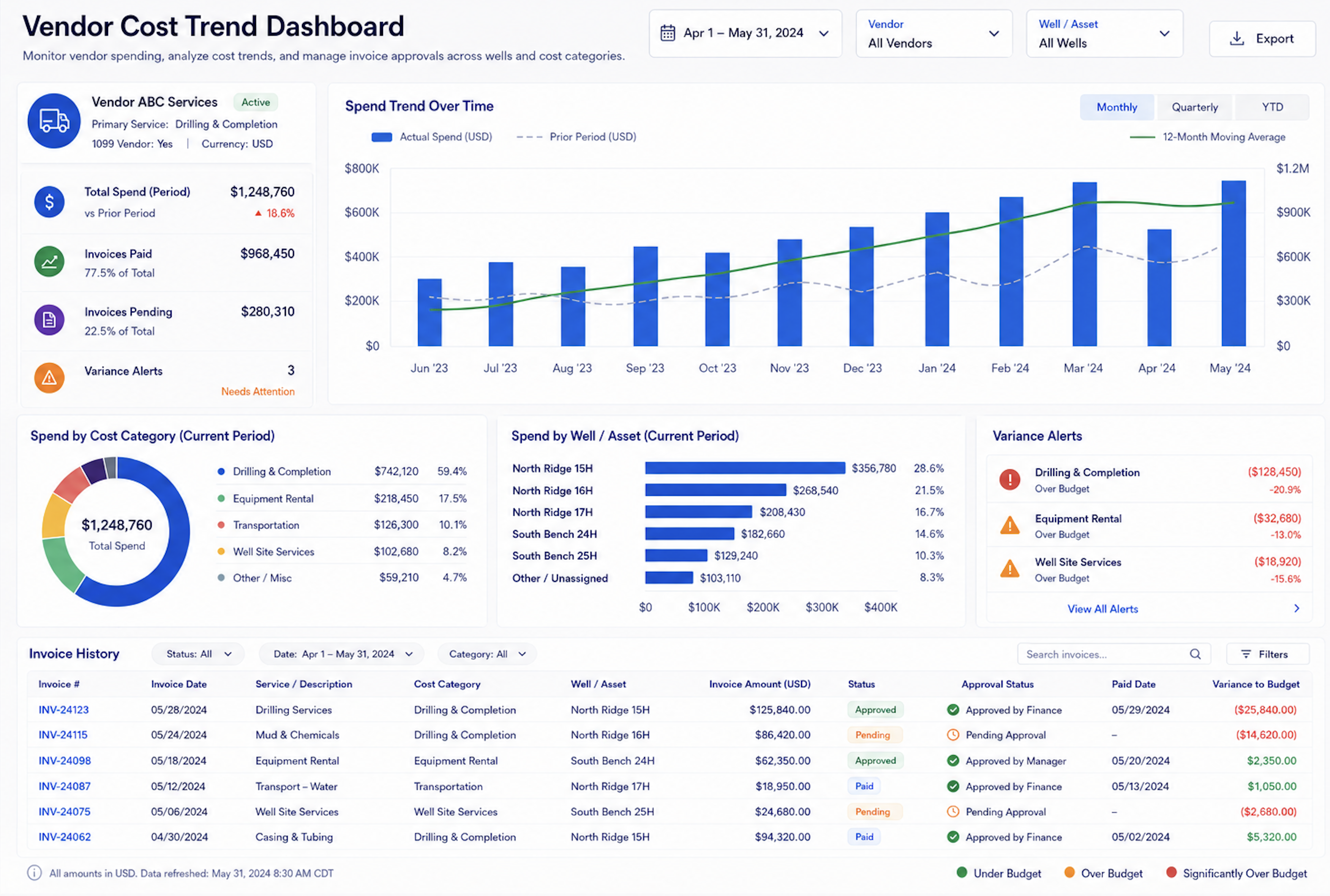
Vendor costs can create hidden cost control problems when invoice patterns are not visible. A single high invoice may be valid if it reflects emergency repair, special equipment, or a workover event. Repeated increases from the same vendor, unclear service dates, duplicate-looking charges, or invoices spread across multiple wells can indicate a different issue.
A cost control workflow should make vendor review specific. The team should not only ask why a vendor total increased. It should see which invoice, which service date, which cost category, which well, which approval, and which field explanation drove the change. That level of detail helps finance ask better questions and helps operations respond with context instead of rebuilding the story later.
For example, a vendor may bill three field service invoices in the same period. One may relate to a planned repair, one may support an AFE job, and one may be miscoded to the wrong lease. If the system only shows the vendor total, the review becomes slow and unclear. If each invoice is tied to well, service date, cost category, approval status, and field note, the team can separate valid cost from correction item.
Approvals Should Preserve the Business Reason
Approval is not only a signature or status. In oil and gas cost control, approval should preserve the business reason behind the cost. When a cost is approved, the record should show whether the decision was based on field urgency, AFE scope, vendor support, asset performance, safety requirement, production impact, or partner billing readiness.
This matters because cost questions often appear later. Management may ask why LOE increased. Partners may ask why a charge was included in JIB. Accounting may need to explain why an invoice was accepted. If the approval record only says “approved,” the team still needs to search for the reason.
A stronger approval workflow keeps the explanation close to the cost. Invoice, well, field note, cost category, AFE reference, approver, approval date, and review comment should remain connected. That makes cost control more defensible and reduces repeated investigation during month-end review, audit support, or partner communication.
Management Needs a Cost Pressure View
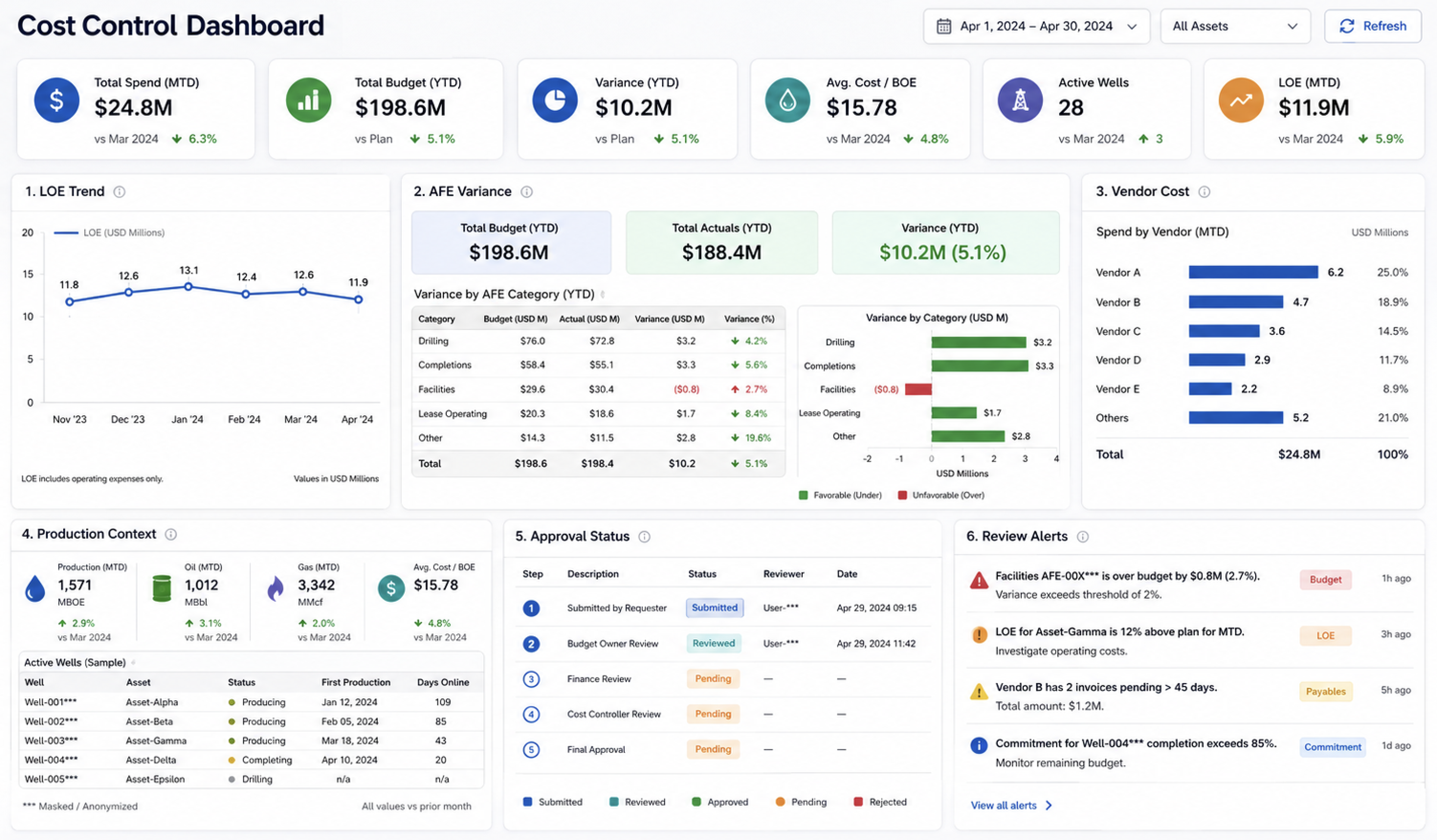
Management does not need only a cost report by category. Leaders need to see where cost pressure is forming, whether it is explained, whether it affects cash flow, and whether it is connected to asset performance. A monthly total is useful, but it rarely tells the team where to act first.
A practical cost pressure view should answer:
Which wells or leases have the largest LOE variance?
Which cost increases are explained by field activity?
Which costs are missing invoice support or approval context?
Which AFE projects are trending above approved budget?
Which vendors show repeated cost increases or unclear invoice patterns?
Which assets have rising cost and falling production?
Which costs may affect JIB readiness or partner explanation?
Which exception needs action before month-end reporting?
Without this view, operators explain cost movement after the close or after partners ask questions. With it, management can see whether the issue is operational, financial, coding-related, vendor-driven, or asset-performance related before the review window closes. Cultivating this proactive diagnostic agility ensures that leadership can deploy corrective operational adjustments in real time, thereby optimizing joint venture alignment and safeguarding fiscal compliance before accounting periods finalize.
How Petrofly Helps Operators Control Cost with Context
Petrofly helps operators connect cost records, field context, AFE activity, production information, approvals, vendor invoices, and reporting views in a more practical workflow. The value is not simply storing cost data. The value is helping teams understand where a cost came from, why it moved, whether it is supported, and what action should happen next.
Petrofly supports cost control through five core capabilities:
Well and lease cost visibility: Review LOE and field costs by well, lease, category, vendor, period, or project context.
AFE-to-actual cost connection: Keep approved budgets, field activity, vendor invoices, category variance, and JIB readiness closer to the same workflow.
Exception and approval review: Identify unusual cost movement, missing support, unclear coding, incomplete approvals, and high-variance records that need action.
Production and cost context: Help teams compare cost movement with production behavior, downtime, field activity, and asset-level performance.
Cloud-based configurable reporting: Give finance, operations, and management a shared view, with reports, dashboards, fields, and review steps adjusted around actual operating needs.
Without this structure, cost control becomes a month-end review of numbers that may already be disconnected from field reality. With Petrofly, operators can connect LOE, AFE costs, invoices, approvals, production context, and management visibility before cost pressure becomes a surprise.
Control Cost Before It Becomes a Surprise
Oil and gas cost control software should help operators understand where costs come from, why they moved, and whether they are connected to the right asset. When LOE, AFE costs, field activity, vendor invoices, production context, and approvals are connected, teams can catch cost pressure earlier and make better operating decisions.
The practical value is not only spending less. It is making cost movement easier to see, review, explain, and act on before it becomes a month-end problem. A good cost control workflow helps operators separate valid field-driven cost from unsupported variance, miscoding, vendor issues, or asset-level performance concerns. Cost control without context becomes accounting review; connected cost control becomes operating visibility.