
Field Ticket Management in Oil and Gas: Why Field Records Matter for Cost Control

Summary
×Field Tickets Connect the Field and the Office
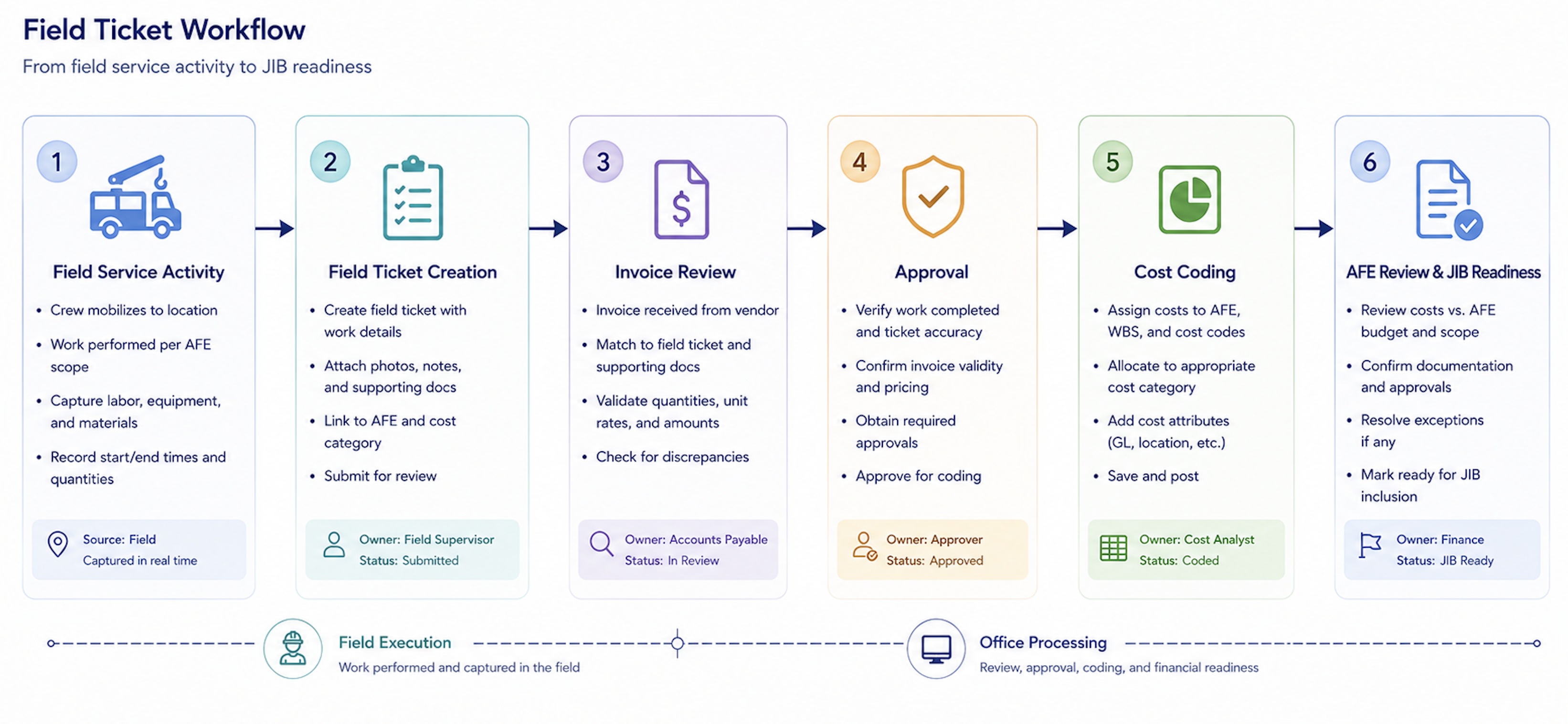
A field ticket records what happened on-site. It may include service date, well or lease, vendor, crew, work performed, quantity, hours, equipment, materials, field approval, and notes. For oil and gas operators, this information is not just operational detail; it becomes evidence behind invoice review, cost coding, AFE tracking, and JIB support.
Without field ticket context, accounting may only see a vendor invoice with a limited description. The invoice may show the vendor, date, and amount, but not enough information to confirm the correct well, service location, work performed, or operating reason. The cost may be legitimate, but the team may not have enough context to approve it confidently. A good field ticket workflow reduces that gap. It allows operations and accounting to work from the same activity record. This makes cost coding, approval, variance review, and partner billing easier to support before month-end pressure builds.
Invoice Matching Starts With Field Detail
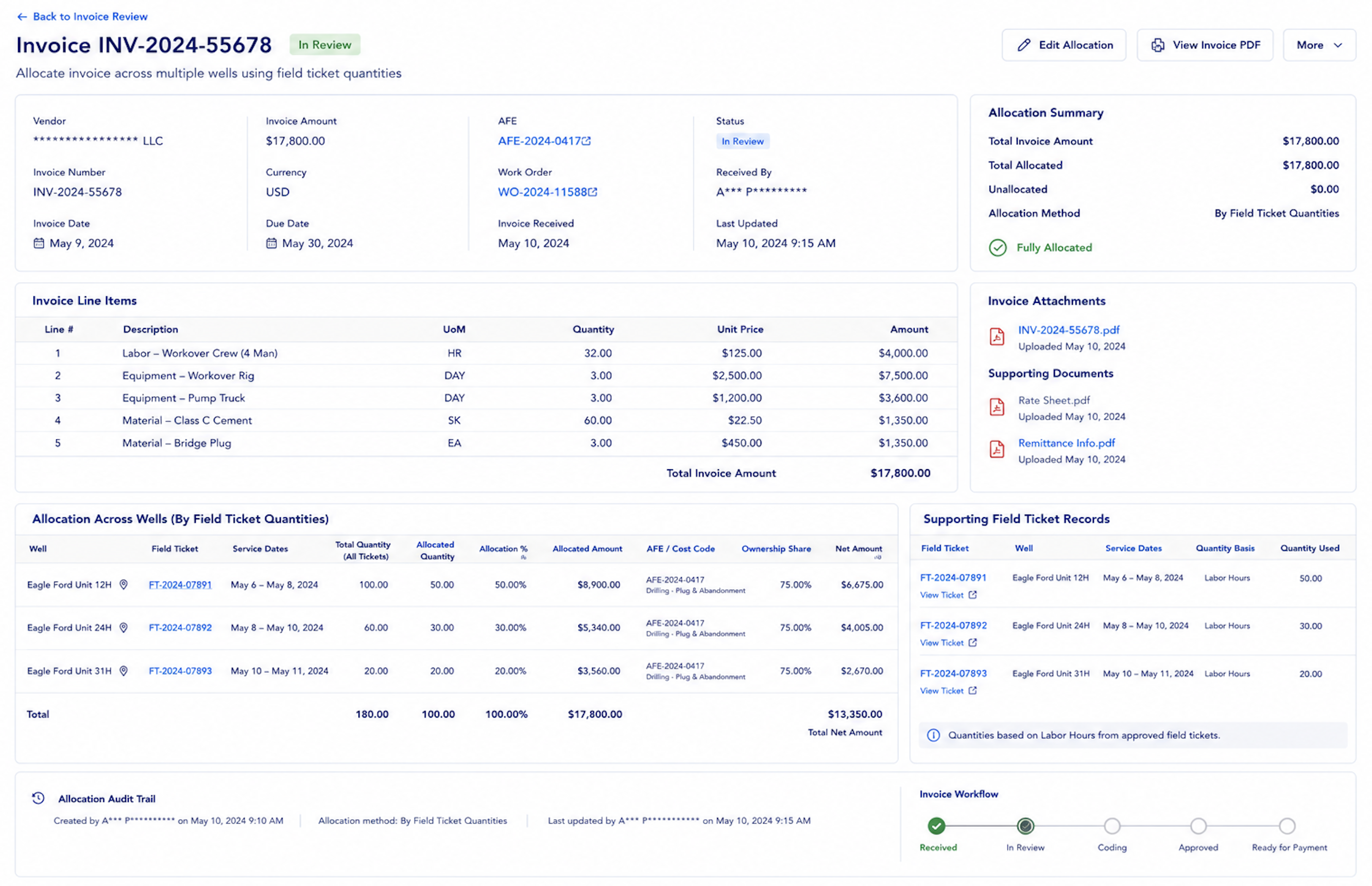
Many invoice questions are really field ticket questions. If a water hauling invoice shows $18,400, the accounting team may need to know which wells were serviced, how many loads were hauled, which dates were included, and whether the quantity matches field records. The invoice alone may not answer those questions.
A simple matching formula is: Invoice Match Difference = Vendor Invoice Amount − Field Ticket Supported Amount. If field tickets support $17,900 of work and the invoice shows $18,400, the difference is $500. That amount may be valid, but it needs explanation before approval.
This type of review does not need to slow the process. It helps teams catch missing tickets, wrong quantities, duplicate charges, rate differences, or costs tied to the wrong asset before the invoice enters accounting or JIB workflows. The earlier the mismatch is found, the easier it is to correct.
What a Useful Field Ticket Should Capture
The strongest field ticket records are specific enough to support later cost review. A vague note such as “service performed” does not help accounting, management, or partners understand the charge. This general lack of clarity frequently introduces tracking blind spots that force back-office professionals into extensive retroactive research during the month-end close. Consequently, relying on non-specific documentation remains a leading cause of unvouched expense disputes and protracted reconciliation cycles throughout the standard project lifecycle.
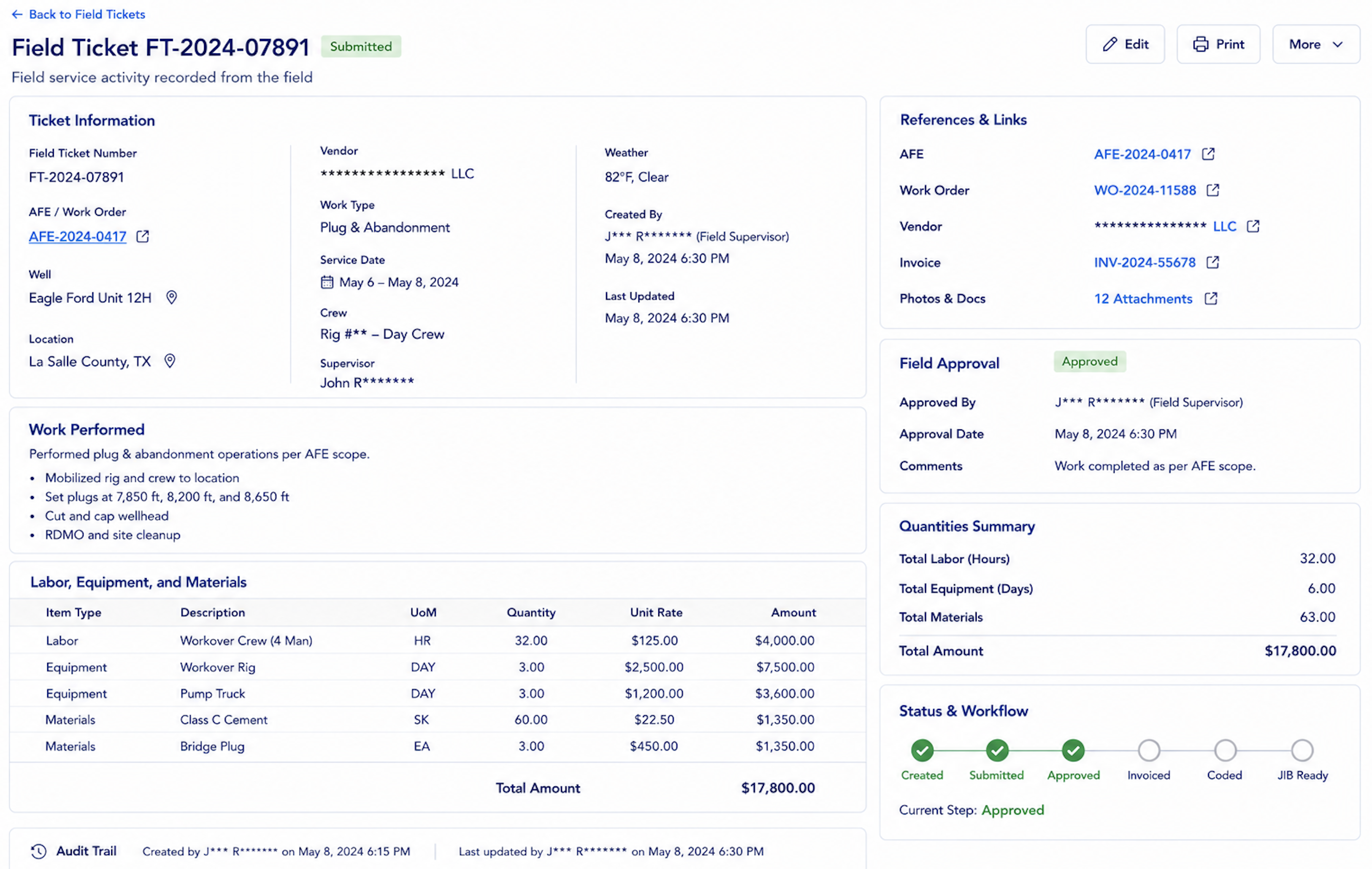
Operators should capture:
Well, lease, field, or site
Service date and work period
Vendor, crew, or technician
Work performed
Quantity, hours, loads, or units
Equipment or materials used
Field approval
Invoice link or expected invoice reference
AFE, work order, or cost center reference when relevant
Notes explaining unusual activity or conditions
These details make the ticket useful beyond the field team. Accounting can review whether the invoice matches actual work. Operations can confirm whether the activity was expected. Management can see whether cost movement has an operating explanation. JIB teams can provide better support if partners ask about the charge.
Field Tickets Help Explain Cost Variance
Field ticket records are especially useful when costs change from one month to another. If disposal cost increases, the field ticket may show higher water volume, additional trucking, longer haul distance, weather delays, or a new disposal route. If labor cost rises, the ticket may show longer field time, emergency repair, or rework.
Cost variance can be measured with: Cost Change Percentage = (Current Period Cost − Prior Period Cost) ÷ Prior Period Cost × 100%. If chemical treatment cost was $6,000 last month and $9,300 this month, the increase is 55%. That increase is not automatically wrong, but it should be supported by field activity.
A connected field ticket workflow helps operators explain the “why” behind the number. Instead of asking field teams to remember what happened weeks later, the system keeps operational evidence close to the cost. This is valuable for monthly review, JIB support, management reporting, and future audit work.
A Practical Example: Water Hauling Across Multiple Wells
Assume a vendor performs water hauling across three wells during one week. The invoice total is $24,000. Field tickets show that Well A accounted for 50% of the loads, Well B for 30%, and Well C for 20%. The allocation can be calculated as: Allocated Cost = Total Invoice Amount × Field Ticket Allocation Percentage. Well A receives $24,000 × 50% = $12,000, Well B receives $7,200, and Well C receives $4,800.
If the field tickets are missing or incomplete, the invoice may still be paid, but allocation becomes harder to defend. A partner may later ask why a specific well received a water hauling charge. With connected field tickets, the operator can show the service dates, load counts, location detail, and allocation basis.
Field Approval Should Be Connected to Cost Approval
Field approval and accounting approval are related, but they are not the same. A field supervisor may confirm that work was performed, while accounting confirms that the invoice amount, coding, and supporting records are ready for processing. When these approvals are disconnected, the invoice may move forward without the full review context.
A better workflow connects field approval to cost approval. The team should be able to see who approved the work in the field, whether the invoice matches the ticket, whether the cost belongs to an AFE or routine LOE, and whether additional review is required. This helps prevent invoices from being approved only because they look familiar.
Operators should pay special attention to high-risk field ticket situations:
High-dollar vendor work
Split activity across multiple wells or leases
Work tied to an AFE or workover
Emergency repair or unplanned service
Missing or late field approval
Quantity differences between ticket and invoice
Repeated charges from the same vendor
Field Tickets Support JIB Accuracy
Field tickets often become important when costs are billed to working interest partners. A partner may not only ask how much was billed, but also what work was performed, where it happened, and why the charge belongs to their asset. A JIB statement with connected field ticket support is easier to review than one that only shows a broad cost category.
Field tickets help connect the operating event to the billing record. If a repair, hauling service, equipment rental, or chemical treatment appears on a JIB statement, the operator can provide the field activity behind the charge. This reduces repeated clarification and helps partners move valid charges toward payment.
The goal is not to attach every possible document to every statement. The goal is to make support available when needed and to ensure that high-risk charges are ready for review before billing. Overloading joint interest statements with thousands of routine files typically creates administrative confusion and slows down the validation process for working interest partners. By focusing internal energy on establishing an on-demand retrieval repository, accounting teams can maintain pristine document hygiene while keeping historical data perfectly accessible. This strategic filtering ensures that core accounting workflows remain highly efficient throughout the entire closing cycle.
How Petrofly Supports Field-to-Cost Control
Petrofly can help operators keep field activity, cost records, approvals, invoices, and reporting closer to the same workflow. This matters when field work affects invoice approval, AFE review, cost control, or JIB explanation. Relying on disconnected communication silos frequently introduces severe data fragmentation that forces back-office accounting teams into extensive retroactive research during the month-end close. By unifying these critical operational touchpoints within a single digital ecosystem, the enterprise successfully eliminates the visibility gaps that traditionally cause downstream billing discrepancies. This continuous alignment ensures that every transaction remains fully verified from the point of origin.
Petrofly can support field ticket management through:
Field-to-office visibility: Keep field activity easier for office teams to review.
Cost context: Connect work performed with related costs, vendors, and approvals.
Invoice support: Help teams compare invoices with field activity before billing.
Cloud-based usage: Give authorized users access without relying only on local files.
Configurable workflows: Adjust fields, reports, and review steps around actual operating needs.
Make Field Activity Easier to Prove
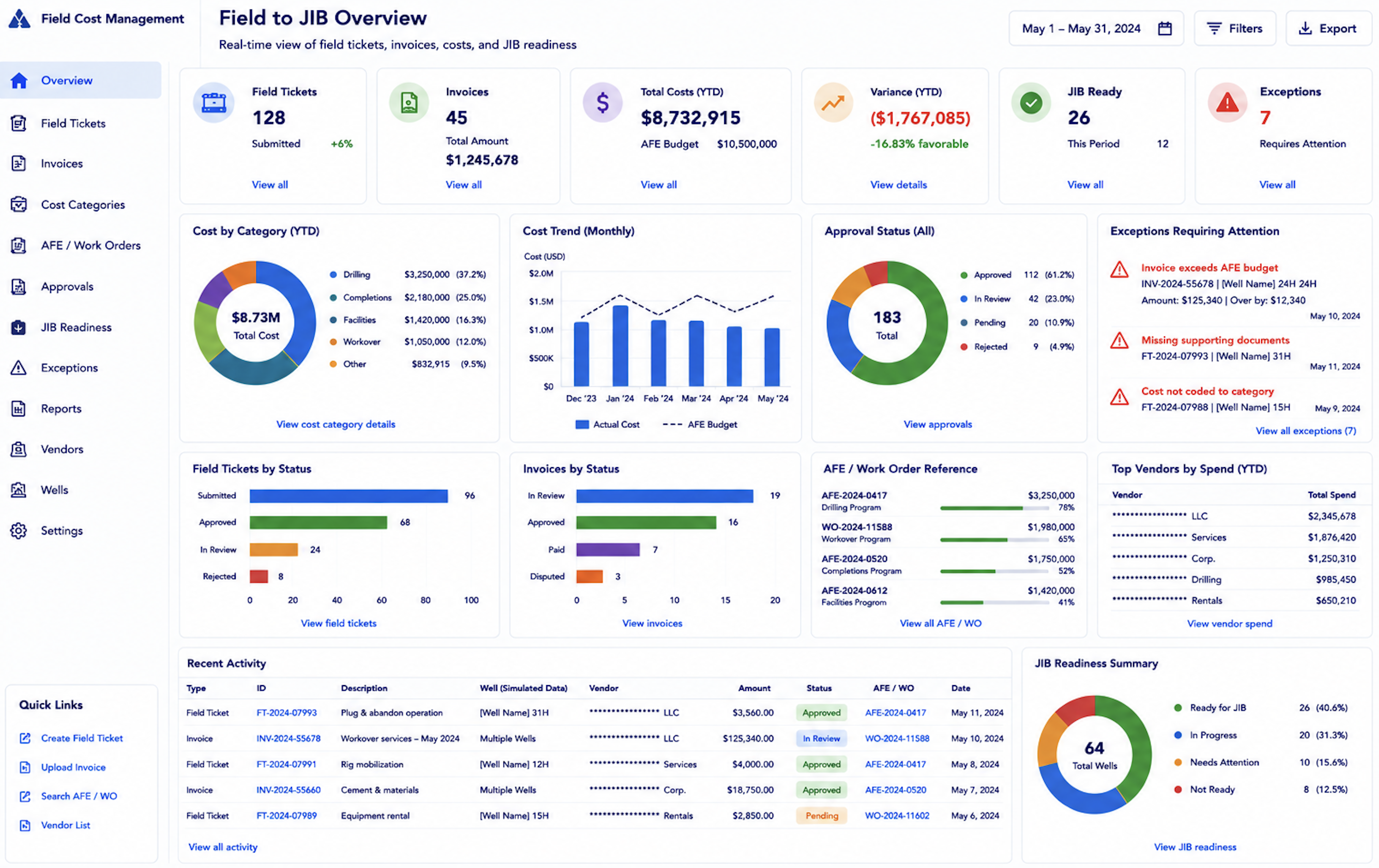
Field ticket management gives operators a stronger link between field activity and financial control. When field tickets are connected to invoices, cost categories, approvals, AFE records, and JIB workflows, teams can review costs faster and explain field-driven changes more clearly.
The practical value is simple: field work becomes easier to verify, invoice questions become easier to resolve, and JIB support becomes stronger before partners ask for clarification. Petrofly can support oil and gas teams that want field records to become part of a traceable cost control workflow.
For teams looking to connect field activity with invoice review and cost visibility, Petrofly can support a focused workflow discussion. Historically, the disconnect between remote job sites and the central accounting office frequently introduces tracking gaps that lead to costly downstream disputes and administrative friction during the close. By anchoring live field ticketing data directly alongside the corresponding vendor invoices, the platform naturally eliminates the visibility blind spots that traditionally plague energy accounting departments. This synchronized approach ensures that every single line-item charge is thoroughly vetted and justified before it enters the ledger.