
JIB Processing Checklist: What Operators Should Track After Statements Are Sent

Summary
×JIB Processing Continues After Delivery
Sending a JIB statement is not the end of the Joint Interest Billing workflow. It is the point where partner review begins. A working interest partner may still need to confirm invoice support, AFE references, cost categories, billing interest, adjustments, or payment timing before approving the statement. For operators, the useful question is not only whether the statement was sent. The more important question is whether the statement is moving toward payment. A statement can be issued on time and still remain unreviewed, partially paid, disputed, or waiting for support.
This is where post-statement JIB processing often becomes hard to control. The billing team may have the issued statement, operations may have the field explanation, finance may have payment status, and partner questions may sit in email. When those records are disconnected, follow-up depends too much on manual searching and individual memory.
Operators should pay attention to:
Whether the partner has reviewed the statement
Whether support is attached to the right charge
Whether the open balance is waiting on approval, support, or dispute resolution
Whether partner questions are connected to the statement record
Whether the next follow-up has a clear owner
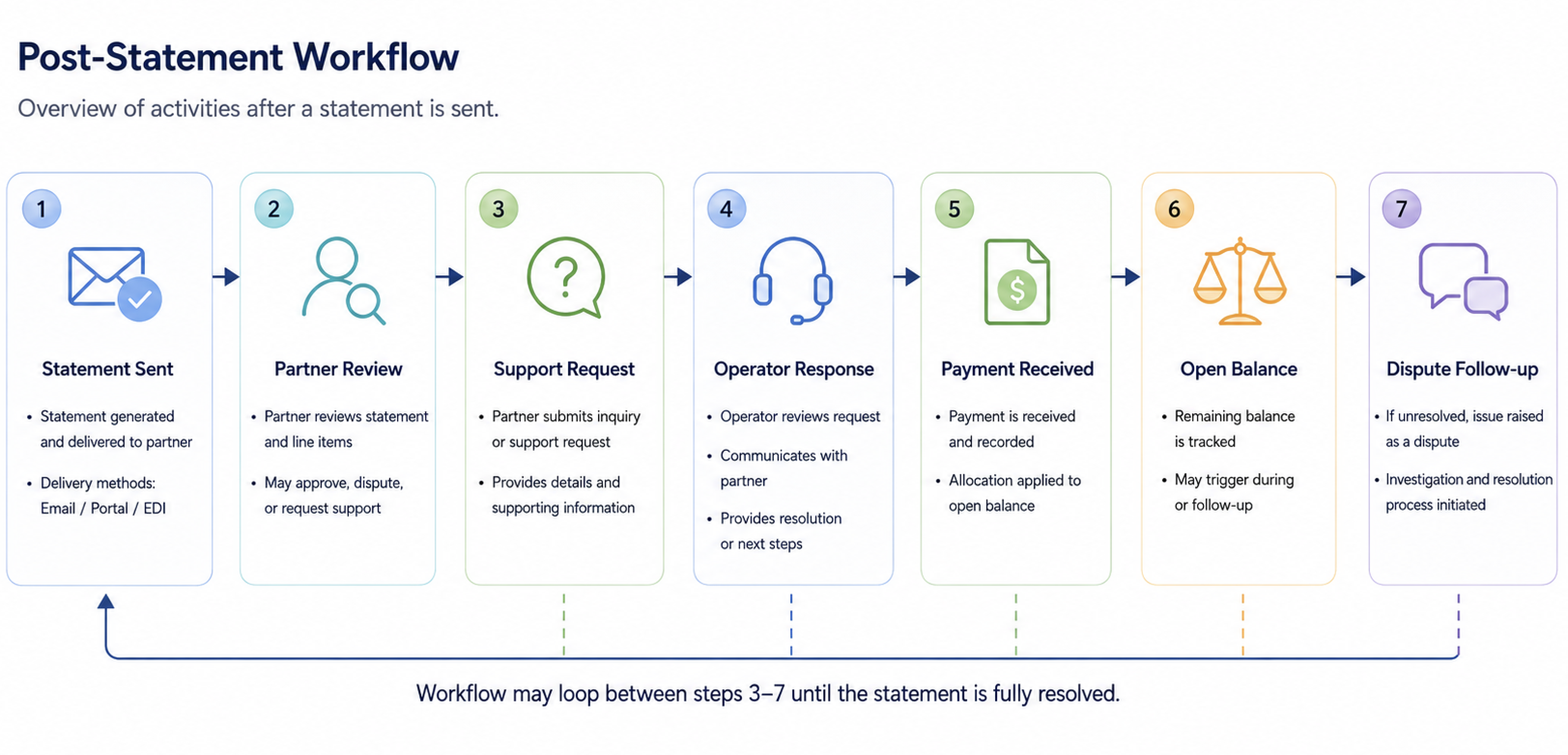
The Real Problem Is Scattered Follow-Up
Most operators already know that unpaid statements, missing documents, and partner questions need attention. The problem is that these items often live in different places. Statement status may be tracked in Excel, supporting documents may sit in folders, partner questions may remain in email, and payment updates may be recorded separately.
This fragmentation makes JIB follow-up slower than it should be. If a partner asks about one line item, the accounting team may need to find the statement, locate the invoice, confirm the AFE reference, ask operations for context, check payment status, and then respond. The answer may be simple, but finding the full context can take longer than the actual response.
A better post-statement workflow keeps the key information connected. The operator should be able to see the statement, partner review status, support files, open balance, disputed amount, question history, and next action in the same workflow. This makes follow-up more actionable and gives management clearer visibility into cash recovery risk.
Common scattered follow-up issues include:
Statement status tracked separately from payment records
Supporting documents stored away from the line item
Partner questions buried in email threads
Disputed amount mixed with open balance
Follow-up ownership unclear across accounting, finance, and operations
Repeated questions not reviewed before the next JIB cycle
Five Areas Operators Should Track
Operators do not need to turn post-statement review into a complicated control process. They need to track the items that explain what is still open, why it is open, and who needs to act next. A practical JIB processing checklist should focus on five areas: statement status, supporting documents, balance classification, partner questions, and follow-up ownership. Statement status should show more than the issued date. Operators should know whether the partner has received, reviewed, approved, partially paid, paid, disputed, or left the statement open. This avoids treating every unpaid balance as the same type of problem.
Supporting documents should be tied to the charge they explain. Invoices, field tickets, AFE references, service dates, approval notes, and cost descriptions should be easy to locate when a partner asks for support. Many JIB questions are support requests before they become disputes.
Open balances and disputed amounts should be separated. A statement may be unpaid because the partner has not reviewed it, because support is pending, or because one charge is disputed. Each situation requires a different follow-up action. Partner questions should stay connected to the statement record. A question about a well, AFE, invoice, cost category, adjustment, or payment status should not live only in email. It should be connected to the response and resolution history. Follow-up ownership should be clear. If accounting, finance, operations, or management needs to respond, the next action should have an owner and a due date. Without ownership, open items can sit until the payment due date has already passed.
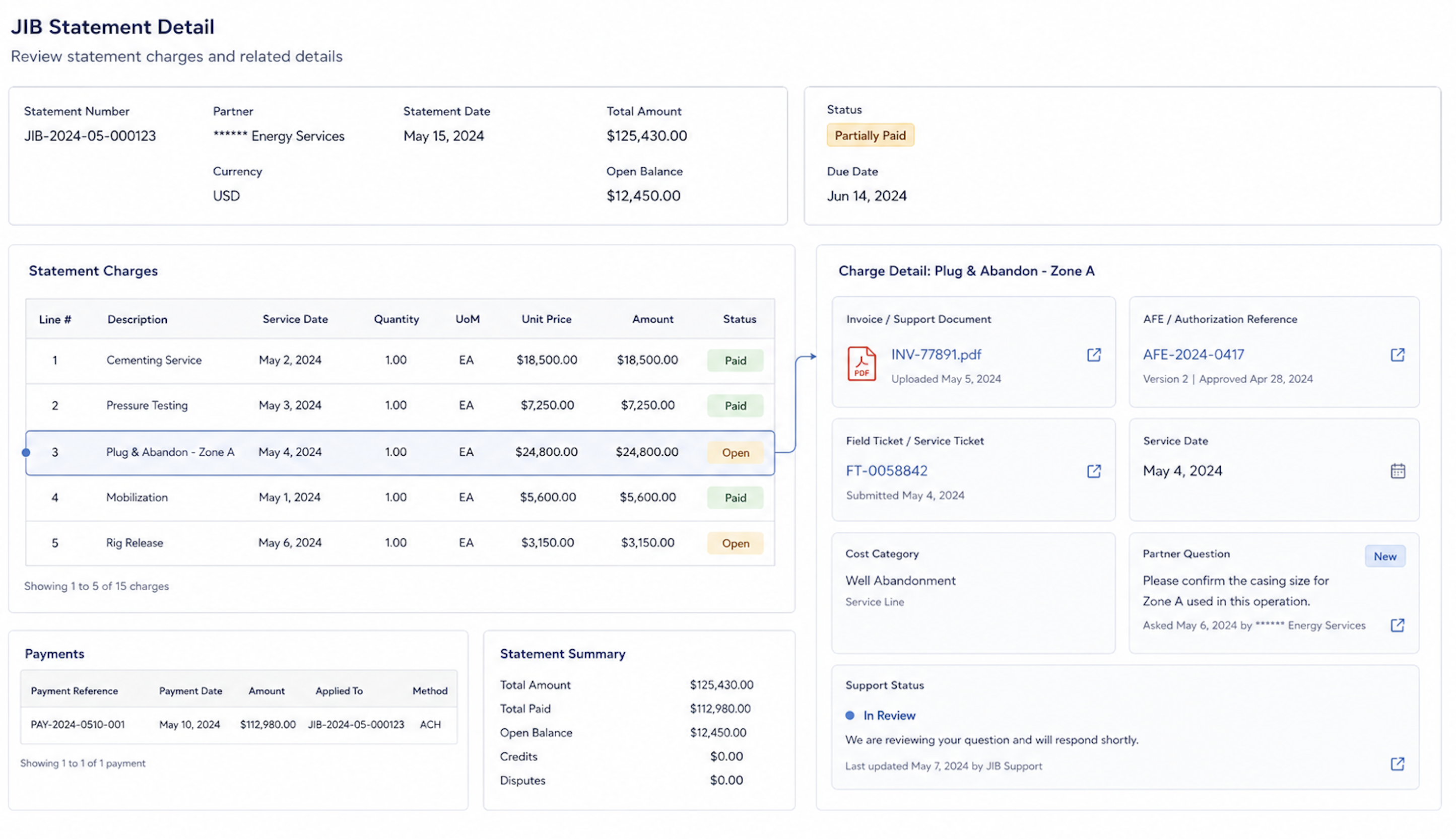
Open Balance Needs a Clear Reason
Operators should not only know that a balance is open. They should know why it is open. A simple open balance formula is: Open JIB Balance = Statement Amount − Payments Received − Credits Applied. For example, if a JIB statement amount is $75,000, the partner has paid $60,000, and a $2,000 credit has been applied, the open balance is $75,000 − $60,000 − $2,000 = $13,000. That number still needs a reason before the team can decide the right next action.
A $13,000 balance with no partner response requires a different follow-up from a $13,000 balance where only one line item is disputed. Clear reason tracking helps finance teams follow up more precisely and helps management understand which balances create real cash recovery risk.
Open balances should be classified by:
Pending partner review
Missing support
Disputed charge
Partial payment
Credit or adjustment pending
Overdue with no response
Escalation needed
Where JIB Software Supports the Workflow
A checklist is useful, but it becomes difficult to maintain if the information stays scattered. JIB software can help operators turn post-statement tracking into a structured workflow. Instead of managing statement status, support requests, partner questions, disputed amounts, payment activity, and follow-up notes separately, the team can manage them around the same JIB record.
This matters most when operators manage multiple partners, leases, wells, and accounting periods. A single open balance may not be difficult to track manually. Dozens of statements, support requests, partial payments, and recurring partner questions are much harder to manage through spreadsheets and email.
JIB software should help operators connect statement history, supporting documents, partner communication, payment status, and follow-up activity. When a partner asks about the same charge later, the team should be able to review the statement, support document, response, payment status, and resolution history without rebuilding the record from memory.
A connected JIB workflow can help teams manage:
Statement status after delivery
Supporting documents by line item
Partner questions and responses
Open balances and disputed amounts
Payment follow-up history
Repeated issues across billing cycles
Management visibility into cash recovery risk
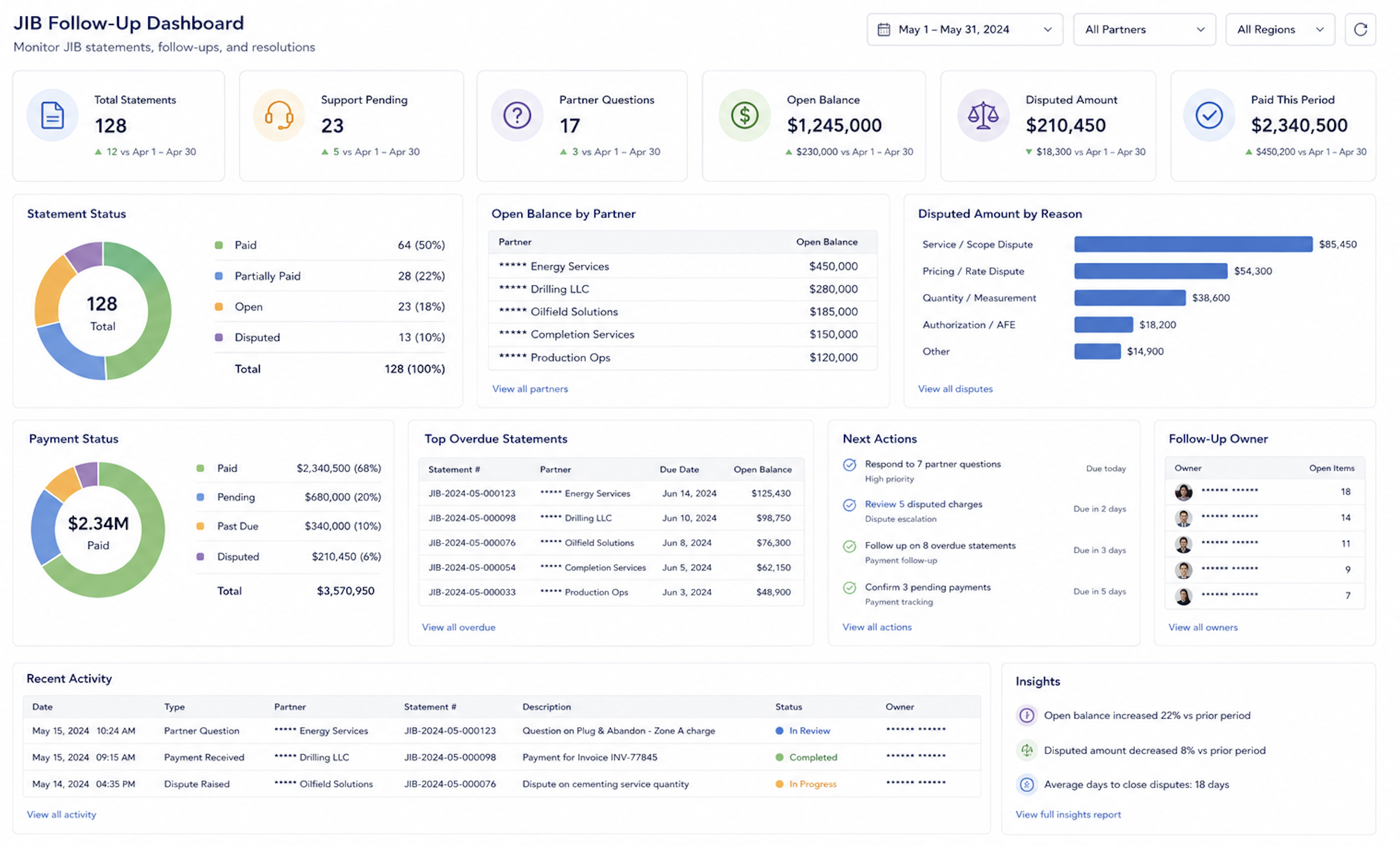
JIB Processing Quick Checklist
After JIB statements are sent, operators should track the items that explain whether each statement is moving toward payment or still waiting on review, support, or follow-up. The checklist should be part of the post-statement workflow, not a separate reminder that sits outside the billing record.
Operators should confirm:
Has the partner reviewed the statement?
Are support files attached to the right charges?
Is the balance open, disputed, partially paid, or pending approval?
Are partner questions tied to the correct wells, AFEs, invoices, or cost categories?
Has the operator response been recorded?
Who owns the next follow-up?
Which issues repeat across billing cycles?
A checklist like this helps accounting and finance teams avoid treating every unpaid balance the same way. A statement waiting for partner review requires a different response from a statement with a disputed line item, missing invoice support, or partial payment. When review status, support files, questions, balances, and follow-up ownership stay connected, operators can respond faster and manage cash recovery risk with more control.
Where Petrofly Can Help
Petrofly can help operators bring more structure to post-statement JIB processing by connecting statement status, support files, partner questions, payment activity, open balances, and follow-up ownership in one workflow. Managing these interconnected billing components within isolated spreadsheets or disconnected email threads frequently introduces severe administrative tracking gaps during the close cycle. By consolidating every post-billing touchpoint into a single centralized ledger environment, the platform effectively eliminates the communication delays that traditionally stall monthly accounts receivable. This continuous tracking mechanism ensures that the financial team possesses comprehensive oversight over the entire collection lifecycle from a single dashboard.
Key areas include:
Post-statement visibility: Track whether statements are sent, reviewed, questioned, partially paid, overdue, or resolved.
Support connection: Keep invoices, AFE references, field tickets, cost notes, and partner questions close to the related charge.
Balance clarity: Separate open balances, disputed amounts, credits, and payment activity so follow-up is more precise.
Cloud-based access: Give accounting, finance, operations, and management users a shared view without relying on scattered files.
Flexible setup and support: Start with JIB follow-up, payment tracking, or reporting first, then adjust fields, workflows, dashboards, and follow-up views with Petrofly’s support team after go-live.
Transitioning to this optimized tracking environment allows oil and gas operators to systematically elevate their daily collection activities into a strategic asset. When an energy organization standardizes its dispute resolution around this structured framework, the resulting financial reports naturally carry their own internal proof of statement accuracy. Resolving complex partner queries through a unified data pipeline remains the most reliable method for accelerating monthly cash call collections and clearing joint audits. Ultimately, this comprehensive governance model consistently helps companies improve administrative workflow efficiency while steadily reinforcing long-term joint venture trust with working interest partners.
Keeping JIB Follow-Up Traceable
A focused post-statement JIB workflow helps operators manage what happens after statements are sent. By keeping statement status, supporting documents, partner questions, payment balances, and follow-up actions connected, accounting and finance teams can respond faster and avoid treating every unpaid amount as the same type of issue.
For operators managing multiple partners and assets, stronger post-statement tracking makes JIB follow-up easier to control and cash recovery easier to monitor. When the full record is connected, teams can see what is open, why it is open, who needs to act, and which balances may create collection or cash flow risk.
Establishing this deep operational connection allows oil and gas companies to systematically transition from reactive data reconciliation to proactive joint venture governance. When an organization standardizes its data flows around this integrated model, the resulting partner statements naturally carry their own internal proof of billing accuracy. Resolving budget variances at the point of origin remains the most effective method for accelerating monthly cash call collections and clearing complex audits without friction. Ultimately, exploring these tailored digital strategies consistently helps progressive energy operators improve long-term administrative efficiency while steadily reinforcing mutual trust with their investment partners.