Invoice Processing Is a JIB Control Point
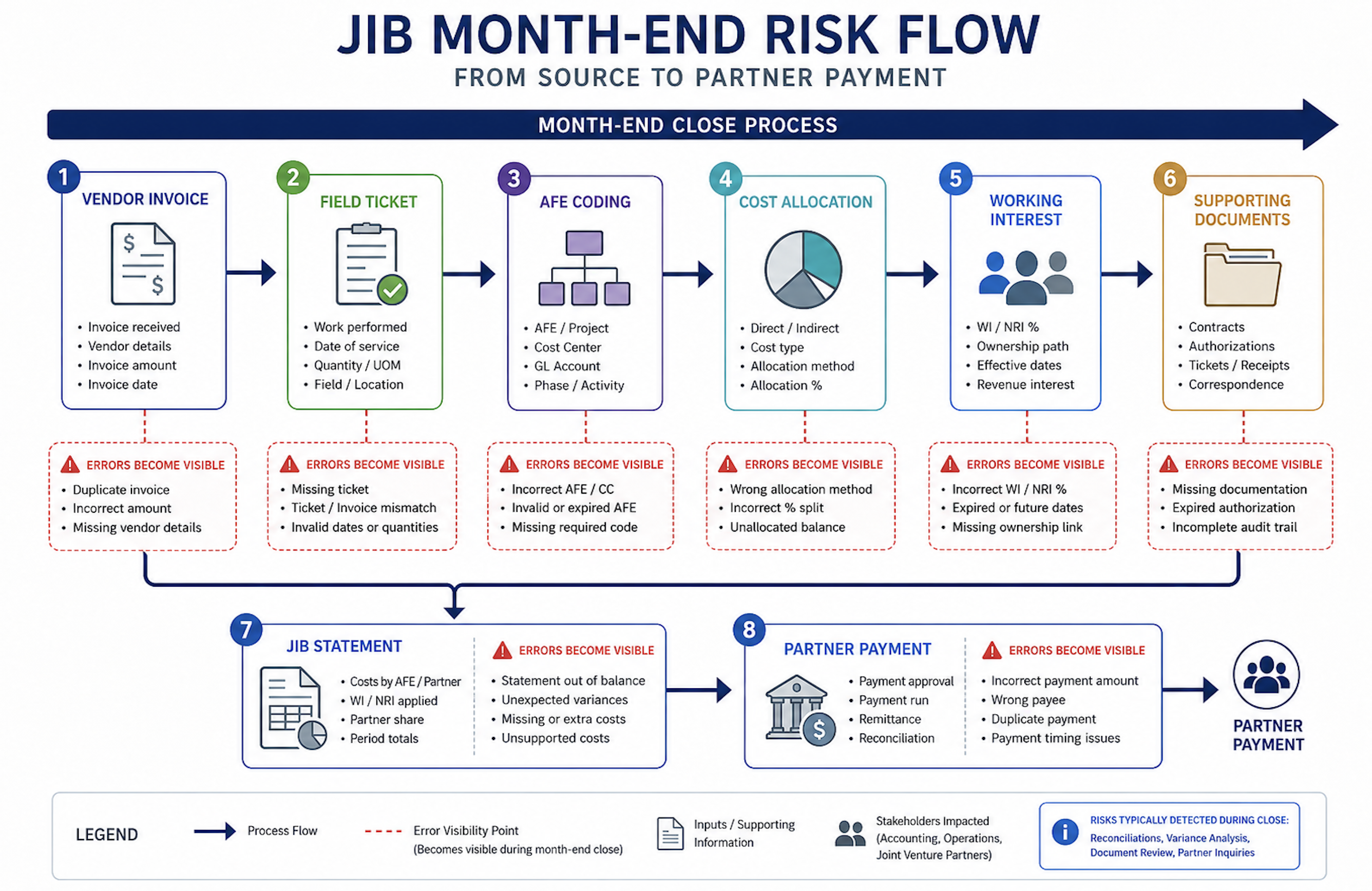
Many JIB issues do not begin when the statement is generated. They begin when a vendor invoice enters the accounting workflow without enough operating context. The invoice may show the vendor, amount, and service description, but still leave open questions about the well, lease, field, AFE, cost category, service date, or approval basis.
For operators, this matters because a cost cannot be cleanly billed to partners if the underlying invoice is not ready. An invoice can be valid and still be difficult to allocate if it is missing the correct asset reference. A charge can be billable and still trigger partner questions if the field ticket, AFE reference, or cost description is not connected before JIB processing begins.
A better invoice-to-JIB workflow checks these details earlier. Instead of waiting until month-end to fix missing information, teams review invoice readiness before costs enter partner billing. This gives accounting, operations, and finance a shared basis for deciding whether a cost is ready for allocation or still needs review.
Match Each Invoice to the Right Asset
The first control step is confirming where the cost belongs. A vendor invoice should not move into JIB processing based only on vendor name and amount. It should be tied to the correct well, lease, field, project, or cost center before allocation begins. Enforcing this initial cost-validation discipline helps upstream financial teams prevent downstream allocation errors, providing joint venture accounting departments with a reliable validation baseline that ensures rigorous expense attribution and simplifies partner audit cycles.
This is especially important when one vendor supports multiple assets. A water hauling vendor may serve several wells in one week. A roustabout crew may complete work across more than one lease. A repair invoice may include labor, materials, and equipment tied to different locations. Without asset-level matching, the invoice may be accurate from the vendor’s perspective but incomplete from a JIB billing perspective.
Operators should confirm:
Well, lease, or field
Service location
Cost center or project reference
Accounting period
Vendor invoice number
Service date
Billable status
When asset matching is weak, the JIB statement may still be generated, but the explanation becomes harder. A partner may ask why the charge was billed to their asset, and the accounting team may need to reconstruct the answer from emails, field notes, and vendor descriptions. Strong asset matching prevents that review burden from moving downstream.
Use Field Tickets to Confirm What Happened On-Site
Field tickets help connect accounting records with field activity. An invoice may show that a vendor billed for water hauling, equipment rental, repair service, or chemical treatment, but the field ticket can show what actually happened on-site. It may include the service date, location, quantity, hours, crew, work performed, and field approval.
This matters because many invoice questions are really operational questions. A partner may not simply ask why an amount appears on the statement. They may ask why the work was needed, where it happened, whether it matches the service period, or why the cost increased compared with prior months.
Useful field ticket details include:
Work date
Service location
Well, lease, or field
Work performed
Quantity, hours, or units
Field approval
Vendor or crew
Link to invoice
Field tickets are most valuable when they are connected before billing. If the invoice and field ticket are matched early, the accounting team can review the cost with more confidence. If they remain separate, month-end JIB processing becomes slower because operations may need to confirm details after the fact.
Connect AFE References Before Costs Become Billable
AFE references should be confirmed before workover, capital, equipment replacement, recompletion, or project-based costs move into JIB statements. Partners often review these charges more closely because they may relate to approved budgets, partner participation, and project scope. If the AFE connection is unclear, a valid invoice can still become a review problem.
An AFE reference helps explain why the cost was incurred and whether it belongs to the approved activity. It also helps the operator compare actual cost with expected budget. Without this connection, accounting may classify the invoice correctly, but partner review may still slow down because the authorization logic is missing.
AFE-related invoice checks should include:
AFE number or project reference
Approved scope
Related well, lease, or field
Cost category or project phase
Approved budget, when relevant
Actual invoice amount
Variance or change note, if needed
For example, a $42,000 invoice for workover services may be billable, but if it enters JIB processing without the AFE number, the partner may hold the charge for clarification. If the invoice is already connected to the AFE, scope, and service date, the charge becomes easier to review and explain. The issue is not only whether the cost is legitimate; it is whether the authorization context is available when the partner reviews the statement.
Split Invoices Create Allocation Risk
Some invoices do not belong to only one well or lease. A vendor may submit one invoice for services across several sites, or one field crew may complete work for multiple assets during the same billing period. If the invoice is not split correctly before JIB processing, costs can be allocated to the wrong partners or create questions during review.
Split invoices need clear allocation logic. The accounting team should know whether the split is based on service date, work order, field ticket, equipment usage, well count, production basis, or another approved method. Without a clear basis, the partner may question not only the amount, but also the allocation method.
Operators should check:
Does the invoice cover more than one well or lease?
Is the split based on field tickets, work orders, or service detail?
Are the allocation percentages or amounts clear?
Does each split line have the correct cost category?
Are all affected partners billed under the correct interest?
This is one of the easiest places for JIB confusion to begin. The invoice may be correct at the vendor level, but wrong at the asset or partner allocation level. Splitting the invoice before billing reduces rework later and gives accounting teams a stronger explanation if partners ask how a shared vendor cost became a partner-level charge.
A Simple Split Invoice Example
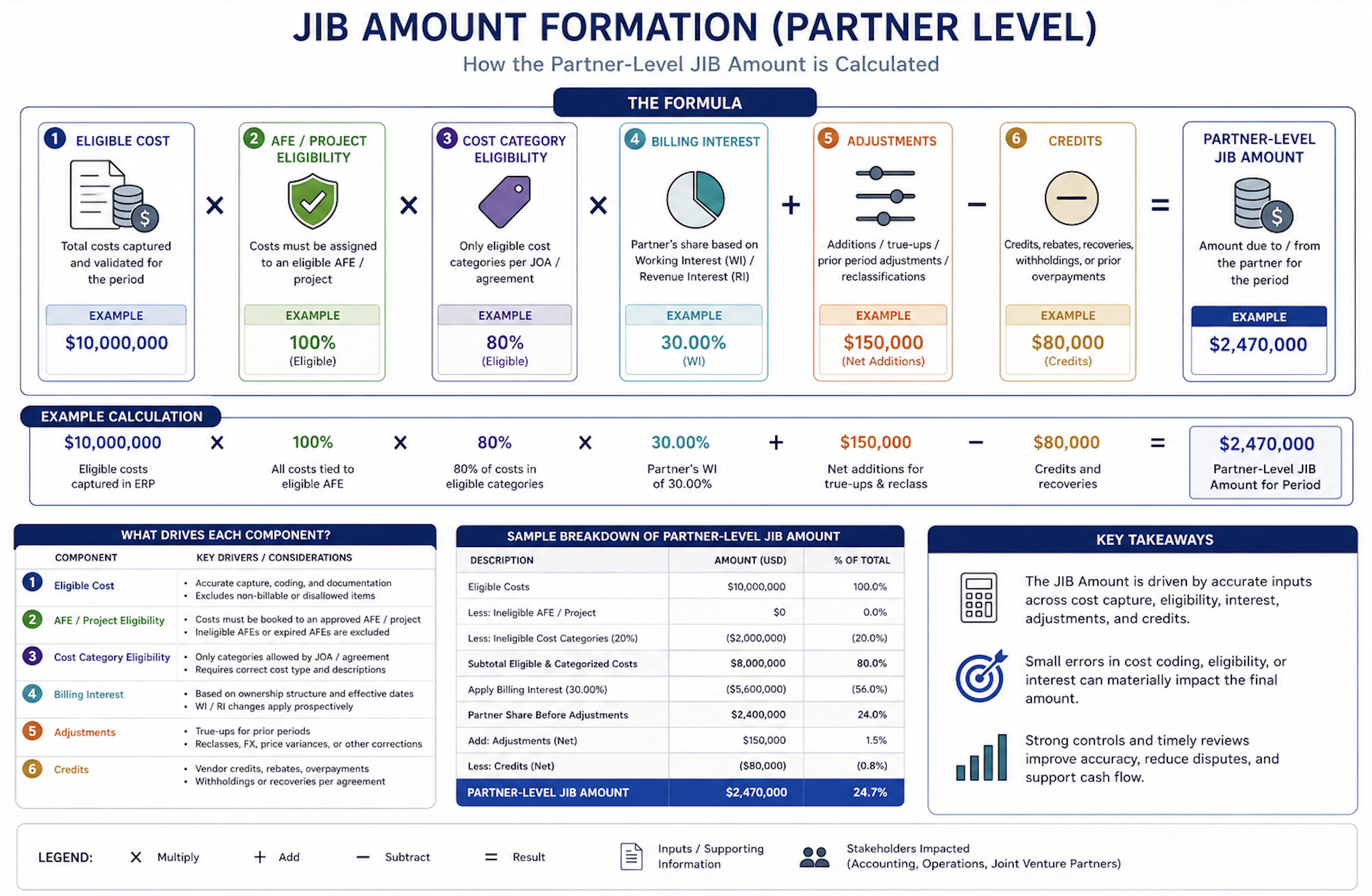
When one vendor invoice covers multiple assets, the operator needs a clear allocation basis before the cost moves into JIB. A simple formula is: Allocated Invoice Amount = Total Invoice Amount × Asset Allocation Percentage. Then the partner-level JIB charge can be calculated as: Partner JIB Charge = Allocated Invoice Amount × Partner Billing Interest. For example, assume a $24,000 water hauling invoice covers two wells. Based on field tickets, 60% belongs to Well A and 40% belongs to Well B. The allocated amount for Well A is $24,000 × 60% = $14,400.
If a working interest partner has a 25% billing interest in Well A, the partner’s JIB charge is $14,400 × 25% = $3,600. This is why split invoices need to be reviewed before billing. Clear split logic helps the operator explain how one vendor invoice became an asset-level and partner-level charge.
Cost Coding Shapes the Partner Review
Cost coding affects how a charge appears in JIB statements. A cost may be routine LOE, workover expense, capital activity, repair, equipment rental, water handling, chemical treatment, or adjustment. If the code is vague or incorrect, the partner may struggle to understand why the charge belongs in the statement.
This is not only an accounting issue. Cost coding affects AFE comparison, partner review, budget analysis, management reporting, and future lookup. A miscoded cost may not stop statement generation, but it can make the statement harder to defend when questions arise.
Operators should review:
Cost category
LOE versus capital classification
AFE-related or non-AFE-related status
Routine versus unusual cost
Adjustment or current-period charge
Partner-facing description
Clear cost coding helps JIB processing move faster. It also helps the operator explain costs without relying on memory. When cost codes, invoice support, and field context are connected, the charge is easier to allocate and easier for partners to review. Cultivating this multidimensional financial visibility allows upstream enterprises to optimize joint interest communications, providing a standardized accounting framework that effectively minimizes partner billing disputes and enhances long-term institutional data fidelity.
Approval Status Should Be Visible Before Billing
Invoice approval is often treated as a finance step, but for JIB it also becomes a billing readiness control. A cost should not move into partner billing simply because it has been entered into the accounting workflow. The team should know whether the invoice has been reviewed, whether operational context has been confirmed, and whether any exception remains open.
Approval status should show more than a yes-or-no result. It should identify who reviewed the invoice, what was approved, whether supporting records were attached, and whether any notes explain unusual cost movement. This is especially important for invoices tied to workovers, AFE-controlled work, split allocations, or high-dollar field activity.
When approval status is disconnected from the JIB workflow, billing teams may need to ask the same questions again during month-end. When approval status is visible early, the team can separate costs that are ready for partner billing from costs that need additional review. This improves billing discipline without slowing down valid charges.
Define JIB Readiness Before Month-End
A mature invoice-to-JIB process should define what “ready for billing” means. Without a clear readiness standard, teams may move invoices forward based on incomplete context, then fix the issues after statements are generated. That creates unnecessary rework and weakens partner confidence.
A practical JIB-ready invoice should have the core information needed for allocation and review. It should be tied to the correct asset, supported by the right operational record, coded clearly, approved through the right workflow, and connected to the billing interest or allocation logic that determines partner share.
A JIB-ready invoice should answer:
What asset does the cost belong to?
What work was performed?
Which field ticket, AFE, or support record explains the charge?
How should the cost be coded?
Is the cost billable to partners?
Does the invoice need to be split?
Has the cost been reviewed and approved?
Can the charge be explained if a partner asks?
This standard gives accounting, operations, and finance a shared definition of readiness. It also helps management understand why some costs can move into billing while others should remain in review.
Where Software Supports Invoice-to-JIB Control
Invoice-to-JIB processing becomes difficult when invoice records, field tickets, AFE references, approvals, and cost codes live in different places. Accounting may have the invoice, operations may have the field ticket, project teams may know the AFE, and finance may only see the cost after it reaches JIB. This creates unnecessary handoffs before billing.
JIB software can help by connecting these records earlier. Instead of waiting until statement generation to find missing context, the system can show whether each invoice has the right well, lease, field ticket, AFE reference, cost category, approval status, and allocation basis. This gives teams a clearer view of which costs are ready for partner billing and which need attention first.
For operators managing many vendors, wells, leases, and partners, this kind of workflow matters. One incomplete invoice may be easy to fix manually. Dozens of invoices with missing asset references, unclear AFE links, split allocations, and incomplete field tickets can create month-end pressure.
Software should help operators manage:
Invoice matching by well, lease, or field
Field ticket connection
AFE reference tracking
Cost category review
Split invoice allocation
Approval status
JIB readiness before billing
Invoice-to-JIB Control Checklist
Before costs move into JIB, operators should confirm that each invoice has enough context to support allocation, partner review, and later explanation. The checklist should not be treated as an isolated document; it should be part of the invoice review workflow before billing begins.
Operators should confirm:
Is the invoice tied to the right well, lease, or field?
Is the service location clear?
Is the field ticket connected when needed?
Is the AFE reference clear for workover, capital, or project-based costs?
Is the cost category specific enough for partner review?
Does the invoice need to be split across assets?
Is the allocation basis clear for split invoices?
Has the cost been reviewed and approved for billing?
Is the charge ready to be explained if a partner asks?
A checklist like this helps accounting, operations, and finance use the same standard before costs reach partner statements. It also reduces the chance that missing context will turn into a billing delay, partner question, or month-end correction.
How Petrofly Supports Invoice-to-JIB Control
Petrofly can help operators strengthen invoice-to-JIB processing by connecting vendor invoices, asset references, AFE details, field tickets, cost categories, approval status, and JIB readiness in one workflow.
Key areas include:
Invoice matching: Tie vendor invoices to the right well, lease, field, project, or cost center before billing.
AFE and field-ticket context: Keep authorization details, service records, field approval, and cost explanations closer to the invoice.
Split allocation review: Support clearer allocation when one invoice covers multiple wells, leases, or partner interests.
JIB readiness: Help teams see which costs are ready for partner billing and which still need review.
Cloud-based access: Give accounting, operations, finance, and management users a shared cost record without relying on scattered files.
Flexible setup and support: Start with invoice-to-JIB review, cost tracking, or reporting first, then adjust fields, workflows, dashboards, and review steps with Petrofly’s support team after go-live.
The value is simple: cleaner invoice context before billing, fewer avoidable partner questions, and a more traceable path from vendor cost to JIB statement.
Building a Cleaner Invoice-to-JIB Process
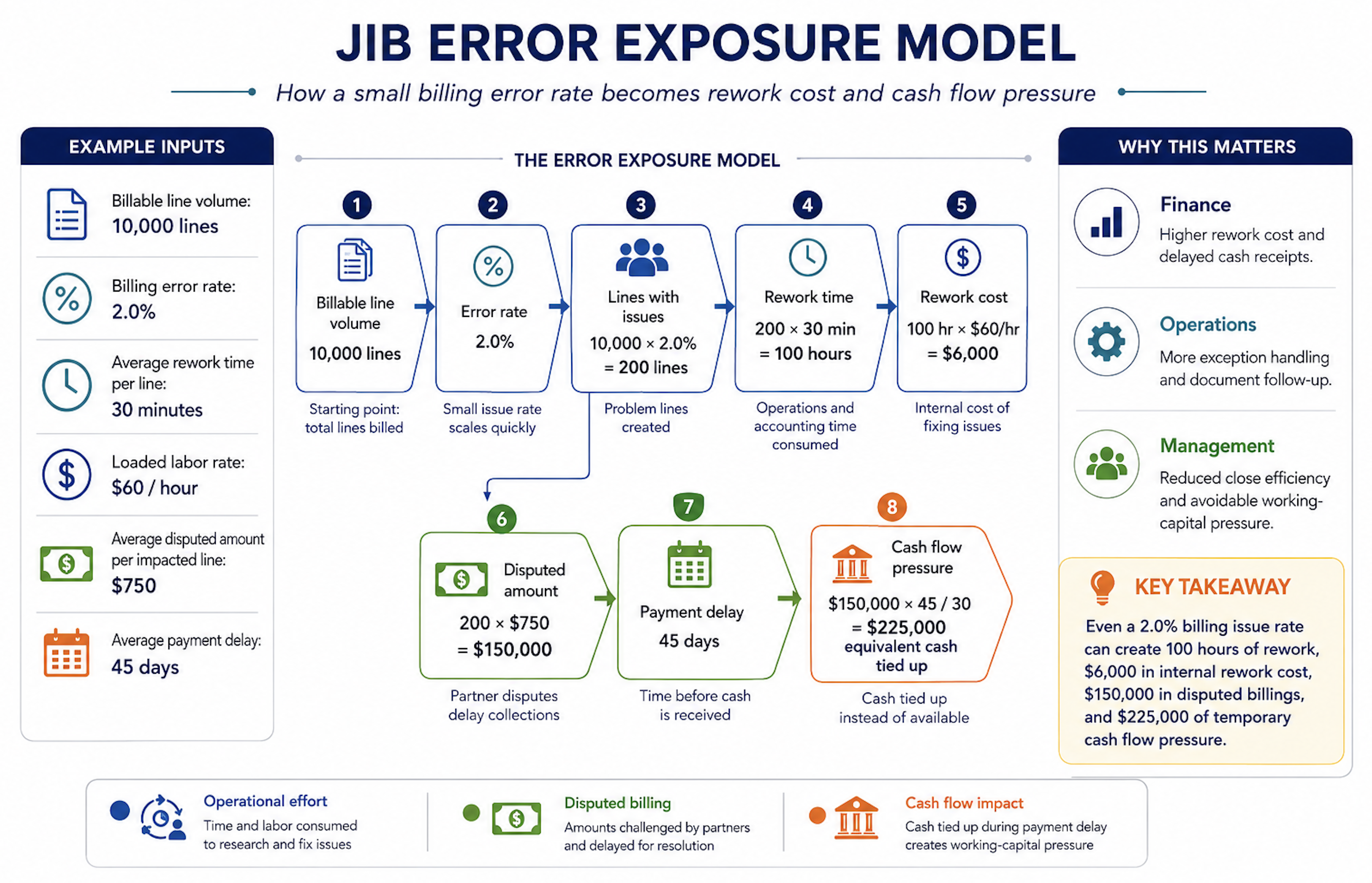
Oil and gas invoice processing has a direct impact on JIB quality. When invoices are matched to the right assets, supported by field tickets, connected to AFEs, coded correctly, and reviewed before billing, operators can reduce month-end rework and make partner statements easier to explain.
A stronger invoice-to-JIB workflow also improves cross-team discipline. Accounting does not need to rebuild field context at the end of the month, operations does not need to answer the same support questions repeatedly, and finance can see which costs are ready for allocation before billing pressure builds. This helps JIB become a controlled workflow rather than a month-end cleanup task.
The practical goal is not only faster invoice handling. It is cleaner billing context before costs reach partners, stronger traceability when questions arise, and more confidence that each JIB charge is ready to be reviewed, allocated, and explained.
To discuss how a more connected invoice-to-JIB workflow could support cleaner billing and fewer partner questions, contact our team for a focused conversation.