Payment Problems Begin Before Payment Day
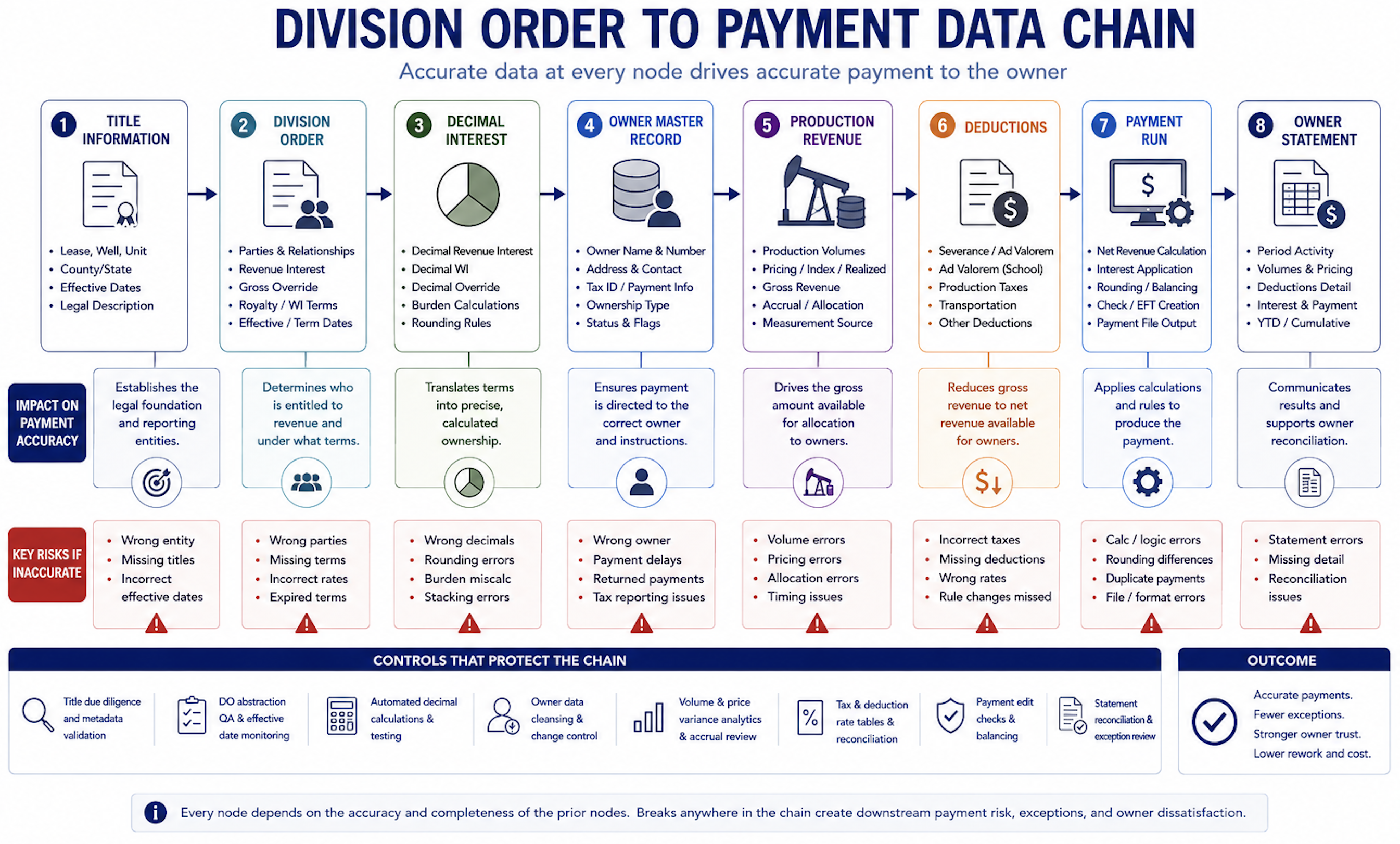
Royalty payment delays often do not begin on payment day. They are usually created earlier in the ownership data lifecycle through division orders, decimal interests, owner information, tax records, payment preferences, and ownership change management. Operators need to connect lease, well, unit, owner, interest, tax information, payment method, and statement record within the same data chain to make payments accurately and consistently.
A division order turns an ownership relationship into an executable payment basis. It typically confirms an owner’s decimal interest in a well, lease, or unit and provides the foundation for production revenue distribution. For operators, a division order should not be treated as a static file. It should be managed as a critical data record that must be maintained, updated, explained, and traced within the royalty payment workflow.
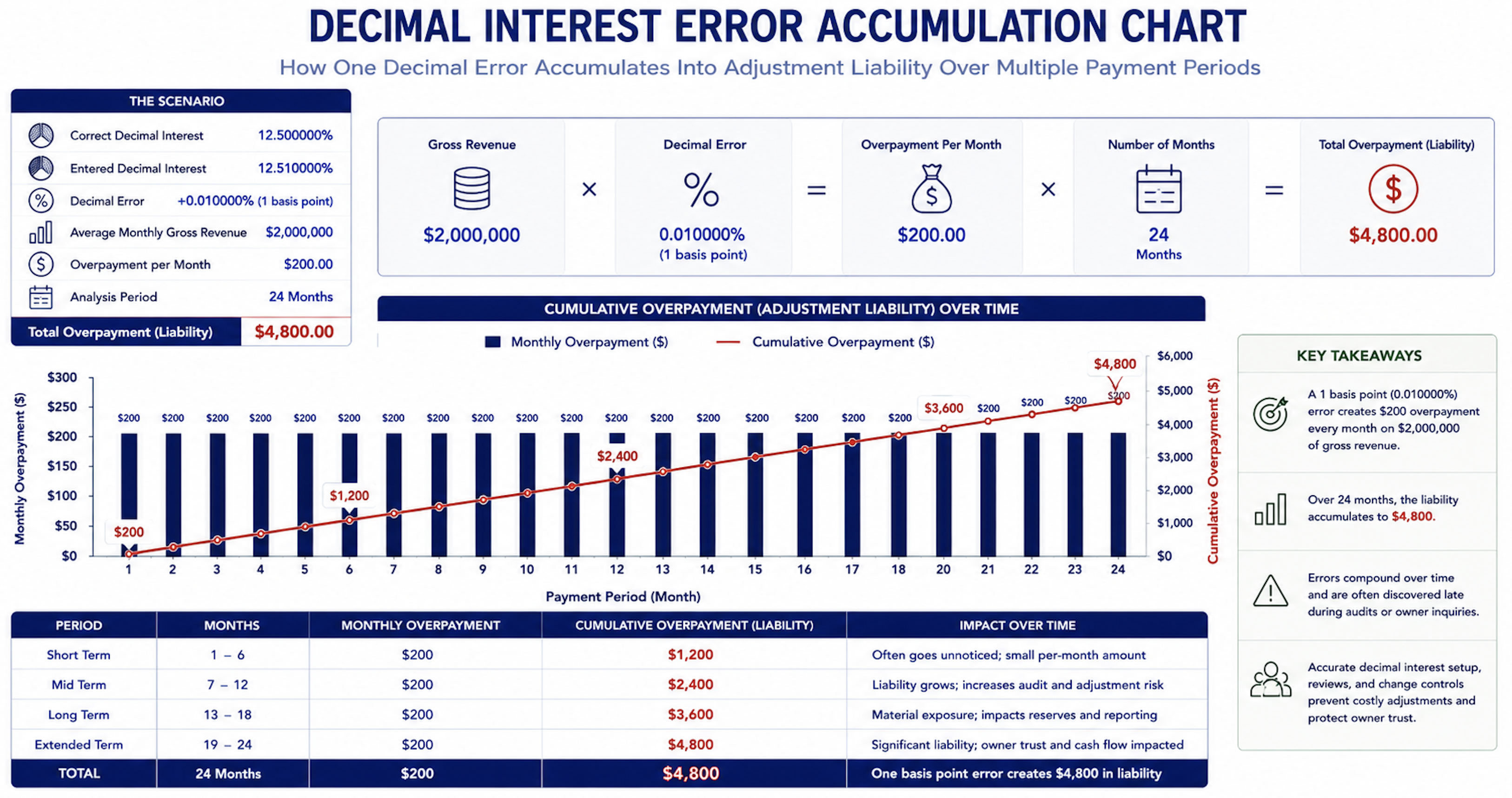
As owner counts, well counts, and payment cycles increase, ownership data errors become more expensive. A decimal interest error may affect only one owner in one payment period, but if the error continues across multiple periods, it can create adjustments, owner inquiries, supplemental payments, historical statement corrections, and audit explanation pressure. Payment accuracy depends less on manual checking during the payment run and more on disciplined ownership data management throughout the payment lifecycle.
The Calculation Depends on Connected Records
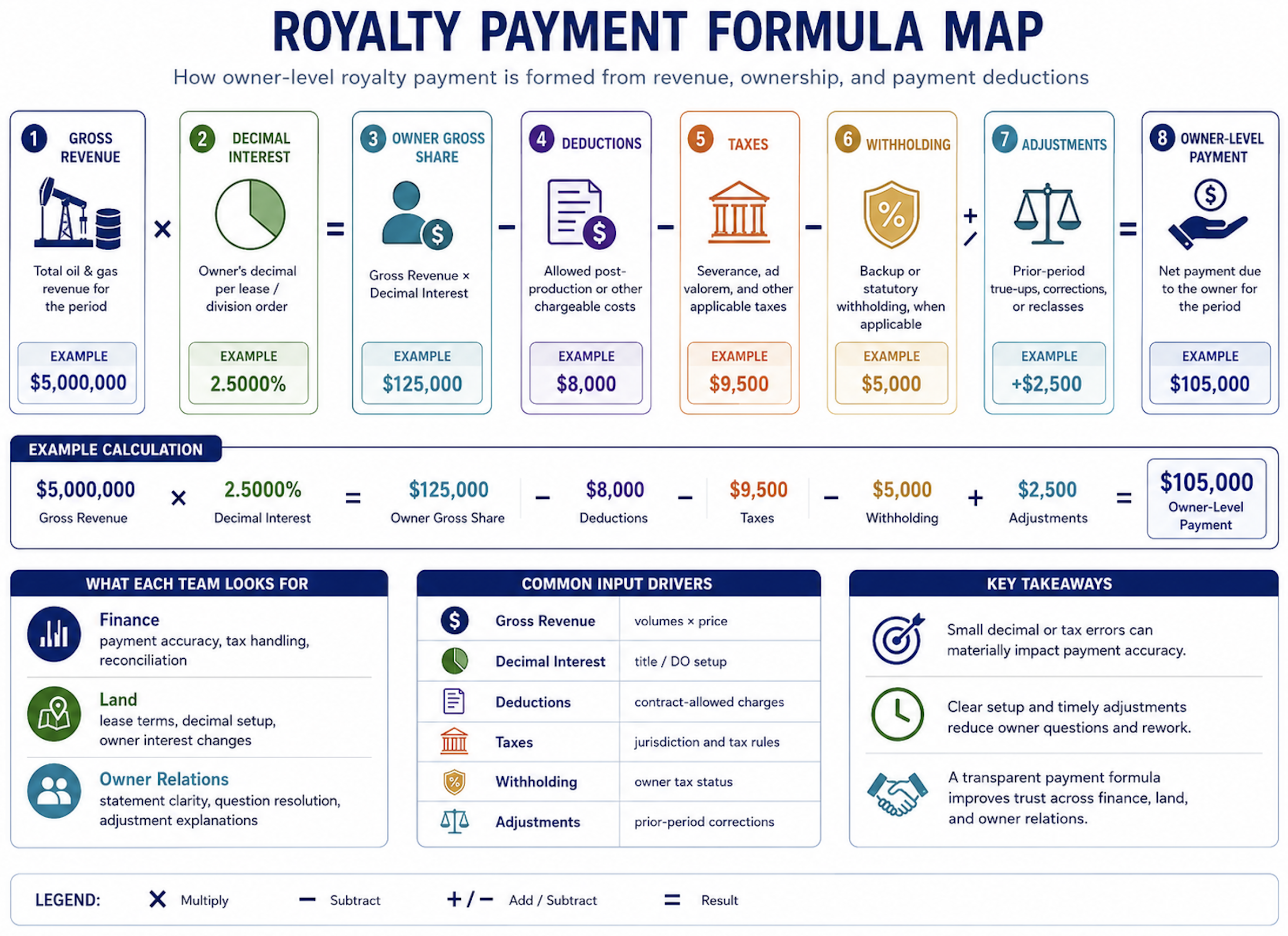
A simplified royalty payment formula can be expressed as: Owner Royalty Payment = Gross Revenue × Owner Decimal Interest − Allocated Deductions − Taxes or Withholding + Adjustments. In this formula, gross revenue depends on production volume, sales price, and related sales records. Owner decimal interest depends on the owner’s interest in the relevant well, lease, or unit. Deductions, taxes, withholding, and adjustments require clear records for deduction basis, tax treatment, historical corrections, and payment period attribution.
Decimal interest is one of the most underestimated variables in the formula. It may look like a small number, but it can be shaped by net mineral acres, unit acres, lease royalty rate, tract participation factor, and owner share. A simplified expression can be written as: Owner Decimal Interest = Owner Net Mineral Acres ÷ Unit Acres × Lease Royalty Rate × Tract Factor × Owner Share.
This formula shows that decimal interest is not an isolated field. It is the result of land, contract, ownership, and unit structure. If any of these variables changes and the system is not updated in time, the owner payment may become inaccurate. More importantly, the error may not be discovered immediately. It may surface later during owner statement review, tax reconciliation, historical adjustment work, or audit preparation.
Small Decimal Errors Can Accumulate Quietly
Assume a well generates $850,000 in gross revenue during one payment period. The correct decimal interest for one owner should be 0.002500, but the system stores it as 0.002050. The payment difference for that period is: Payment Difference = $850,000 × (0.002500 − 0.002050) = $382.50.
A single-period difference of $382.50 may appear small. If the error continues for 12 payment periods, the accumulated difference becomes $4,590. If similar errors exist across multiple owners or wells, the back-office team must manage more than a supplemental payment. It must also handle statement adjustments, owner communication, payment history review, and audit trail preparation.
A decimal interest error also tends to spread across workflows. It affects payment amount, owner statements, withholding calculations, 1099 reporting, and historical revenue records. If the system does not retain the effective date, change basis, and historical version of interest changes, the team may struggle to explain when the value changed, why it changed, and which payments were affected.
Payment Readiness Is a Better Control Point
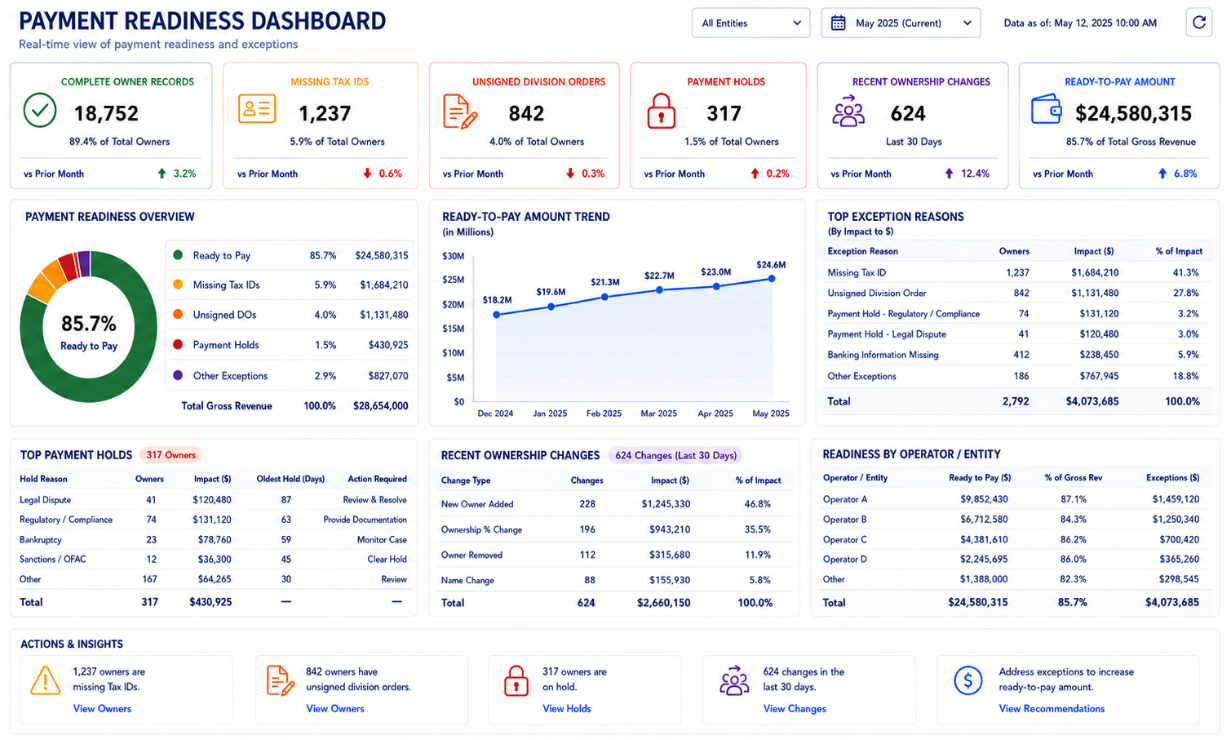
Operators can use payment readiness rate to measure data preparedness before payment execution: Payment Readiness Rate = Payable Owners with Complete Records ÷ Total Payable Owners × 100%. A complete record usually includes valid owner identity, tax ID, mailing address, payment method, division order status, decimal interest, hold reason, and statement preference.
If an operator has 2,000 payable owners in the current cycle and 160 have missing tax IDs, unsigned division orders, incomplete payment methods, or unclear hold reasons, the payment readiness rate is 1,840 ÷ 2,000 × 100% = 92%. A readiness rate of 92% may look acceptable at first glance, but the remaining 160 exception records can generate significant owner questions, payment holds, and later adjustments.
If each exception takes an average of 20 minutes to investigate and resolve, the team needs more than 53 hours of data review and communication. If these issues appear only on payment day, the payment team is forced into reactive resolution. A stronger process moves owner data issues before the payment run by continuously identifying incomplete records, unsigned division orders, missing tax data, unresolved holds, and recent ownership changes throughout the payment cycle.
Owner Questions Reveal Explanation Gaps
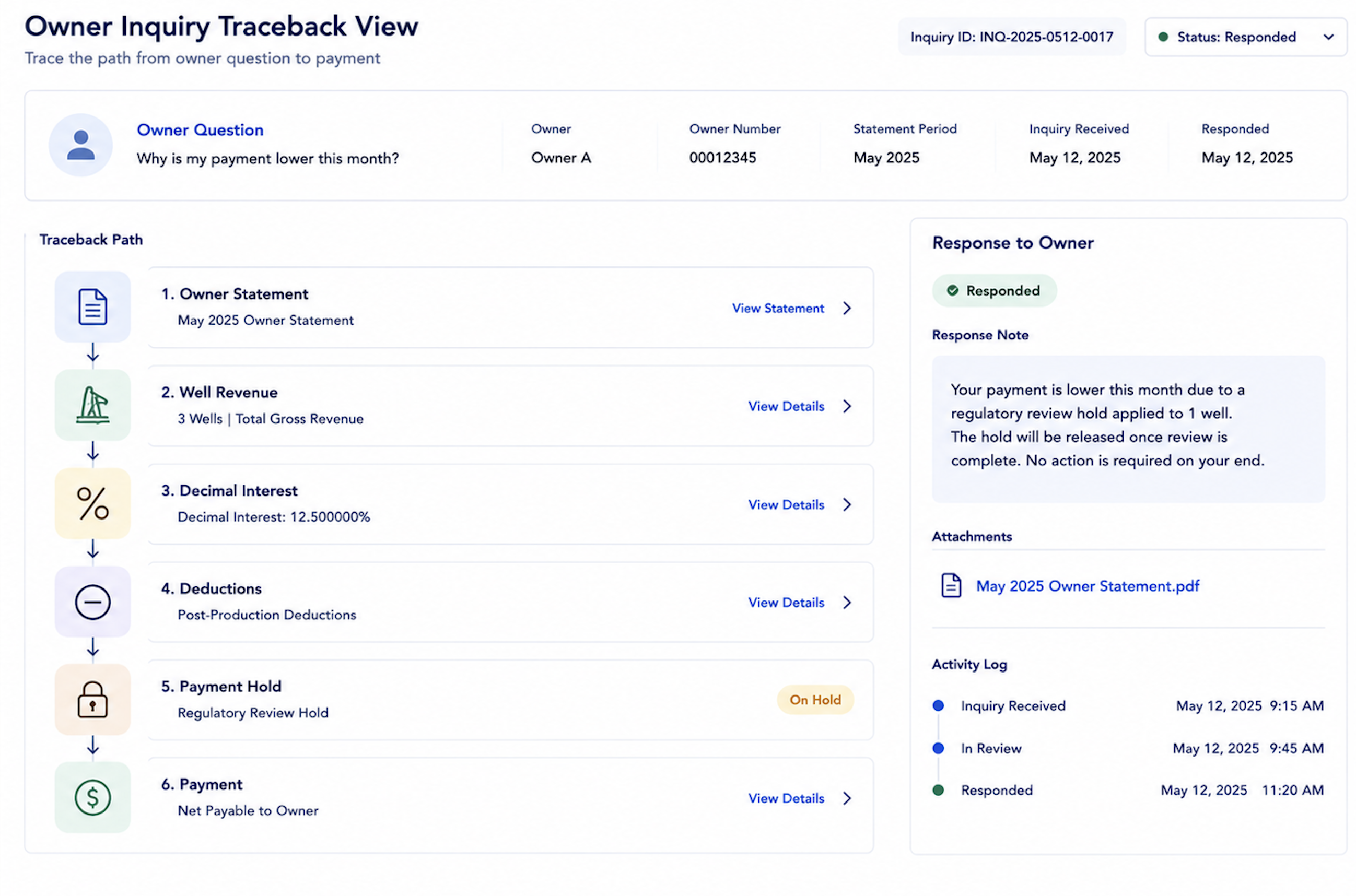
Royalty owners usually do not ask questions using system terminology. They may ask why this month’s payment is lower, why no payment was received, why deductions increased, or why the statement differs from the prior period. The answer may depend on production data, decimal interest, deductions, division order status, payment hold, tax record, and prior adjustments.
When teams must search across spreadsheets, emails, PDFs, and individual folders, response speed and consistency decline. An owner inquiry may be passed between land, accounting, and owner relations, with each team holding only part of the answer. From the owner’s perspective, inconsistent explanation can weaken confidence in the operator’s payment process.
A more mature owner relations workflow should allow the team to trace how a payment amount was formed. When an owner asks about a change, the team should be able to move from the statement to well-level revenue, then to decimal interest, deductions, payment status, and adjustment history. This type of record reduces explanation time and helps prevent the same issue from recurring in future payment cycles.
Ownership Data Needs Governance, Not Just Storage
Division order management should not stop at file storage. Operators need to record document status, effective date, related well or unit, interest impact, change source, approver, and change reason. If a PDF is only stored in a folder and its key fields are not converted into verifiable data, the system cannot support payment readiness or owner inquiry resolution effectively.
A stronger ownership data governance framework usually includes four principles:
Single owner record: Owner information should not be maintained separately across disconnected systems, spreadsheets, and folders. A single owner record helps reduce duplicate maintenance, inconsistent contact information, and unclear payment status.
Effective-dated interest: Ownership percentages should be managed by effective date, not only as a current value. This is critical when transfers, inheritance updates, unit revisions, or ownership corrections affect prior and future payment periods differently.
Documented change trail: Every ownership or decimal interest change should connect to a source document, responsible user, approval record, effective date, and affected payment scope. This gives accounting, land, and owner relations teams a shared explanation when owners ask why a payment changed.
Exception-based review: Teams should prioritize records most likely to affect payment, including missing tax information, unsigned division orders, unclear hold reasons, recent ownership changes, and decimal interest mismatches.
These principles move data management from reactive search to proactive control. Operators can identify incomplete owner records, division orders needing update, and ownership changes that may affect payment before the payment run. In this model, royalty payment is not only a settlement process. It becomes a shared foundation for owner data, payment accuracy, and relationship management.
Payment Controls Should Start Before the Run
A practical royalty control process should separate payment-ready records from records that still need review. This is more useful than waiting for a payment file to fail or for an owner to call after a missed payment. The earlier the team can identify the exception, the easier it is to assign responsibility, complete missing information, and protect the payment cycle.
Before payment run, operators should confirm:
Owner master records are complete and current
Tax ID, mailing address, and payment method are verified
Division order status is visible and up to date
Decimal interest is approved, effective-dated, and traceable to support records
Ownership changes have been reflected before payment calculation
Payment holds have clear reasons and assigned next actions
Deductions, taxes, withholding, and adjustments are traceable
Suspense items are categorized by owner, property, amount, reason, and aging
Recent ownership changes are reviewed for payment impact
Ready-to-pay owners and exception owners are clearly separated
This checklist should not live outside the workflow. It should be part of the regular royalty payment process, supported by clear ownership, current data, and a review trail. When the checklist is treated as a control discipline rather than a last-minute review, payment teams can reduce avoidable delays and improve owner-facing consistency.
Owner Communication Requires the Same Data Trail
Before owner communication, payment teams should confirm that the information behind each statement and payment decision is easy to retrieve. A payment may be calculated correctly, but if the team cannot explain it, the process still creates operational risk. Owner communication is strongest when it is supported by the same records used for payment calculation.
Before responding to owner questions, teams should confirm:
Owner statements connect to payment history
Payment changes can be traced to revenue, decimal interest, deductions, holds, or adjustments
Owner inquiry notes are connected to the relevant payment record
Historical payment records are available for lookup
Division order records and related files are easy to retrieve
Owner communication history is visible to accounting, land, and owner relations teams
Recurring owner questions are reviewed for process improvement
1099-related payment records are organized for annual reporting
Payment corrections and supplemental payments include clear explanations
Owner-facing answers can be supported by system records, not memory
This level of traceability improves more than response speed. It also helps teams identify recurring process gaps. If many owner questions relate to missing deduction explanations, unclear decimal changes, or unsigned division orders, those inquiries should become inputs for process improvement rather than isolated customer service events.
How Petrofly Supports Ownership-to-Payment Control
Petrofly can help oil and gas operators connect ownership data, division orders, payment records, statements, 1099 records, and owner communication in a more organized workflow. The value is not only generating payment files. It is making the data behind those payments easier to review, maintain, and explain.
Petrofly can support this process through:
Ownership and division order visibility: Keep owner records, DOI details, title-related changes, supporting files, and division order status easier to review.
Royalty payment tracking: Support royalty share allocation, payment records, statement generation, and bulk payment activity across recurring cycles.
Payment readiness control: Help teams identify missing owner data, payment holds, unsigned division orders, and records that still need review before release.
Owner communication context: Keep statements, payment questions, document history, and communication notes closer to the payment record.
1099 and reporting support: Organize owner and partner payment history, 1099-MISC, 1099-NEC, bulk generation, and historical reporting records.
Cloud-based access and flexible setup: Allow teams to start with priority workflows such as royalty payments, division orders, owner relations, or reporting, then adjust fields, workflows, and views around actual operating needs.
Dedicated support after go-live: Assist with setup, data organization, workflow refinements, reporting questions, and follow-up needs as payment processes evolve.
For operators, the practical value is a clearer link between ownership data and payment execution. When division orders, owner records, statements, payment activity, and communication history are connected, teams can spend less time reconstructing payment context and more time resolving the issues that affect payment accuracy.
A More Traceable Royalty Payment Process
Royalty payment accuracy depends on ownership data discipline before the payment run, not manual checking on payment day. Operators that connect division orders, decimal interests, owner records, payment history, statements, and reporting requirements within a coherent workflow can reduce delays, lower owner inquiry volume, and improve audit readiness.
The strongest royalty payment workflow is not only about calculating the correct amount. It is about being able to explain why that amount was paid, why a payment was held, why a decimal changed, and how a statement connects back to ownership records and revenue data. When these records are connected, owner relations teams can respond faster, accounting teams can reduce correction work, and management can see payment readiness before the cycle is under pressure.
Accurate royalty payments depend on disciplined ownership data management across division orders, decimal interests, owner records, payment readiness, owner statements, and reporting history. A connected workflow helps operators make royalty payments more traceable, explainable, and easier to manage across recurring payment cycles.
To discuss how a more connected ownership-to-payment workflow could support royalty payment accuracy, contact our team for a focused conversation.