Information Asymmetry Drives Review Risk
Working interest owners in non-operated assets carry cost exposure and investment risk, but they usually do not manage field execution, vendor invoices, daily cost approvals, or JIB statement generation. The operator performs the work and allocates costs, while the non-operator must determine whether the JIB charges are reasonable, aligned with the AFE, supported by documentation, and ready for payment. This structure means that non-operated financial control is not about executing operations; it is about reviewing information, interpreting variances, and preserving decision evidence.
The challenge is not simply reading one statement. A working interest owner may hold interests across multiple non-operated assets and receive JIB statements from different operators. Each operator may use different statement formats, cost categories, supporting document practices, and communication timelines. If the non-operator relies only on spreadsheets, emails, and individual memory, review consistency becomes harder to maintain as the asset portfolio grows.
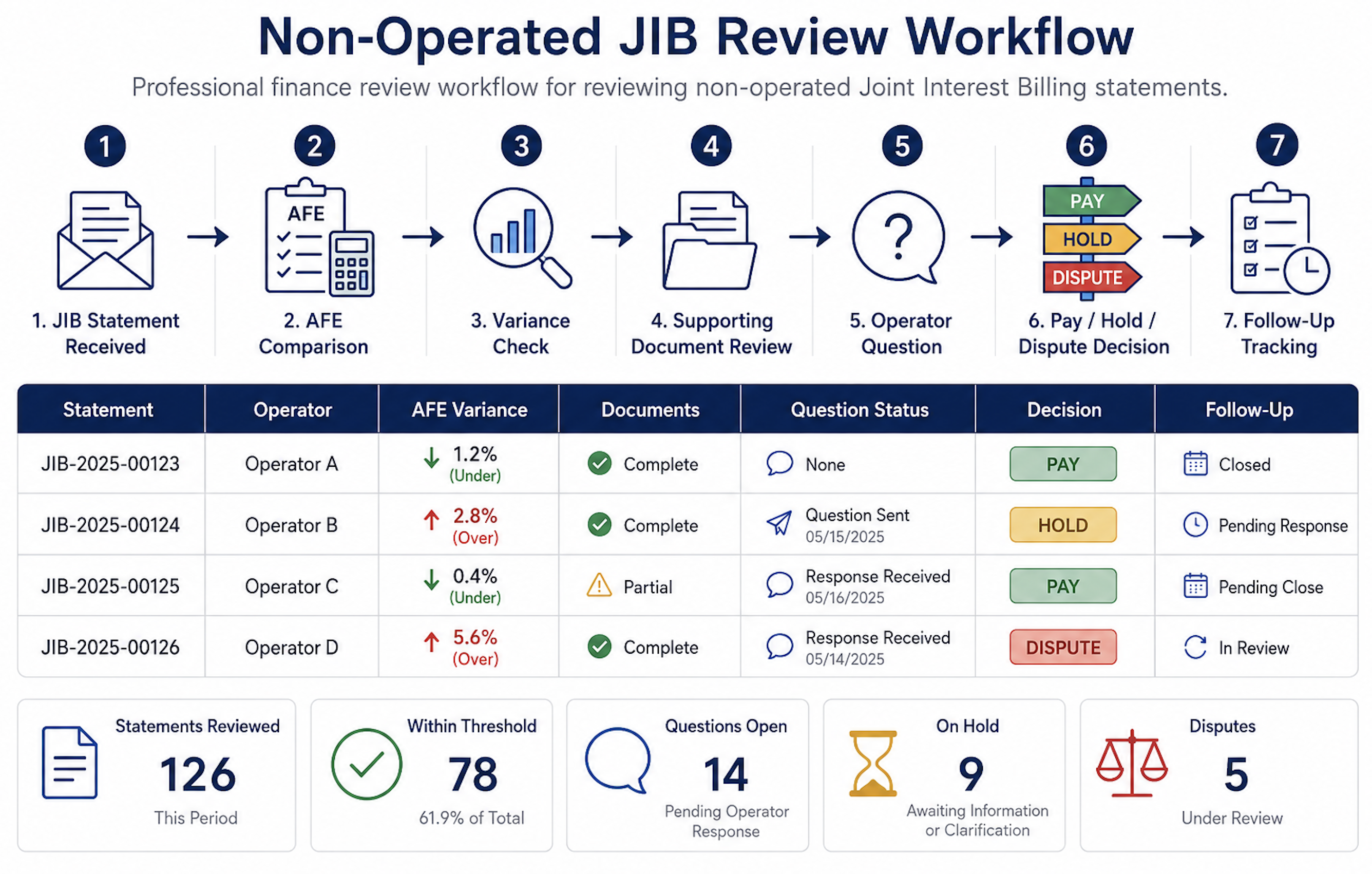
Non-operated financial control requires a repeatable method. Non-operators do not need to duplicate the operator’s full accounting process, but they do need a clear JIB review workflow that includes AFE comparison, cost category review, document verification, question tracking, payment decisioning, and historical recordkeeping. This workflow helps investment teams distinguish normal cost movement, charges requiring explanation, and exceptions that may require dispute.
AFE Variance Is a Signal, Not a Verdict
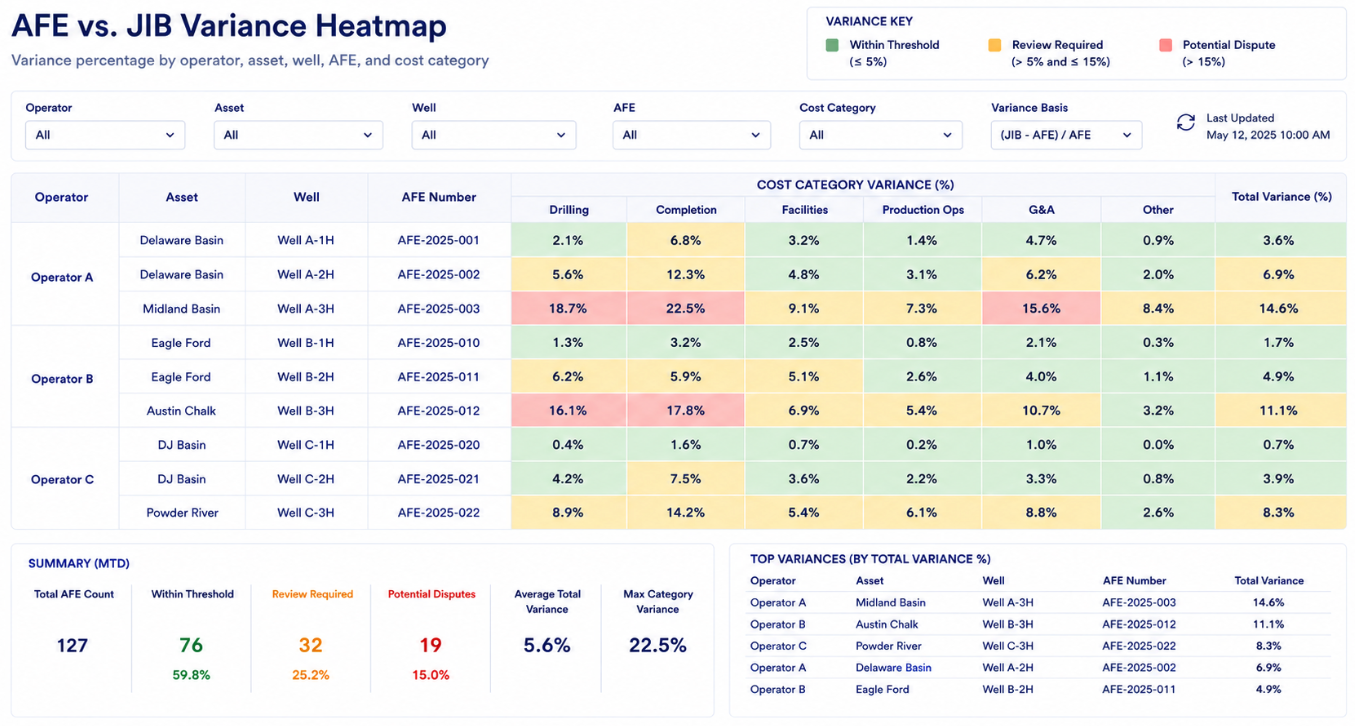
An AFE is an authorization budget, while a JIB represents actual cost allocation. A difference between the two does not necessarily mean a charge is wrong. Actual costs may be affected by scope changes, service cost inflation, weather delays, equipment availability, geological conditions, workover complexity, or project timing.
The non-operator’s task is not to ask whether a variance exists. The more useful question is whether the variance is reasonable, explained, documented, and consistent with the agreement and authorization logic. A cost increase may be valid, but it still needs enough supporting context for the owner to approve payment with confidence.
A basic AFE variance formula can be expressed as: AFE Variance Percentage = (Cumulative JIB Actual Cost − Approved AFE Budget) ÷ Approved AFE Budget × 100%. Assume a workover AFE was approved at $2,000,000, and cumulative JIB actual cost received to date is $2,350,000. The variance percentage is ($2,350,000 − $2,000,000) ÷ $2,000,000 × 100% = 17.5%.
If the non-operator’s internal review threshold is 10%, the project should enter enhanced review rather than automatic payment. Further review should confirm whether there is a revised AFE, scope change, field explanation, operator notice, or supporting documentation. The variance itself is only a signal; the real control point is whether the explanation and evidence are sufficient.
Working Interest Converts Variance into Exposure
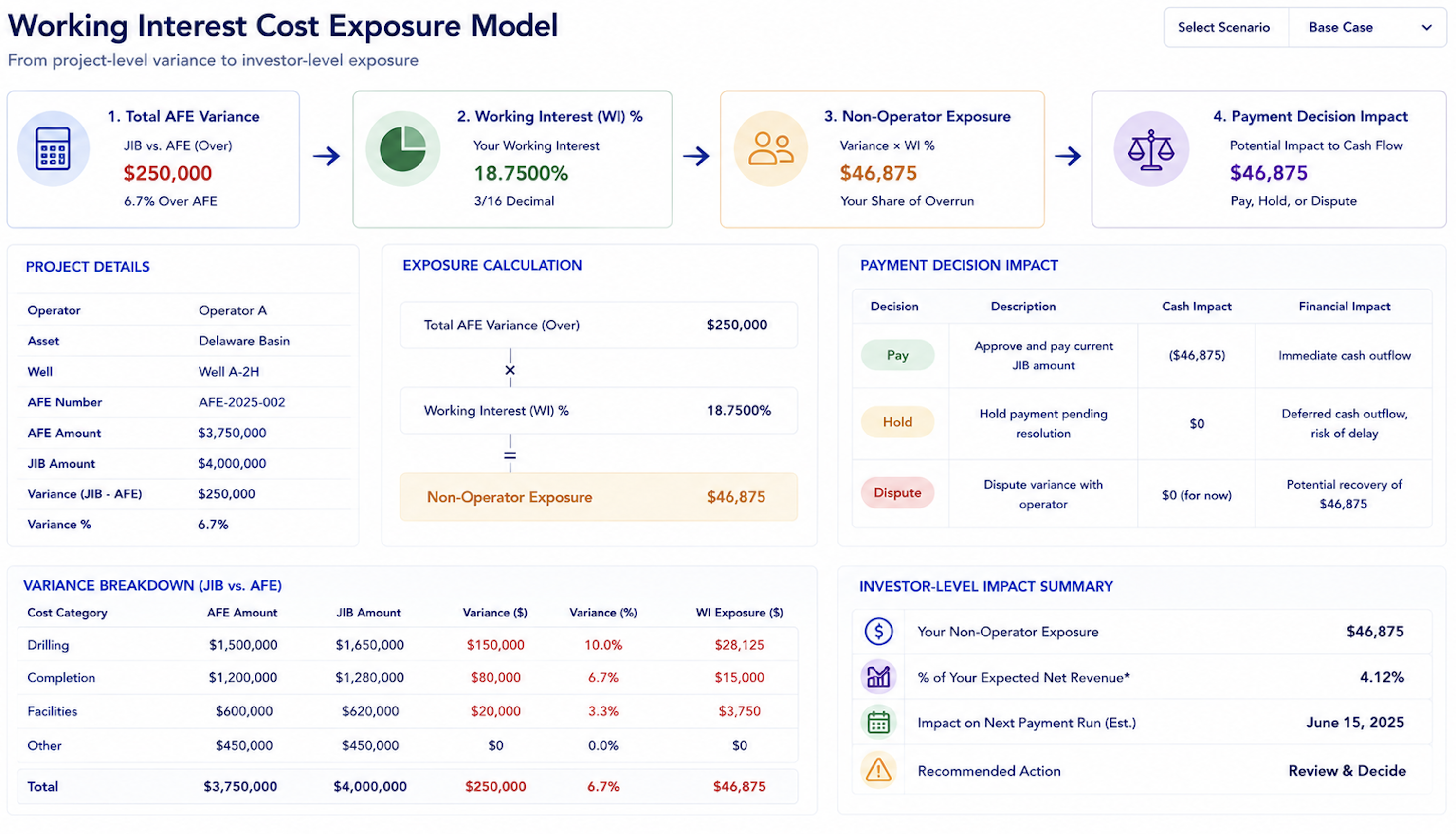
When reviewing JIB, non-operators should look beyond total project variance and calculate their own exposure under working interest. A $350,000 project variance has very different implications for a party holding 5% working interest versus a party holding 35%. Review resources should be prioritized toward items with greater financial impact on the non-operator’s portfolio rather than sorted only by total project amount.
A simple exposure formula is: Non-Operator Cost Exposure = JIB Variance Amount × Working Interest Percentage. Using the prior example, the approved AFE is $2,000,000, cumulative JIB actual cost is $2,350,000, and the variance amount is $350,000. If a working interest owner holds 18.75%, the cost exposure is $350,000 × 18.75% = $65,625.
This amount does not automatically require dispute, but it should receive management attention. Non-operators can combine cost exposure with document completeness, operator history, payment due date, and cash planning to decide whether to pay, partially pay, hold pending support, or ask the operator for clarification. In this model, JIB review becomes part of investment risk management rather than basic statement checking.
Review Priority Should Reflect Risk, Not Only Amount
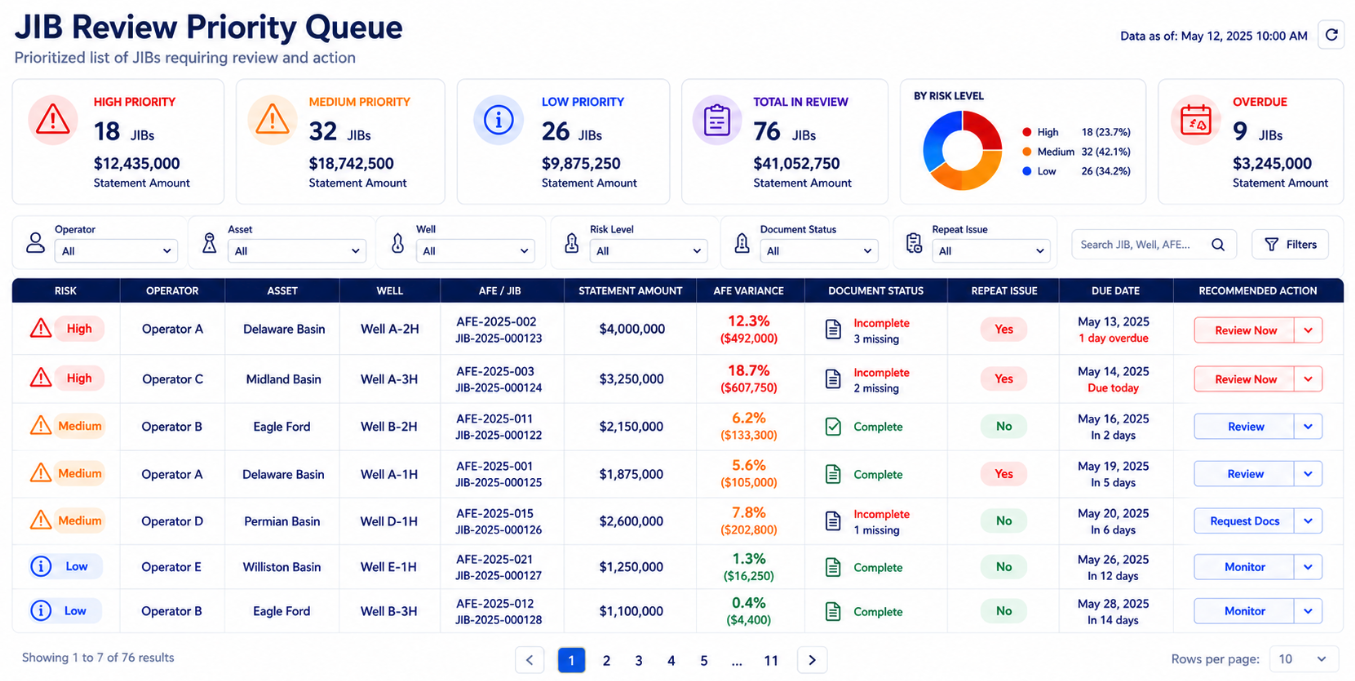
Non-operators usually cannot review every JIB line item with the same level of attention. A more practical approach is to build a review priority model that combines amount, variance, document completeness, repeat issues, and payment due date pressure. A large charge with complete support may be less risky than a smaller charge that repeatedly appears without documentation.
A practical review priority formula can be expressed as: Review Priority Score = Amount Weight + Variance Weight + Missing Document Weight + Repeat Issue Weight + Due Date Risk Weight. The model does not need to be complex at first. Non-operators can assign a score from 1 to 5 to each factor and refine the scoring logic as review patterns become clearer.
For example, variance above 10% may receive 4 points, missing support may receive 5 points, repeat issues from the same operator over the prior three periods may receive 4 points, and a due date within seven days may receive 3 points. An $18,000 charge may not be large, but if it lacks invoice support, appears in a cost category that does not align with the AFE, and comes from an operator with similar issues in prior periods, it may deserve higher priority than a $75,000 charge that is well documented and clearly explained.
This scoring approach helps non-operators focus limited review resources on the items that most affect investment judgment. It also improves internal consistency. Instead of relying on whoever reviews the statement first, the team can apply the same review logic across operators, assets, and accounting periods.
Spreadsheets Track Records, but They Do Not Control Review
Many working interest owners begin by managing JIB statements in spreadsheets. This is a reasonable starting point. A spreadsheet can record operator, asset, period, amount, well, AFE, due date, payment status, and notes. For small portfolios and low transaction volume, this can support basic tracking.
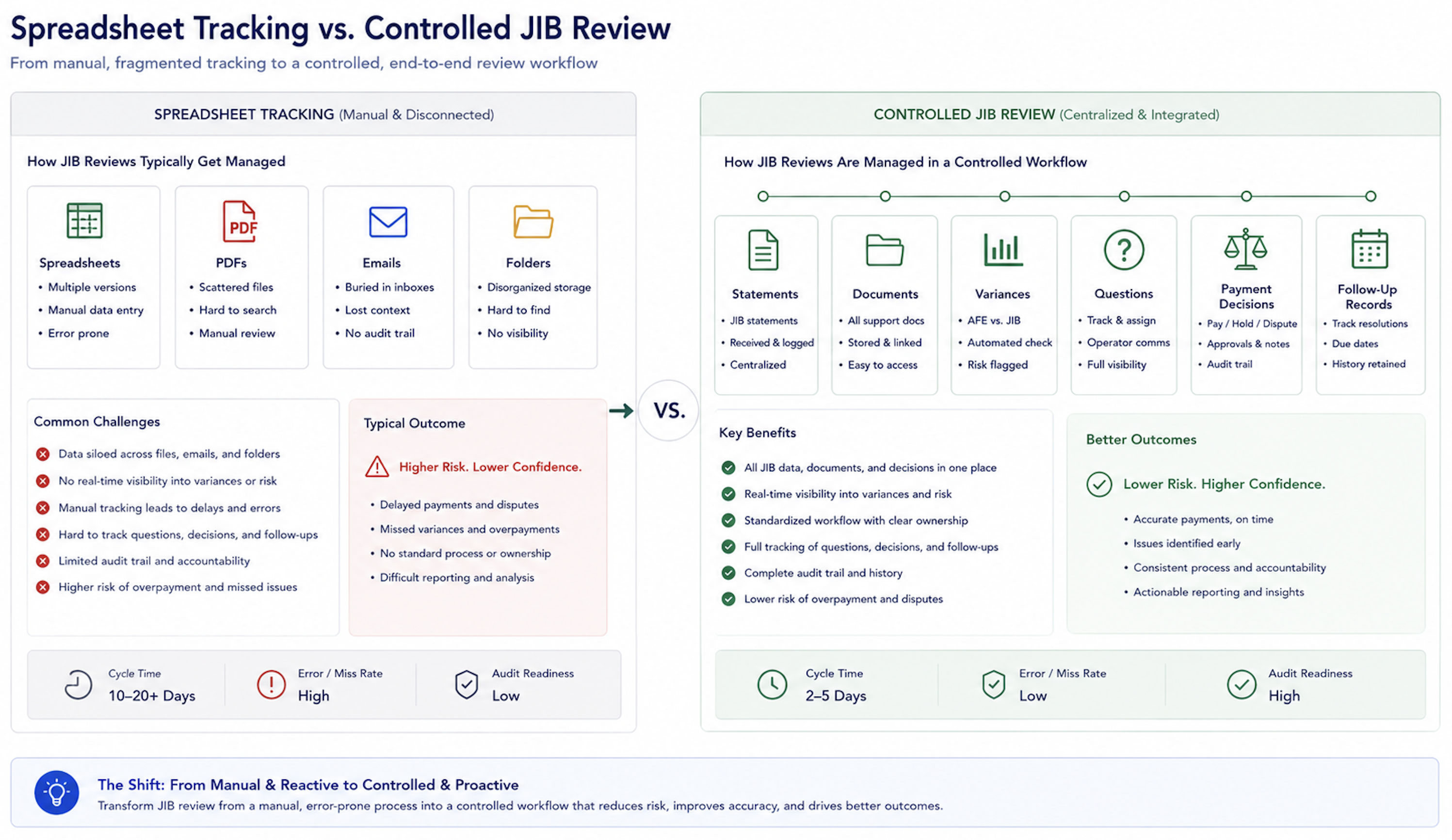
As assets, operators, statements, and supporting documents increase, spreadsheet limitations become more visible. Spreadsheets do not manage evidence, operator responses, version history, multi-user collaboration, payment decisions, or multi-period variance trends in a stable way. More importantly, they do not easily tell the team which questions remain open, which charges are on hold, which variances are recurring, or which payment decisions lack support.
Non-operators do not simply need a bigger spreadsheet. They need a clearer review workflow. Each JIB statement should have a received date, review status, issue list, operator response, payment decision, internal owner, and follow-up date. This preserves history even when team members change and prevents the same issue from being reopened without context.
Payment Decisions Need Evidence
Non-operator payment decisions are rarely limited to pay or do not pay. More practical categories include pay, pay with note, partial pay, hold pending support, and dispute escalation. Each decision should have a clear basis, including amount, variance reason, document status, operator response, internal owner, and next action. A payment decision without a record is difficult to defend during audit, investment review, or management questioning.
A structured payment decision record can be divided into three layers:
Financial basis: Statement amount, AFE amount, variance amount, working interest exposure, and due date. The reviewer should understand the size of the obligation and whether it matters materially to the portfolio.
Evidence basis: Supporting documents, operator explanation, field activity context, and operating agreement reference. The purpose is to confirm whether the charge is supported and whether additional information is needed.
Decision basis: Reason for pay, hold, partial pay, or dispute, along with internal owner and follow-up date. The record should explain what decision was made, why it was made, and what happens next.
This structure reduces inconsistent internal judgment. Different reviewers can evaluate similar charges using the same standard rather than relying only on personal experience. For management, it also improves portfolio-level visibility into which operators generate unanswered questions, which assets show higher cost variance, and which payments are delayed due to missing support.
Operator Cash Recovery Depends on Review Clarity
Non-operator JIB review directly affects the operator’s payment recovery speed, partner communication cost, and long-term trust. Before payment, working interest owners typically evaluate AFE variance, cost category, supporting documents, historical adjustments, and payment due date pressure. If these elements are not clearly presented in the JIB statement, the operator is more likely to receive clarification requests, and part of the billed amount may be held.
For operators, improving JIB transparency is not only about meeting partner expectations. It is an important control measure for protecting the cash recovery cycle. When charges exceed an AFE threshold, LOE changes materially, workover costs increase, or adjustments appear on a statement, the operator can prepare explanation notes and supporting documents before statement issuance. This reduces repeated communication after billing and helps partners reach payment decisions faster.
The value of a JIB management system is therefore not limited to generating statements. It also improves the explainability and traceability of those statements. The more consistently operators manage JIB statements, interest partner information, payment records, and supporting context, the easier it becomes for partners to assess whether charges are reasonable. Financial control and partner relationships are not separate topics; they are two sides of the same JIB workflow.
A Practical Review Standard for Non-Operators
Working interest owners can use a structured review standard to preserve decision evidence and reduce inconsistent payment decisions across operators and assets. The goal is not to slow down every payment. The goal is to make review effort proportional to risk and to ensure that decisions can be explained later.
Before reviewing the statement, non-operators should confirm:
Operator, asset, well, lease, and accounting period
Statement received date and payment due date
Whether the charge relates to an approved AFE, LOE, workover, or adjustment
Working interest percentage used for allocation
Whether the ownership percentage changed during the period
Whether the statement format, cost categories, or supporting detail differ from prior periods
Before making a payment decision, they should confirm:
Cumulative JIB actual cost against approved AFE budget
Variance percentage and working interest cost exposure
Cost categories with unusual movement
Invoice support or operator explanation for material charges
Missing documents, unfamiliar vendors, or duplicate-looking charges
Consistency with the operating agreement and authorization logic
Whether the item should be paid, partially paid, held, or disputed
Internal owner and follow-up date for unresolved items
Before closing the review record, they should confirm:
Operator responses are stored with the related statement or line item
Payment decision notes and supporting documents are preserved
Open questions are tracked by operator, asset, amount, and due date
Recurring issues are reviewed across operators or accounting periods
Final payment status is connected to the statement record
Review history can support audit, investment review, and management questions
How Petrofly Supports Clearer Partner Review
Petrofly can help operators organize the JIB information that non-operated partners need to review charges with more confidence. The focus is not only statement generation, but keeping billing records, interest partner information, payment activity, and supporting context easier to manage across billing cycles.
Petrofly can support this process through:
JIB statement organization: Keep JIB statements, partner records, and related payment activity easier to track.
Interest partner visibility: Maintain partner information, division order records, DOI details, and related files in a more organized workflow.
Payment follow-up: Connect statement status, payment records, balances, and follow-up history so open items are easier to monitor.
Support for clearer explanations: Keep cost context, partner questions, and related records closer to the billing workflow.
Cloud-based access: Give authorized users a shared place to review billing and partner records without relying only on scattered files.
Flexible setup and dedicated support: Configure reporting, fields, workflows, and review views around actual JIB management needs, with support after go-live as requirements evolve.
For operators, the practical value is reducing the time spent searching for files, repeating explanations, and tracking questions across accounting periods. Clearer JIB records also make it easier for non-operators to complete review and move valid charges toward payment.
Financial Control Without Operating Control
Financial control for non-operated working interest owners is not about duplicating the operator’s accounting process. It is about building a repeatable, explainable, and traceable JIB review discipline. A strong review model uses AFE variance analysis, working interest cost exposure, review priority scoring, and payment decision records to identify high-risk charges and protect investment returns.
For operators, understanding non-operator review logic is equally important. Clearer JIB records, partner information, supporting documents, and payment tracking can reduce partner questions, improve payment communication, and move JIB from statement output into a more transparent partner management workflow.
When both sides work from clearer records, JIB becomes less reactive. Non-operators can review charges with stronger evidence, while operators can support payment recovery with better statement context and follow-up visibility. This is how JIB review becomes a financial control process rather than a recurring search through statements, emails, and disconnected files.
To discuss how clearer JIB records and partner review workflows could support payment confidence and cost recovery, contact our team for a focused conversation.