Payment Calculation Is Only One Control Point
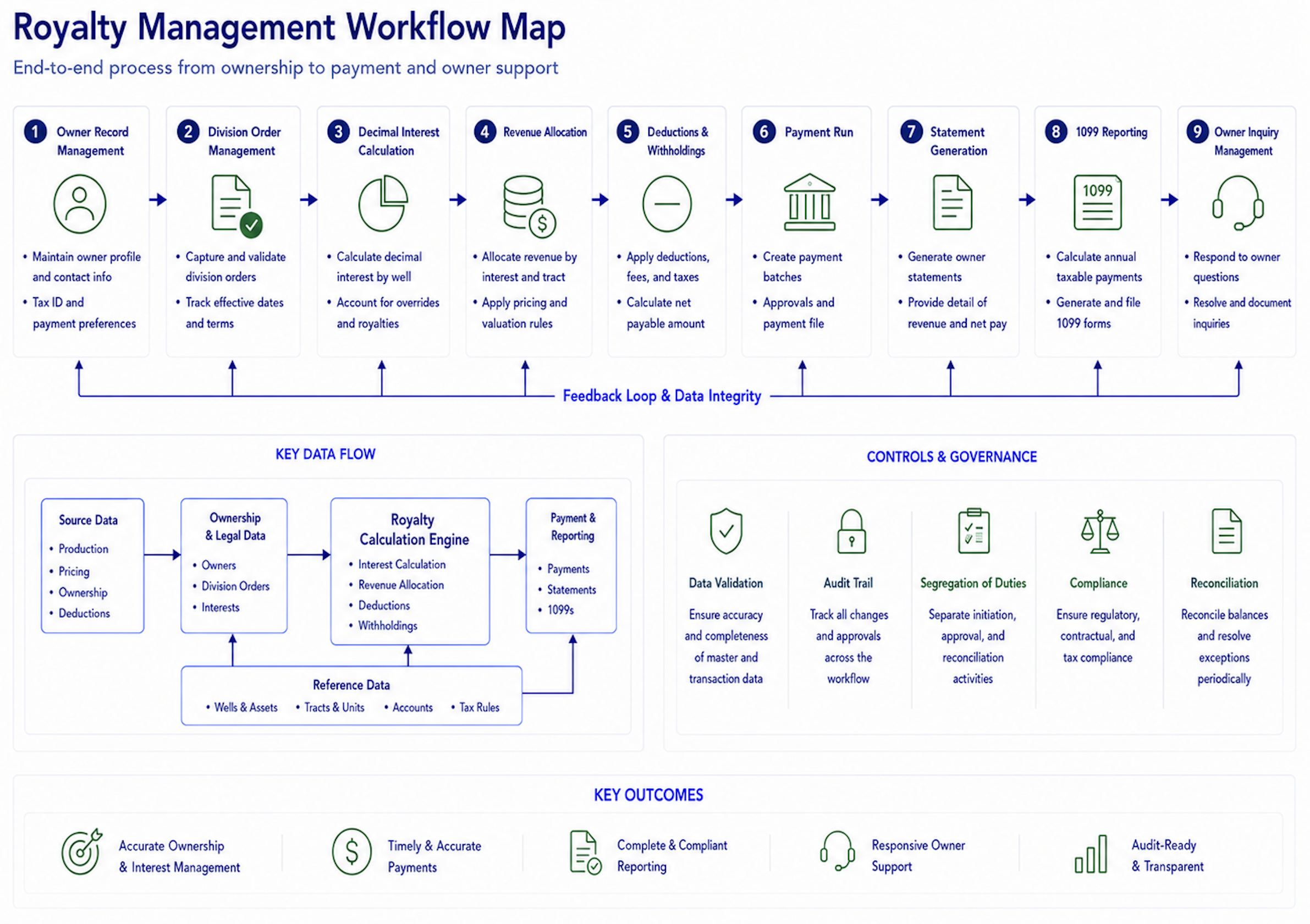
Many operators begin their evaluation of royalty management software by asking whether the system can calculate owner payments. That question is important, but it only covers the final stage of the royalty workflow. The factors that truly affect payment efficiency and owner satisfaction are whether owner information, division orders, decimal interests, payment status, statement generation, tax reporting, and owner communication can be managed continuously.
Royalty payment is not a one-time accounting action. It is a recurring, high-volume, long-term relationship management process. Every owner record, interest change, statement, payment, and owner inquiry affects future operating efficiency. If this information is spread across spreadsheets, PDFs, emails, and legacy tools, the back-office team may still spend significant time explaining, searching, and correcting even if the payment amount can eventually be calculated.
The value of royalty management software should therefore not be measured only by whether it can execute a payment run. A more practical evaluation asks whether the system improves payment readiness, reduces owner inquiries, supports statement traceability, lowers 1099 preparation pressure, and gives teams complete records when owners ask questions. The software should support the full royalty operations workflow, not only the payment button.
Owner Records Are the Operating Foundation
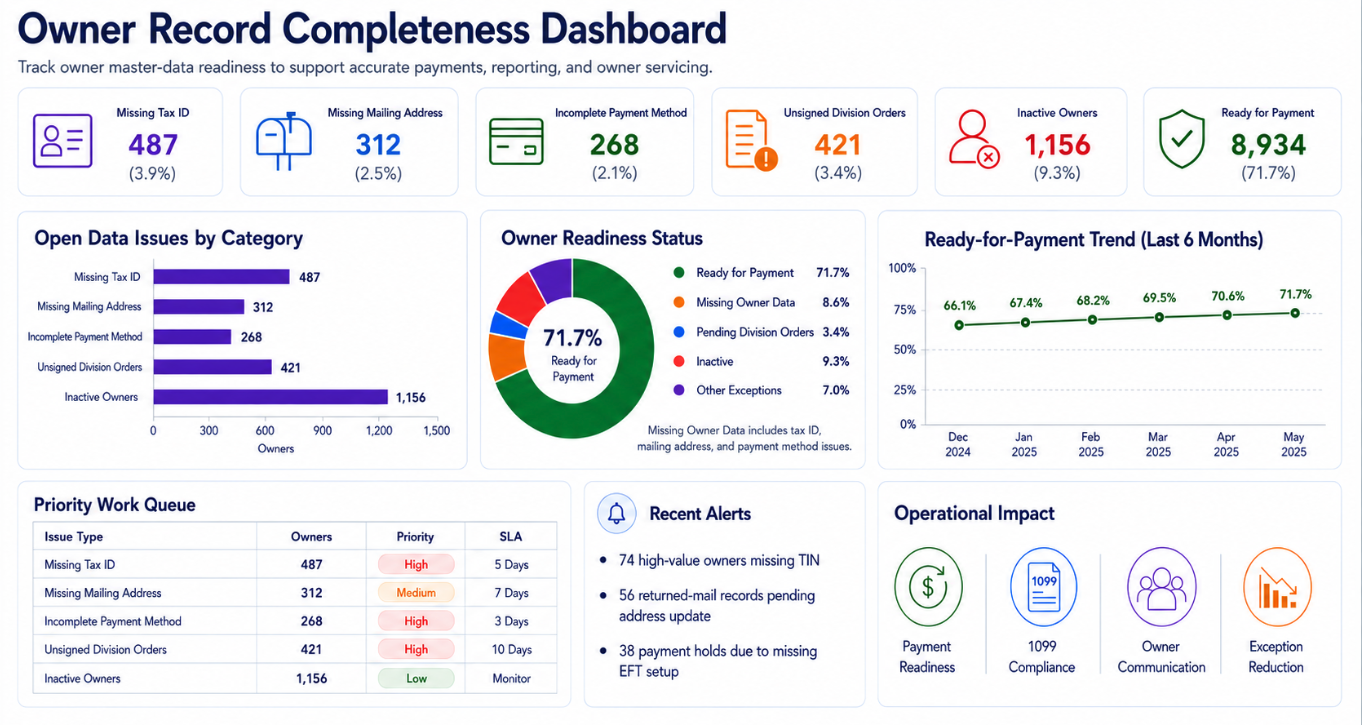
The center of royalty management software should not be the payment transaction alone. It should be the owner record. A complete owner record should connect owner identity, tax information, mailing address, payment method, division orders, well or lease interests, payment history, statement history, documents, and communication notes. When owner records are complete, payment workflows become more stable because the system can identify which owners are ready to pay and which records still need attention.
Operators can use owner data completeness rate to measure owner record quality: Owner Data Completeness Rate = Complete Owner Records ÷ Total Active Owner Records × 100%. Assume an operator has 3,200 active owner records, and 420 are missing tax ID, mailing address, payment method, division order status, or statement preference. The completeness rate is 2,780 ÷ 3,200 × 100% = 86.9%.
At first glance, 86.9% may look acceptable. The remaining 420 exception records, however, can create payment holds, returned mail, owner inquiries, tax reporting gaps, and manual review pressure. These issues usually do not appear only once. They appear during each payment cycle, statement run, and year-end reporting process, which is why software should help teams identify incomplete owner records continuously rather than waiting until payments fail or owners complain.
Payment Readiness Should Be Visible Before Execution
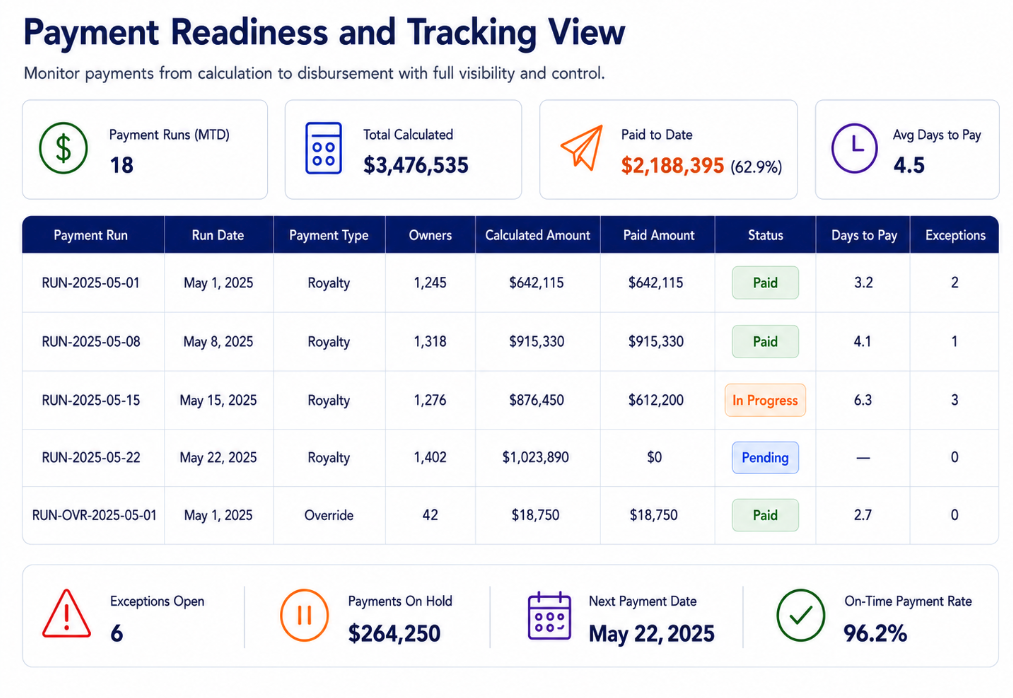
Royalty payment efficiency depends not only on calculation speed, but also on data readiness before payment execution. A payment cycle may include owner eligibility, payment threshold, withholding, deductions, division order status, payment method, and hold reason. If these conditions are not reviewed before the payment run, the team may spend payment day resolving exceptions.
Payment readiness rate can help measure preparedness: Payment Readiness Rate = Owners Ready for Payment ÷ Total Payable Owners × 100%. Assume there are 2,500 payable owners in the current cycle, and 275 have missing information, unresolved hold status, threshold issues, or payment method problems. The payment readiness rate is 2,225 ÷ 2,500 × 100% = 89%.
This number helps management understand whether payment risk is visible before execution. If readiness remains below target, the issue is usually not payment calculation. It is owner data, division order status, payment method, or exception management. Payment tracking is equally important because teams need to know when statements were generated, when payments were recorded, which owners have been processed, and which items still require follow-up.
Owner Statements Carry the Explanation Burden
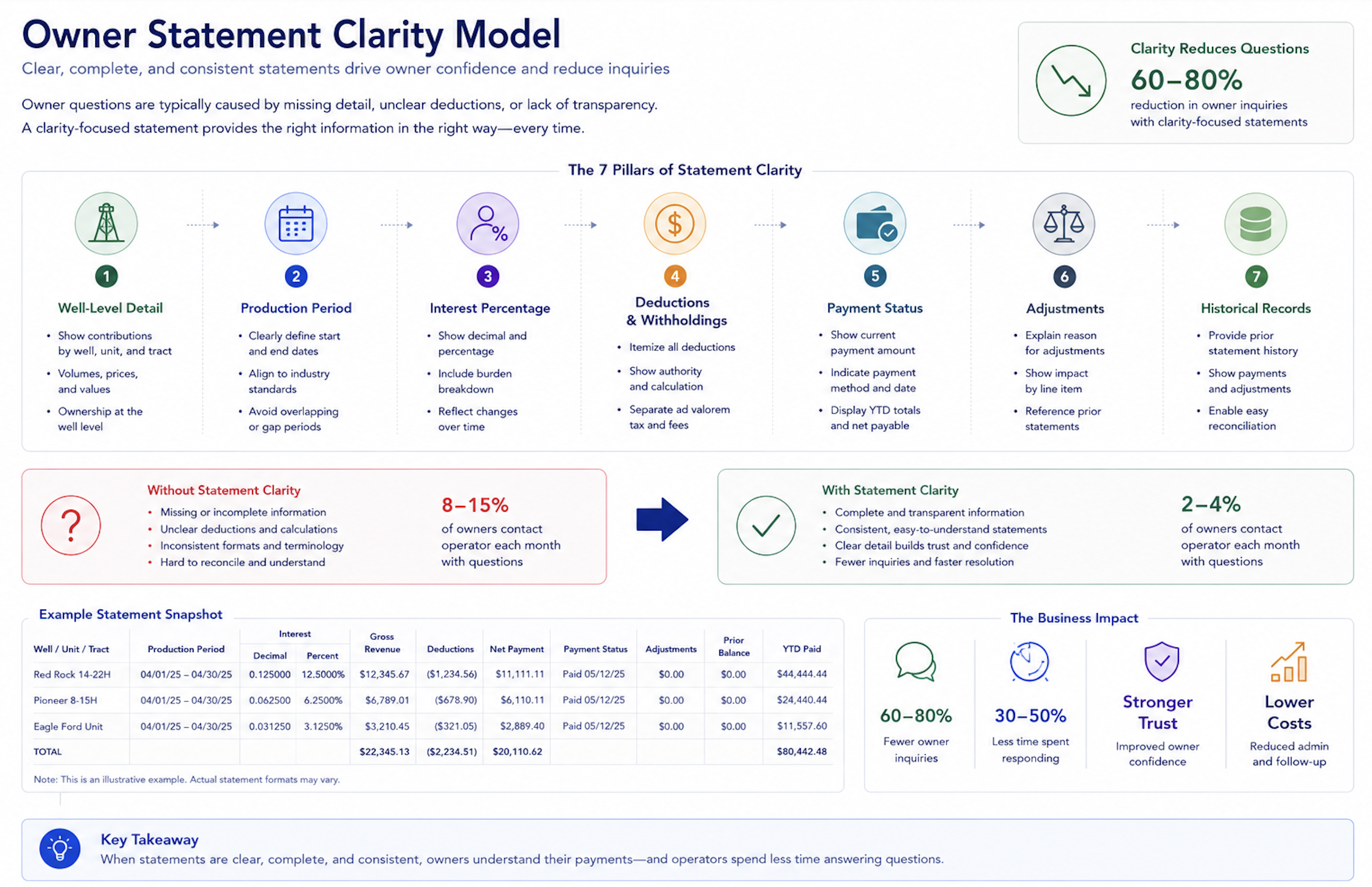
Owner statements are one of the most important communication points in the royalty workflow. Owners usually care about more than the payment amount. They may want to know which well the payment came from, which production period it reflects, what interest was applied, which deductions were taken, why the amount changed, and whether there was a prior-period adjustment.
If the statement structure is unclear, the owner relations team carries the explanation burden. A payment may be correct from an accounting perspective, but if the statement does not make the source and logic clear, the owner may still ask for clarification. Over time, repeated questions about the same statement fields can become a signal that the payment workflow is not explaining itself well enough.
Owner inquiry rate can help measure whether statements are easy to understand: Owner Inquiry Rate = Number of Owner Questions ÷ Number of Statements Issued × 100%. Assume an operator generates 4,000 statements per month and receives 320 owner questions. The owner inquiry rate is 320 ÷ 4,000 × 100% = 8%.
If each question takes an average of 18 minutes to resolve, the team spends 96 hours per month responding to owner questions. If clearer statement detail, payment records, and communication history reduce the inquiry rate from 8% to 5%, monthly owner questions fall by 120, reducing repetitive communication by approximately 36 hours. This calculation is not a fixed performance claim; it shows how statement clarity can directly affect back-office workload.
1099 Readiness Should Not Wait for Year-End
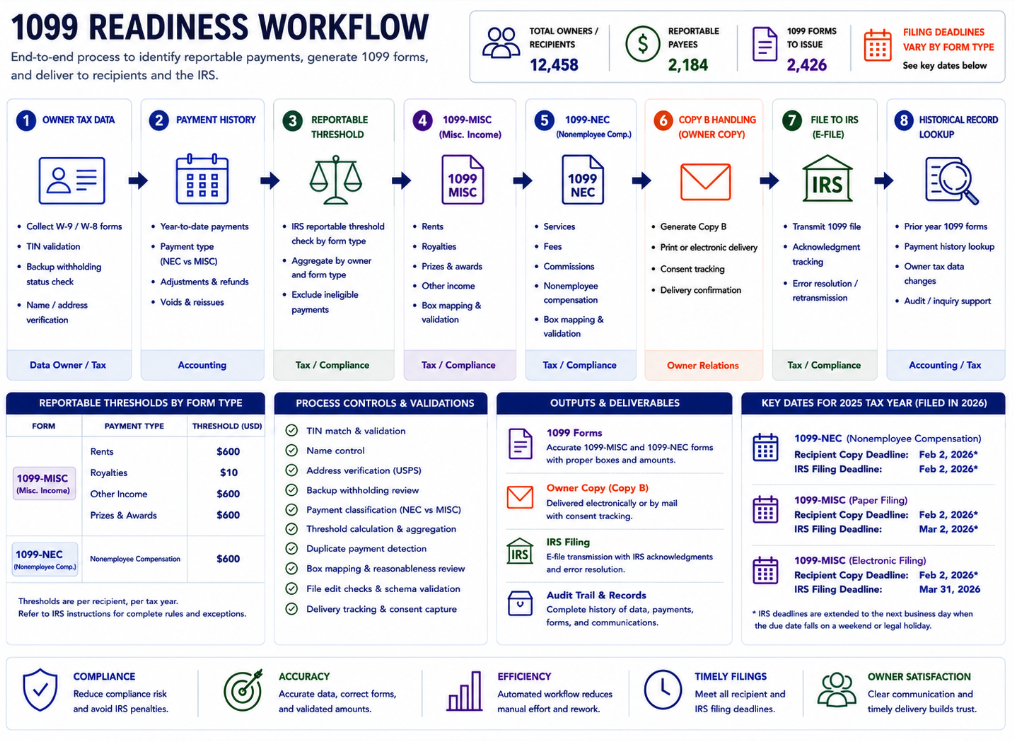
Royalty management software should also support year-end reporting discipline. Many teams focus on completing payments during the year and only begin organizing owner payments, tax classifications, 1099-MISC, 1099-NEC, mailing information, and historical records when tax season approaches. This creates late pressure and exposes gaps in historical data quality.
Operators can measure annual reporting readiness with 1099 readiness rate: 1099 Readiness Rate = Reportable Owners with Complete Tax and Payment Records ÷ Total Reportable Owners × 100%. Assume an operator has 1,800 reportable owners at year-end, and 126 are missing tax information, mailing address, or payment classification. The 1099 readiness rate is 1,674 ÷ 1,800 × 100% = 93%.
A readiness rate of 93% does not necessarily mean tax season will be easy, because the remaining 126 exception records may require concentrated manual work. A stronger royalty management workflow maintains tax information, payment history, statement copies, and owner records throughout the year. Year-end reporting then becomes a validation and export process rather than a data-repair exercise, which reduces tax season pressure and improves consistency in historical payment lookup.
Royalty Reconciliation Protects Long-Term Trust
Royalty reconciliation helps connect purchase statement amounts, production month, volume allocation, and royalty calculation. For operators, reconciliation is not only about confirming that payment was made. It is also about confirming that allocated amounts align with the production month, owner interest, and supporting records. Without a reconciliation view, teams may struggle to explain why an owner’s payment changed from one month to another.
A simplified reconciliation variance formula can be expressed as: Royalty Reconciliation Variance = Allocated Royalty Amount − Expected Royalty Amount. Expected royalty amount can be calculated using gross revenue, owner decimal interest, deductions, and adjustment assumptions. If the expected royalty amount for a production month is $145,000 and the allocated amount is $141,800, the reconciliation variance is $141,800 − $145,000 = −$3,200.
This variance does not automatically mean an error occurred, but it must be explainable. It may result from production month allocation, deductions, withholding, prior adjustments, or owner status changes. Royalty management software should help teams turn reconciliation from a later-stage correction process into a routine control activity, keeping payment history, statement detail, and owner communication aligned.
A Practical Evaluation Standard for Operators
Operators can evaluate royalty management software by asking whether it supports the full owner payment lifecycle, not only payment calculation. The system should help teams manage owner records, division orders, payment readiness, statements, owner inquiries, 1099 preparation, reconciliation, and long-term record control. A long feature list is less useful than a workflow that helps the team reduce exceptions before they become payment delays or owner questions.
For owner record and division order control, operators should confirm:
Can the system maintain owner identity, tax information, mailing address, payment method, documents, and communication notes in one owner record?
Can owner records connect to wells, leases, units, division orders, and interest records?
Can teams track missing tax IDs, unsigned division orders, bad addresses, incomplete payment methods, and inactive owner records?
Can ownership changes, title changes, DOI letters, and related files be stored with clear history?
Can the system identify owner records that are not ready for payment before the payment run?
For payment readiness and payment tracking, operators should confirm:
Can the system show which owners are ready to pay and which owners are blocked by exceptions?
Can payment holds be categorized by reason, owner, property, amount, and aging?
Can payment activity be tracked by owner, lease, field, or payment cycle?
Can teams see generated statements, recorded payments, pending follow-up, and unresolved items?
Can the system support bulk generation while preserving individual payment history?
For statement and owner inquiry support, operators should confirm:
Can owner statements show enough detail to explain well, production period, interest, deductions, adjustments, and payment status?
Can owner questions connect to the related statement, payment record, or owner account?
Can users look up historical payment records and prior statements quickly?
Can communication notes be retained so different team members can answer owners consistently?
Can repeated inquiry patterns be reviewed to improve statement clarity?
For 1099 and reporting readiness, operators should confirm:
Can the system organize 1099-MISC, 1099-NEC, Copy B handling, and historical 1099 records?
Can reportable owners with missing tax or payment information be identified before year-end?
Can owner payment history support annual reporting and later lookup?
Can bulk generation reduce repetitive tax season work while preserving reviewability?
Can historical 1099 records be accessed when owners or accountants ask for prior-year information?
For reconciliation and long-term record control, operators should confirm:
Can purchase statement allocation connect to production month and royalty calculation?
Can the system calculate royalties by production month and connect results to payment records?
Can reconciliation variance be reviewed and explained?
Can payment records, statement records, and owner communication remain connected over time?
Can the system support management visibility into payment readiness, inquiry volume, reconciliation issues, and reporting risk?
How Petrofly Supports Royalty Operations Control
Petrofly can help operators organize royalty payments, interest partners, division orders, payment records, reconciliation, 1099 preparation, and owner communication in a more connected workflow. The focus is not only completing payment activity, but making owner-facing payment records easier to track, explain, and maintain over time.
Petrofly can support this process through:
Owner and interest data control: Keep interest partners, division orders, DOI letters, related files, and ownership title changes easier to manage.
Royalty payment tracking: Support royalty share allocation, payment records, statement generation, bulk generation, and payment activity by owner, lease, or field.
Reconciliation context: Connect purchase statement allocation, production month, royalty calculation, and payment history more clearly.
1099 readiness: Support 1099-MISC, 1099-NEC, payment reports, bulk Copy B generation, and historical 1099 records.
Owner communication support: Keep payment records, statement history, and owner-related context easier to retrieve when questions arise.
Cloud-based and flexible setup: Allow teams to start with priority workflows, then adjust fields, reports, dashboards, and workflow views around actual operating needs.
Dedicated support after go-live: Assist with setup, data organization, user training, workflow refinements, reporting questions, and follow-up needs as the process evolves.
For operators, the practical value is a more stable foundation for royalty operations. When owner records, payment activity, statements, reconciliation, and reporting requirements are connected, teams can reduce repeated searching and keep owner-facing answers closer to the data that supports them.
From Payment Task to Owner Relations Workflow
Royalty management software is not only about calculating payment amounts. It helps operators build a complete workflow from owner records to payment tracking, statement generation, royalty reconciliation, 1099 preparation, and owner communication. By measuring owner data completeness, payment readiness, owner inquiry rate, reconciliation variance, and 1099 readiness, operators can identify the root causes of payment delays and owner questions more clearly.
The strongest royalty management workflow connects owner data, division orders, payment records, statement history, communication notes, reconciliation activity, and annual reporting requirements. This makes payments easier to explain, exceptions easier to resolve, and historical records easier to retrieve. For operators, the goal is not just to issue payments; it is to manage the full owner relations workflow with traceability and control.
A connected royalty workflow helps turn royalty management from a payment task into a traceable owner relations operation. When owner records, payment activity, statements, reconciliation, and 1099 history are easier to maintain, teams can reduce payment delays, answer owner questions faster, and preserve stronger long-term records.
To discuss how a more connected royalty management workflow could support payment readiness and owner communication, contact our team for a focused conversation.