Selection Risk Usually Starts with Fit
For small and mid-sized oil and gas operators, software selection often fails not because the system has too few features, but because it does not fit the way the business actually operates. Large enterprise systems may provide broad coverage, but the implementation timeline, configuration complexity, training effort, and internal management burden may exceed the team’s capacity. Generic accounting software may be easy to use, but it often struggles with oil and gas workflows such as JIB, royalty payments, interest partners, division orders, well-level reporting, and owner relations.
The core selection question is not which system is the largest. It is which system can support the most important current workflows at a manageable cost while leaving room for future growth. Small and mid-sized operators often need to balance limited teams, limited IT resources, and ongoing operating pressure, so a strong demo does not automatically mean a strong operating fit.
A better selection process starts with business problems. Operators should define what currently affects efficiency and cash flow the most. The issue may be unclear JIB generation and payment tracking, high royalty payment workload, too many owner questions, month-end work that still depends on spreadsheets, or limited cross-asset visibility for management. Only after the problem is clearly defined can vendor evaluation move beyond generic product presentations.
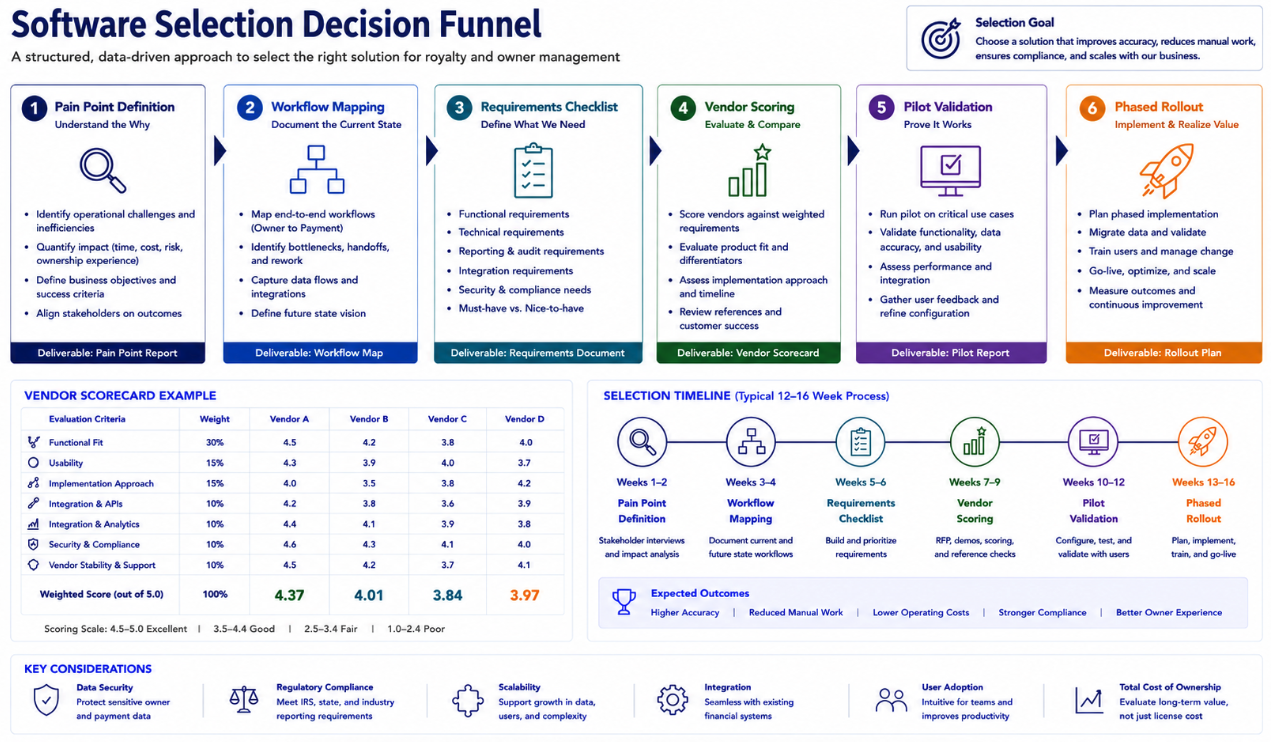
Requirements Should Describe Workflows
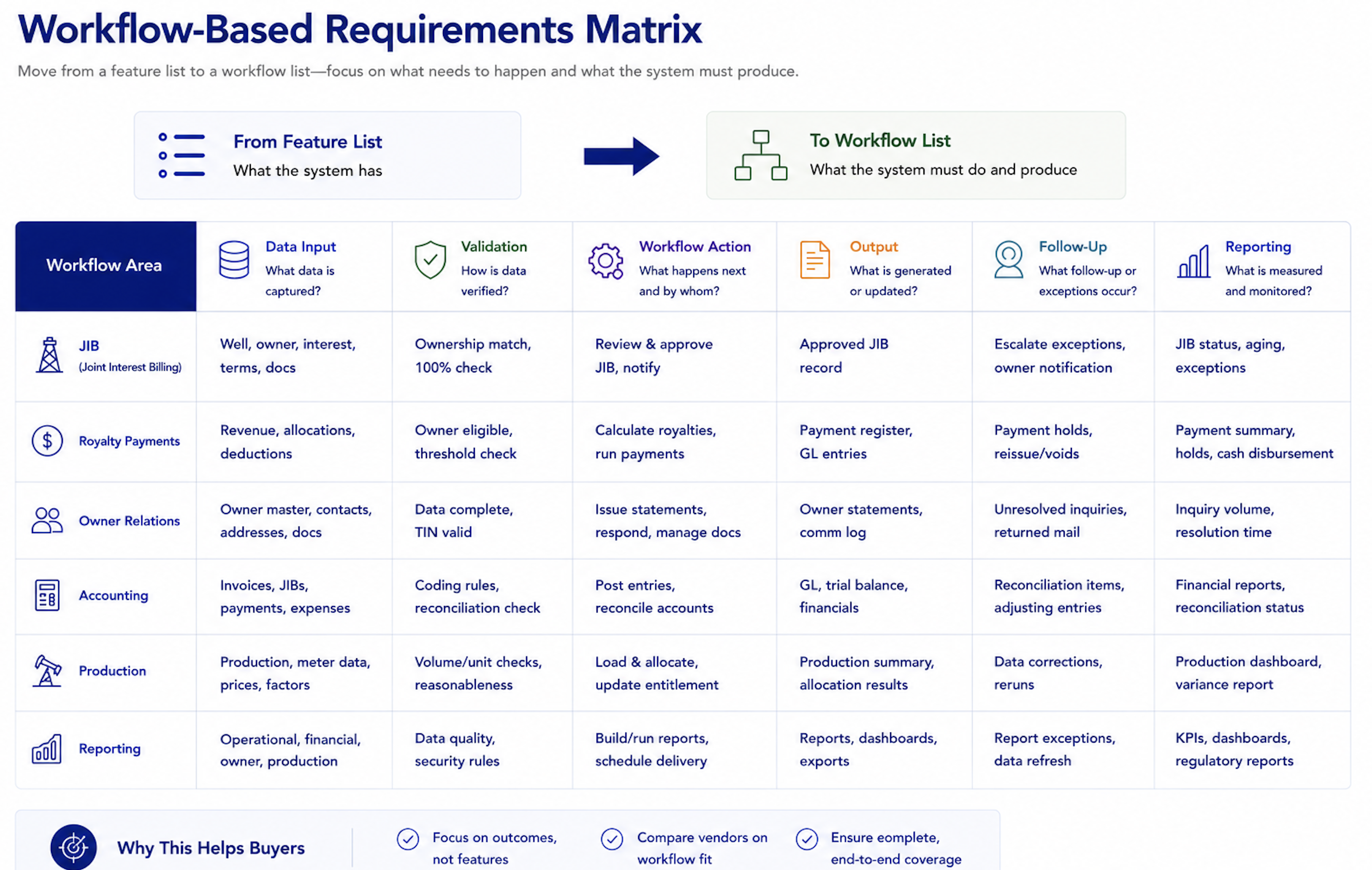
Many selection projects begin with a feature checklist, such as accounting, JIB, royalty payments, reporting, document storage, and user permissions. That checklist is useful, but it is not enough. What determines whether a system fits is whether those features support a complete workflow, not whether each feature exists on its own.
For JIB, the requirement should not simply say “generate JIB statements.” A stronger requirement asks how costs enter the system, whether they can be associated with owners, leases, or fields, how payment records are tracked, how historical statements can be searched, how partner information is maintained, and how the team supports communication after statements are generated. Royalty payment requirements should also go beyond “process royalty payments” and examine royalty share allocation, payment tracking, statement generation, bulk generation, owner information, division orders, and 1099 preparation as one connected workflow.
Operators can divide requirements into four groups:
Must-have workflow requirements: Workflows that must be solved in the first implementation phase, such as JIB statement management, royalty payment tracking, owner records, payment records, or month-end reporting.
Control requirements: Permissions, approvals, record tracking, validation rules, audit history, and user access that protect sensitive data and reduce process risk.
Reporting requirements: Finance, operations, owner relations, and management views that support actual decisions rather than basic data exports.
Future-phase requirements: Deeper integrations, custom reporting, analytics, or additional operational workflows that can wait until the foundation is stable.
This structure helps operators avoid two common mistakes. One is buying software that is too narrow and leaves core work in spreadsheets. The other is trying to solve every possible requirement in the first phase, which can increase implementation risk before users see value.
Vendor Scoring Should Test Real Use
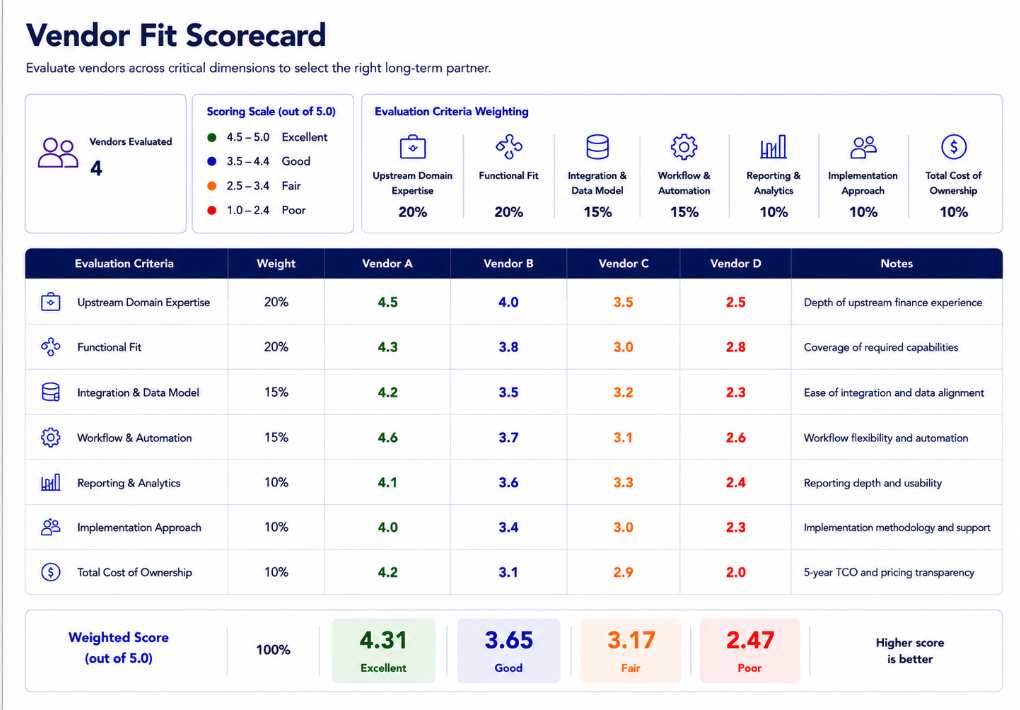
Product demos usually show an ideal process. Real implementation involves historical data, user habits, process differences, field definitions, permission setup, training schedules, and reporting standards. Small and mid-sized operators should not only ask whether the system can perform a task; they should ask how it performs the task, how much implementation effort is required, and whether the team can keep using it consistently.
A simplified vendor fit model can be expressed as: Vendor Fit Score = Σ Requirement Weight × Capability Score − Implementation Risk Penalty. Requirement weight reflects how important a requirement is to the operator. Capability score reflects how well the vendor supports it. Implementation risk penalty reflects risks from data migration, configuration complexity, training effort, process change, and internal resource requirements.
The value of this model is not to create an overly complex scoring sheet. It is to help teams convert subjective demo impressions into a more comparable procurement decision. For example, one vendor may provide broad functionality but require a long implementation timeline, complex configuration, and significant internal IT participation. Another vendor may provide more focused coverage but allow the operator to address core JIB, royalty payment, and owner relations workflows first, with room to expand later. If the operator’s greatest pain is billing, payment, and owner communication, the second option may provide stronger practical fit.
Cost Should Include the Work Around the Software
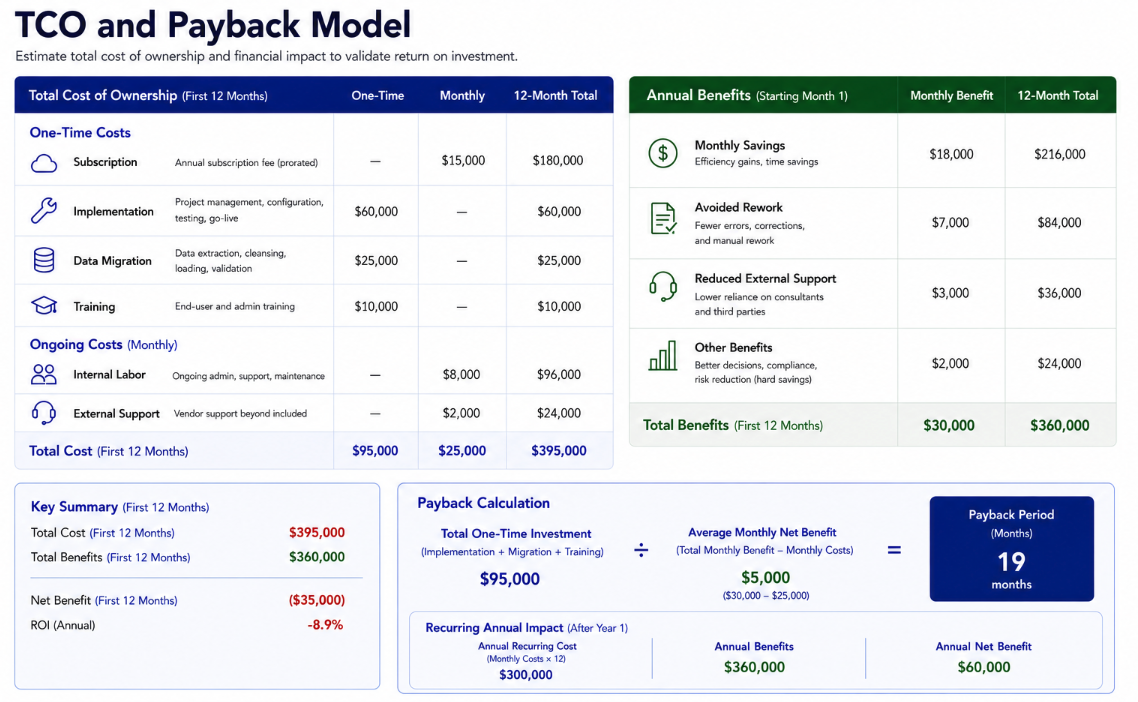
Software cost is not only the subscription fee. A system with a lower price may still require extensive manual work, external consultants, complex migration, or ongoing manual reporting. A system with a higher subscription cost may provide more operational value if it reduces repeated data entry, payment review, historical lookup, and month-end reporting effort.
A basic total cost formula can be expressed as: Total Cost of Ownership = Subscription Fees + Implementation Fees + Data Migration Cost + Training Cost + Integration Cost + Internal Labor Cost + Process Disruption Cost. This formula reminds operators not to compare only monthly or annual fees. Data migration may involve cleaning historical owner records, division orders, payment records, well data, and accounting codes. Training cost reflects the time required for teams to learn new workflows. Internal labor cost includes the time spent by finance, operations, land, owner relations, and management during implementation.
Operators can also use a simplified payback model: Payback Months = Initial Implementation Cost ÷ Monthly Net Benefit. Assume a system has an initial implementation cost of $48,000. After implementation, it reduces 85 hours per month of repeated review and reporting work. At a fully loaded labor cost of $75 per hour, this equals $6,375 in monthly labor savings. If the system also helps reduce $2,000 in external support and rework cost, the monthly net benefit is $8,375. The simplified payback period is $48,000 ÷ $8,375 ≈ 5.7 months.
This calculation is not a fixed performance claim. It is an evaluation method. Each operator should adjust assumptions based on transaction volume, labor cost, error rate, payment delays, and reporting workload. The point is to evaluate software value using operating data, not only purchase price.
Implementation Risk Should Be Visible Early
For small and mid-sized operators, one of the greatest risks is starting too large. If the first phase tries to include accounting, JIB, royalty payments, production, inventory, reporting, integrations, and historical data cleanup, the team can become overwhelmed. A stronger approach is to identify high-impact processes first and implement in phases.
An implementation complexity index can help estimate risk: Implementation Complexity Index = Data Volume Score + Process Variation Score + User Change Score + Integration Dependency Score + Reporting Complexity Score. Data volume score reflects the amount of historical data and cleanup difficulty. Process variation score reflects differences across assets, teams, or business lines. User change score reflects how difficult it will be for users to move away from current workflows. Integration dependency score reflects reliance on external system connections. Reporting complexity score reflects the complexity of management and finance reporting definitions.
For example, a project that first implements owner relations and basic royalty payment workflows may have a manageable data and user change profile. A project that attempts a full ERP replacement, historical migration, and multiple integrations in the first phase will carry higher implementation risk, even if the vendor is capable. For small and mid-sized operators, the selection strategy should prioritize reducing the chance of first-phase failure rather than covering every possible requirement immediately.
Phased Rollout Reduces Adoption Pressure
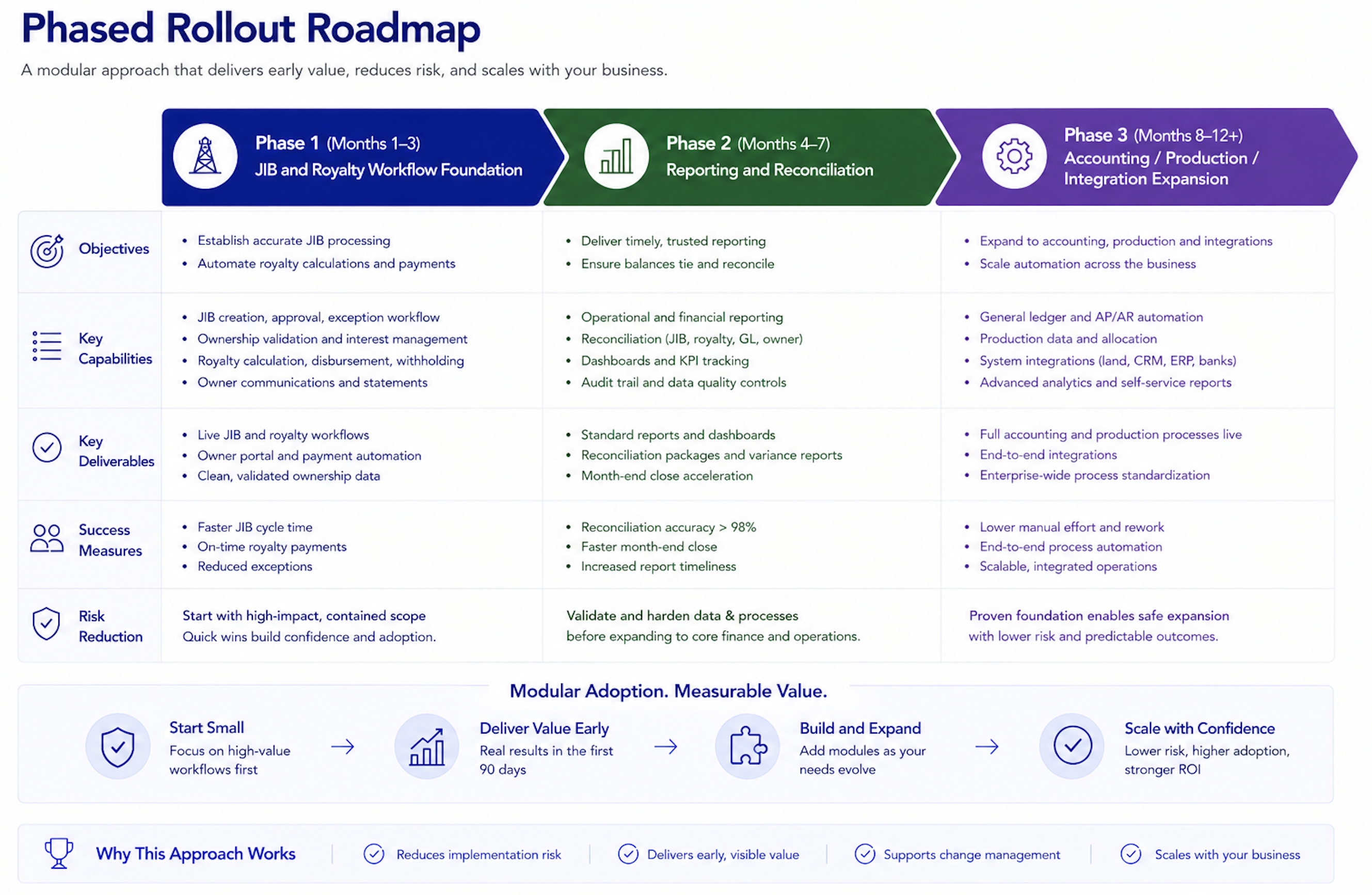
Small and mid-sized operators are often better served by phased rollout. The first phase can focus on the most painful, clearest, and most measurable workflow, such as JIB statement management, royalty payment tracking, or owner relations. The second phase can expand into reporting, 1099 preparation, and royalty reconciliation. The third phase can consider deeper integrations, custom workflows, or additional business processes.
Phased rollout does not mean poor long-term planning. In fact, the first phase should confirm whether the system can support future expansion across JIB, royalty payments, interest partners, division orders, and reporting. This allows the operator to solve current pain points quickly without limiting future operating maturity.
A common phased rollout may look like this:
Phase 1: Workflow foundation Focus on high-impact JIB and royalty workflows, including statements, payment records, owner or partner information, and basic reporting.
Phase 2: Reporting and reconciliation Strengthen management reporting, 1099 preparation, royalty reconciliation, and payment history lookup.
Phase 3: Expansion and integration Consider accounting, production, custom reporting, deeper integrations, or additional operational workflows based on actual system adoption and business maturity.
Selection Requires More Than One Department
Software selection should not be completed by one department alone. Finance understands JIB, royalty payments, GL, AP, and reporting pain points. Land and owner relations teams understand interest partners, division orders, title changes, and owner communication. Operations teams understand wells, leases, field activity, and production context. Management cares about cash flow, efficiency, risk, and long-term scalability.
Cross-functional participation does not mean larger meetings. It means each role must validate a specific part of the workflow. Finance should validate billing and payment processes. Owner relations should validate owner information, statements, communication, and 1099-related workflows. Operations should validate whether asset, well, lease, and production information can connect to downstream finance workflows. Management should validate whether the system improves visibility, reduces rework, and supports future growth.
Small and mid-sized operators should especially avoid the problem of returning to spreadsheets after implementation. If end users are not involved in requirements, the system may not fit daily work. If management does not define key metrics, the project may struggle to prove value after launch. Effective selection brings business goals, user workflows, and management metrics into the same decision framework.
A Practical Selection Checklist
Operators can use the following checklist to evaluate whether a software option fits real workflows, team capacity, and future growth needs. The purpose is not to turn selection into a paperwork exercise. It is to make sure each vendor is evaluated against operating reality rather than presentation quality.
For workflow fit, operators should ask:
Which workflows must be solved in the first phase?
Does the system support JIB, royalty payments, owner relations, division orders, reporting, and payment records as connected workflows?
Can the system organize data around owners, leases, fields, wells, entities, and accounting periods?
Which workflows are standard, configurable, or custom?
Will users still need Excel for critical daily processes after implementation?
For vendor fit, operators should ask:
Does the vendor understand upstream oil and gas workflows?
Can the vendor demonstrate real JIB, royalty payment, owner relations, and reporting scenarios?
Can the vendor explain implementation effort clearly, not only product capability?
Can the system support the operator’s current size while allowing future expansion?
Does the support model fit the operator’s internal team capacity?
For cost and value, operators should ask:
What is the full cost beyond subscription fees?
What data migration, training, configuration, integration, and internal labor costs should be expected?
Which manual tasks will the system reduce or remove?
What measurable value should be expected in reporting time, payment tracking, owner communication, or month-end control?
What assumptions are used in payback or ROI calculations?
For implementation risk, operators should ask:
How much historical data must be cleaned or migrated?
How many user groups need training?
Which reports, approvals, and permissions must be configured before go-live?
Which reports, approvals, and permissions must be configured before go-live?
What risks could cause delays during implementation?
For phased rollout, operators should ask:
What should be included in Phase 1?
Which workflows can move to Phase 2 or Phase 3?
Can the operator start with JIB, royalty payment, or owner relations workflows before expanding?
Can the system add accounting, production, reporting, or integrations later?
How will success be measured after each phase?
How Petrofly Fits a Practical Selection Path
Petrofly can support small and mid-sized oil and gas operators that want software to match real operating workflows without starting with an overly broad system replacement. The most relevant fit is where teams need to organize JIB, royalty payments, owner relations, interest partners, division orders, payment records, reporting, and related operating data in a more consistent cloud software environment.
Petrofly can support this selection path through:
Workflow-first adoption: Start with high-impact workflows such as JIB, royalty payments, owner relations, or reporting before expanding into additional processes.
Oil and gas data structure: Organize records around wells, leases, fields, owners, partners, payments, statements, and operating periods.
Cloud-based access: Give authorized teams a shared environment without heavy local installation or scattered files.
Customer-specific configuration: Adjust fields, reports, dashboards, workflow views, and usage priorities around actual operating needs.
Dedicated support after go-live: Assist with onboarding, data organization, workflow refinement, reporting questions, and future rollout planning.
Practical cost fit: Improve the workflows that create the most pressure first, rather than overbuilding the software environment from day one.
For selection teams, Petrofly is best evaluated through workflow fit and rollout practicality. Operators can define the first implementation phase around the most urgent pain points, then expand into accounting, production, reporting, integrations, or additional workflows as needs become clearer.
Choosing Software That the Team Can Actually Run
Software selection for small and mid-sized oil and gas operators should begin with workflow fit, implementation risk, and measurable value rather than feature count or system size. A system should be evaluated by how well it supports real workflows, how much implementation burden it creates, whether users can adopt it consistently, and whether it can grow with the business.
Workflow-based requirements, vendor fit scoring, total cost of ownership modeling, implementation complexity analysis, and phased rollout planning help operators compare software options more objectively. These tools do not need to make the process complicated. They help operators avoid decisions based only on polished demos and feature volume.
For small and mid-sized operators, the goal is not to buy the biggest system. It is to choose software that improves control, reduces repeated work, and fits the team’s ability to implement and grow. When the selection process starts with operating reality, the final system is more likely to support daily use after the demo is over.
To discuss how a practical software selection and rollout path could support your oil and gas operations, contact our team for a focused conversation.