Fragmentation Creates Hidden Operating Cost
Upstream oil and gas finance workflows usually span accounting, land, operations, owner relations, and management. JIB may be handled by the accounting team, division orders may be maintained by land or owner relations, royalty payments may sit in a separate workflow, and production data may come from field or production systems. Each team may complete its own work, but if data and status are not connected, the overall operating model absorbs the cost of handoffs, reconciliation, and repeated lookup.
Fragmented systems do not always appear as system failures. They more often appear as long month-end review cycles, repeated owner questions, unclear JIB payment status, difficult historical statement lookup, manual management reporting, and different teams using different versions of the same owner, well, or payment information. As wells, owners, partners, and reporting requirements grow, these problems become a real back-office operating cost.
The goal of workflow integration is not simply to put every feature into one large platform. It is to create clear relationships among key business objects. Wells, leases, owners, interest partners, division orders, JIB statements, royalty payments, production months, invoices, purchase statements, and reports should be traceable to their related context. When these objects are connected, teams can reduce repeated reconciliation and explain cost, payment, and reporting changes faster.
Workflow Latency Shows the Cost of Waiting
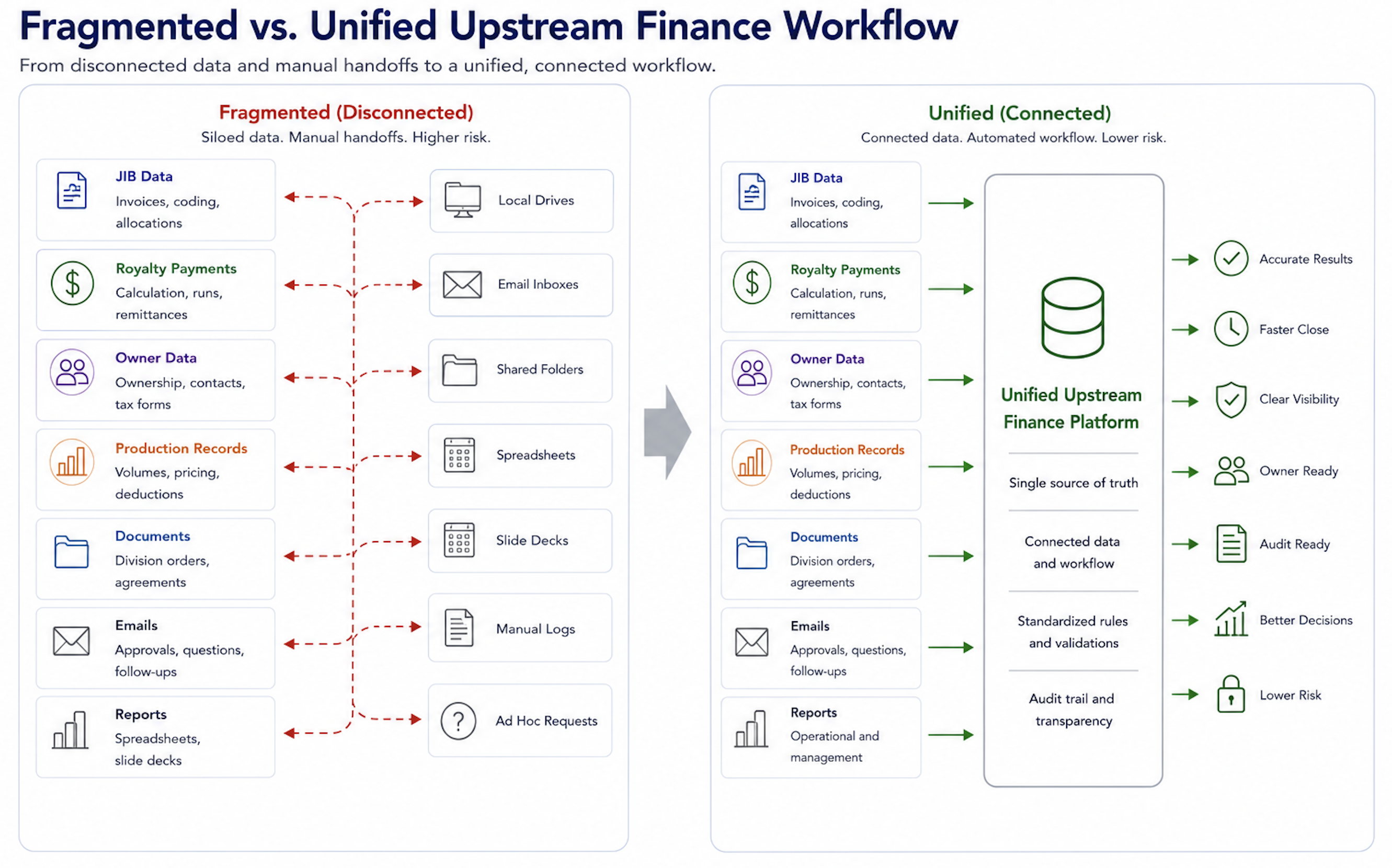
One key effect of disconnected processes is workflow latency, which is the time between business data creation and its availability for action or decision-making. For JIB, this may be the time from vendor invoice entry to allocation, statement generation, partner delivery, and payment recording. For royalty payments, it may be the time required to connect purchase statement, production month, owner interest, payment record, and owner statement.
A simple formula can be used: Workflow Latency = Σ Handoff Waiting Time + Σ Rework Time + Σ Exception Resolution Time. Assume an expense record moves from invoice entry to JIB statement generation through four handoffs: AP, operations, accounting, and partner billing. Each handoff waits an average of 1.5 days. If the cost is missing an AFE reference or supporting document and requires 3 additional days of exception resolution, the workflow latency before the cost reaches the JIB statement may be 4 × 1.5 + 3 = 9 days.
These 9 days do not necessarily result from poor employee performance. They result from weak process connection. If the team must confirm field context through email, look up ownership percentages in spreadsheets, search folders for supporting documents, and manually update payment status, latency becomes part of the operating model. Integrated workflows make data and status visible earlier, instead of leaving teams to chase information at month-end.
Reconciliation Load Reflects Back-Office Pressure
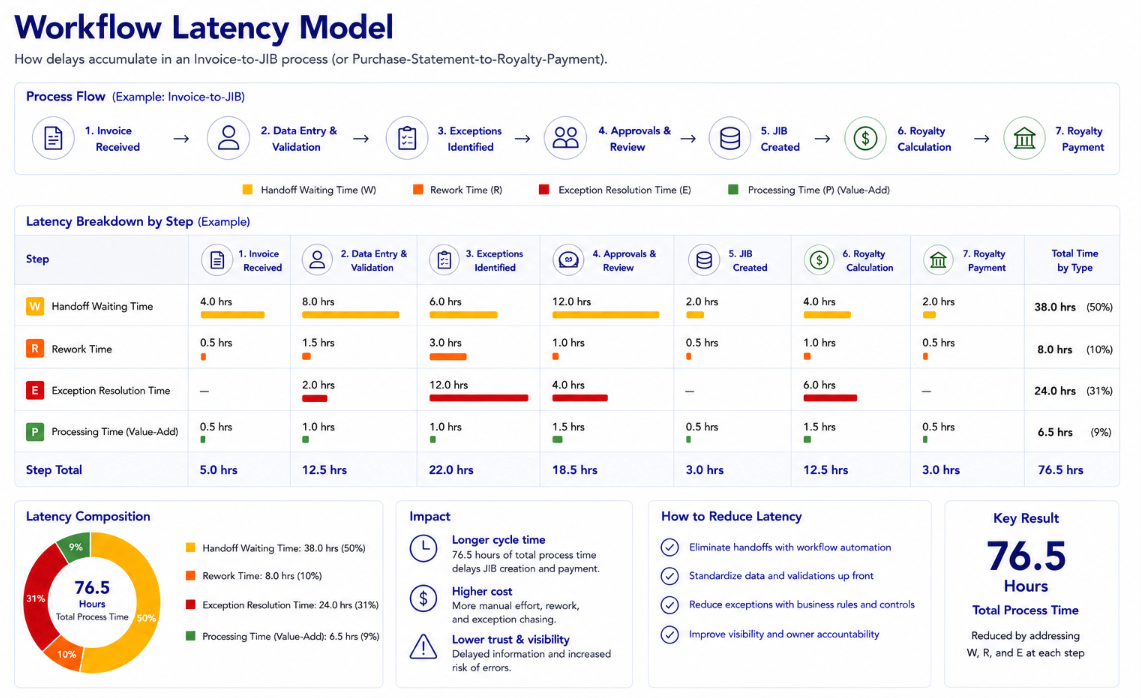
Fragmented workflows also increase reconciliation load. Teams must constantly confirm whether different data sources agree: owner records against division orders, JIB statements against expense records, royalty payments against production months and purchase statements, and management reports against underlying transactions. The more data sources, records, and exceptions involved, the heavier the reconciliation burden becomes.
A simple estimate can be expressed as: Reconciliation Load = Number of Data Sources × Records per Period × Exception Rate. Assume an operator reviews owner records, JIB statements, royalty payments, production records, and reports from 5 data sources. Each cycle includes 8,000 records, and the exception rate is 2%. The potential exception points are 5 × 8,000 × 2% = 800 exception points.
This does not mean all 800 points require complex review, but it shows the scale of confirmation, explanation, and exclusion work the team may face each month. If these exceptions do not have centralized status management, teams can lose time searching across emails, spreadsheets, and folders. A better approach is to place exceptions into a traceable workflow with owner, status, cause, and follow-up action.
Integration Should Connect Business Objects
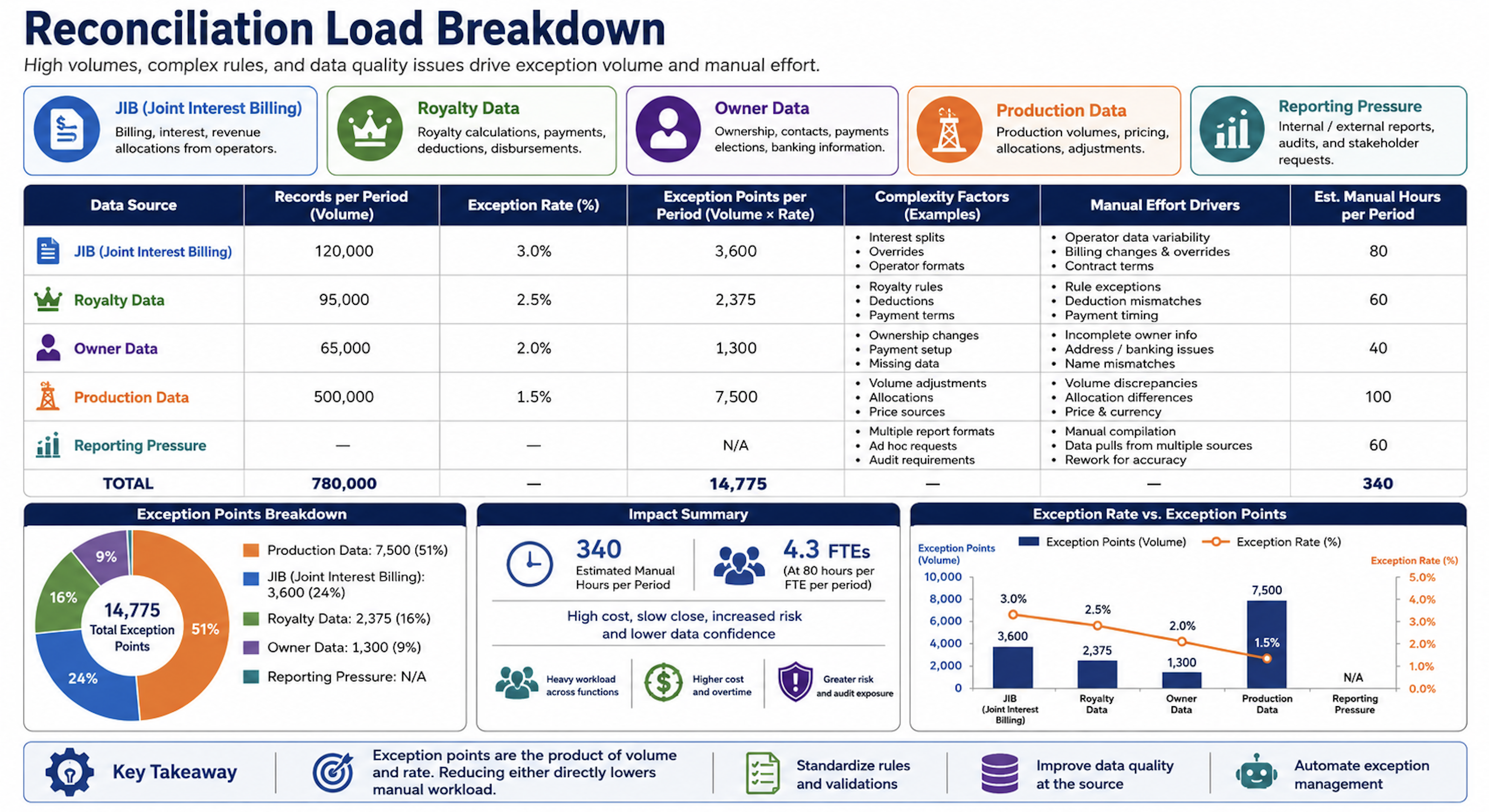
Effective integration is not merely about placing several screens inside the same system. It is about connecting business objects in meaningful ways. A well should connect to leases, owners, interest partners, division orders, production records, expenses, JIB statements, and royalty payments. An owner should connect to division orders, payment records, statements, 1099 records, and communication history. A payment record should trace back to calculation basis, statement, production month, or invoice source.
This type of object connection reduces many back-office problems. When an owner asks why a payment changed, the team does not need to rebuild the answer from scratch. It can move from owner record to statement, payment record, interest information, and production period. When a partner questions a JIB charge, the team can trace from the JIB statement to expense, well, lease, cost category, and supporting context. When management reviews reports, it can better understand which workflows produced the numbers.
A basic indicator for data duplication risk is: Data Duplication Risk = Number of Repeated Manual Entries × Criticality of Field × Update Frequency. Owner address, tax ID, decimal interest, payment status, and division order status are high-criticality fields. If these fields are maintained repeatedly across multiple systems or spreadsheets and updated frequently, the risk of inconsistency increases. Integrated workflows reduce repeated entry and scattered maintenance of high-criticality fields, helping teams work from a more consistent record.
JIB and Royalty Share a Data Foundation
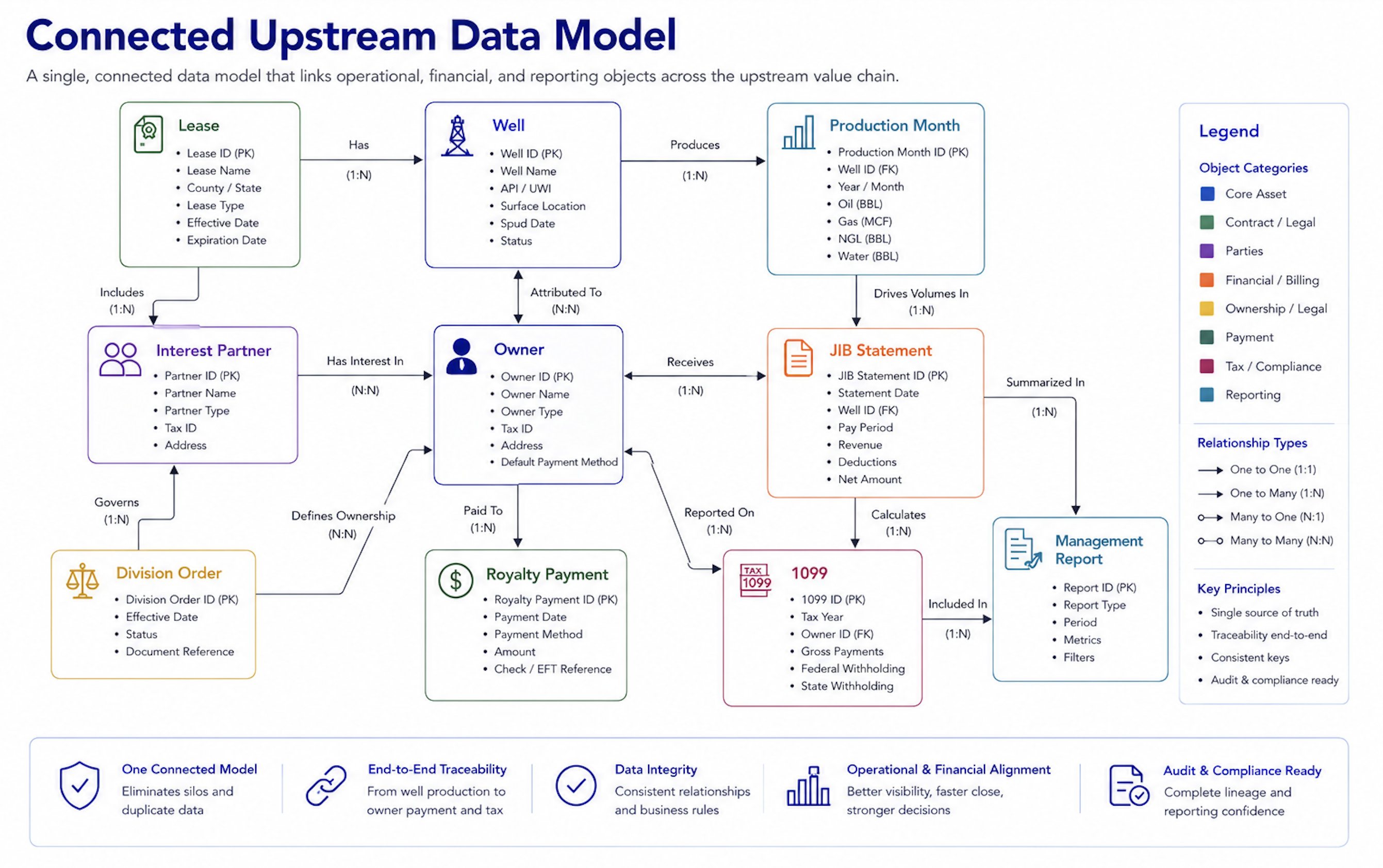
JIB and royalty payment serve different audiences, but they share many underlying data elements. JIB serves working interest partners and focuses on expense allocation, partner billing, and payment recovery. Royalty payment serves royalty owners and focuses on revenue distribution, decimal interest, deductions, statements, and tax reporting. They may appear to be separate workflows, but both rely on owner or partner data, well or lease context, period records, adjustments, documents, and payment tracking.
When JIB and royalty payment are managed in complete separation, operators can create two recordkeeping models: one for cost allocation and one for revenue distribution. In the short term, this may function. Over time, it increases the complexity of owner and partner data maintenance, statement lookup, payment tracking, and reporting reconciliation. The problem becomes more visible during staff transitions, asset growth, acquisitions, or increased reporting requirements.
A stronger operating model allows JIB and royalty payment to preserve their different business rules while sharing a more consistent data foundation. Interest partners, division orders, owner records, payment history, statements, and relevant documents should be maintained with as little duplication as possible. This allows operators to preserve process specificity while improving back-office consistency.
Reporting Should Come from Daily Workflows
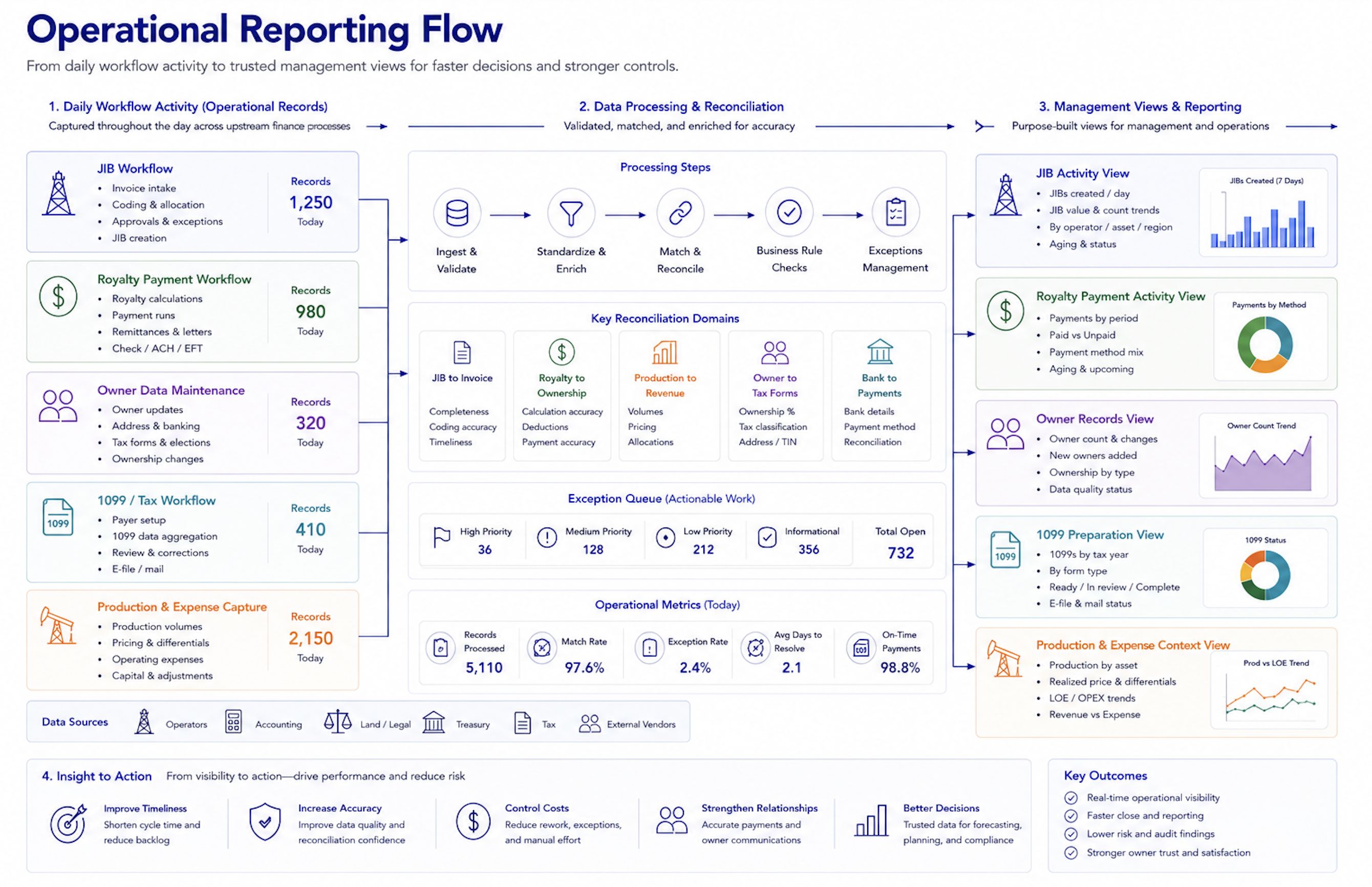
Many operators do not lack reporting. They lack reporting that comes naturally from daily workflows. When management needs to review JIB status, royalty payment progress, owner questions, payment holds, cash recovery, production performance, or well profitability, teams may need to export data from multiple systems and spreadsheets, then assemble the report manually. These reports are often delayed and may vary depending on who prepared them.
A more mature reporting model uses daily workflow status as the reporting foundation. Whether JIB statements have been generated, payments have been recorded, royalty payments have been completed, owner records are complete, 1099 preparation is ready, or production records align with revenue allocation are all operational status signals. If these signals are maintained during daily work, management reporting does not need to rely entirely on month-end assembly.
Reporting lag can be measured as: Reporting Lag = Report Delivery Date − Operational Event Date. If a JIB statement is generated and sent on March 5, but management does not see payment status and disputed amount until a manually prepared report on March 25, reporting lag is 20 days. This is not only a reporting problem. It means management cannot assess cash recovery risk in time. Integrated workflows help operational events become management visibility faster.
Integration Maturity Should Match Team Capacity
Operators can use four stages to assess financial workflow integration maturity. This model helps teams understand whether they are only storing records or actually building operating control. It also helps small and mid-sized operators avoid overbuilding before the organization is ready.
Record keeping is the first stage. Teams can record JIB, royalty payments, and owner information, but they still rely heavily on spreadsheets, folders, emails, and manual lookup. The organization has records, but not enough workflow visibility. Process organization comes next. Key records are managed more centrally, and statements, payments, owner records, and partner information become easier to search. Teams spend less time locating information, but status tracking and exception management may still be inconsistent.
Workflow control means teams can consistently track statuses, exceptions, documents, follow-up actions, and payment records. This stage improves accountability because open issues are visible and tied to a responsible owner or workflow status. Management visibility is the most mature stage. Workflow data supports faster decisions around cash flow, owner relations, partner communication, operational performance, and reporting risk. Management can see what is happening before issues become month-end surprises.
This maturity model helps operators choose a realistic path. Many teams do not need full integration, advanced analytics, or complex automation on day one. A more practical approach is to organize the most painful workflows across JIB, royalty payments, owner data, and reporting first, then expand into reconciliation, custom reporting, or cross-functional visibility.
A Practical Integration Checklist
Operators can use the following questions to evaluate whether financial workflows are becoming more connected, traceable, and useful for daily operations. The purpose is not to create another disconnected checklist. It is to test whether key records, statuses, and decisions are actually easier to trace across teams.
For JIB and partner workflows, operators should ask:
Are JIB statements connected to owners, leases, fields, or assets?
Can payment records be traced back to the related JIB statement?
Are interest partners and billing records maintained in a consistent structure?
Can partner questions be connected to statement history and payment status?
Can teams search historical JIB records without relying on folders or emails?
For royalty payment and owner workflows, operators should ask:
Are owner records connected to royalty payments, statements, and division orders?
Can royalty payments be reviewed by owner, lease, field, or production month?
Can payment records support owner questions and historical lookup?
Are division orders, DOI letters, title ownership changes, and related files connected to owner workflows?
Can 1099 records and prior-year payment history be retrieved when needed?
For production and cost context, operators should ask:
Can production data connect to payment, reporting, or profitability review?
Are run tickets, daily production, chemical tracking, or lease operating details available for operational context?
Can expenses and production activity support lease or field profitability views?
Can finance teams understand whether reported numbers connect to field activity?
Can management view production and cost context without assembling reports manually?
For reporting and management visibility, operators should ask:
Do daily workflow records support management reporting?
Can teams see JIB activity, royalty payment activity, owner records, 1099 preparation, production, and expense context in a more consistent way?
Can reporting lag be reduced by using workflow status instead of month-end manual assembly?
Are exceptions tracked with owner, cause, status, and follow-up action?
Can management see cash flow, owner relations, and operating performance risk earlier?
For implementation and expansion, operators should ask:
Which workflows should be connected first?
Which workflows can wait for a later phase?
What data must be cleaned before integration creates value?
Which custom reports, integrations, workflow rules, or advanced analytics are truly needed?
Does the rollout plan match team capacity, data quality, and management goals?
How Petrofly Supports Integrated Upstream Workflows
Petrofly can help upstream oil and gas teams build a more consistent financial operating environment across JIB, royalty payments, owner relations, production management, cost control, reporting, and customized workflow needs. The practical value is not isolated automation; it is helping teams connect the records and statuses that support billing, payments, owner questions, production context, and management visibility.
Petrofly can support this operating model through:
JIB and partner workflow organization: Manage JIB statements, payments, interest partners, billing records, and related follow-up in a more connected structure.
Royalty and owner relations support: Connect royalty payments, division orders, title ownership changes, DOI letters, 1099 assistance, reconciliation, and owner-related records.
Production and operating context: Support production management, lease and field profitability views, production notifications, run tickets, daily production, chemical tracking, and lease operating information.
Cloud-based workflow access: Give authorized teams a shared environment without relying only on local files, spreadsheets, or disconnected folders.
Flexible setup and phased rollout: Start with high-priority workflows, then define custom reporting, integrations, workflow rules, or analytics based on team capacity and business value.
Dedicated support after go-live: Assist with setup, data organization, workflow refinement, reporting questions, and ongoing process adjustments as needs evolve.
For operators, Petrofly’s role is to help create a more reliable process foundation. Standard JIB, royalty payment, owner relations, production, reconciliation, and reporting workflows can be organized first, while custom requirements can be planned by scope and priority so the system grows with the team rather than overwhelming it.
From Fragmented Records to Operating Visibility
Integrated financial workflows help upstream oil and gas operators reduce hidden back-office cost by connecting the records, statuses, and explanations behind JIB, royalty payments, owner data, production context, and reporting. The goal is not to automate every task at once. The goal is to create reliable relationships among business objects so teams can trace cost, payment, owner, partner, and reporting activity without rebuilding context each month.
Workflow latency, reconciliation load, data duplication risk, and reporting lag give operators practical ways to understand the cost of fragmentation. These measures do not need to become complex analytics projects. They help management see where disconnected work creates delay, rework, inconsistency, and cash flow visibility gaps.
A more connected operating model helps finance, land, operations, owner relations, and management work from a stronger shared record. When upstream financial workflows are traceable, teams can respond faster, explain payment and billing outcomes more clearly, and improve management visibility before issues become month-end pressure.
To discuss how more integrated upstream financial workflows could support JIB, royalty payment, owner relations, and reporting visibility, contact our team for a focused conversation.